Executive summary
A door shrink wrapping machine covers rectangular door and window frames with clear film on a conveyor line. Each frame travels on the conveyor under a film roll, film is pulled down over it, and a heated pressing unit heats and seals the film around the frame. The wrapped frame continues along the conveyor and comes out ready for storage or transport. Frame size range and film choice are confirmed per project.
Table of Contents
- Why door shrink wrapping
- What the machine does
- Conveyor, film roll and heating unit
- Cycle and control
- What the footage shows
- Typical configuration
- Selection checklist
- Operation and safety
- Engineering FAQ
- Next step
- Related reading
- Sources and standards
Why door shrink wrapping
Door and window frames can pick up dust, scratches and moisture while they are made, stored or shipped. A clear film wrap around each frame keeps the surface clean and protects it from scuffing.
The machine applies the film on a conveyor line, so frames move through in sequence without being wrapped by hand. Frame size and film choice are confirmed per project.
What the machine does
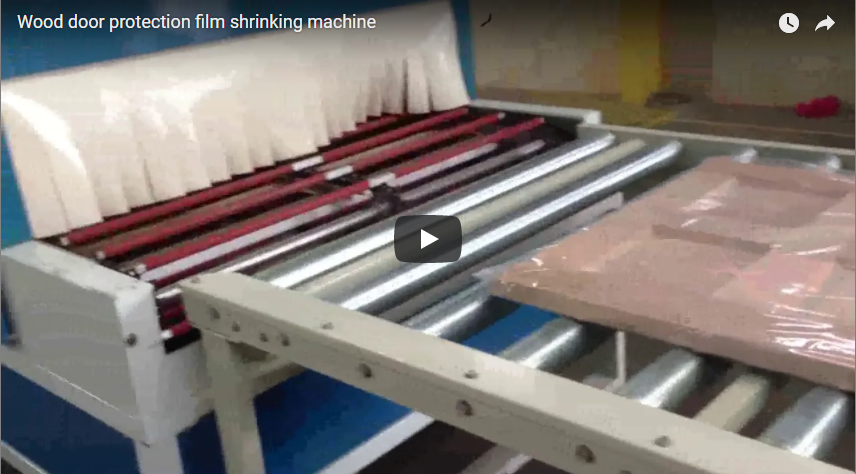
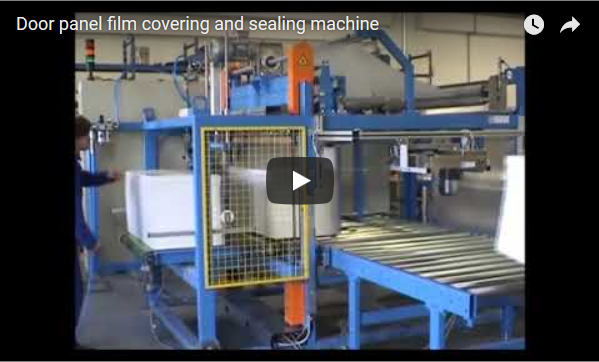
The machine is a door shrink wrapping machine with a green conveyor, a clear film roll mounted on top and a heating unit over the belt. The operator places a frame on the conveyor or lets it enter from the line, and the machine pulls the film over the frame and seals it.
The heating unit presses down and shrinks the film for a tight cover, then the wrapped frame moves out at the far end. Frame size and film type are confirmed per project.
Conveyor, film roll and heating unit
The green conveyor carries each frame through the machine, and the clear film roll on the top frame feeds film down over the workpiece. The heating unit above the belt presses the film onto the frame and heats it so the film shrinks tight.
The control cabinet on the left side carries the control panel screen and status lights used to run the line. Conveyor speed and film width are confirmed per project.
Cycle and control
The operator starts the cycle from the control panel screen, and frames follow one after the other on the conveyor. The film pulls down over each frame, the heating unit presses and seals it, and the conveyor moves the wrapped frame out.
The machine runs continuously while frames are fed, and it stops when the line stops. Cycle speed and heater settings are confirmed per project.
What the footage shows
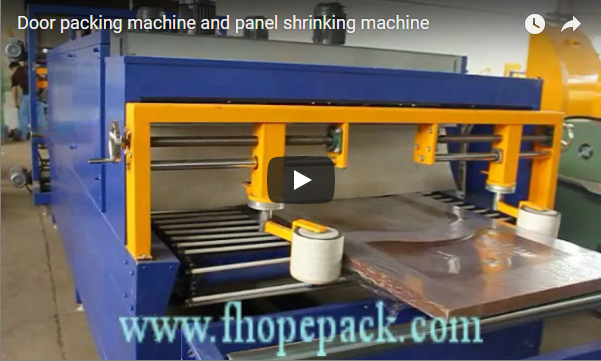
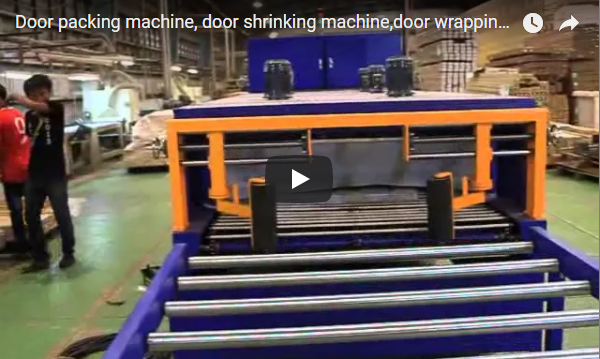
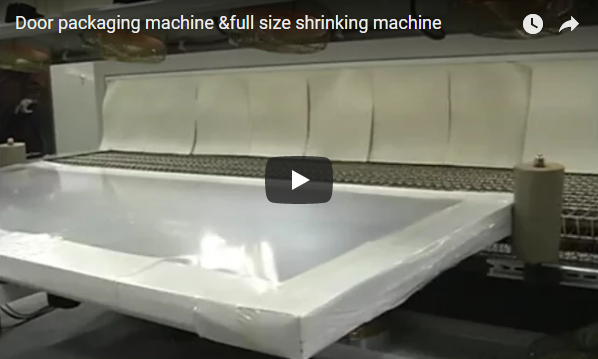
The footage opens at the control cabinet and panel, then the conveyor feeds white door and window frames under the film roll. The heating unit presses down over each frame and the wrapped frames move off the end of the line. The footage is a general demonstration, so your frame size, film choice and line speed are confirmed per project.
Typical configuration
Figures below list functional design boundaries rather than numeric values, and are confirmed per project.
| Parameter | Typical range, confirmed per project |
|---|---|
| Load | rectangular door and window frames on conveyor |
| Film | clear film from top roll, pulled over frame |
| Heating | heated pressing unit over the belt |
| Conveyor | green belt carrying frames in sequence |
| Control | control panel screen on the left cabinet |
| Electrical supply | 380 V three phase 50 Hz, or 220 V single phase for light machines, selected per project |
Selection checklist
| Question | Confirm per project |
|---|---|
| Frame | length, width, profile |
| Film | width, thickness, shrink |
| Conveyor | speed, feed direction |
| Heating | setpoint, press time |
| Site | floor space, access |
| Electrical supply | voltage, phase and frequency on site |
Operation and safety
Place the frame on the conveyor or set the feed, start the cycle from the control panel screen, and keep clear of the heating unit while the film is pressed. Do not reach into the heating area while the machine runs.
Routine checks cover the film roll, the conveyor and the heating unit, per the machine manual. Confirm each frame is clear of the press before the cycle advances.
Engineering FAQ
Q: What does this machine do? A: It covers rectangular door and window frames with clear film on a conveyor by pulling film over each frame and sealing it with a heated unit.
Q: How is the film applied? A: The film rolls down from the top over the frame, and the heating unit presses it on by closing down onto the profile so the film shrinks tight.
Q: Why wrap frames on a conveyor? A: Frames move through the line in sequence, so each one is wrapped the same way without handling by hand.
Q: What frames suit the machine? A: Rectangular door and window frames of a given length can be handled, and the exact range is confirmed per project when you send your frame size.
Q: What does it protect against? A: The clear film keeps dust, scratches and moisture off the frame when it is stored or shipped.
Next step
- Email us at info@fhopepack.com with your frame size and line speed.
- We send a door shrink wrapping machine proposal within 48 hours.
- We confirm the film choice and conveyor speed for your frames.
Related reading
- Door Shrink Wrapping: Operation and Applications
- Wood door protection film shrinking machine
- Shrink wrap machine product line
- Automatic shrink wrapping machine
Sources and standards
- ISO 12100:2010 Safety of machinery, general principles for design and risk assessment
- EN 415-10:2014 Safety of packaging machines, general requirements
- EN ISO 13849-1:2023 Safety of machinery, safety-related parts of control systems
FHOPE door shrink wrapping machine demonstration video. Reviewed as a general demonstration; frame size, film choice and line speed confirmed per project.
Last reviewed: 2026-10-11