Executive summary A turntable wrapper earns its keep when the pallet sits still enough to wrap clean. This guide covers turntable pallet wrapping with conveyor integration: how the platform rotates the load while the film carriage rises, why tall or top-heavy loads need speed control and compression, and how a buffered infeed keeps the wrapping cell from slowing the line. Load sizes and wrap patterns are configured per project.
Table of Contents
- How a turntable wrapper works
- Stabilizing top-heavy loads
- Conveyor integration
- Measuring load height
- Film cut, seal and outfeed
- When a turntable is not the answer
- Typical configuration
- What the video shows
- Selection checklist
- Controls, safety and maintenance
- Engineering FAQ
- Next step
- Related reading
- Sources and standards
How a turntable wrapper works
A turntable stretch wrapper sets the pallet on a motorized platform and rotates it while a vertical film carriage rises and lowers, laying film in overlapping turns. Because the load rotates, the same ring of film reaches every side, and the wrapper gives a full cover from a compact footprint.
This is the workhorse setup for stable, standard-duty loads in warehousing, food and building materials.
Stabilizing top-heavy loads
Rotation does the wrapping, and it also makes demands of the load. A tall stack with a high center of gravity can slide under its own rotation, and so can a layer that has gone slightly curved or damp. When that happens, the film at the bottom takes the shear and tears.
Two controls fix this class of load. A variable-speed drive ramps the platform gently instead of snapping it into rotation, and a compression platen presses down on the pallet top during the cycle, holding the layers together against the turning force. We size these to your load stability per project.
Conveyor integration
A wrapper inside a line needs to receive and send pallets without becoming the choke point. A buffered infeed holds one or two pallets waiting while the wrapper cycles, so upstream production is not stopped by the next wrap.
Centering guides line the pallet up for the platform. Roller drives carry flat-deck pallets, while heavy three-runner skids run on chain conveyors, with the choice made per project.
Measuring load height
A load that is bagged for wrapping at a fixed height wastes film on short stacks and leaves tall stacks thin at the top. A height detector reads each pallet as it enters and sets the film pattern for that load, so mixed heights run without an operator typing a new number each time.
Film cut, seal and outfeed
At the end of the cycle the film is cut and the tail is sealed to the wrap so it does not flap in transit. The finished pallet then transfers out under control, carrying the load to its next step on the line.
When a turntable is not the answer
Long goods that are not palletized—such as lumber lengths, pipes, doors and rolled textiles—rotate poorly on a turntable because their length defeats the geometry. For these, a horizontal orbital wrapper is a different machine: the product passes on the conveyor while a film ring travels around it, so no rotational torque reaches the load.
We recommend the orbital architecture for long or off-center loads, per project.
Typical configuration
Figures below are common starting envelopes for this machine class and are confirmed per project.
| Parameter | Typical range, confirmed per project |
|---|---|
| Load envelope | standard pallet footprints such as 1200 x 1000 mm with a confirmed height ceiling |
| Turntable | platform sized to pallet, with rotation control |
| Drive | variable-speed for load stability |
| Height sensing | automatic height detection for wrap pattern |
| Conveyor | buffered infeed and controlled outfeed |
| Electrical supply | 380 V three phase 50 Hz, or 220 V single phase for small stations, selected per project to the plant supply |
What the video shows
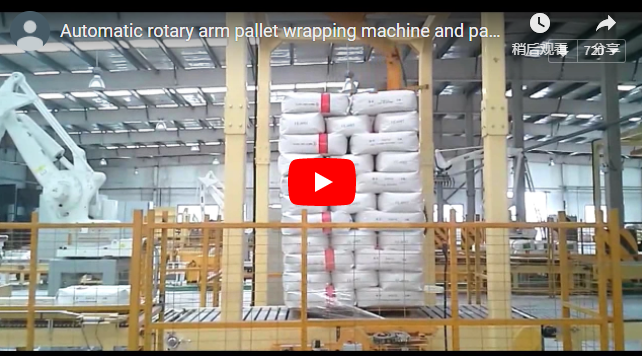
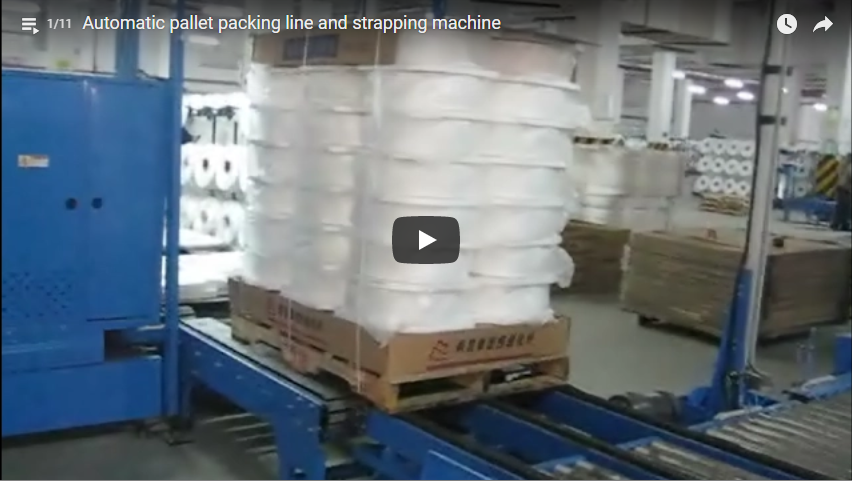
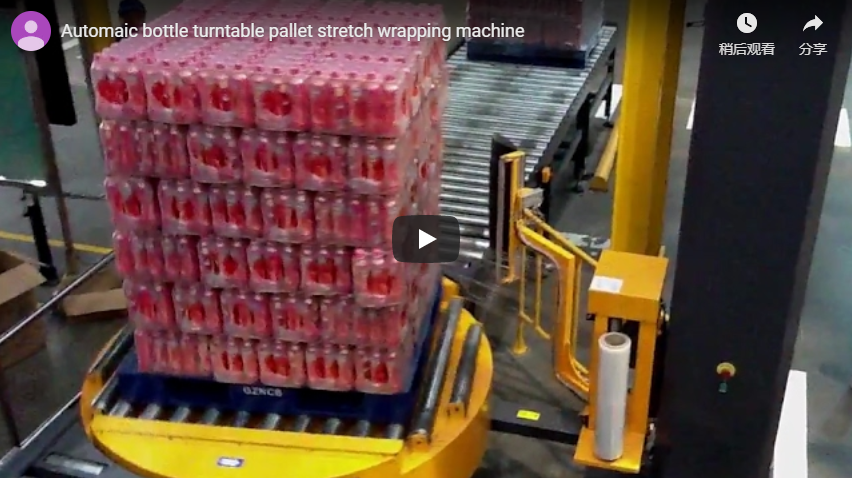
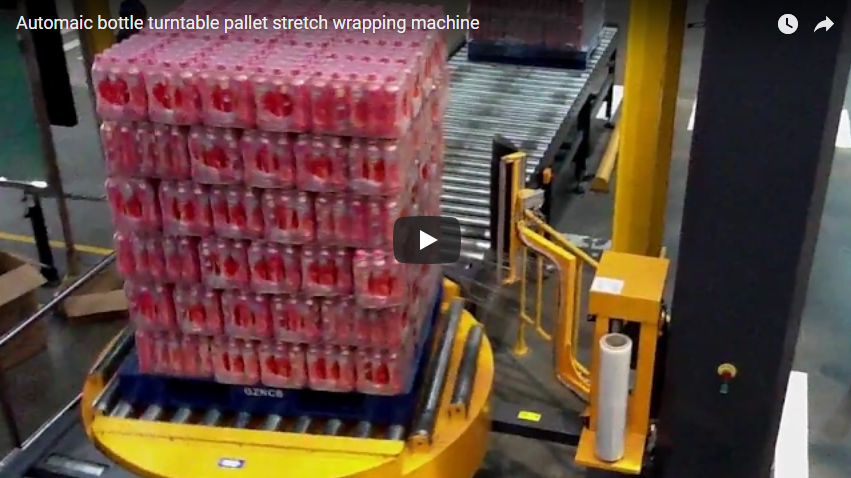
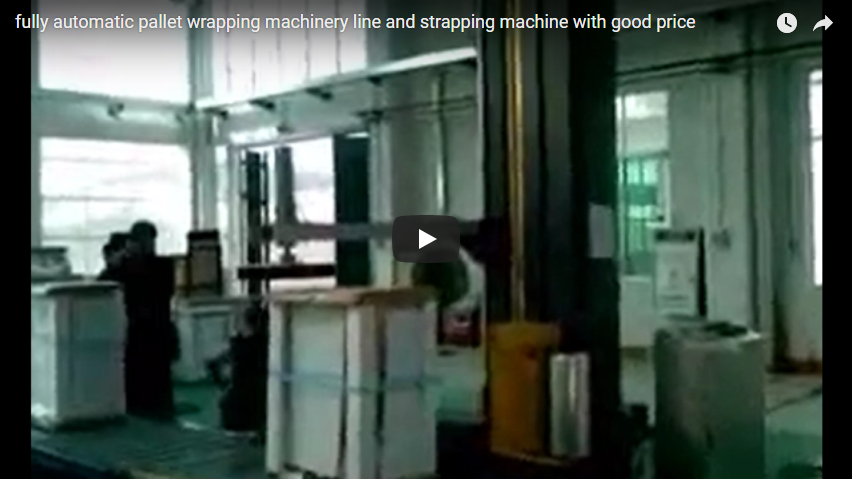
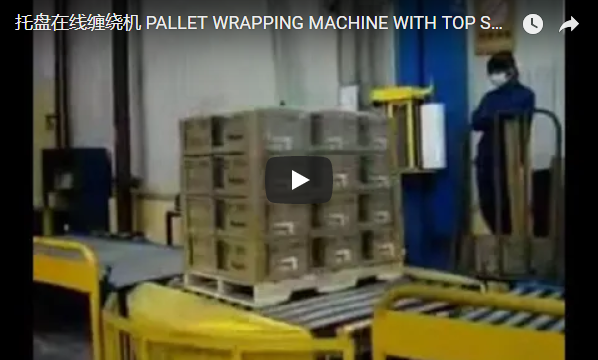
Our footage shows a turntable wrapper taking a pallet off a conveyor, wrapping it with a vertical film carriage and sending it out. It is a general demonstration, so load envelope, film and line interface for your plant are confirmed with us per project.
Selection checklist
| Question | Confirm per project |
|---|---|
| Pallet sizes | turntable and conveyor envelope |
| Load stability | top-heavy or non-stackable layers |
| Film in use | gauge and pre-stretch range |
| Line interface | buffer size and conveyor speed |
| Load heights | whether height sensing is needed |
| Electrical supply | voltage, phase and frequency on site |
Controls, safety and maintenance
The wrapper runs from a control panel with an emergency stop at the operator position and guarding around the rotating platform. Keep hands clear of the platform and film carriage while the cycle runs. The maintenance that matters most is on the film path. Pre-stretch rollers gather dust and fiber, so they need regular cleaning and gap checks, and the height sensors should be wiped to keep readings true, per the machine manual.
Engineering FAQ
Q: Why does a top-heavy pallet tear its film? A: Under rotation, the layers try to slide against each other, and the shear lands at the bottom film seal. Speed control and a compression platen stop that slide.
Q: Does it need an operator on every load? A: No. Height sensing and recipe patterns run the cycle automatically; the operator monitors the panel.
Q: How does it fit into a line? A: A buffered infeed holds pallets while the wrapper cycles, and the outfeed transfers the wrapped pallet on, so the cell does not pace the line.
Q: Turntable or orbital wrapper? A: Palletized, stackable loads suit a turntable. Long or off-center goods suit an orbital wrapper where the film ring travels around a stationary product.
Q: What loads are covered? A: Palletized, stackable goods across warehousing, food and building materials. Specific pallet dimensions and height ceilings are confirmed per project.
Next step
- Email us at info@fhopepack.com with your pallet sizes, loads and line pace.
- We send wrapper options, conveyor layout and a layout drawing within 48 hours.
- We arrange a site survey to confirm floor and line interface.
Related reading
- Automatic turntable pallet wrapping machine and top sheet covering
- Semiauto pallet stretch wrapping machine
- Steel coil tilter with customized service
- FHOPE packing machinery product lines
Sources and standards
- ISO 12100:2010 — Safety of machinery. General principles for design, risk assessment and risk reduction
- EN 415-10:2014 — Safety of packaging machines. General requirements
- EN ISO 13849-1:2023 — Safety of machinery. Safety-related parts of control systems
- FHOPE turntable pallet wrapping machine with conveyors demonstration video. Reviewed as a general demonstration; load envelope, film and line interface confirmed per project.
Last reviewed: 2026-10-10