Executive summary
Wide-width coil wrapping covers a large steel or aluminium coil with stretch film, paper or VCI so the coil leaves dry, square and ready for storage or export. Film is dispensed from an orbital ring carriage that orbits the product while the coil sits on a powered or idle support. Our heavy master-coil class (FPS-2000) takes coil width 600–2,500 mm, OD 700–2,500 mm and up to 10,000 kg under crane loading. A worked example checks a 1,500 mm-wide aluminium coil against that range and estimates film length at a set overlap.
Table of Contents
- Why wide coils need a dedicated wrap station
- Layout: orbital ring, support and crane load
- The machine shown
- Wide / master coil wrapping data
- Worked example: a 1,500 mm-wide aluminium coil
- Selection checklist: what to send us
- Safety and EN 415-10
- Engineering FAQ
- Next step
- Related reading
- Sources
Why wide coils need a dedicated wrap station
A bare wide coil picks up moisture, dust and edge damage in storage and on the truck. Manual sheet wrapping on a 1,500 mm face is slow and hard to keep square. A dedicated orbital wrapping station applies film (or paper / VCI) in controlled layers while the coil stays on a fixed support, so every coil leaves with the same coverage.
Wide coils also need a support and ring path sized for the face width. A slit-coil eye-through wrapper built for 100–400 mm width will not clear a 1,500 mm master coil. The station has to match coil ID, OD, width and weight together.
Layout: orbital ring, support and crane load
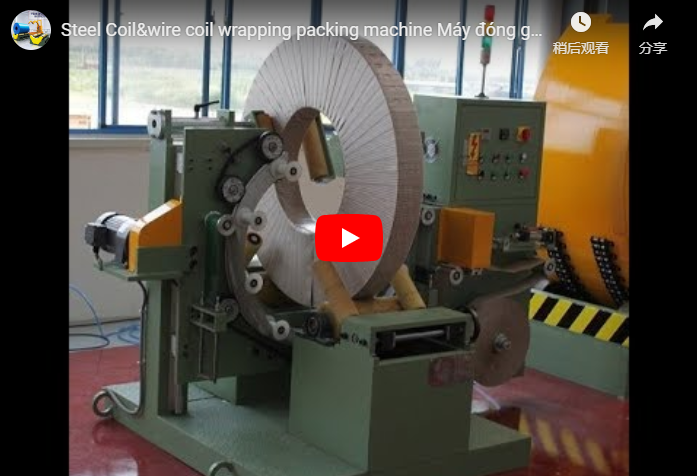
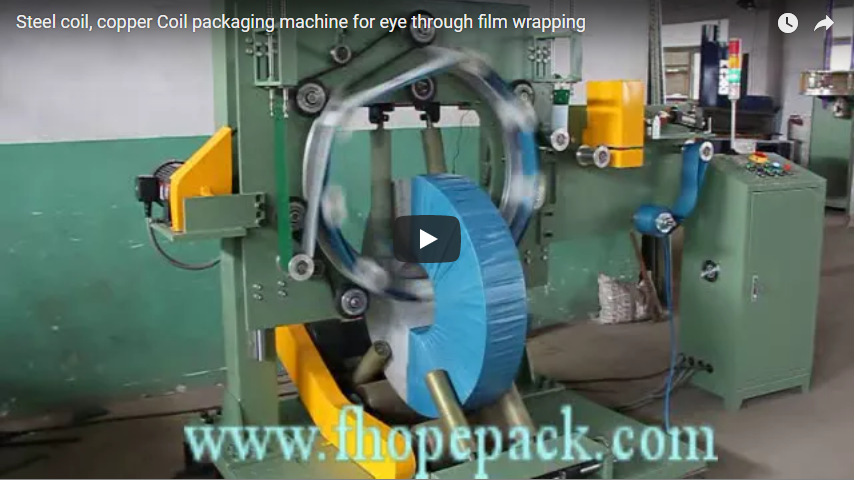
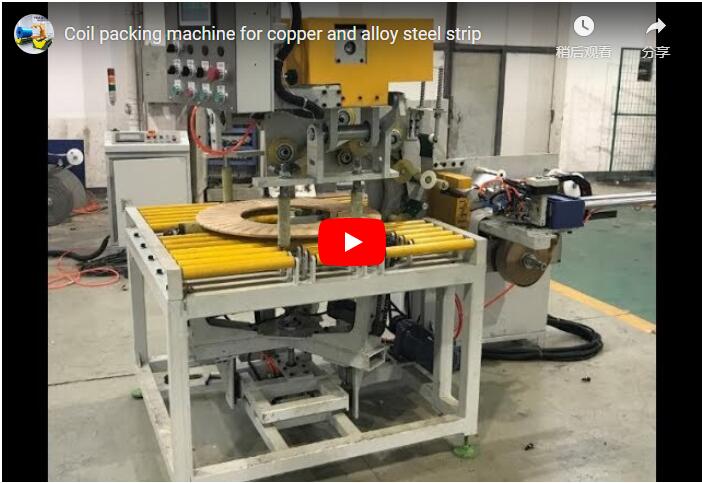
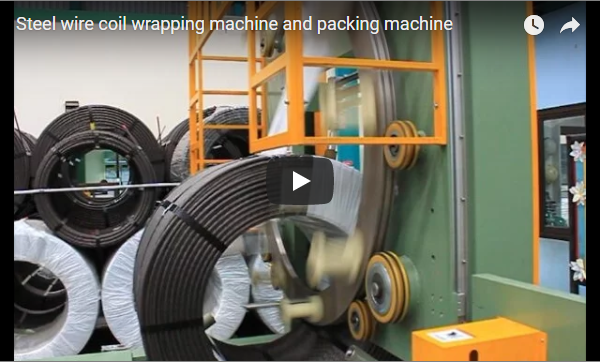
For heavy or wide coils the usual layout is crane loading. The crane sets the coil on the supporting platform or clamp. The operator starts the cycle from the side cabinet. An orbital ring carriage carries the film roll and orbits the product, laying spiral layers until the face and outer diameter are covered. When the cycle ends, the crane lifts the wrapped coil off the same support.
A yellow mesh safety fence keeps people out of the wrap envelope. Soft start and stop on the drive reduce jerk on a multi-ton coil. Film type, layer count and overlap are set per project against the destination climate and handling chain.
The machine shown
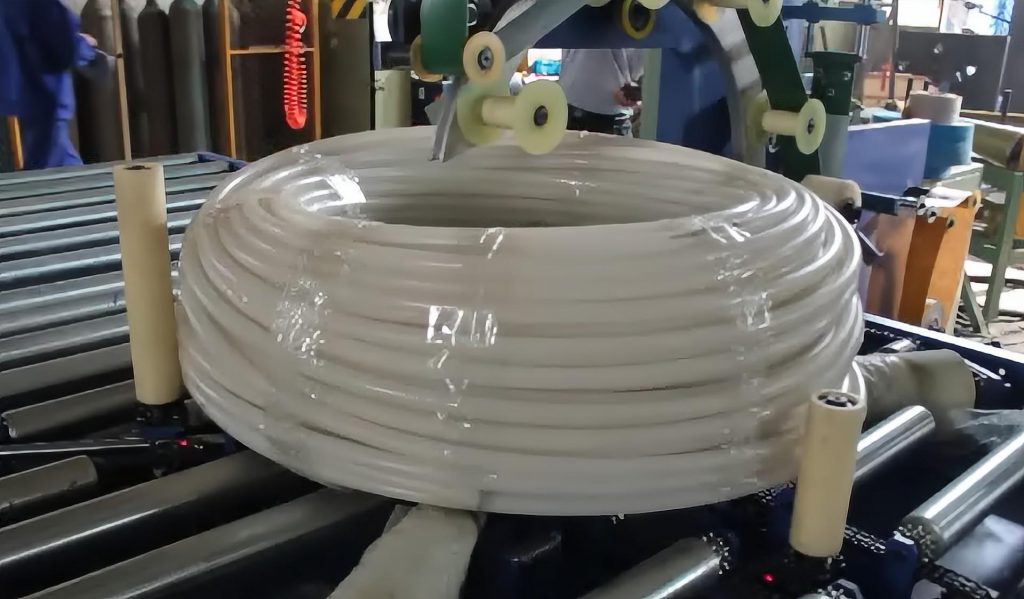
Our wide-coil wrapping station is shown here on a large spoked reel, a skeleton drum about as wide as a master coil. The reel stands on edge on yellow powered support rollers that turn it slowly. A vertical orbital ring passes through the open centre of the reel, and its carriage lays stretch film through and around the rim until the whole reel is covered.
The same ring and roller support takes a solid master coil. A yellow mesh fence surrounds the wrap zone. The grey control cabinet sits to the side of the machine so the operator stays clear of the moving ring path.
Wide / master coil wrapping data
Product-page size class for crane-loaded heavy master coils (FPS-2000):
| Item | FPS-2000 |
|---|---|
| Coil ID | 508 / 810 mm |
| Coil OD | 700–2,500 mm |
| Coil width | 600–2,500 mm |
| Max coil weight | 10,000 kg |
| Loading | Crane |
| Typical materials | Stretch film, VCI film, waterproof layer |
Smaller trolley-loaded models (FPS-400 / 500 / 600 / 800 and FPW / FPCA series) cover narrower slit coils; they are the wrong size class when the face width is around 1,500 mm. Exact film roll size, overlap range and ring speed are confirmed on the order drawing for the coil mix you send.
Worked example: a 1,500 mm-wide aluminium coil
Take an illustrative aluminium master coil: OD 1,800 mm, ID 610 mm, width 1,500 mm, near-solid fill 0.98, density 2,700 kg/m³.
Weight check. Volume ≈ π/4 × (1.8² − 0.61²) × 1.5 = 3.40 m³. Mass ≈ 3.40 × 2,700 × 0.98 ≈ 9,000 kg, inside the FPS-2000 10,000 kg limit. Width 1,500 mm sits inside 600–2,500 mm and OD 1,800 mm inside 700–2,500 mm.
Steel note. The same geometry in steel (7,850 kg/m³) is about 26,100 kg at 0.98 fill — well above 10,000 kg — so a steel coil of this size needs our heavy-duty custom frame series, not the standard FPS-2000. Send real weight before we freeze the frame class.
Film length (illustrative). With 500 mm film at 50% overlap, advance per ring turn = 250 mm. Turns around the OD ≈ π × 1.8 / 0.25 ≈ 22.6. Eye-path length per turn ≈ (OD − ID) + 2 × width = (1.800 − 0.610) + 3.000 = 4.190 m. Film ≈ 22.6 × 4.190 ≈ 95 m for a single-layer pass; multi-layer wraps scale from that.
Selection checklist: what to send us
- Coil ID, OD, width and max weight (worst coil in the mix).
- Loading method: crane, trolley or conveyor.
- Film or paper / VCI preference and target overlap.
- Whether the station stands alone or sits in a packing line with upender, strapper or labeler.
- Destination market for the safety file (CE / other).
Safety and EN 415-10
For CE markets we use EN 415-10 as the packaging-machine reference, with a risk assessment to ISO 12100. The main hazards are the orbital ring path, the coil support and the crane interface. A perimeter fence keeps people out of the wrap envelope; the control cabinet is placed so the operator does not stand under the load path. Interlocks and emergency stop are confirmed on the project risk file.
Engineering FAQ
Q: Can one station wrap both 400 mm slit coils and 1,500 mm master coils? A: No. Slit-coil models are sized for narrow faces and trolley loads. A 1,500 mm face needs the wide / master class (FPS-2000 band) or a custom frame, so mixed plants run two stations.
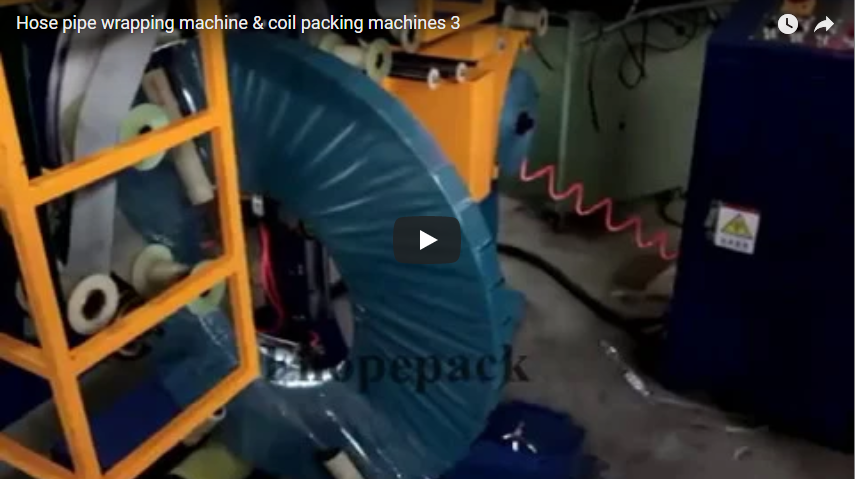
Q: Is every wrap eye-through orbital? A: For steel coils and reels, yes: the ring carriage orbits through the eye so the film seals inside and out, while support rollers turn the coil. We match the ring path to the coil orientation and your loading method.
Q: Which materials can we run? A: Stretch film, paper and VCI film are the usual set on the steel-coil wrapping page; waterproof outer layers are added for export. Exact roll ID / OD / width are set per order.
Q: Which standard do you cite for CE? A: EN 415-10 with an ISO 12100 risk assessment. Local rules for the crane interface are added in the project file.
Next step
- Send your coil mix (ID / OD / width / weight) and loading method to info@fhopepack.com.
- We map it to FPS-2000 or a heavy-duty custom frame and note any change.
- We reply within 24 hours with a wrap layout sketch and a cycle estimate for your coil mix.
Related reading
- Master Steel Coil Stretch Wrapper with Paper
- Buyer’s Guide: Integrating Stretch Wrapping and Downender Stacking for Heavy Steel Coils
- Steel Coil Packing with Paper and Stretch Film: Eye-Through Wrap, Eye Up
- Coil packaging equipment for big size coil wrapping
- Steel coil wrapping machine (product)
Sources
- FHOPE steel coil wrapping machine product page: FPS-2000 size band (ID 508/810 mm, OD 700–2,500 mm, width 600–2,500 mm, max 10,000 kg, crane loading)
- Machine features from our wide-coil orbital wrapping station (ring carriage, support, side cabinet, yellow mesh fence)
- Coil weight and film-path figures: our worked example, illustrative aluminium coil figures
- Standards: EN 415-10; ISO 12100:2010
Last reviewed: 2026-10-18