Executive summary
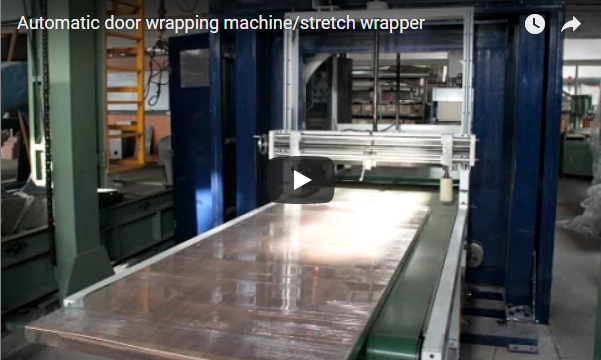
A horizontal wrapping machine for glass doors packs each door lying flat on a conveyor, so the glass stays flat and is handled as little as possible. The door is covered in film, the film is cut and sealed round it, and the pack can be shrunk tight in a hot-air tunnel. Our economic door shrink line takes doors 600–1,250 mm wide and 20–60 mm thick, with 30–80 µm PE film, at up to 12 m/min. Below: the two horizontal methods, how the sealing line works, a worked cycle example and what to send us.
Table of Contents
- Why glass doors need careful packing
- Two horizontal methods
- How the film sealing line works
- Machine data
- Worked example: one glass door
- Good practice for glass
- Selection checklist
- Safety: EN 415-10 and ISO 12100
- Engineering FAQ
- Next step
- Related reading
- Sources
Why glass doors need careful packing
A glass door is heavy, flat and easy to scratch, and the corners of the glass and frame chip if they knock. Packing by hand means lifting and turning each door several times, and every lift is a chance to drop or scrape it. A horizontal line keeps the door flat on rollers from infeed to outfeed. The film goes on without turning the door over by hand.
The film cover protects the glass from dust, scratches and moisture in transit and on site, and a clear film lets the installer see the right door without opening the pack.
Two horizontal methods
| Method | How it works | Best for |
|---|---|---|
| Film seal and shrink | film from top and bottom rolls covers the door; a heat blade cuts and seals; a hot-air tunnel shrinks it tight | sealed, smooth, retail-grade packs |
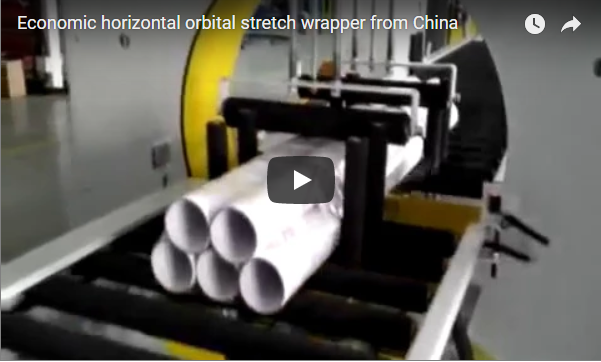
| Orbital stretch wrapping | a ring spirals stretch film round the door as it passes through | lower film cost, mixed sizes, doors with handles fitted |
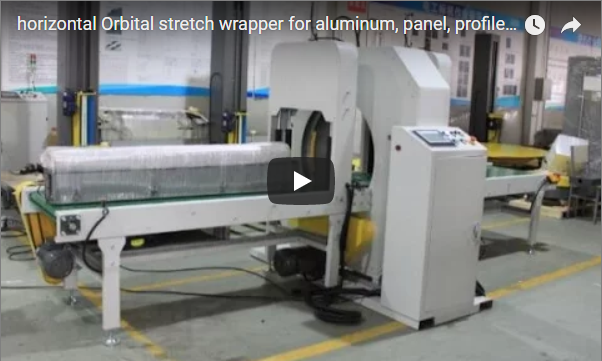
Here “horizontal wrapping” covers both. Our orbital furniture wrapper (see automatic door wrapping machine) handles doors, panels, kitchen fronts and kitchen glass windows. For glass doors where a closed, clean finish matters, the sealing line is the usual choice.
How the film sealing line works
- Load. The operator pushes the door, glass and frame flat, onto the powered infeed roller conveyor.
- Cover. As the door runs in, film is drawn from the roll and laid over it.
- Seal. The overhead sealing frame comes down while the door is held still, the heat blade cuts the film and seals it round the door, then lifts. A photoelectric sensor times the cut to the door length.
- Shrink. On a shrink line the door passes through the hot-air tunnel at 100–220°C, and two vertical press rollers smooth the edges.
- Unload. The covered door leaves on the outfeed for stacking.
The PLC sets seal timing, conveyor speed and tunnel temperature for each door size.
Machine data
| Item | Economic door shrink line |
|---|---|
| Door width | 600–1,250 mm |
| Door thickness | 20–60 mm |
| Table height | 800 mm |
| Door weight | up to 120 kg with the heavy-duty conveyor option, per our door quotations |
| Film | PE shrink film, 30–80 µm |
| Conveyor | 0–12 m/min |
| Tunnel | hot air, 100–220°C |
| Shrinking power | 37 kW |
| Supply | 380 V, 50/60 Hz, 3-phase |
For longer doors and heavier film, our automatic door shrinking machine takes 1,000–4,000 mm lengths and PE, PVC or POF film of 80–150 microns.
Worked example: one glass door
Illustrative door: 2,000 × 800 × 40 mm, 50 µm PE film, conveyor at 6 m/min with a 0.5 m gap between doors.
| Check | Calculation | Result |
|---|---|---|
| Fits the line? | 800 within 600–1,250; 40 within 20–60 | yes |
| Time per door | (2.0 + 0.5) ÷ 6 × 60 | 25 s |
| Output, conveyor limit | 3,600 ÷ 25 | 144 per hour |
| Output, real line | 3,600 ÷ (25 + t_seal) | t_seal measured at factory test |
| Film area (all faces) | 2 × (2.0 × 0.8 + 2.0 × 0.04 + 0.8 × 0.04) | ≈ 3.42 m² |
| Film mass | 3.42 × 0.00005 × 920 kg/m³ | ≈ 0.16 kg |
Result. The conveyor alone allows about 25 s a door, or 144 an hour. A bar sealer stops the door while the blade comes down, so its dwell time t_seal adds to each cycle unless a motion sealer seals on the move. Each door uses roughly 0.16 kg of film before seal trim. In practice one operator loading glass doors sets the pace, so plan on loading time rather than conveyor speed.
Good practice for glass
- Fit corner protectors before the film goes on; the film holds them in place.
- Keep the conveyor rollers clean so grit does not scratch the glass.
- Set the tunnel temperature low enough that the frame finish and seals are not marked.
- Leave handles and locks off until site, or choose stretch wrapping if they are fitted.
Selection checklist
- Door length, width, thickness and weight.
- Glass only, or frame and glass.
- Doors per hour.
- Sealed only, or sealed and shrunk.
- Fittings already mounted or not.
Safety: EN 415-10 and ISO 12100
Wrapping and sealing machines are built to EN 415-10, with the risk assessment done to ISO 12100. The hazards are the descending sealing unit, the hot blade and tunnel, and the nip at the conveyor rollers. The sealer is guarded, the photoelectric sensor controls when it moves, and the tunnel is insulated.
Engineering FAQ
Q: What size of glass door fits? A: On the economic line, 600–1,250 mm wide and 20–60 mm thick; longer doors go to the automatic line, 1,000–4,000 mm.
Q: Which film? A: PE shrink film of 30–80 µm on the economic line.
Q: Shrink or stretch? A: Shrink for a sealed, smooth pack; stretch for lower film cost or doors with fittings.
Q: What do you need to quote? A: Maximum length × width × thickness and weight of the door.
Next step
- Send door sizes, weights and output to info@fhopepack.com.
- We choose sealing, shrinking or stretch wrapping.
- We reply within 24 hours with a proposal and quotation.
Related reading
- Economic type door shrink packing machine (product)
- Automatic door shrinking machine (product)
- Door shrinking machine with motion sealer (product)
- Door and panel shrink packaging machine
- Panel shrinking machine
Sources
- FHOPE product pages: economic door shrink packing machine; automatic door shrinking machine; orbital furniture wrapper
- FHOPE project correspondence and quotations on door packing
- Our glass door wrapping line shown above
- Worked example: illustrative figures
- Standards: EN 415-10; ISO 12100:2010
Last reviewed: 2026-10-19