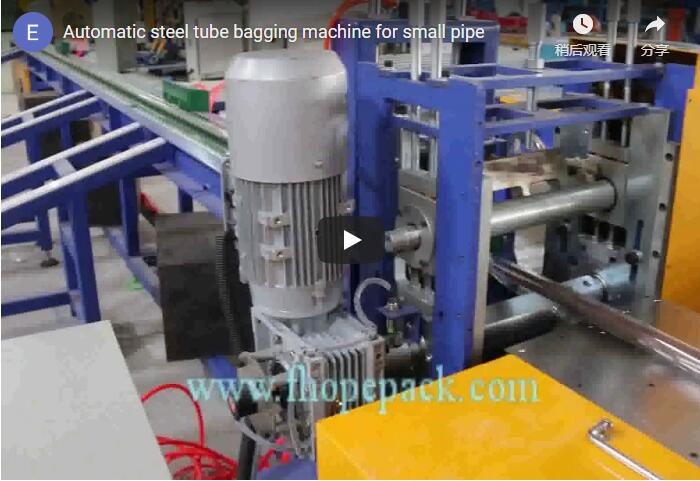
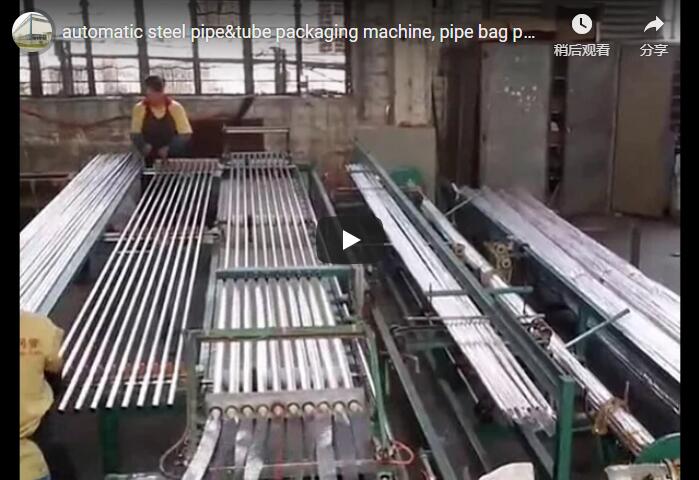
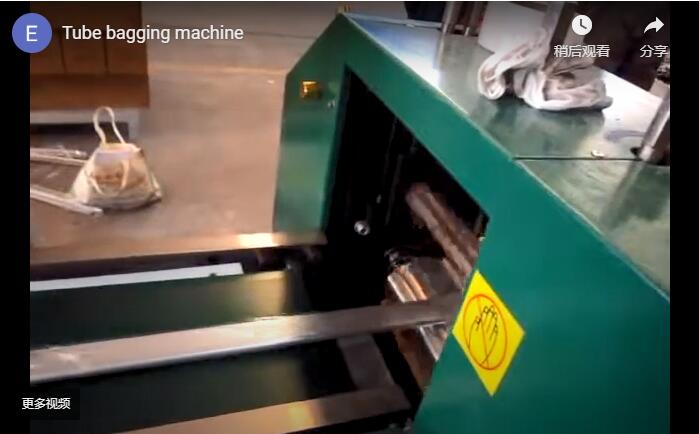
Executive summary Our online pipe bagging machine sits at the end of the extrusion line and packs small plastic pipes without an operator handling each length. It counts the pipes automatically, ties the bundle with LLDPE stretch film, then pushes it into a welded PE, PP or HDPE bag. It takes pipes of Φ20–65 mm and 3–6 m long, makes bundles of Φ180–250 mm and 10–50 kg, and runs at more than 1 bundle/min.
Table of Contents
- What the video shows
- The bagging sequence
- Sizing the bundle
- Bag film and roll
- Machine data
- Controls and safety
- Selection checklist
- Engineering FAQ
- Next step
- Related reading
- Sources
What the video shows
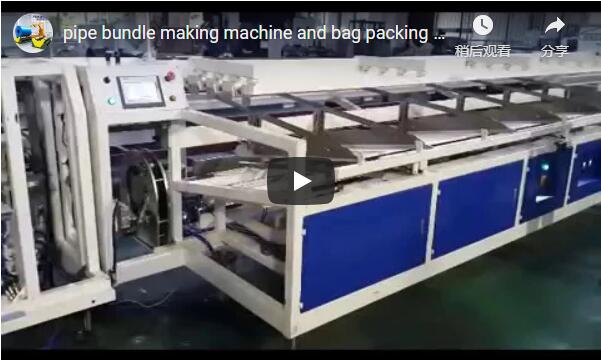
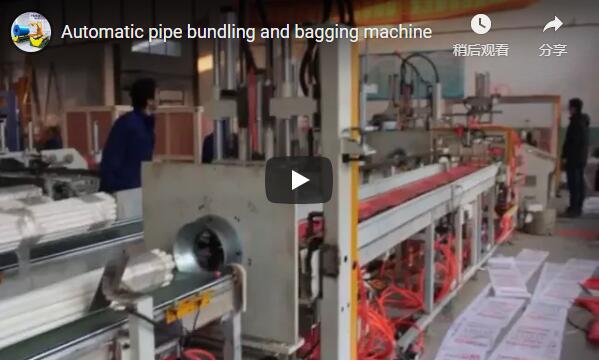
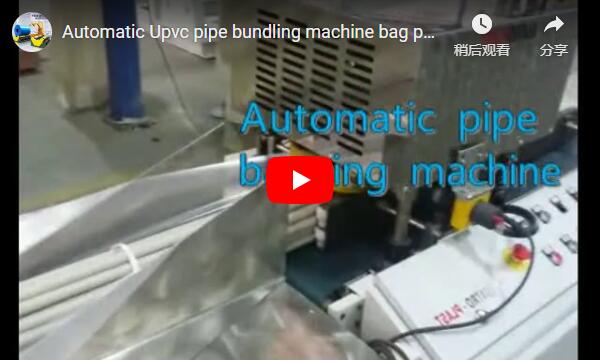
White plastic pipes lie on the inclined collecting table of our white and blue line. They roll down to the counting and bundling station, where a ring head ties the bundle with film. The control panel with a touch screen and a red emergency stop sits on the frame beside the station. The tied bundle then moves on to the bagging station, is pushed into a bag, and leaves the line sealed.
The bagging sequence
- Collect. Pipes from the extruder and cutter roll onto the collecting table.
- Count. The machine counts pipes automatically, by program setting.
- Tie. LLDPE stretch film ties the bundle so it stays round before bagging.
- Make the bag. The machine forms a bag from welded PE or PP film.
- Fill. A pusher drives the bundle into the bag.
- Seal and discharge. The bag is sealed and carried to the line end, where it is tilted off.
Tying before bagging matters on small pipes. A loose bundle of thin pipes spreads as the pusher drives it, and the ends catch on the bag mouth.
Sizing the bundle
Bundle size limits are a diameter of 180–250 mm and a weight of 10–50 kg. Illustrative example with round pipe packed in a hexagonal bundle, where pipes per bundle ≈ 0.8 × (bundle OD ÷ pipe OD)², rounded down on small counts, which pack less densely:
| Pipe OD | Bundle OD | Pipes per bundle (approx.) |
|---|---|---|
| 20 mm | 200 mm | about 80 |
| 32 mm | 220 mm | about 37 |
| 63 mm | 250 mm | about 11 |
Check the weight too: a long, heavy-wall pipe can reach the 50 kg limit before the bundle reaches 250 mm. Set the count by whichever limit comes first. The actual count for your pipe is set in the program after trials.
Bag film and roll
| Item | Value |
|---|---|
| Bag material | PE, PP or HDPE |
| Bag thickness | 30–80 µm |
| Bag roll size | OD 200–500 mm |
| Tying material | LLDPE stretch film |
Thicker bag film protects better against sharp pipe ends, and thinner film runs more bags per roll. Choose the thickness on the heaviest bundle you run.
Machine data
| Item | Value |
|---|---|
| Pipe diameter | Φ20–65 mm |
| Pipe length | 3–6 m |
| Bundle OD | Φ180–250 mm |
| Bundle weight | 10–50 kg |
| Counting | Automatic, by program setting |
| Speed | More than 1 bundle/min |
| Feeding | Automatic |
| Air supply | 5–7 bar |
On our PPR and PVC bagging line, the bundle range runs from 110 to 260 mm OD at about 1–3 bundles/min.
Controls and safety
The line runs from the touch-screen panel, where the pipe count is set by program, and a red emergency stop sits on the panel.
The standards that apply depend on the destination market. For CE markets, ISO 12100 sets the risk-assessment method and EN 415-10 sets general requirements for packaging machines.
Selection checklist for a pipe bagging machine
- Pipe OD, wall thickness and length.
- Pipes per bundle, or bundle weight.
- Single pipe or bundle bagging.
- Extrusion line speed, in pipes per minute.
- Bag material and thickness.
- Compressed air available on site.
Engineering FAQ
Q: What pipe sizes does it bag? A: Pipes of Φ20–65 mm and 3–6 m long, in bundles of Φ180–250 mm.
Q: How fast is it? A: More than 1 bundle/min on this machine, and about 1–3 bundles/min on our PPR and PVC bagging line.
Q: Why tie the bundle before bagging? A: Tying is step 3 of 6 in the sequence. The film tie keeps thin pipes round, so they slide into the bag without spreading.
Q: What bag film does it use? A: PE, PP or HDPE, 30–80 µm thick, made into a bag on the machine.
Q: What utilities does it need? A: Power and compressed air at 5–7 bar.
Next step
We plan your pipe bagging machine in three steps:
- Submit your layout drawing with pipe sizes, lengths and extruder output to info@fhopepack.com.
- Receive a proposal within 48 hours, with the bundle plan and bag spec.
- Book a site survey to check the line end and floor space.
Related reading
- Pipe bag packing machine
- PPR and PVC pipe bagging line
- Video: automatic bagging machine for tube and pipe
Sources
- Machine data: pipe bag packing machine page
- Line sequence and PPR/PVC bundle range: PPR and PVC pipe bagging line page
- Machine in action: our pipe bundle bagging video on YouTube
- Bundle count: our worked example, illustrative values
- Standards scope: ISO 12100:2010, EN 415-10:2014
Last reviewed: 2026-10-04