Executive summary — A third-party clip follows a flexible-pipe and hose coil line from winding to coil strapping. We present our own equivalent machines, built to order and configured per project. The line pairs a coiling station and a coil-strapping station, with the same CE safety framework applying.
Table of Contents
- What the video shows
- Coiling and coil strapping flow
- How our equivalent machines are specified
- Example calculation (illustrative)
- Controls and safety
- Selection checklist for a pipe and hose coil line
- Engineering FAQ
- Next step
- Related reading
- Sources
What the video shows
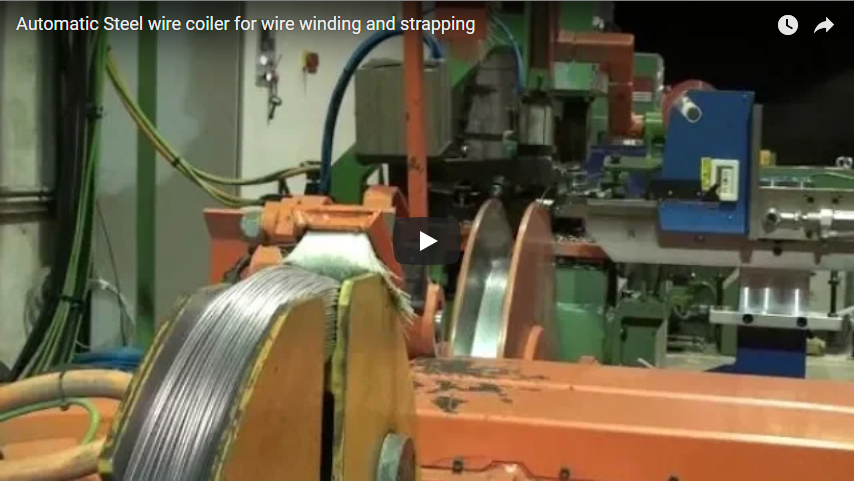
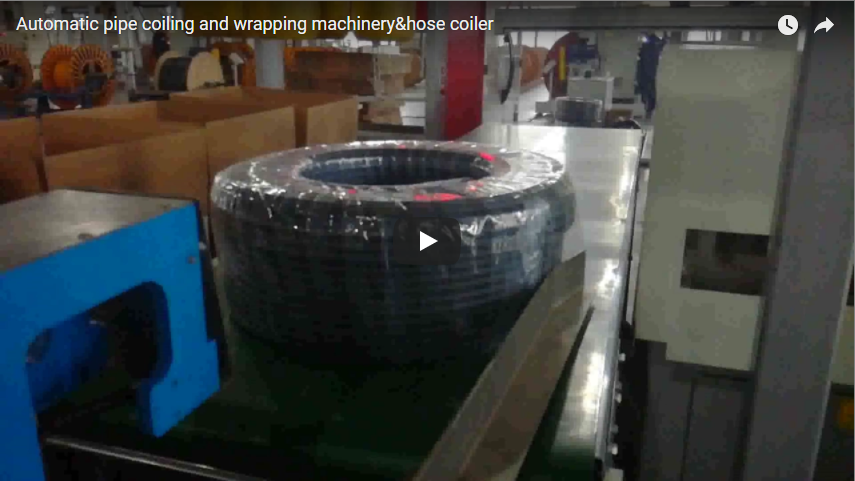
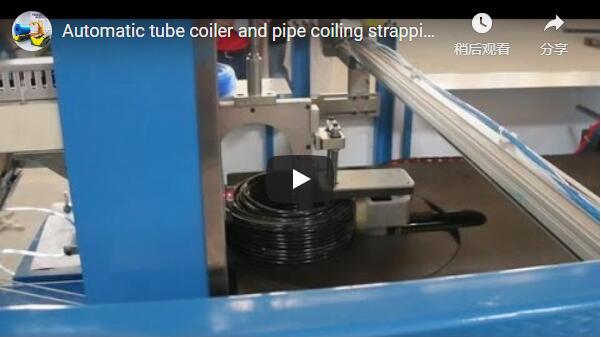
A wound coil of cable sits on a pallet beside an automated winding machine. A coil of flexible pipe stands in the foreground, ahead of a packaging station.
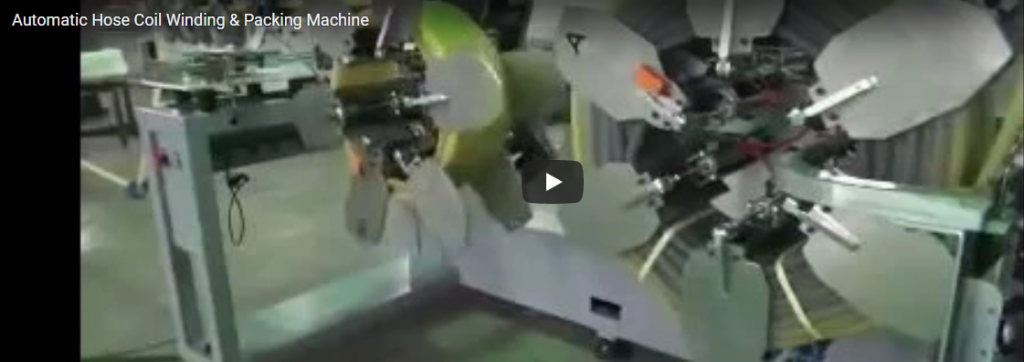
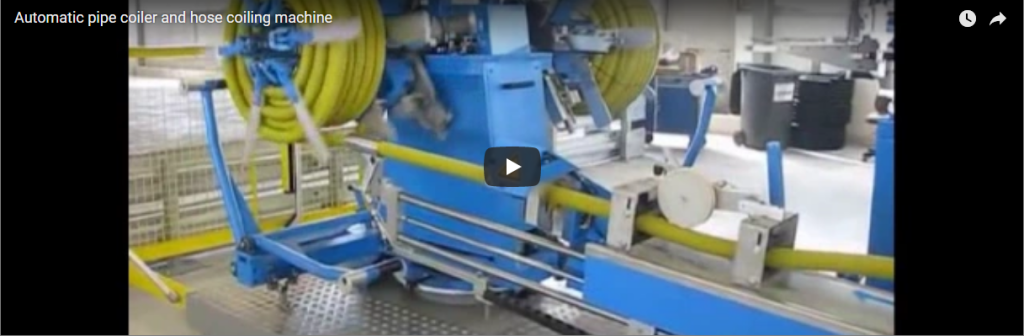
A machine then feeds flexible hose onto a rotating spool at the winding station. A wound coil appears in the background of a later wide shot, and a control monitor sits on a machine enclosure.
The middle part of the film shows a conveyor-fed area where personnel appear near the conveyor.
Later shots show a large industrial machine with a coil of hose beside it. Long hose lengths are routed across the conveyor feed into a take-up that winds the coiled hose.
A glass-and-metal safety enclosure guards the wrapping station behind the line. The film closes on the machine floor with no load on the line.
Coiling and coil strapping flow
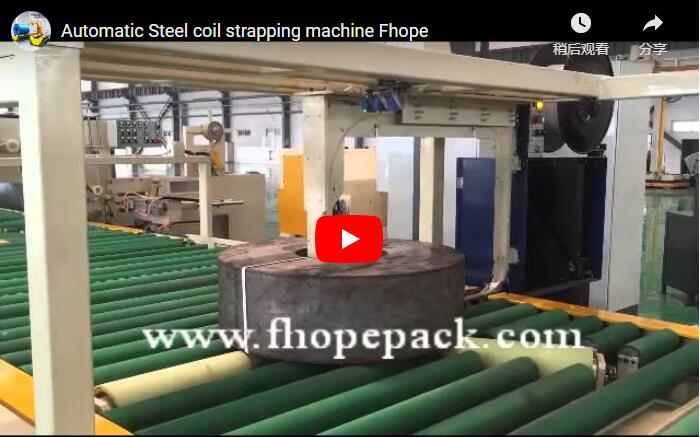
The line pairs a coiling station and a coil-strapping station. At the coiling station the flexible pipe or hose is fed onto a rotating spool. It is wound until the coil reaches its set outside diameter. The coil then moves to the strapping station, where bands hold it compact and stable on the pallet.
In our equivalent setup both stations belong to the same machine family. They hand the coil over automatically, so the sequence runs from raw hose to a strapped, pallet-ready coil without re-handling the load.
How our equivalent machines are specified
While the video shows an industry-standard reference layout, our engineering team designs and manufactures equivalents tailored to customer coil schedules. The figures below are the ranges our equivalent units are specified for.
| Parameter | Our equivalent machines, specified for (configured per project) |
|---|---|
| Hose or pipe outside diameter | 16–32 mm |
| Smaller-coiler hose outside diameter | 2–16 mm, 8–20 mm or 15–30 mm |
| Coil inside diameter | 200–400 mm or 250–400 mm; larger-coiler units 400–540 mm |
| Coil outside diameter | 400–600 mm |
| Coil thickness (coil build) | 40–120 mm or 200–320 mm, typical selection tiers |
| Coil weight | 10–40 kg |
| Coiling speed | up to 70 m/min |
| PP strap width | 10 mm |
| Air supply | 6 bar |
Coil thickness (coil build) is the wound thickness of the finished coil. The 40–120 mm and 200–320 mm bands are the two typical selection tiers — standard units are usually built for the 40–120 mm coil and wide-tier units for the 200–320 mm coil. Where small coils make up only a small part of the mix, one machine can be customized to cover the full 40–320 mm range.
Give us your hose size and your coil inside diameter, outside diameter and thickness (build). The equipment is then set around your actual product.
Example calculation (illustrative)
The figures in this section are an illustrative customer example. They are not measured from the film, and your plant data will differ.
For a coil outside diameter of 0.6 m, the outside circumference is π × 0.6 ≈ 1.885 m.
For a coil section 0.6 m across, a bore of 0.3 m and a width of 0.2 m, a strap pass around the section is about 2 × (0.2 + (0.6 − 0.3) / 2) = 0.7 m.
Bring your own figures and your layout to the proposal stage. The cycle time and strap length are then sized against them.
Controls and safety
Keep personnel outside the guarded zone while the line runs. The glass-and-metal enclosures shown at the wrapping and packaging stations keep the moving parts guarded. For work at the coil or the load, stop the machine and isolate the power. Lock out the drive per your site procedure before any manual step. Never reach into the coil or the wrapping area while the machine is running.
The standards that apply depend on the destination market. For CE markets, ISO 12100 sets the risk-assessment method and EN 415-10 covers the general safety requirements of packaging machines.
Selection checklist for a pipe and hose coil line
A coil line suits your plant when the product mix is stable enough for a dedicated winding station and a dedicated strapping station.
Review the hose outside diameter and the coil bore, outside diameter and thickness (build) against the ranges above. Review the compressed-air supply and the PP strap width. Define the planned output per hour and the working shifts. Those inputs become the coiling speed and the strapping cycle for your layout.
Engineering FAQ
Q: How is the coil built up? A: A rotating spool turns and guides the hose on until the target outside diameter is reached.
Q: Is the machine in this clip the product you sell? A: We manufacture custom-engineered equivalents designed to match or exceed the layout shown, built to project specifications.
Q: What coil sizes can the equipment be set up for? A: The usable envelope depends on the coiler model. The table above lists the inside and outside diameter and coil thickness ranges, with every value configurable per project.
Q: How wide is the PP strap used on the coil? A: The standard material is 10 mm PP strap. Width, thickness and the strapping cycle itself are fixed per project.
Next step
- Submit your layout drawing.
- Receive a proposal within 48 hours.
- Book a site survey.
Email: info@fhopepack.com
Related reading
- Automatic Tube Coiler and Pipe Coiling Strapping Machine
- Pipe Coiling & Strapping Machine
- Economic Cable Coil Packing Machine: FPCA Specs, Wrap Time and Overlap Setup
- HDPE Pipe Coil and Hose Wrapping Machine: Eye-Through Ring Wrapping Explained
- Cable Coil Packing Machine for Small-ID Wire Coils: How the Ring Passes a 90 mm Eye
- Automatic Pipe Coiling and Wrapping Machine for Hose and Plastic Tubes
Sources
- Automatic pipe coiler machine
- Automatic hose coiling machine FCL-600
- Standards: ISO 12100 and EN 415-10, as applicable for the destination market
- FHOPE engineering team
Last reviewed: 2026-10-07