Executive summary For large wire coils we use a full-automatic eye-through wrapper that lays paper and stretch film in one pass, then passes the coil on for unloading. It takes coils of 750–1,500 mm OD, 100–500 mm wide and 80–1,000 kg. One coil wraps in about 40–65 s, depending on size. A worked example works out how much paper and film one large coil takes.
Table of Contents
- Why large wire coils need a dedicated wrapper
- The line shown
- How the wrapper works
- Load, wrap, unload
- Technical data
- Paper and film rolls
- Worked example: paper and film per coil
- Selection checklist: what to send us
- Safety and EN 415-10
- Engineering FAQ
- Next step
- Related reading
- Sources
Why large wire coils need a dedicated wrapper
Large wire and rod coils are heavy, open-sided and easy to mark. On a sea voyage they meet salt air and condensation, so they need a closed cover of paper and film. They also need to leave the wrapper without a crane hook scraping the fresh wrap.
A wrapper built for big coils centres the ring on the coil, wraps it through the eye and hands it straight to the unloading equipment.
The line shown
Our demonstration line has blue steel frames and a vertical wrapping ring inside a yellow mesh fence. A large wire coil sits on a yellow roller platform in the ring and turns while it is wrapped. Beyond the wrapper, a roller conveyor leads to an overhead beam station where coils are lifted off for unloading. Nobody enters the fenced area while the ring turns.
How the wrapper works
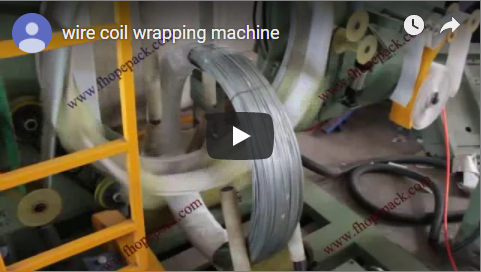
Ring and material carriage. The ring carries the stretch film through the coil eye, and the paper or HDPE tape goes round with it. So both layers go on at once, film over paper. The material roll is fixed next to the wrapping station for quick changes.
Supporting rollers. PU-covered rollers turn the coil slowly so each ring turn lands on fresh surface. Their speed runs on an inverter, as does the ring speed, so the overlap can be set.
Height and centring. A motor sets the ring height to suit the coil size, and the supporting rollers adjust by motor too. The PLC detects the coil OD for the wrap program.
Cutter. A separate carriage and cutter cut the material at the end of the wrap.
Load, wrap, unload
- The wrapping station moves to its loading position.
- The coil is placed on the supporting rollers.
- The station moves to the packing position.
- The ring wraps the coil with paper and film, then cuts the material.
- The station moves back, and the coil is unloaded.
Because the wrapping station moves, the ring is out of the way during loading and unloading. That leaves headroom for lifting and keeps the operator clear.
Technical data
| Item | Value |
|---|---|
| Coil weight | 80–1,000 kg |
| Coil OD | 750–1,500 mm |
| Coil ID | 490–610 mm |
| Coil width | 100–500 mm |
| Wrap time | 40–50 s for 800 mm OD; 50–65 s for 1,500 mm OD, 500 mm wide |
| Roller speed | 2–4 m/min |
| Ring speed | 10–90 r/min |
| Overlap | 10–90% |
| Power | about 3.0 kW, 380 V, 50 Hz, 3 phase |
| Air supply | 5–8 bar |
| Machine size | about 1,600 × 1,800 × 2,000 mm |
| Site conditions | 5–45 °C, 20–99% humidity, dusty atmosphere |
Paper and film rolls
| Material | Width | Roll OD | Core ID | Thickness |
|---|---|---|---|---|
| Paper, HDPE or knitted belt | 100–120 mm | 100–450 mm | 76 mm | over 85 gsm |
| Stretch film or PVC film | 100–120 mm | 100–200 mm | 76 mm | over 23 micron |
Paper goes on first for a breathable, scratch-proof layer, and film on top seals out water and dust.
Worked example: paper and film per coil
A wire rod mill packs coils of 1,300 mm OD, 508 mm ID and 400 mm width, weighing 900 kg. It wraps 120 mm paper and 120 mm film at 50% overlap. These are illustrative customer figures.
Fit. All four sizes sit inside the machine's ranges, and 900 kg is under the 1,000 kg limit.
Path per turn. One turn goes through the eye, round the outside and over both faces. The radial depth is (1,300 − 508) ÷ 2 = 396 mm. So one turn is 2 × 396 + 2 × 400 = 1,592 mm.
Turns. At 50% overlap each turn advances 120 × 0.5 = 60 mm at the OD. The OD circumference is π × 1,300 = 4,084 mm, so the ring makes 4,084 ÷ 60 = 68 turns.
Material. 68 × 1.592 = 108 m of paper and 108 m of film go on each coil. That is the applied length; the film roll pays out less, because the film stretches under tension. At 85 gsm, the paper weighs 108 × 0.12 × 85 = 1,102 g, about 1.1 kg per coil.
Time. This coil lies between the two published sizes, so expect a wrap time of 40–65 s. Coils per hour = 3,600 ÷ (t_wrap + t_load + t_unload), with your handling times.
Selection checklist: what to send us
- Coil OD, ID, width and weight range.
- Packing material: paper, film, HDPE or knitted belt.
- Coils per hour.
- How coils arrive and leave: crane, conveyor or hook.
- Air and power supply.
- Climate at the site.
Safety and EN 415-10
For CE markets we follow EN 415-10 as the reference, with a risk assessment to ISO 12100. The main hazards are the turning ring, the moving wrapping station and the coil on the rollers.
The machine has guardrails for loading and unloading, soft start and stop, and a separate electrical box. Fence the ring zone, as on our demonstration line, and keep people out while the ring turns.
Engineering FAQ
Q: Can it wrap paper and film together? A: Yes. The ring takes film and paper round the coil together, so both layers go on in one pass.
Q: Can it handle different coil sizes without manual adjustment? A: The ring height and supporting rollers adjust by motor, and the PLC detects the coil OD for the wrap.
Q: Why does the wrapping station move? A: So the ring is out of the way when coils are loaded and unloaded. It gives headroom and keeps the operator clear.
Q: Which standards do you build to? A: EN 415-10 as our CE reference, with an ISO 12100 risk assessment.
Next step
- Email your coil sizes, weight and packing material to info@fhopepack.com.
- We reply within 24 hours with a proposal, with the wrapper and the loading and unloading layout.
- We send a layout drawing for your coil packing area.
Related reading
- Steel wire packing machine with paper and film
- How to choose the coil wrapping machine per your steel wire coil
- How to make the steel wire packing for sea shipping
- What kind of stretch film fits coil packing
- Wire coil wrapping machine
Sources
- Specifications: FHOPE steel wire packing machine with paper and film product page
- Machine video: large wire coil wrapping on YouTube
- Paper and film per coil: our worked example, illustrative coil figures
- Standards: EN 415-10 (packaging machines, general safety); ISO 12100:2010
Last reviewed: 2026-10-17