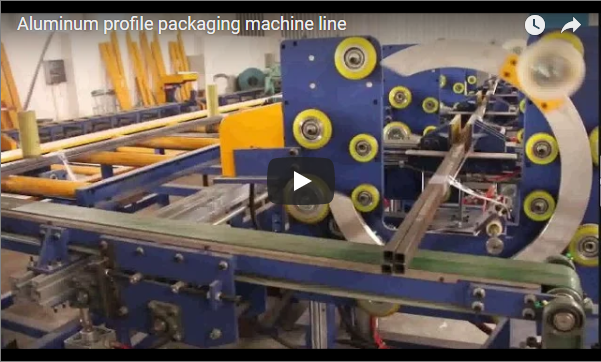
Aluminum profile bundle packing line with timers for forklifter handling

Executive summary This video shows an automatic packing line that wraps long bundles of aluminum profiles in stretch film, then releases the finished bundle toward the end of the conveyor for pickup — a setup designed so a forklift can handle uniform, film-protected bundles. The footage runs a full wrap cycle unattended: the wrapping unit dispenses film, a moving arm carries it along the bundle, and the wrapped bundle exits down the line. Specifications, cycle times, and timer values are not shown in the video; confirm those with the manufacturer before purchasing.

Why this line matters for forklift-based handling

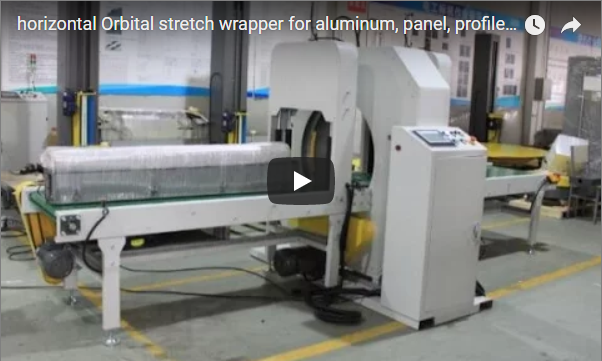
If your plant moves aluminum profiles by forklift, the way a bundle is packed directly affects how safely and quickly it can be grabbed, stacked, and shipped. Loose or inconsistently wrapped bundles shift under clamps and forks, scratch against each other in transit, and arrive at the customer looking worn. The line in this video addresses that problem at the source: it takes a long bundle of extruded aluminum profiles, wraps it tightly in transparent stretch film while it travels along a conveyor, and presents a uniform, rigid package at the output end.

The title mentions timers. On the footage, the machine’s control cabinet includes a touchscreen and physical buttons, and a three-color signal tower shows the line’s running state. However, the video never displays timer values, counts, or setpoints on screen. What you can reasonably infer is that the line runs on an automatic, repeatable cycle — feeding, wrapping, and releasing each bundle without an operator touching it. Exact timer programming and cycle duration are points to verify with the manufacturer.

The machine in action: what the video shows

The video runs roughly three and a half minutes, shot from fixed positions around the line. Here is the sequence as it appears on screen:

Approx. time What happens
0–24 s Standby scene. A white control cabinet sits in the foreground; a long aluminum profile bundle (partly wrapped) rests on the conveyor. Two workers in orange uniforms and a yellow forklift are visible in the background. The signal tower switches from red to green.
30–48 s The packing unit starts. Transparent stretch film unwinds from the spool and covers the profile bundle; the arm/carriage begins moving toward the sealing area.
48–60 s Wrapping continues. The film fully covers the bundle; the arm completes a clamping and sealing motion. No operator intervenes — the machine runs automatically.
60–84 s The finished bundle is pushed toward the end of the conveyor, into the next stage. The wrapping unit resets and waits for the next feed. The tower stays green.
90–174 s A second cycle is shown in more detail. The bundle enters the wrapping zone with its front end pre-wrapped; clamps lightly press it to prevent sliding; the wrapping arm sweeps across the bundle, laying film in a spiral pattern; the arm returns to its home position; the bundle, now fully wrapped with neatly gathered film edges, travels out of the wrapping zone.
180–216 s A third segment shows the line in standby/waiting mode, with a bundle centered on the conveyor, supported at both ends, and a worker standing nearby observing. A wider shot reveals the conveyor layout and a numbered doorway in the background.

Key observations across the whole video:

  • The bundle never rotates or flips. It stays horizontal and travels left to right the entire time, which keeps profiles aligned and protects shaped edges.
  • Wrapping is spiral-style. The arm moves along the stationary-traveling bundle, laying film in overlapping layers rather than spinning the product — the standard approach for long, fragile extrusions.
  • The line runs unattended during wrapping. Workers appear in the background but do not touch the product during the cycle shown.
  • Status is communicated by a three-color tower light. Green means running/ready; red appears at idle and on stop states.

Direct observation notes

The following notes stay close to what is actually visible in the footage, with only grammar-level editing for readability.

  • The machine frame is light gray painted metal (likely welded steel); the control cabinet is a white powder-coated panel; some rails and supports are bare silver-gray metal.
  • Main components: a vertical control cabinet with a touchscreen and multi-color buttons (red/green/gray); a vertical wrapping unit with a film spool, tension rollers, a heat-seal/cutting module, and pneumatic clamps; yellow safety guarding/barriers beside the conveyor; a roller conveyor system with yellow-painted edges; a red/yellow/green signal tower; a red mushroom-head emergency stop button and a yellow e-stop switch; orange and blue air lines and cable carriers overhead.
  • Control panel layout: touchscreen at the top center of the cabinet; below it, one red main/e-stop button, one green start button, one red stop button, and roughly seven gray function buttons; a covered terminal area on the right.
  • The product is a bundle of aluminum profiles, long and rectangular in overall form, multiple parallel bars, silver-gray metallic finish with visible groove/flange cross-sections. Estimated single-bar width around 5–8 cm; bundle length visually over 2 m. Bundle width estimated around 20–30 cm.
  • The film is transparent stretch film; wrapped bundles show a glossy surface with spiral wrap lines.
  • A second emergency stop is visible on a side column (yellow housing, red cap), and a pull-cord emergency stop handle is partially visible near the floor at the rear right.
  • Yellow metal guarding, roughly 80–100 cm high, runs along the conveyor sides.
  • Readable text in the footage: a watermark reading “FHOPE GROUP / PACKAGING SOLUTION FOR YOU” in the upper-left corner of all frames; text printed on the back of a worker’s uniform (a company name and website, not related to the machine itself); and a large blue number “1” above a doorway. No machine nameplates, parameter labels, warning texts, or serial numbers are readable anywhere on the equipment.

What the video does not show

This is where your due-diligence list begins. The footage is genuine, but it omits almost everything a buyer needs on paper:

  • Rated throughput (bundles per hour) and precise cycle time
  • Timer and counter setpoints or any on-screen numeric values
  • Aluminum alloy/temper specs of the profiles processed
  • Motor power, air pressure requirements, supply voltage and frequency
  • Film specification (thickness, width, material)
  • Machine overall dimensions and weight
  • PLC or HMI brand and whether an MES/remote-monitoring interface is available
  • Safety certifications (CE, UL, ISO or equivalent marks)
  • Maximum load per bundle
  • Commissioning, training, warranty, and spare-parts terms

None of these are visible or readable in the video. Treat every number a salesperson quotes as unverified until it appears in a written specification sheet.

Fit criteria: is this type of line right for your operation?

Use this short checklist against your own plant conditions:

  • Product shape: long, straight profiles that can lie horizontally and travel without turning. Shaped/grooved cross-sections like those in the video are typical input.
  • Handling method: forklift or clamp-truck pickup of uniform bundles. The wrapped, rigid bundle is what makes clamp handling safe.
  • Volume: the line’s value shows at repeatable, batch-level volume. For a few bundles a day, manual wrapping may still be economical.
  • Upstream/downstream flow: the video shows bundles arriving on the conveyor already staged, and leaving toward a further stage. You need a plan for how bundles reach the infeed and where they go after — stacking, staging, or direct loading.
  • Floor space and guarding: the line includes conveyor runs, a wrapping zone with a moving arm, and side guarding. Confirm the layout fits your aisle and forklift routes.

If most boxes tick, this category of line is worth quoting. If your bundles vary wildly in length or profile count, ask specifically how the machine adapts between bundle sizes.

Questions to verify with the manufacturer

Bring this list to your first conversation:

  1. What cycle time and hourly output can the line achieve for our bundle dimensions?
  2. How are the timers configured, and can wrap overlap, arm speed, and conveyor speed be adjusted per product?
  3. What range of bundle lengths, widths, and weights does the machine accept?
  4. What film specification does the machine require, and is standard roll stock compatible?
  5. What safety options are available — light curtains, interlocked gates, additional e-stops — beyond the guarding and e-stops visible in the video?
  6. What are the warranty, spare-parts lead times, and commissioning/training arrangements?

FAQ

Does the machine turn the bundle during wrapping? No. In the footage the bundle stays horizontal and moves only along the conveyor while the wrapping arm travels over it. This suits long extrusions that should not be rotated.

Is any operator needed during the wrap cycle? The cycles shown run without anyone touching the product. Workers are present in the plant but not at the machine. Whether an operator is needed for loading or unloading depends on your upstream/downstream setup — check with the manufacturer.

What do the signal lights mean? A red/yellow/green tower indicates machine state. Green is shown during running/ready periods and red during idle/stop in the footage. Exact alarm and fault indications are not demonstrated — confirm the full logic with the manufacturer.

Are the timer values shown on screen? No. The touchscreen is visible but never displays numbers in the video. Timer functions are referenced in the product description, but their ranges and settings must be verified with the manufacturer.

Can the line handle different bundle sizes? The video shows one bundle type only. Adaptability to other lengths, cross-sections, and bundle counts is a standard pre-purchase question — verify with the manufacturer.

Maintenance and safety considerations

The visible hardware suggests routine industrial upkeep: keep the film carriage and tension rollers clean, check pneumatic lines (orange and blue tubing is visible overhead) for wear, and periodically test both emergency stops — the mushroom-head button on the control cabinet and the column-mounted switch. The video does not show a lubrication schedule, spare-parts list, or maintenance intervals; ask for the manual. Safety-wise, yellow guarding runs along the conveyor and the wrapping arm operates within a guarded zone, but no light curtain or interlocked door is clearly visible. If your risk assessment requires higher protection levels, raise this during specification.

Related reading

Explore more of our packing equipment on fhopepack.com:

Next step

The most reliable way to judge this line is against your own profiles and bundle sizes. Send us your product dimensions, bundle weights, and target output, and we will confirm feasibility, cycle estimates, and a quotation. Visit our contact page to start the conversation or request a live demonstration.


Source and method: This article is based on a video of the aluminum profile bundle packing line. The footage was analyzed frame-by-frame using a vision model on sampled frames; the video contains background music only, with no narration or speech to transcribe. All observations above come from what is visible on screen; items the video does not show are listed explicitly and should be verified with the manufacturer.

Published: 2026-09-03