> **Executive summary**
>
> The way to pack the coil package by machine is an eye-through wrap: the coil lies flat, a press-down arm holds it, and a film ring passes through the eye until the whole coil is sealed. Our FPCA-200 takes small coils of 200–350 mm ID, 500–650 mm OD and 10–50 kg, at 25–35 s per coil. A worked example compares film use at 30% and 50% overlap.
Table of Contents
- What a machine-packed coil package gives you
- Horizontal eye-through wrapper with press-down arm
- Packing one coil
- FPCA-200 data
- Worked example: 30% or 50% overlap
- Getting a neat package
- Selection checklist
- Safety: EN 415-10 and ISO 12100
- Engineering FAQ
- Next step
- Related reading
- Sources
What a machine-packed coil package gives you
A small coil packed by hand in film or tape looks different every time. The overlap varies, the film is loose in places and the eye is often left half covered. A machine package is the same on every coil: the same overlap, the same tension and a closed, sealed surface.
It is also faster. One operator loads and unloads while the machine wraps.
Horizontal eye-through wrapper with press-down arm
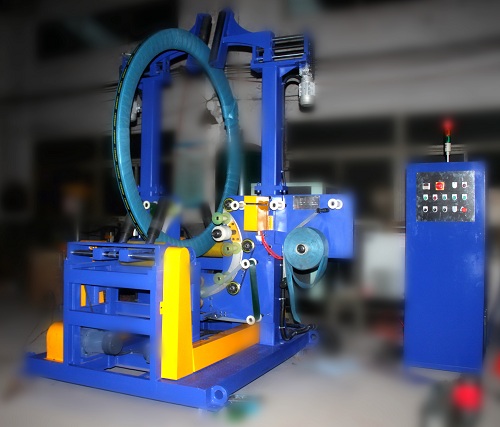
Our FPCA-200 has a horizontal table and a vertical wrapping ring that passes through the coil eye.
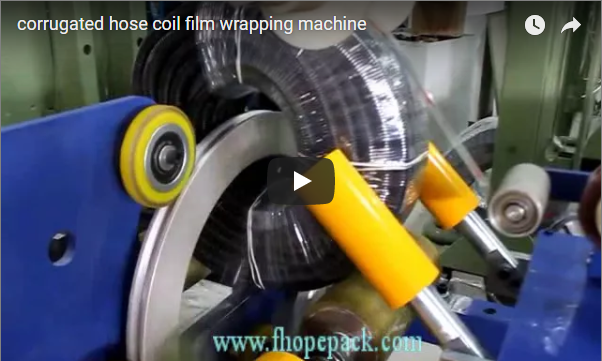
The coil lies flat on support rollers. A yellow press-down arm with a spring-loaded screw and soft rollers comes down onto the top of the coil. It holds the coil flat and keeps it turning at the same speed as the ring. Sheet-metal covers enclose the drive parts and pinch points. The stretch film spirals round the coil section until it is fully covered.
For coils under about 8 kg we fit the press-down device as standard, because a very light coil shakes in wrapping without it. On heavier soft coils it keeps the coil flat so it does not deform.
Packing one coil
1. **Load.** Place the coil flat on the rollers, with the ring through the eye.
2. **Hold.** Bring the press-down arm onto the coil. Its height is set to the coil width.
3. **Tie on.** Fix the film end to the coil.
4. **Wrap.** Start the cycle. The support rollers turn the coil through one full 360° rotation while the ring makes many helical passes through the eye.
5. **Finish.** Cut the film, lift the arm and take the coil off.
FPCA-200 data
From our FPCA-200 soft coil wrapping machine page:
| Item | FPCA-200 |
| :--- | :--- |
| Coil ID | 200–350 mm |
| Coil OD | 500–650 mm |
| Coil width | 150–300 mm |
| Coil weight | 10–50 kg |
| Wrapping time | 25–35 s per coil |
| Max ring speed | 100 r/min |
| Power | 2.0 kW, 380 V 60 Hz 3-phase |
| Film | stretch film, core 50 mm, OD 100–140 mm, width 90 mm |
| Paper (optional) | core 50 mm, OD 100–450 mm, width 90 mm |
The machine is built for soft coils packed horizontally, and gives support so the coil does not deform. Other sizes are built to order.
Worked example: 30% or 50% overlap
Illustrative coil: ID 300 mm, OD 600 mm, width 200 mm, 25 kg, with 90 mm film.
**ID circumference.** π × 300 ≈ 942 mm. This is where the film is most crowded, so the overlap is set here.
**Film path per wrap.** 2 × (150 + 200) = 700 mm round the coil section.
| Overlap | Advance per wrap | Wraps | Film on coil | Ring time at 100 r/min |
| :--- | :--- | :--- | :--- | :--- |
| 50% | 90 × 0.5 = 45 mm | 942 ÷ 45 ≈ 21 | 21 × 0.7 ≈ 14.7 m | ≈ 12.6 s |
| 30% | 90 × 0.7 = 63 mm | 942 ÷ 63 ≈ 15 | 15 × 0.7 ≈ 10.5 m | ≈ 9.0 s |
**Result.** Going from 50% to 30% overlap saves about 4.2 m of film per coil, close to 30%, and about 3.6 s of ring time. The cost is a single layer over most of the coil. For moisture protection we keep 50%; for dust cover, 30% is usually enough. The wrapping time stays within the 25–35 s per coil once loading is added.
Getting a neat package
- **Set the arm height to the coil.** Too high and the coil slips; too low and it drags.
- **Keep the tension low on soft coils.** The film should lie flat, not cut into the edges.
- **Tie on at the same place each time.** The overlap then ends at the start point.
- **Check the film roll OD.** A near-empty roll changes the tension.
Selection checklist
1. Coil ID, OD, width and weight.
2. Coil type: hose, cable, wire or tube.
3. Coils per hour.
4. Film or paper, and the overlap you need.
5. Labels or logo tape.
6. Country of installation (voltage and CE).
Safety: EN 415-10 and ISO 12100
For this wrapper our design reference is EN 415-10, and the CE file is built on an ISO 12100 risk assessment. The hazards are the ring through the coil eye, the support rollers and the press-down arm. Covers guard the drive parts, and the guard at the feed side closes off the ring area. Loading, tie-on and unloading are done with the ring stopped.
Engineering FAQ
Q: Why does a small coil need a press-down arm?
A: A light coil does not grip the rollers well by its own weight. The arm adds the grip and holds the coil flat, and its height adjusts to the coil.
Q: Can it wrap with paper instead of film?
A: Yes. Paper rolls up to 450 mm OD can be used, for coils that must breathe.
Q: How many coils per hour?
A: At 25–35 s per coil, the wrap time allows about 100–140 coils per hour; loading speed sets the real figure.
Q: Which standard applies?
A: We design to EN 415-10, and the CE risk assessment follows ISO 12100.
Next step
1. **Send your coil sizes and weights** to info@fhopepack.com.
2. **We check the fit** against the FPCA-200.
3. **We reply within 24 hours** with a quotation.
Related reading
- [FPCA-200 soft coil wrapping machine (product)](https://www.fhopepack.com/Hose-packaging-machine/Coil-wrapper-FPCA-200H.html)
- [Hose coil wrapping machine by film](https://www.fhopepack.com/videos/hose-coil-wrapping-machine-by-film/)
- [Cable coil packing machine and wire packing machine](https://www.fhopepack.com/videos/cable-coil-packing-machine-and-wire-packing-machine/)
- [How to load and unload a coil on a coil wrapping machine](https://www.fhopepack.com/videos/the-way-to-load-and-unload-coil-by-the-device-of-coil-wrapping-machine/)
Sources
- FHOPE FPCA-200 coil wrapping machine product page
- Our FPCA-200 wrapper shown above
- Worked example: illustrative figures
- Standards: EN 415-10; ISO 12100:2010
Last reviewed: 2026-10-18