Executive summary
Stretch film around the sides of a pallet does not stop dust or water landing on top. Our automatic turntable pallet wrapping machine adds a top sheet dispenser on a gantry above the turntable. It lays a sheet of film over the load, then the side wraps lock the sheet edges down, and the film is clamped and cut with no operator at the machine.
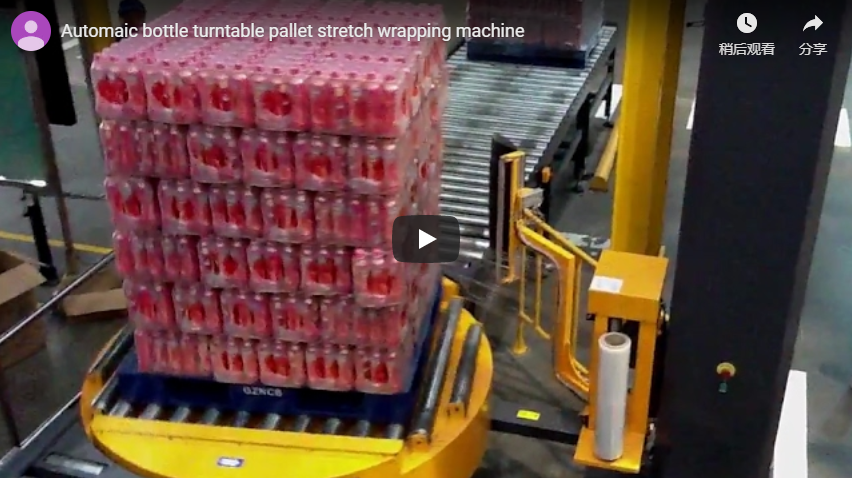
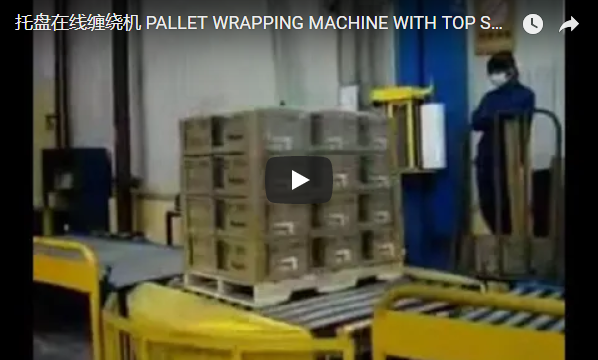
A large yellow turntable sits between two blue gantry columns that carry the top sheet arm. The film mast with its pre-stretch carriage stands at the side, next to a pneumatic clamp-and-cut unit at turntable height. The control cabinet beside the frame has a status light, and a carton load on a wooden pallet shows the finished result: a sheet over the top, sealed in by the side wraps.
Table of Contents
- Why add a top sheet
- Machine sequence
- Machine data
- Sizing the top sheet
- Film per load
- Selection checklist
- Safety
- Engineering FAQ
- Next step
- Related reading
- Sources
Why add a top sheet
Side wrapping leaves an open top. Loads stored outdoors, shipped by sea or held in dusty warehouses pick up water and dirt there. A top sheet closes that face, and because the side wraps cross over its edges, the sheet stays put without tape. On an automatic machine it also removes the step where an operator climbs or reaches over the load.
Machine sequence
- A forklift sets the load on the turntable.
- The turntable starts with a soft start and the carriage wraps the bottom winds.
- The carriage spirals up to the top of the load and holds there.
- The top sheet arm positions film over the load and cuts the sheet to length.
- The top winds go on over the sheet edges, then the carriage spirals down.
- The pneumatic clamp grips the film, cuts it and wipes the tail onto the load, and the turntable stops at home.
The top sheet is laid during the wrapping cycle, and the sheet length can be set for each wrap program to save film. Laying the sheet before the top winds, as above, gives a water-resistant top. For dust covers only, the sheet can go on at the start of the cycle; the timing for your load is confirmed at quote.
Machine data
| Item | B series automatic turntable wrapper (B300 page) |
|---|---|
| Output | at least 24 loads per hour |
| Maximum load | 1,800 kg |
| Turntable | 2,200 mm diameter, about 400 mm high |
| Turntable speed | up to 12 rpm, soft start and stop |
| Film | LLDPE, 0.025 mm, 500 mm wide, 76 mm core |
| Pre-stretch | 250%, optional 100% to 300% |
| Carriage | inverter drive, 2.9 m/min |
| Winds | bottom, middle and top, 0–99 each |
| Film end | pneumatic clamp, heated-wire cut, brush wipe |
| Power and air | AC 380 V, 3 phase, 50 Hz; air 6–8 kgf/cm² (about 5.9–7.8 bar) |
Top sheet film thickness, sheet roll width and the gantry height are set to your load and confirmed at quote.
Sizing the top sheet
Sheet width ≥ load width + 2 × overhang
Sheet length ≥ load length + 2 × overhang
Example only: a 1,200 × 1,000 mm load with a 150 mm overhang on each side needs a sheet at least 1,000 + 300 = 1,300 mm wide and 1,200 + 300 = 1,500 mm long. The overhang hangs down the sides of the load, so the top wrap band must be taller than the overhang, or the lower edge of the sheet stays loose. With 500 mm film and 3 top winds the top band is well over 150 mm deep, so the whole overhang is covered.
Check the load against the turntable: a 1,200 × 1,000 mm load has a diagonal of about 1,562 mm, which fits inside the 2,200 mm turntable.
Film per load
Film off the roll ≈ turns × load perimeter ÷ (1 + pre-stretch)
Example only: 20 turns on a 1,200 × 1,000 mm load use 20 × 4.4 m = 88 m of film on the load. At 250% pre-stretch the roll gives 88 ÷ 3.5 ≈ 25 m. Add the top sheet, about 1.5 m per load in the example above.
Selection checklist
- Load size, height and weight.
- Loads per hour.
- Top sheet: needed on every load or only some.
- Storage: indoor, outdoor or sea freight.
- Film thickness and pre-stretch.
- Forklift loading or conveyor in-feed.
Safety
We design our pallet wrappers to EN 415-6 for pallet wrapping machines, with EN ISO 12100:2010 for risk assessment and EN 60204-1 for the electrical equipment. A red mushroom emergency stop and a lockable disconnect are fitted, and the turntable stops at a set home position so the forklift does not hit a moving load.
Engineering FAQ
Q: Can the top sheet be turned off for some loads? A: Yes, the top sheet is a program setting. Loads that stay indoors can be wrapped on the sides only.
Q: What holds the top sheet before the side wraps catch it? A: The sheet lies flat on the load and the turntable holds still while it is laid. The top winds follow straight away and pin the overhang down.
Q: Can the machine be put in line with conveyors later? A: Yes, infeed and outfeed conveyors are an option on the B series.
Next step
- Send your load size, weight, height and loads per hour to info@fhopepack.com.
- We set the turntable, top sheet size and wrap program.
- We reply within 24 hours with a proposal and quotation.
Related reading
- Automatic pallet wrapping machine B300 (product)
- B series pallet wrapping machine with top film dispenser
- How a PE sheet dispenser covers pallets automatically
Sources
- FHOPE product page: B300 automatic pallet wrapping machine
- EN 415-6; EN ISO 12100:2010; EN 60204-1
Last reviewed: 2026-10-20