Understanding the Pallet Exchanging Machine: Operation and Benefits
This video showcases a pallet exchanging machine undergoing testing. These machines offer an efficient solution for swapping pallets at floor level.
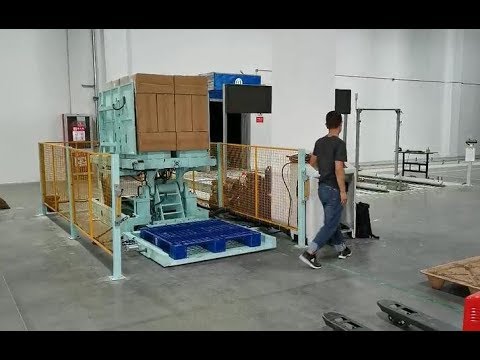
Let's delve deeper into how these systems work and the advantages they bring to material handling operations.
1. How Does a Pallet Exchanging Machine Function?
A pallet exchanging machine, often referred to as a pallet changer or pallet transfer system, is specifically designed to replace the pallet beneath a load without requiring manual restacking. The core mechanism involves:
- Loading: A forklift places the palletized load onto the machine's platform at floor level.
- Clamping: Secure clamps engage the load to hold it steady during the process.
- Tilting: The machine tilts the clamped load, typically by 90 degrees. This lifts the original pallet clear of the load.
- Exchanging: The original pallet is removed, and a new target pallet (e.g., a shipping pallet, plastic pallet, or replacement) is positioned adjacent to the tilted load.
- Return: The machine gently tilts the load back to the horizontal position, settling it onto the new pallet.
- Release: The clamps release the load, now resting securely on the new pallet, ready for removal by a forklift.
This method provides a relatively fast and stable way to transfer goods between pallets.

2. Key Features and Technical Specifications
While specific models vary, typical features and specifications for this type of pallet exchanger include:
- Operation Method: 90-degree tilting mechanism for floor-level pallet exchange.
- Loading Capacity: Often capable of handling loads up to 2.5 Tonnes (2500 kg).
- Maximum Load Height: Can typically accommodate loads up to 2000mm in height.
- Pallet Changing Time: Efficient cycle times, often around 20 seconds per exchange (excluding forklift handling).
- Construction: Built with a strong, robust structure suitable for industrial environments.
- Safety Level: Designed to meet safety standards, often indicated by certifications like CE.
3. Why Use a Pallet Exchanging Machine? Key Applications and Benefits
These machines address several common challenges in logistics and manufacturing:
- Replacing Damaged Pallets: Easily swap out broken or unsuitable pallets without manually handling the goods, preventing product damage and delays.
- Switching Pallet Types: Transfer loads from in-house wooden pallets to plastic hygiene pallets, or onto export-compliant or customer-required pallets.
- Improving Warehouse Efficiency: Automates and speeds up the pallet changing process compared to manual methods, increasing throughput.
- Enhancing Worker Safety: Significantly reduces the need for manual lifting and restacking of heavy or awkward loads, lowering the risk of musculoskeletal injuries. (See general guidance on material handling safety from sources like OSHA - Note: External link to relevant safety authority).
- Streamlining Operations: Integrates smoothly into receiving, dispatch, or quality control areas where pallet swaps are necessary.
- Alternative to 180-Degree Inverters: Provides a different method compared to full pallet inverters, which may be preferable for certain load types or facility layouts.
Industries that frequently benefit include warehousing, distribution centers, food and beverage production, pharmaceuticals, and general manufacturing.
4. Pallet Exchanger (90-Degree) vs. Pallet Inverter (180-Degree)

It's important to distinguish between 90-degree pallet exchangers and 180-degree pallet inverters:
- Pallet Exchanger (90-Degree): Tilts the load onto its side to allow pallet removal and replacement from underneath.
- Pallet Inverter (180-Degree): Clamps the load and rotates it a full 180 degrees, allowing the original pallet (now on top) to be removed and replaced before rotating back.
The choice between them depends on the specific application, load stability, required footprint, and operational flow.
5. Integrating Pallet Changers into Your Workflow
Effective integration involves considering:
- Placement: Locating the machine strategically in receiving docks, shipping areas, or near production lines where pallet changes are frequent.
- Material Flow: Ensuring smooth forklift access for loading and unloading the machine.
- Training: Properly training operators on safe and efficient use of the equipment.
6. Considerations Before Implementation
When selecting a pallet exchanging machine, evaluate:
- Load Characteristics: Weight, dimensions, stability, and fragility of the products being handled.
- Pallet Compatibility: Ensure the machine can handle the sizes and types of pallets used (both incoming and outgoing).
- Throughput Needs: Match the machine's cycle time to your operational requirements.
- Facility Space: Consider the machine's footprint and required operating area.
- Safety Features: Verify robust clamping, emergency stops, and guarding.
In summary, the 90-degree pallet exchanging machine offers a valuable, automated solution for efficiently and safely swapping pallets at floor level. By reducing manual handling and speeding up transfer processes, it contributes significantly to optimized logistics and warehouse operations.