How Automated Steel Coil Packing Reduces Downtime and Ensures Stability
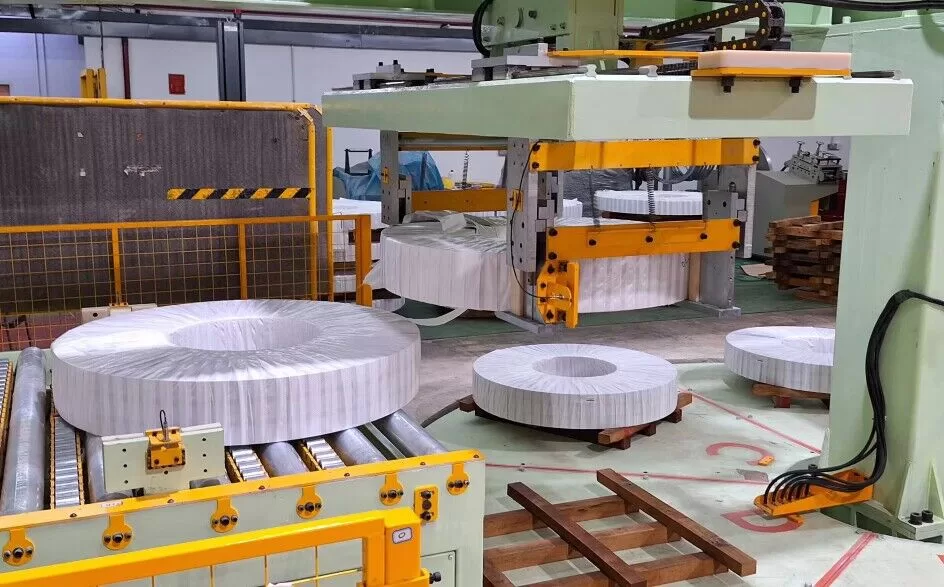
In the demanding steel manufacturing industry, maintaining operational efficiency and ensuring product integrity are paramount. A critical process influencing both aspects is steel coil packaging. Inefficient or inconsistent packing can lead to costly downtime and compromise the stability of coils during storage and transport. This article examines how implementing automated steel coil packing systems effectively minimizes operational interruptions, streamlines production flow, and enhances the stability of finished coils, thereby strengthening a manufacturer's operational performance.
1. Addressing the Need for Automation in Steel Coil Packing
Traditionally, steel coil packaging relied heavily on manual labor. This approach is not only labor-intensive but also susceptible to inconsistencies, potential safety hazards, and slower throughput. Manual packing operations can introduce variability in wrap tension, strap placement, and overall package quality, potentially leading to coil damage or delays in the production line.
Automation technology in steel coil packing directly confronts these challenges. By automating tasks like wrapping, strapping, and handling, manufacturers benefit from:
- Increased Speed: Automated systems operate significantly faster than manual methods, reducing bottlenecks at the end of the production line.
- Reduced Human Error: Automation ensures consistent application of packaging materials according to pre-set parameters, minimizing errors that could compromise package integrity.
- Continuous Operation: Automated lines can run consistently with minimal human intervention, reducing delays associated with breaks, shift changes, or manual adjustments.
2. Understanding Downtime in Steel Manufacturing
Downtime, particularly unplanned downtime, represents a major operational hurdle for steel manufacturers. Causes can range from equipment malfunctions and material shortages to inefficiencies in processes like packaging. Each minute the line isn't running translates directly into lost production capacity, delayed shipments, and increased operational costs.
In manual packing scenarios, downtime can stem from the need for frequent breaks, inconsistencies requiring rework, slow changeovers between coil sizes, or safety-related stops. The inherent variability in manual task execution can lead to unpredictable delays. Automated steel coil packing systems mitigate many of these issues by providing reliable, continuous, and predictable performance, significantly reducing unplanned stops and boosting overall equipment effectiveness (OEE).
3. How Automated Steel Coil Packing Systems Reduce Downtime

Automated steel coil packing lines are specifically engineered for continuous, efficient operation, integrating smoothly with upstream production processes. Key downtime reduction features include:
- Continuous Operation Capability: Designed for 24/7 operation, automated systems eliminate the stop-start nature of manual packing, ensuring the packaging process keeps pace with production output.
- Rapid Setup and Changeovers: Systems featuring programmable logic controllers (PLCs) allow for quick adjustments to accommodate different coil dimensions and packing specifications via pre-set recipes, minimizing transition time between product runs.
- Real-Time Monitoring and Diagnostics: Integrated sensors and diagnostic tools continuously monitor system status. Potential issues like material depletion, misalignment, or component faults are detected instantly, often alerting operators before a major stoppage occurs, enabling proactive maintenance and swift resolution.
- Reduced Manual Handling: Automating the movement and manipulation of heavy coils minimizes delays associated with crane availability or manual positioning, streamlining the flow.
By automating these critical functions, manufacturers can substantially minimize idle time, achieve higher throughput rates, and maintain a more predictable production schedule.
4. Enhancing Coil Stability Through Automated Packing
Maintaining the stability of packed steel coils is essential to prevent damage such as edge deformation, surface scratches, telescoping, or corrosion during handling, storage, and shipment. Unstable or poorly secured coils are vulnerable to shifting, leading to costly material losses. Automated steel coil packing systems enhance stability through precise and repeatable techniques:
- Precision Wrapping Application: Automated stretch wrapping machines apply protective films (like stretch film or VCI paper) uniformly around the coil. The system precisely controls material tension, overlap percentage, and the number of layers, creating a tight, secure wrap that prevents internal movement and protects against environmental factors.
- Consistent and Secure Strapping: Automated strapping machines apply steel or PET straps at programmed locations with consistent, optimal tension. Accurate placement and uniform tension ensure the coil remains tightly bound, maintaining its form and integrity throughout the logistics chain. This consistency is difficult to achieve manually.
This high level of consistency in wrapping and strapping directly translates to reduced risk of product damage, minimizing costly returns, customer claims, and the associated operational disruptions.
5. Key Components of Automated Steel Coil Packing Lines
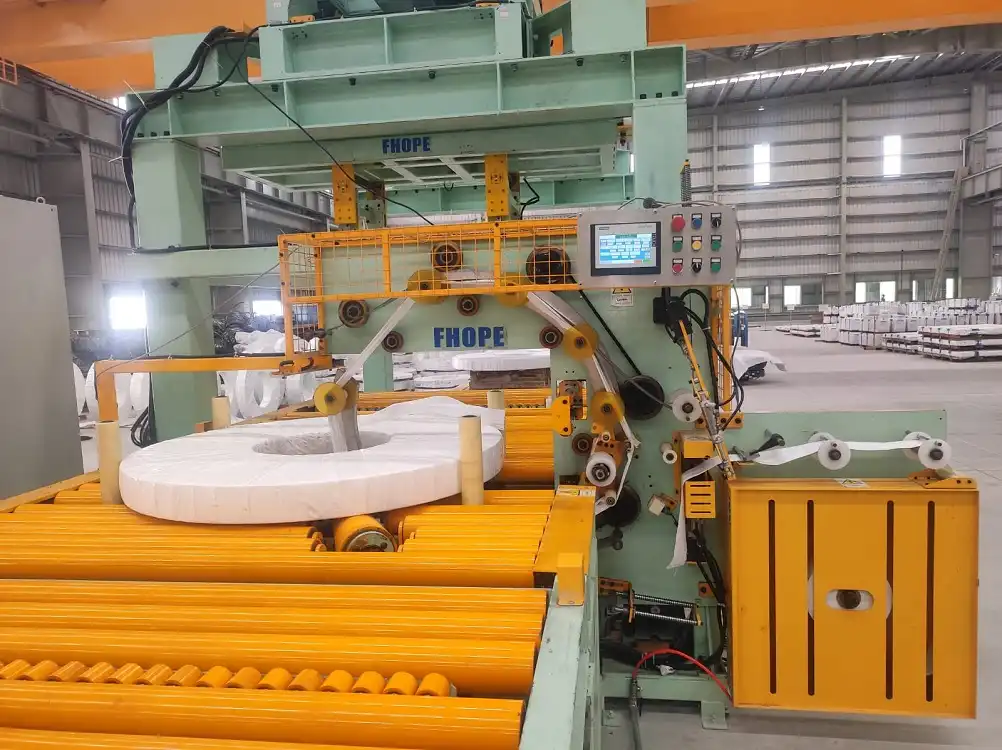
A typical automated steel coil packing line integrates several key components, each contributing to reduced downtime and improved packing stability:
- Coil Input Stations (e.g., Turnstiles, Saddles): These manage the flow of coils into the packing line, often holding multiple coils to create a buffer and reduce reliance on immediate crane availability, thus minimizing waiting time.
- Coil Up-enders/Down-enders: These machines safely and efficiently rotate coils from horizontal to vertical orientation (or vice versa) as needed for specific packing processes (like eye-to-sky strapping), ensuring proper positioning for stable and consistent packaging.
- Conveyor Systems: Automated conveyors (roller, chain, or walking beam) transport coils smoothly between stations (weighing, strapping, wrapping, labeling, palletizing), eliminating manual handling bottlenecks and reducing transit time within the line.
- Automated Strapping Machines: Apply radial or through-the-eye straps with consistent tension and precise placement, critical for securing the coil bundle and preventing telescoping. Different heads handle steel or PET strapping.
- Automated Wrapping Machines: Enclose the coil in protective materials (stretch film, VCI paper/film, barrier foil) using orbital or horizontal wrapping techniques, ensuring consistent coverage and tension for environmental protection and stability.
- Labeling and Marking Systems: Apply identification labels or marks automatically, ensuring accurate tracking without manual intervention delays.
- Stacking/Palletizing Units: Automatically stack smaller coils or place large coils onto pallets or skids, preparing them for storage or shipment efficiently and safely.
These components operate synergistically, controlled by a central PLC system, to create a highly efficient, reliable, and integrated packing process.
6. Ensuring Consistency and Quality with Automation
A significant advantage of automation is the unwavering consistency it delivers. Manual packing inherently involves human variability – differences in technique, fatigue, or attention can lead to inconsistent package quality. A poorly wrapped or strapped coil might pass initial inspection but fail during transit, leading to damage claims and rework, ultimately impacting operational flow.
Automated systems execute packing tasks based on precisely defined parameters stored in the control system. Sensors provide feedback, ensuring, for example, that wrapping tension is maintained consistently or that straps are applied at the exact programmed locations and torque. This repeatability guarantees that every coil receives the same high standard of packaging.
This process consistency not only safeguards the product quality but also reduces material waste by applying the optimal amount of film and strapping each time. Furthermore, consistent packaging enhances brand perception and customer satisfaction by delivering products that arrive undamaged and professionally presented.
7. The Long-Term Operational Benefits of Automated Steel Coil Packing
While requiring an initial capital investment, automated steel coil packing systems provide substantial long-term operational and financial advantages:
- Increased Productivity and Throughput: Continuous, high-speed operation allows manufacturers to pack more coils per shift, increasing overall plant output capacity without necessarily increasing footprint.
- Optimized Labor Utilization: Automation reduces the need for manual labor in repetitive and physically demanding packing tasks, allowing personnel to be reallocated to higher-value activities like quality control, maintenance, or process supervision.
- Reduced Packaging Material Consumption: Precise control over material application minimizes overuse of stretch film and strapping, leading to significant cost savings and reduced environmental impact.
- Enhanced Workplace Safety: Automating the handling and packing of heavy, potentially sharp-edged steel coils significantly reduces the risk of manual handling injuries, contributing to a safer work environment.
- Improved Product Protection: Consistent, high-quality packaging minimizes the risk of damage during handling and transport, reducing costs associated with scrap, rework, and customer complaints.
- Better Data Integration: Automated systems can often provide valuable operational data (cycle times, material usage, fault logs) that can be integrated into plant-wide monitoring systems (like SCADA or MES) for process optimization and predictive maintenance.
Conclusion
In the competitive landscape of steel manufacturing, minimizing downtime and ensuring the physical integrity of products during transit are non-negotiable. Automated steel coil packing systems provide a robust solution to address the inefficiencies and inconsistencies often associated with manual processes. By delivering continuous operation, precise material application, and consistent quality, these systems significantly reduce operational interruptions and enhance the stability and protection of packed coils.
Investing in appropriate automation technology for coil packaging is increasingly becoming a strategic necessity. It enables manufacturers to improve productivity, lower operational costs, enhance safety, and deliver high-quality, reliably packed products, ultimately strengthening their market position and operational resilience.