Executive summary
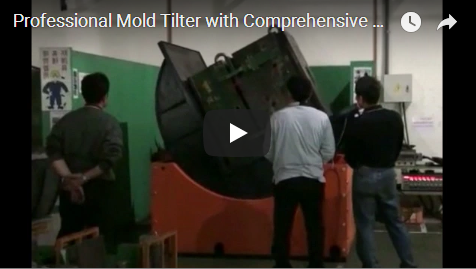
The volteadora de moldes de 90 grados is a 90-degree mold tilter that holds a large metal mold in an arc-shaped carrier and turns it between vertical and horizontal. The crane presents the mold, a worker supervises while the carrier rotates, and the crane then lifts the mold away for the next step. A striped safety fence around the base keeps people clear of the moving carrier. Mold size, load and cycle are confirmed per project.
Table of Contents
- Why turn a mold 90 degrees
- What the machine does
- Arc carrier and base
- Cycle time and control
- What the footage shows
- Typical configuration
- Selection checklist
- Operation and safety
- Engineering FAQ
- Next step
- Related reading
- Sources and standards
Why turn a mold 90 degrees
A large metal mold is heavy and awkward, and its working face often needs to arrive facing a specific direction. Turning such a mold by hand is slow and risky, so the machine rotates it on a carrier instead of relying on manual force. The angle and the loads are confirmed per project.
What the machine does
The machine is a 90-degree mold tilter with an arc-shaped carrier that takes the mold from a crane and turns it between vertical and horizontal. The crane lowers the mold into the carrier, the carrier rotates through the turn, and the crane lifts the finished orientation away. Mold size and cycle are confirmed per project.
Arc carrier and base
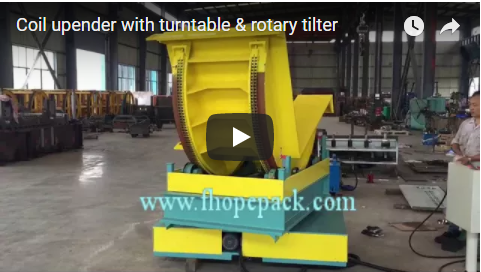
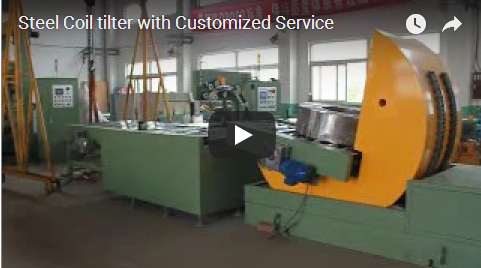
A yellow arc-shaped carrier supports the mold through the turn, and a base below the rotating section holds the assembly. The curved shape matches the path the mold follows, so the load stays supported as it rotates. Carrier size and load are confirmed per project.
Cycle time and control
The operator starts the cycle once the mold is seated on the carrier, and the carrier rotates the mold through the turn at a steady pace. When the mold reaches the new orientation, the machine stops and the crane lifts it away. Cycle start and stop are confirmed per project.
What the footage shows
Our footage shows a metal mold suspended from a crane over the tilter, then carried through a 90-degree turn while a worker keeps watch. It is a general demonstration, so your mold size, load and cycle are confirmed with us per project.
Typical configuration
Figures below list functional design boundaries rather than numeric values, and are confirmed per project.
| Parameter | Typical range, confirmed per project |
|---|---|
| Load | metal molds presented by crane |
| Tilt | 90 degrees from vertical to horizontal |
| Carrier | arc-shaped rotating section |
| Guard | striped safety fence around the base |
| Control | cycle start and stop on site |
| Electrical supply | 380 V three phase 50 Hz, or 220 V single phase for light machines, selected per project |
Selection checklist
| Question | Confirm per project |
|---|---|
| Mold | size, weight and fixing points |
| Handling | crane or hoist that presents the molds |
| Angle | 90 degrees or custom tilt |
| Cycle | turn time and stops per shift |
| Site | floor space and access for the crane |
| Electrical supply | voltage, phase and frequency on site |
Operation and safety
The crane places the mold into the carrier at the starting position, the operator checks that it is seated, and then starts the tilt from the panel. Keep people clear of the fenced zone while the carrier moves, and keep the load inside the rated capacity. Routine checks cover the carrier, the base and the fence, per the machine manual.
Engineering FAQ
Q: What does this machine do? A: It rotates a large metal mold by turning an arc-shaped carrier through 90 degrees between vertical and horizontal.
Q: Why use a tilter for molds? A: Heavy molds are safer to turn on a carrier than by hand, and the turn keeps the load supported through the whole arc.
Q: How is the mold handled? A: A crane presents the mold and lifts it away, while the machine holds it through the turn.
Q: Can the angle be set differently? A: The tilt is matched to your molds through the project setup, so a 90-degree turn is the common case and other angles are confirmed per project.
Q: What do I confirm before ordering? A: Tell us your mold size and weight, how the crane presents the molds, and the site supply, and we confirm the machine through a short review of your line.
Next step
- Email us at info@fhopepack.com with your mold sizes and weights.
- We send a 90-degree mold tilter proposal within 48 hours.
- We confirm the carrier size and tilt angle for your molds.
Related reading
- Professional mold tilter with comprehensive technical support
- Steel coil tilter with customized service
- Coil tilter and coil upender
- FHOPE packing machinery product lines
Sources and standards
- ISO 12100:2010 Safety of machinery, general principles for design and risk assessment
- EN 415-10:2014 Safety of packaging machines, general requirements
- EN ISO 13849-1:2023 Safety of machinery, safety-related parts of control systems
FHOPE 90-degree mold tilter demonstration video. Reviewed as a general demonstration; mold size, load and cycle confirmed per project.
Last reviewed: 2026-10-11