Samenvatting Wire coil wrapping and packing works best as one line: the coiler winds and straps the coil, a roller conveyor centres it, an eye-through wrapper covers it and the coils are stacked for dispatch. Our FPW-300 wrapper takes wire coils of 450–850 mm OD and up to 250 kg. The key design step is balancing the line, so a worked example matches coil weight, coiler rate and wrapping time.
Inhoudsopgave
- The four stages of a wire coil packing line
- What our demonstration line shows
- Coiling and strapping
- Doorzichtige verpakking
- Stacking and dispatch
- FPW-300 wrapper data
- Worked example: balancing coiler and wrapper
- Selectiechecklist: wat moet u ons toesturen?
- Veiligheid en EN 415-10
- Veelgestelde vragen over techniek
- Volgende stap
- Gerelateerd lezen
- Bronnen
The four stages of a wire coil packing line
- Pay-off and coiling. Wire runs from the pay-off into the coiler, which counts the length and winds the coil.
- Sterk. The coil is tied through the eye so it keeps its shape.
- Inpakken. An eye-through wrapper covers the coil in film, paper or both.
- Stapelen. Wrapped coils are collected and stacked for pallets or cartons.
Each stage hands the coil to the next on roller conveyors, so nobody lifts a coil by hand.
What our demonstration line shows
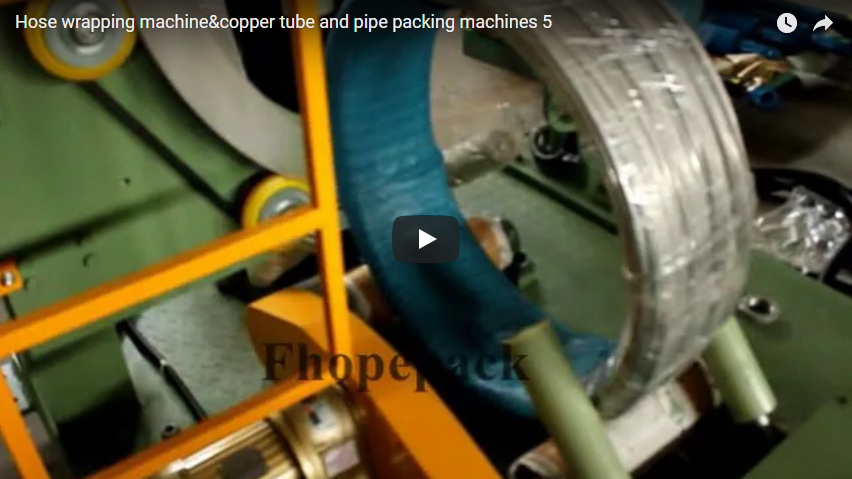
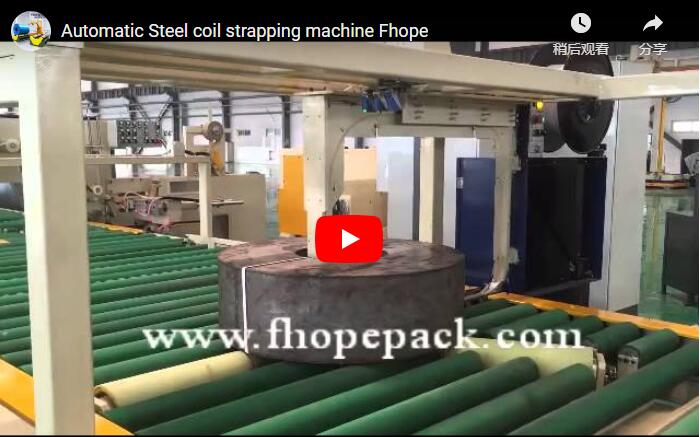
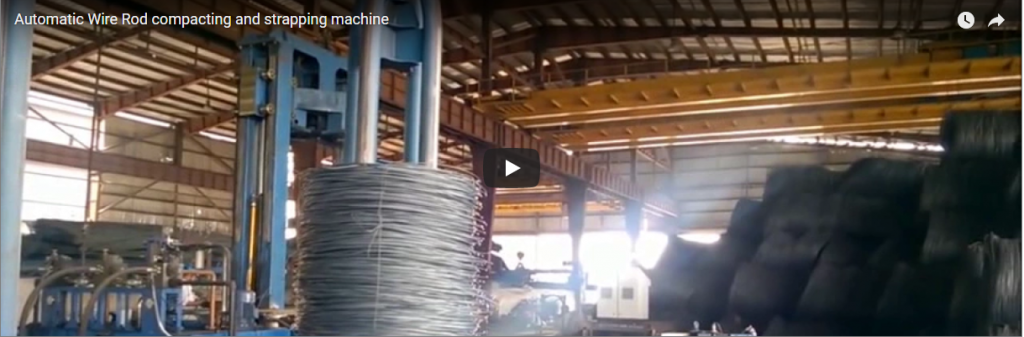
Wrapped coils in green film run along a roller conveyor between upright centring rollers. Small bare wire coils, tied with straps, sit on a spoked holder at the end of the line. A layout drawing then shows the whole line: pay-off coilers, wrapping station and a stacking gantry.
Coiling and strapping
Our automatic wire coiler winds at 200–800 m/min. It makes about 20 coils an hour on one head and 40 on two, where one head winds while the other is unloaded. Those rates apply to lighter coils; heavy coils take longer to wind, as the example shows. The length counter works to the centimetre, and an accumulator holds 5–20 m of wire to keep tension steady.
The strapper ties PP strap through the eye at 2–6 points, depending on the model. Strapping first matters: a tied coil keeps its shape on the conveyor and through the wrapper.
Doorzichtige verpakking
The wrapper’s ring passes the material through the coil eye while rollers turn the coil. Each turn overlaps the last, and the overlap rate sets how many layers cover the coil. The FPW-300 runs PVC, LLDPE, PE, paper or HDPE, on a 50 mm core, 100–120 mm wide.
The PLC stores coil types, so changing from one coil size to another takes a recipe change. The FPW-300 needs no air supply.
Stacking and dispatch
At the end of the line, wrapped coils are collected for stacking. The layout shown uses a gantry above a stacking table, so coils go onto the pallet or into cartons in a fixed pattern. We size the stacker to your pallet and coil weight.
FPW-300 wrapper data
| Item | FPW-300 |
|---|---|
| coil ID | 300 – 700 mm |
| coil OD | 450 – 850 mm |
| Coil breedte | 100 – 300 mm |
| coil gewicht | 10-250 kg |
| Materiaal | PVC, LLDPE, PE, papier, HDPE |
| Materiaalrol | 50 mm core, 100–250 mm OD, 100–120 mm wide |
| overlap | 10-90% |
| Power | 1.5 kW, 380 V, 50 Hz, 3-fasen |
| Luchttoevoer | geen |
For coils above these sizes, we move up to the larger FPW models.
Worked example: balancing coiler and wrapper
A plant makes 50 kg coils of 1.6 mm steel wire, 600 mm OD, 400 mm ID and 150 mm wide. It wraps them in 100 mm film at 50% overlap. These are illustrative customer figures.
Pasvorm. The coil is inside every FPW-300 range, and 50 kg is well under 250 kg.
Draad lengte. The wire’s cross-section is π ÷ 4 × 1.6² = 2.01 mm². One metre weighs 2.01 × 10⁻⁶ × 7,850 = 0.0158 kg. So a 50 kg coil holds 50 ÷ 0.0158 = 3,165 m of wire.
Coiling time. At 600 m/min that takes 3,165 ÷ 600 = 5.3 min, or about 317 s. With two heads alternating, a coil leaves the coiler about every 317 s. So the line runs at about 3,600 ÷ 317 = 11 coils an hour, not the nominal 40, because each coil is heavy.
Inpakken. At 50% overlap each turn advances 100 × 0.5 = 50 mm at the OD. The OD circumference is π × 600 = 1,885 mm, so the ring makes 1,885 ÷ 50 = 38 turns. The wrapper has 317 s minus handling time to make them. Even if handling took half the cycle, 158 s, the ring would need only 38 ÷ 158 × 60 = 14 r/min. So the wrapper is not the bottleneck here.
Film. One turn goes through the eye and round the coil: 2 × (600 − 400) ÷ 2 + 2 × 150 = 500 mm. So 38 turns lay 38 × 0.5 = 19 m of film on each coil. That is the applied length; less comes off the roll, because the film is stretched.
Algemene regel. The line rate is set by the slowest stage. For the coiler, t = L ÷ v; for the wrapper, t = turns ÷ ring speed + handling. Lighter coils push the bottleneck towards the wrapper and stacker.
Selectiechecklist: wat moet u ons toesturen?
- Draaddiameter en materiaal.
- Coil weight or length, and coil OD, ID and width.
- Line speed from drawing or pay-off.
- Strap type and number of points.
- Wrapping material: film, paper or both.
- Stacking: pallet size, pattern and coils per pallet.
Veiligheid en EN 415-10
For CE markets we follow EN 415-10 as the reference, with a risk assessment to ISO 12100. The main hazards are the turning winder, the strapping head, the wrapping ring and the stacker.
The coiler stops at once if the wire breaks. Guard the wrapping ring and the stacker zone, and keep hands out of the winder while the line runs.
Veelgestelde vragen over techniek
Q: Can one wrapper serve two coilers? A: Often yes, when the coils are heavy and the coilers are slow. Run the balance in the worked example with your coil weight.
Q: Which wrapping material should we use? A: Film for dust and water, paper where the wire must breathe, or both. The FPW-300 runs PVC, LLDPE, PE, paper and HDPE.
Q: Does the FPW-300 need compressed air? A: No. It runs on 1.5 kW electric power only.
V: Aan welke normen voldoet u bij de bouw? A: EN 415-10 als CE-referentie, met een risicobeoordeling volgens ISO 12100.
Volgende stap
- Email your wire size, coil weight and line speed naar info@fhopepack.com.
- Wij reageren binnen 24 uur met een voorstel., with the coiler, wrapper and stacking layout.
- We sturen een lay-outtekening. for your wire packing line.
Gerelateerd lezen
- Draadwikkelmachine FPW-300
- Automatic wire coiler with strapping
- Hoe staaldraad te verpakken met een automatische machine
- Automatic steel wire coiler for wire winding and strapping
- Hoe kies je de juiste spoelwikkelmachine voor jouw staaldraadspoel?
Bronnen
- Specifications: FHOPE FPW-300 wire coil wrapping machine and automatic wire coiler product pages
- Machinevideo: wire coil packing line on YouTube
- Line balance and film: our worked example, illustrative wire figures
- Normen: EN 415-10 (verpakkingsmachines, algemene veiligheid); ISO 12100:2010
Laatst beoordeeld: 17-10-2026