**Zusammenfassung**
> Our rotating coil upender tips a coil through 90 degrees on a V or flat table, and its base turns the coil through 180 degrees to face the next station. Models FPCT-05, FPCT-10 and FPCT-40 cover loads up to 40 t. A worm gear drive with an inverter gives a soft start and stop and holds the table at any angle. A worked example works out a coil's weight, picks the model and checks the hourly rate.
Inhaltsverzeichnis
- Why upend a coil instead of lifting it over
- Two motions: tilt and turn
- Drive, holding and limits
- Rotating coil upender specifications
- Worked example: coil weight, model and coils per hour
- Auswahlliste: Was Sie uns senden sollten
- Sicherheit und EN 415-10
- Häufig gestellte Fragen zur Technik
- Nächster Schritt
- Verwandte lesen
- Quellen
Why upend a coil instead of lifting it over
Slitting, banding and storage often need a coil eye-horizontal at one step and eye-vertical at the next. Turning it with a crane and chains means a swinging load and edges that dent where the chain bites.
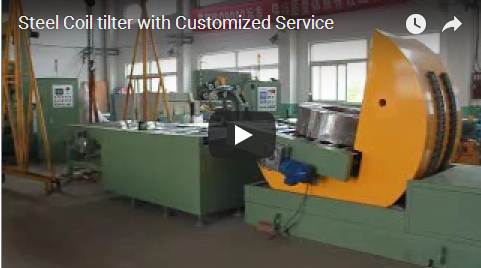
An upender does it on a fixed table. The coil sits in the cradle, the table tilts, and the coil ends up on its other face without leaving the machine. Operators stand at the control panel, away from the coil while it moves.
Two motions: tilt and turn
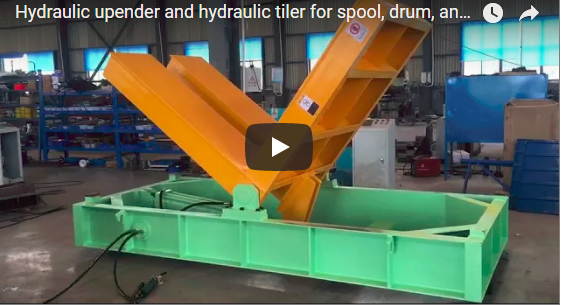
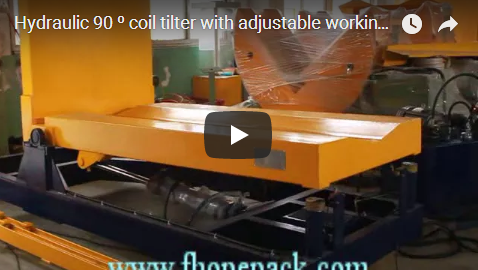
**Tilt.** The upper frame carries the V table and flat table at right angles. As it rotates through 90 degrees, the coil's weight passes from one table to the other. A coil that lies eye-horizontal in the V ends up eye-vertical on the flat table, and the reverse.
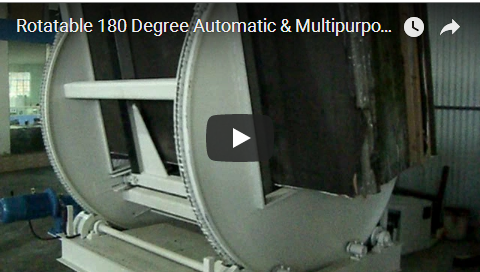
**Turn.** The base frame carries a rotating table that turns the whole tilter through 180 degrees. Load from one aisle, upend, turn, and the coil faces the crane or conveyor on the other side. Nobody has to drive round to pick it up.
Drive, holding and limits
A gear motor drives the tilt through helical gears and a worm reducer. The worm holds its position, so the table can stop and stay at any angle. An inverter sets the speed and gives a soft start and stop, which keeps a heavy coil from rocking in the V.
Electric and mechanical displacement limiters stop the tilt at its end positions. A levelling device lets us set the machine true on an uneven floor. The machine has its own electric panel.
Rotating coil upender specifications
| Item | FPCT-05 | FPCT-10 | FPCT-40 |
| :--- | :--- | :--- | :--- |
| Max load | up to 5 t | up to 10 t | up to 40 t |
| Power | about 4.0 kW | about 5.0 kW | about 15 kW |
| Upending angle | 90° | 90° | 90° |
| Base rotation | 180° | 180° | 180° |
| Tilt time | 60–90 s per coil | 60–90 s per coil | 60–90 s per coil |
| V table | 1,500 × 1,500 mm, customised | as required | as required |
| Flat table | 1,500 × 1,500 mm, customised | as required | as required |
| Power supply | 380 V, 50 Hz, 3 phase | 380 V, 50 Hz, 3 phase | 380 V, 50 Hz, 3 phase |
Worked example: coil weight, model and coils per hour
Take a steel coil 1,200 mm outside diameter, 508 mm inside diameter and 1,000 mm wide. The plant moves 12 coils an hour, and each crane pick or set-down takes 90 s. These are illustrative customer figures.
**Weight.** The steel volume is π ÷ 4 × (1.2² − 0.508²) × 1.0 = 0.928 m³. At 7,850 kg/m³ the coil weighs about 7,290 kg, or 7.3 t.
**Model.** The FPCT-05 is too small for 7.3 t. The FPCT-10 takes up to 10 t with room for a heavier coil later. The 1,200 mm coil also fits a 1,500 × 1,500 mm table with 150 mm to spare on each side.
**Cycle.** One coil needs a crane set-down, a tilt, a base turn and a crane pick. With the tilt at 60–90 s and the base turn taking time r, which we confirm for your model and coil, the cycle is 90 + (60 to 90) + r + 90 s.
| Tilt time | Cycle without turn | Coils per hour |
| :--- | :--- | :--- |
| 60 s | 240 s + r | 3,600 ÷ (240 + r) |
| 90 s | 270 s + r | 3,600 ÷ (270 + r) |
Even with r = 0, one upender gives 15 coils an hour at best and 13 at the slow end. That covers 12 coils an hour only if the base turn takes no more than 3,600 ÷ 12 − 270 = 30 s. If it takes longer, run the turn while the crane travels, or tilt faster on the inverter.
Auswahlliste: Was Sie uns senden sollten
1. Coil outside and inside diameter.
2. Coil width and heaviest weight.
3. Material: steel, aluminium, copper or cable.
4. Starting and finishing position: eye-horizontal or eye-vertical.
5. Whether you need the 180° base turn, and which side loads and unloads.
6. Coils per hour, and crane or conveyor at each side.
Sicherheit und EN 415-10
We build our upenders to CE requirements, with EN 415-10 as the reference and an ISO 12100 risk assessment. The tilting frame, the turning base and the coil itself are the main hazards. Displacement limiters stop the tilt at its ends, and the worm drive holds the table if power is lost. Fence or mark the swept area of the frame and base, and keep people out of it while either moves.
Häufig gestellte Fragen zur Technik
Q: Can it stop part-way through the tilt?
A: Yes. Position locking lets the machine stop and hold at any angle.
Q: Can the tables be made for our coil sizes?
A: Yes. The V table and flat table are sized to your product.
Q: Does it handle moulds as well as coils?
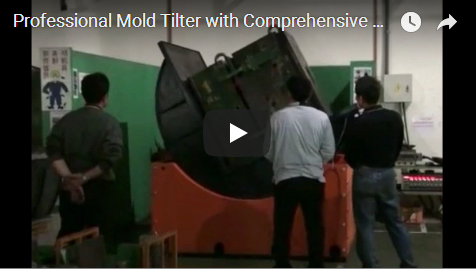
A: Yes. Steel coils and moulds are both typical loads.
F: Welche Sicherheitsstandards gelten?
A: In CE markets, EN 415-10 as the reference and ISO 12100 for the risk assessment.
Nächster Schritt
1. **Email your coil sizes, weights and coils per hour** to **info@fhopepack.com**.
2. **We reply within 24 hours with a proposal**, with the model and table sizes.
3. **We send a layout drawing** showing the crane and conveyor sides.
Verwandte lesen
- [Rotating coil upender](https://www.fhopepack.com/Mechanical/Rotating-Coil-Upender.html)
- [Coil upender and tilter FPCT series](https://www.fhopepack.com/Mechanical/Coil-Upender-Tilter.html)
- [90 degree coil tilter with a rotatable base](https://www.fhopepack.com/videos/90-degree-coil-tilter-with-a-rotatable-base/)
- [The 90 degree coil upender with rotary base](https://www.fhopepack.com/videos/the-90-degree-coil-upender-with-rotary-base/)
Quellen
- Specifications: FHOPE rotating coil upender product page
- Machine video: [coil upender with turntable and rotary tilter on YouTube](https://www.youtube.com/watch?v=4FtVCccHKgI)
- Coil weight, model and cycle: our worked example, illustrative coil figures
- Normen: EN 415-10 (Verpackungsmaschinen, allgemeine Sicherheit); ISO 12100:2010
Letzte Überprüfung: 21.09.2026