**Zusammenfassung**
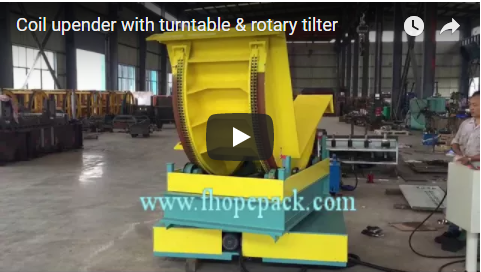
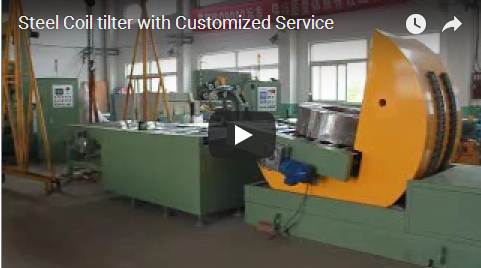
> This clip shows our coil tilter with a rotary base in our workshop. The orange V-cradle tilts through 90 degrees to turn a coil from eye-horizontal to eye-vertical or back, and the black base slews the whole tilter through 180 degrees. That way the coil is loaded from one side and leaves facing the next conveyor or the crane, without a second handling move.
Inhaltsverzeichnis
- Was der Clip zeigt
- Warum eine Drehbasis hinzufügen?
- Zyklus pro Spule
- Was wir pro Pflanze festgelegt haben
- Auswahl-Checkliste
- Sicherheit
- Häufig gestellte Fragen zur Technik
- Nächster Schritt
- Verwandte lesen
- Quellen
Was der Clip zeigt
| Schritt | Was Sie sehen |
|---|---|
| Machine | An orange V-cradle tilter with an L-shaped table on a black rotary base |
| Tilting | The cradle tilts through 90 degrees, from V-cradle up to the flat table |
| Slewing | The base turns the whole tilter round through 180 degrees |
| Return | The cradle tilts back and the base returns to the load side |
| Workshop | Other FHOPE coil machines stand in the background |
Warum eine Drehbasis hinzufügen?
- **One less move.** The coil is tilted and turned in one station, so no crane move is needed to face it the right way.
- **Flexible layout.** Load and discharge can be on opposite sides of the tilter.
- **Fits existing lines.** The base points the coil at an existing conveyor or stacker.
- **Safer handling.** Operators stay outside the cell while the coil turns.
Zyklus pro Spule
**Ausgearbeitetes Beispiel (zur Veranschaulichung).**
| Artikel | Wert |
|---|---|
| Tilt 90 degrees (illustrative) | 40 s |
| Slew 180 degrees (illustrative) | 30 s |
| Load, unload and return moves (illustrative) | 50 s |
| Cycle, 40 + 30 + 50 | 120 s |
| Windungen pro Stunde, 3,600 ÷ 120 | 30 Windungen |
Was wir pro Pflanze festgelegt haben
| Einstellung | Abhängig von |
|---|---|
| Cradle size | Coil OD, ID and width |
| Capacity | Heaviest coil |
| Slew angle | 180 degrees, or set per layout |
| Drive | Hydraulic or electric, per plant |
Auswahl-Checkliste
- [ ] Spulengewicht, Außendurchmesser, Innendurchmesser und Breite.
- [ ] Tilt direction: eye-horizontal to eye-vertical or back.
- [ ] Slew angle needed.
- [ ] Load and discharge sides.
- [ ] Spulen pro Stunde.
- [ ] Pit or floor mounting.
Sicherheit
- Fence the cell; keep clear of the slewing base and the cradle.
- Lock out before entering the cell.
- Use PU or rubber pads where the coil surface must not be marked.
- Für die CE-Märkte ist die Maschine nach ISO 12100 und EN 415-10 ausgelegt.
Häufig gestellte Fragen zur Technik
Q: What does the rotary base add?
A: It slews the tilter through 180 degrees, so the coil leaves facing the next station.
Q: How far does the cradle tilt?
A: Through 90 degrees, turning the coil from eye-horizontal to eye-vertical or back.
F: Wie viele Spulen pro Stunde?
A: About 30 coils per hour with an illustrative 120 s cycle that includes the return moves; real output depends on coil handling and layout.
Q: Can the slew angle be other than 180 degrees?
A: Yes, we set it to suit the layout.
Q: Is the drive hydraulic?
A: We supply hydraulic or electric drive, per plant.
F: Welche Normen gelten?
A: Für CE-Märkte: ISO 12100 und EN 415-10.
Nächster Schritt
Wir passen einen Spulenneiger in drei Schritten an den Drehsockel an:
1. **Submit your layout drawing** with coil weights and sizes, tilt direction and layout, to **info@fhopepack.com**.
2. **Sie erhalten innerhalb von 48 Stunden ein Angebot** mit den Maschinendaten und dem Layout.
3. **Book a site survey** so we confirm the floor and crane layout.
Verwandte lesen
- [90-Degree Coil Upender with Rotary Base](https://www.fhopepack.com/videos/the-90-degree-coil-upender-with-rotary-base/)
- [Hydraulic Coil Tilter for 90° Turning](https://www.fhopepack.com/videos/hydraulic-coil-tilter-the-smart-fix-for-costly-coil-handling/)
- [Coil Upender with Transfer Trolley](https://www.fhopepack.com/videos/steel-coil-upender-for-coil-unloading-with-transfer-trolley/)
- [Coil upender and tilter range](https://www.fhopepack.com/Mechanical/Coil-Upender-Tilter.html)
Quellen
- Maschineninhalt: FHOPE-Entwicklungsteam, 04.10.2026
- Clip: [the video on YouTube](https://www.youtube.com/watch?v=j0X0U6bwrVs)
- Zyklen pro Spule: unser Rechenbeispiel, illustrative Werte
- Geltungsbereich der Normen: ISO 12100:2010; [EN 415-10:2014](https://www.nen.nl/en/nen-en-415-10-2014-en-191845)
- Einreichungszeitpunkt für Vorschläge: Genehmigung des Haus-CTA (Vorschlag innerhalb von 48 Stunden)
Letzte Überprüfung: 21.09.2026