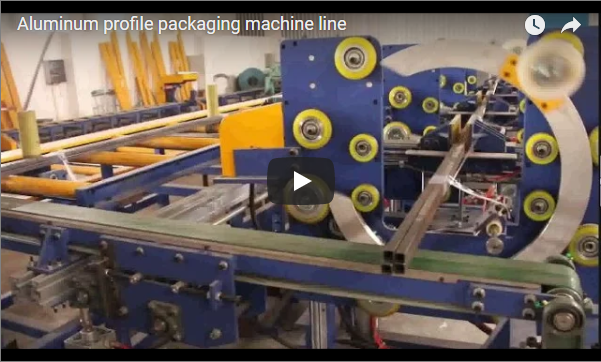
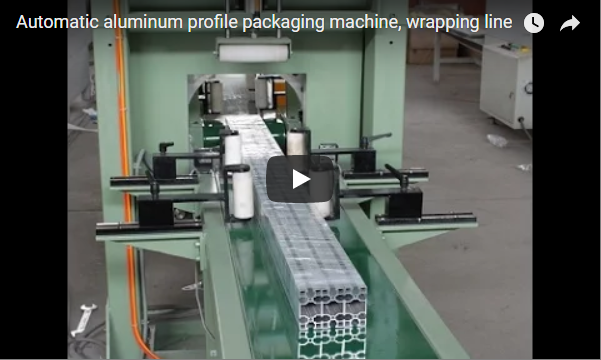
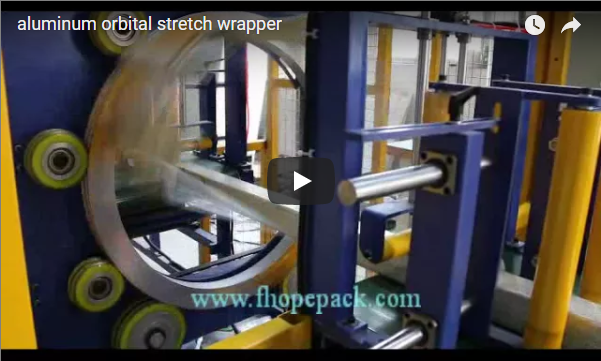
Kopsavilkums A bar wrapping machine utilizes an orbital rotating ring that orbits around a linearly moving, non-rotating workpiece. Our S200 small orbital wrapper handles single bars and light rigid bundles from 10 mm to 200 mm cross-section (measured across the diagonal), minimum length 300 mm, and unit weights up to 100 kg. It operates at an adjustable ring speed of 20–120 RPM and conveying speeds of 4–12 m/min powered by a 2.1 kW drive system. Bundles exceeding 200 mm in section or measuring up to 10 m in length transition to the heavy-duty rod wrapping platform, running at 30–60 RPM with 6.5–6.8 kW installed power. Spiral film distribution strictly follows the kinematic relationship: Pitch (mm) = Film Width (mm) × (1 − Overlap %).
Saturs
- Two machines, one decision
- Why the bar never rotates
- Film pitch: the three-number method
- Length and conveyor bridging
- Centring the bar and setting tension
- Film and packing materials
- Vadība un automatizācija
- Drošība un standarti
- Stieņu iesaiņošanas mašīnas izvēles kontrolsaraksts
- Inženierijas bieži uzdotie jautājumi
- Nākamais solis
- Saistītā lasāmviela
- Avoti
Two machines, one decision
Bar packaging at FHOPE relies on horizontal orbital ring-type wrappers. Selecting the correct machine platform depends on three primary physical parameters: the maximum cross-sectional envelope (outer diagonal), overall bar length, and total unit mass.
Standarta S200 Small Orbital Wrapper handles individual precision bars, aluminum extrusions, copper tubes, and light profiles. The workpiece travels horizontally along an infeed powered roller conveyor, passes through a high-speed rotating aluminum ring carriage that deposits stretch film in a continuous spiral, and transfers seamlessly onto the outfeed table.
For industrial bundles, structural steel rods, and long rebar packs, the Rod Wrapping Machine provides the heavy-duty frame, reinforced roller beds, and dual-material capability needed for massive loads.
| Inženiertehniskais parametrs | S200 Small Orbital Wrapper | Heavy-Duty Rod Wrapping Machine |
|---|---|---|
| Cross-Section Envelope (OD / Diagonal) | 10–200 mm | 200–500 mm (Custom frames up to 2000 mm) |
| Workpiece Length Range | No 300 mm līdz 6000 mm | 2000 mm to 10000 mm (Extendable) |
| Maksimālā kravnesība | 10–100 kg (Standard bench) | 100–4000 kg (Reinforced structure) |
| Gredzena rotācijas ātrums | 20–120 RPM (VFD modulated) | 30–60 RPM (Heavy-duty geared ring) |
| Conveying Linear Velocity | 4–12 m/min | 2–12 m/min |
| Uzstādītā piedziņas jauda | Aptuveni 2.1 kW | 6.5–6.8 kW |
| Saderīgi iepakojuma materiāli | LLDPE stretch film (120–200 mm width) | LLDPE stretch film, PE film, VCI anti-rust paper, woven knit belt |
| Workpiece Hold-Down Mechanism | Pneumatic overhead stabilization rollers | Heavy-duty dual overhead clamps + V-rollers |
Note: The heavy-duty rod wrapping machine platform uses modular engineering frames. While standard guide configurations cover bundles up to 500 mm OD, custom production lines accommodate packages up to 2000 mm OD and 4000 kg bundle mass. Confirm your maximum pack diagonal and bundle deflection limits during proposal engineering.
For high-volume continuous output, the fully automated E200 horizontālā stiepes iesaiņošanas iekārta integrates an automatic pneumatic mechanical clamping arm, hot-blade/shear cutting system, and optical material sensors for uninterrupted inline operation.
Why the bar never rotates
On both orbital wrapper variants, the product remains purely in linear translation: the bar advances longitudinally on roller conveyors while the packaging ring revolves around it in the vertical plane.
For long, slender, or non-axisymmetric stock, this kinematic arrangement is essential:
- Elimination of Dynamic Whipping: Rotating a slender 6000 mm bright steel bar or aluminum extrusion on its own central axis at high speed induces severe centrifugal whipping, bending deflection, and balance loss.
- Virsmas aizsardzība: Non-rotating pass-through eliminates the friction, twisting, and scuffing that rotary chucks or spinning rollers inflict on polished, anodized, or ground surfaces.
- Symmetrical Tension Distribution: Positioning the product precisely along the ring’s geometric center ensures that carriage film tension acts uniformly around the perimeter, preventing the product from walking, yawing, or jumping off the roller centerline.
Film pitch: the three-number method
Wrapping pitch (P) represents the linear distance the product travels along the conveyor during one complete (360°) revolution of the orbital ring. Correct pitch dictates containment force, moisture sealing, and consumable efficiency:
Pitch (mm) = Film Width (mm) × [1 - (Overlap % ÷ 100)]Synchronizing conveyor linear feed with ring angular velocity requires dimensional parity:
Pitch (mm) = [Conveyor Speed (m/min) × 1000] ÷ Ring Speed (RPM)From these fundamental equations, wrapper operation is tuned using three steps:
- Calculate Target Pitch: For a standard 200 mm wide film roll applied at a 50% overlap rate, target pitch is:
200 × (1 - 0.50) = 100 mm. - Match Inverter Drive Frequencies: A 100 mm pitch requires a 10:1 ratio between linear conveyor speed (in mm/min) and ring rotational speed (in RPM). Setting the conveyor to 6 m/min (6000 mm/min) requires a ring speed of
6000 ÷ 100 = 60 RPM. At the S200’s top speed of 12 m/min, the ring ramps up to 120 RPM via synchronized inverter control. - Calculate Pure Wrapping Cycle Time:
Wrapping Time (s) = [Workpiece Length (m) ÷ Conveyor Speed (m/min)] × 60A 6 m finished bar clears the wrapping ring in 60 seconds at 6 m/min, and in just 30 seconds at 12 m/min. Total machine cycle time adds infeed transit, sensor debounce, and outfeed index times.
Adjusting overlap controls the unit packaging cost. Increasing overlap from 30% to 75% doubles film consumption per linear meter while providing structural hoop strength for loose rod bundles. Setting overlap below 20% is recommended only for dust covers or temporary warehouse handling.
Length and conveyor bridging
A rigid bar must bridge the open mechanical throat between the infeed and outfeed conveyors across the ring rotation plane. This gap establishes the absolute minimum product length.
Minimum Product Length ≥ Inter-Roller Throat Gap + (2 × Minimum Support Margin)- S200 Compact Platform: Designed with cantilevered, close-coupled infeed and outfeed powered roller conveyors (standard 2000 mm length each). The central ring throat gap is minimized to allow rigid bars pat 300 mm īss to pass safely from the driving roller to the receiving roller without falling into the ring frame.
- E200 Inline Platform: Incorporates automated safety gates and clamping mechanisms, requiring a minimum package length of 1000 mm.
- Rod Wrapping Platform: Built with heavy-duty structural steel roller beds capable of moving 2000 mm to 10000 mm steel bundles. Driven rollers feature high-durometer polyurethane or vulcanized rubber coatings to grip greasy or smooth steel bar surfaces.
For products shorter than the throat gap, pneumatic walking beams or auxiliary bridge transfer plates must be specified. For bars exceeding 6000 mm, modular unpowered or powered conveyor extensions are added to prevent tail droop.
Centring the bar and setting tension
Uniform film application depends on maintaining the workpiece along the neutral axis of the orbital ring.
Centering Clearance Margin: D_ring_throat ≥ √(W² + H²) + 2 × C_dynamicReģions W un H are the width and height of the bundle cross-section, and C_dynamic is dynamic running clearance (minimum 50 mm) to prevent the spinning film carriage from colliding with product corners.
- Vertical and Lateral Positioning: The S200 utilizes an adjustable height-centering mechanism and adjustable side guide rollers to support varying bundle profiles. On heavy rod wrappers, a motorized scissors-lift table or synchronized V-roller bed centers hexagonal, round, or square bundles automatically.
- Dynamic Hold-Down Clamping: When wrapping a light 10 mm bar, the tangential film pull (typically 30–70 N) can violently lift and oscillate the workpiece. The S200 incorporates adjustable overhead pneumatic press rollers at both the infeed and outfeed sides. These polyurethane-coated wheels clamp the bar firmly against the driven conveyor rollers, suppressing vibration and eliminating line jams.
- Friction Braking and Film Tension: The rotary film carriage features a mechanical friction-plate tensioner with a calibrated spring-loaded brake. This allows operators to run high stretch tension on heavy steel bundles without snapping film or necking down thin, hollow-wall aluminum profiles.
Film and packing materials
The S200 operates primarily with Cast or Blown LLDPE stretch film rolls:
- Rites platums: 120–200 mm
- Maksimālais ārējais diametrs: 150–200 mm
- Galvenais diametrs: Standard 50 mm (2.0 inch) internal core (76 mm / 3.0 inch adapters available)
- Filmas biezums20–35 µm
The industrial rod wrapping machine features dual-ring or heavy-duty single-ring carriages capable of applying multiple packaging materials in a single pass:
- LLDPE elastīga plēve: Delivers an airtight, moisture-resistant external seal with high elastic recovery.
- VCI (Vapor Corrosion Inhibitor) Paper: Applied directly against bare carbon steel, chrome-plated rods, or polished alloy bars to passivate the metal surface and prevent oxidation during ocean freight transit.
- HDPE Woven Knit Belt: Applied as a durable outer wrap to resist abrasion and impact damage from wire slings, chains, and forklift tines during handling.
Vadība un automatizācija
The S200 is driven by an industrial PLC system paired with an operator touchscreen HMI:
- Optical Position Sensing: Optical retroreflective or through-beam photocells detect the incoming bar’s leading edge, triggering ring acceleration, film clamping, and conveying sequencing. A second sensor identifies the trailing edge to initiate post-wrap reinforcement and cycle stops.
- Frequency Inverter Regulation: Variable frequency drives (VFD) govern both the ring drive motor and conveyor motors, providing independent S-curve acceleration and deceleration to eliminate mechanical shock on the drive belts.
- Automation Interfacing: The electrical cabinet includes clean dry contacts and Profinet/EtherNet/IP integration points to sync with upstream cold saws, cooling beds, or downstream automated stacking and bundling stations. An optional pneumatic mechanical arm provides automated film clamping and hot-wire cutting.
Drošība un standarti
Rotating rings present extreme mechanical hazard points involving high-inertia nip zones, shear points, and potential material entanglement.
- Mechanical Guarding: The S200 is enclosed in heavy-duty welded steel mesh perimeter guards surrounding the ring envelope, preventing operator limbs from entering the rotation plane.
- Atbilstība saskaņotajiem standartiem: For export to European and international markets, equipment risk assessment, functional safety design, and commissioning comply with:
- ISO 12100: 2010Mašīnu drošība — Vispārīgie projektēšanas principi — Riska novērtēšana un riska samazināšana.
- LV 415-6: 2013: Safety of packaging machines — Part 6: Pallet and product wrapping machines.
- LV-60204 1Rūpniecisko mašīnu elektriskās iekārtas.
- ISO-13849 1: Safety-related parts of control systems (featuring dual-channel emergency stop circuits and interlocked guard door switches to achieve Category 3 / PLd functional safety).
- Drive Stability: High-wear polyurethane support and guide wheels with dynamic balanced alloy rings prevent carriage derailment even under emergency stop (E-stop) decelerations.
Stieņu iesaiņošanas mašīnas izvēles kontrolsaraksts
To confirm machine sizing and calculate cycle times for your facility, compile the following operational parameters:
- Maximum Section Envelope: Width × Height or outside bundle diameter across the furthest diagonal corners (
√(W² + H²)). - Workpiece Length Limits: Minimum length (must bridge the 300 mm throat gap) and maximum length (to determine conveyor extension lengths).
- Svara diapazons: Minimum single bar weight and maximum bundle load (kg/m and total pack mass).
- Mērķa izvade: Number of bars or bundles per hour (used to evaluate required conveyor speeds and ring RPM).
- Workpiece Surface Sensitivity: Polished, painted, bright-drawn, or rough-sawn (determines roller coating: steel, rubber, or polyurethane).
- Packaging Material Requirement: Stretch film only, VCI rust-inhibitor paper, or composite woven belt.
- Līnijas izkārtojums: Standalone semi-automatic manual feed unit or fully integrated inline wrapper with automatic film feed, cut, and wipe down.
Inženierijas bieži uzdotie jautājumi
Q: What is the absolute smallest bar cross-section and length the S200 can reliably wrap? A: The physical lower limit is 10 mm in diameter/thickness and 300 mm in length. Parts shorter than 300 mm cannot bridge the clearance gap between the infeed and outfeed roller conveyors without specialized custom bridge plates.
Q: How do I eliminate spiral banding gaps on the bar ends? A: Configure the PLC HMI parameter for “End Wrap Reinforcement Count” to 2 or 3 revolutions. The conveyor feed pauses for 1–2 seconds while the ring rotates at the leading and trailing edges, ensuring a complete multi-layer moisture seal.
Q: What causes thin round steel bars to vibrate or jump inside the wrapping ring? A: Dynamic imbalance occurs when the overhead pneumatic hold-down rollers are unpressurized or misaligned. Thin bars (10–20 mm) have low section modulus and will deflect under the 30–70 N tangential pull of the film carriage. Clamping pressure must be tuned between 0.2 and 0.4 MPa to hold the bar flat against the driven conveyor rollers.
Q: What is the maintenance cycle for the ring friction drive wheels? A: The polyurethane friction drive and idler wheels should be visually inspected every 500 operating hours for surface glazing or particulate embedment. Under two-shift operation, replacement is typically scheduled every 6000 to 8000 hours, depending on ring acceleration profiles and operating RPM.
Q: When must a packaging line transition from the S200 to the heavy-duty rod wrapping platform? A: Transition occurs when bundle cross-sections exceed 200 mm, bundle lengths exceed 6000 mm, unit weights exceed 100 kg, or when primary packaging requires heavy protective layers like VCI paper or woven knit belts.
Nākamais solis
Submit your packaging requirements to our machine engineering team:
- Send Your Layout and Specifications: Forward your bar cross-section drawings, length ranges, bundle weights, hourly cycle targets, and preferred packaging materials to info@fhopepack.com.
- Engineering Review & Sizing Analysis (within 48 hours): Receive a complete technical proposal including machine envelope confirmation, conveyor layout drawings, calculated overlap pitch tables, and utility requirements.
- Rūpnīcas pieņemšanas pārbaude (FAT): Ship sample bar bundles to our testing lab for wrapping verification, stretch ratio measurement, and high-speed motion testing before equipment dispatch.
Saistītā lasāmviela
- Semi-Auto Horizontal Orbital Wrapper Solutions
- Automatic High-Speed Horizontal Stretch Wrapping Machines
- Custom Engineered Orbital Packaging Systems
- Rod Orbital Wrapper and Bar Wrapping Systems: Comprehensive Engineering Guide
- High-Throughput Automatic Steel Bar Wrapping Equipment
Avoti
- S200 Technical Specifications and Layout Matrices: FHOPE S200 Semi-Auto Horizontal Orbital Wrapper Technical Documentation
- Automated Inline Sizing and Film Delivery Data: E200 Automatic Horizontal Wrapper Specifications
- Heavy-Duty Bundle Handling and Material Specifications: FHOPE Heavy-Duty Rod Wrapping Machine Series
- Starptautiskā drošības atbilstība: ISO 12100:2010 Safety of Machinery — Risk Assessment un EN 415-6 Packaging Machines Safety Requirements