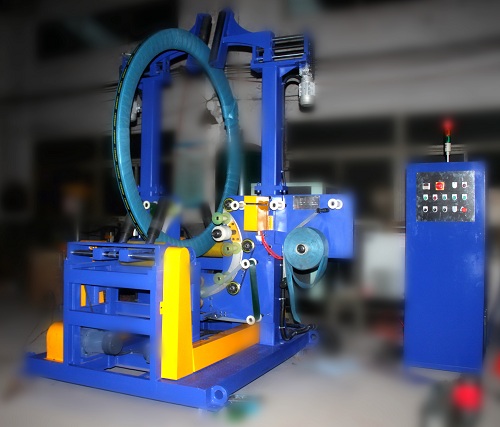
銅コイル包装のエンドツーエンド自動化:2段階ストレッチ包装からパレット積みまで

エグゼクティブサマリー This video shows an automated copper coil packaging line built around a staged process: stretch-film wrapping, transfer by roller conveyor, then strapping. The main wrap-to-strap sequence plays out in about 20 seconds of footage. A stacking arm placing wrapped coils onto a pallet appears only in a short montage inset. This article separates what the camera actually shows from what it merely suggests.

The footage is a factory-floor montage of one packaging line handling large copper coils. There is no narration — only background music — so every claim below comes from what is visible in the frames. If you are evaluating a coil packaging line, use this page as a factual walk-through first and a question list second.

ビデオでわかること

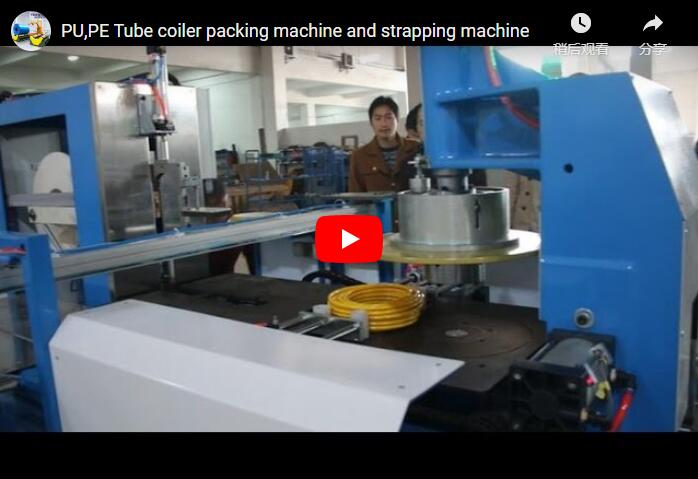
The line is arranged linearly: a roller conveyor feeds coils into a wrapping station, and a second machine performs strapping. The table below maps the main sequence against the timestamps in the footage.

時間 What happens on camera
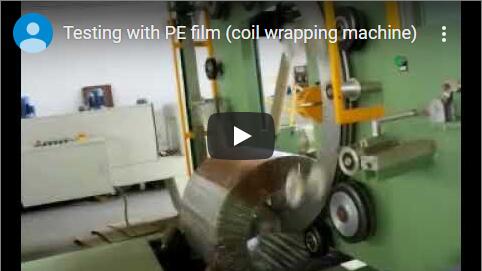
0:00-0:08 A worker wearing an orange hard hat stands beside the first machine, holding a control handle. A rotating arm wraps 透明ストレッチフィルム around a large copper coil resting on グリーンローラー.
0:08-0:14 The arm stops. The coil is fully covered and the film sits tight against the metal surface. The arm retracts from the coil.
0:14-0:20 The scene cuts to a second machine with a yellow frame. An arm descends from above and wraps ストラップ材 around the coil in multiple turns. Green and red indicator lights alternate on the control panel.
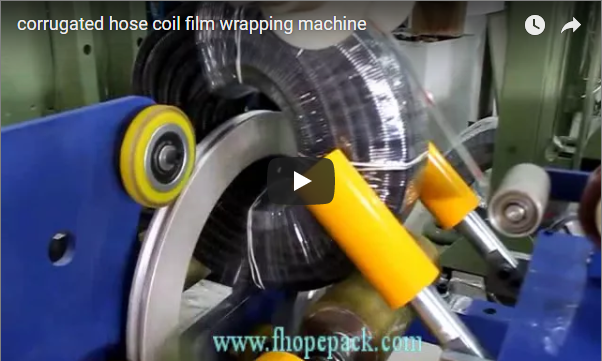
Later montage segment The wrapping station makes two separate wrap passes, with the roller conveyor indexing the coil between passes. The control cabinet screen displays the words “Packing Solution”.
Final inset A montage shows a ストラップユニットstacking arm placing wrapped coils onto a pallet.

ビデオ全体を通して、 picture-in-picture insets show other machines and packaging scenes. These inserts are the only place where pallet stacking and some strapping details appear, which matters for how you read the title of this post.

How one coil travels through the line

Following one coil from infeed to output, the visible steps are:

  1. フィード。 The coil is placed on the roller conveyor and moved under the wrapping arm. It sits horizontally for the entire video — no turning, tilting, or flipping is shown.
  2. Stage 1 — stretch film. The rotating arm circles the coil, and film is released from a spindle above the arm. The coil stays still while the arm does the moving.
  3. Hand-off. Once the wrap pass is complete, the arm retracts and the conveyor carries the coil forward to the next position.
  4. Stage 2 — strapping. At the second machine, an arm descends from above and wraps strap around the coil in several turns, tensioning and securing it. The strap material could be plastic or steel; the frames do not settle that question.
  5. 出力。 The strapped coil continues along the conveyor toward the next process step.
  6. Palletizing — inset only. A stacking arm placing wrapped coils on a pallet is glimpsed in a montage inset, not in the main continuous sequence.

One nuance worth noting: in the later segment, the wrapping station performs two distinct wrap passes separated by conveyor indexing, while the first segment shows wrap on one machine and strap on a second. The edit jumps between stations, so a single unbroken shot of the whole flow is not available.

映像に映っている機械構造

The structural details below come directly from the frames. The “apparent role” column is a reasonable reading of what each part does, not a manufacturer specification.

成分 Observed on camera 明らかな役割
腕を包む Rotates around the coil; film pays off from a spindle above Applies stretch film to the coil’s outer surface
Strapping arm Descends from above; makes multiple strap turns Secures the wrapped coil with strap
ローラーコンベヤー Green and yellow rollers carry the coil Moves the coil between stations; the coil occupies most of the conveyor width
制御盤 Touchscreen HMI with green, red, and yellow indicator lights Shows run status and parameters
Pendant handle Held by the worker at the first machine Manual jog or monitoring input
Painted steel frames White and yellow industrial paint; sturdy construction 機械構造
Hoses and lines Blue and black lines routed to the arm and control unit Power or actuation supply to moving parts

The two processing machines sit in a line, connected by the conveyor, with the control cabinet positioned beside the wrapping station.

直接観察記録

The following notes stay close to what the frames show, with only light editorial smoothing.

  • A worker in an orange hard hat stands beside the first machine holding a control handle; hand movement is slight and no hands-on contact with the coil is observed.
  • The coil rests horizontally on the rollers throughout; it moves only when the conveyor advances.
  • In the close shots, the wrapped film lies tight against the coil surface with no visible wrinkles; wrapped coils seen elsewhere in the montage show some stretch marks and creases.
  • The bare copper surface is bright and metallic before wrapping; the film gives it a semi-transparent cover.
  • During the strapping stage, 緑と赤のインジケーターライト alternate on the control panel.
  • Readable text in the frames includes a blue Chinese-language safety banner above the first machine, a red Chinese-language quality slogan on the wall behind the second machine, and the phrase “Packing Solution” on a control screen.
  • A short manufacturer mark appears as a watermark in the frame; no model plates, capacity figures, or numeric specifications are readable anywhere.

The pallet-stacking segment: what is actually shown

This post’s title promises pallet stacking, so the evidence deserves a precise boundary. In the footage, stacking appears only in a montage inset near the end, where a robotic arm is shown placing wrapped coils onto a pallet. The main continuous sequence ends at strapping. The final wide frames also show the line layout extending toward a stacking area after the wrapping station.

Treat palletizing as plausible and likely part of the full scope, but not demonstrated in continuous footage on this page. If stacking automation is a purchase requirement, ask for dedicated video of the stacking cell running your coil.

動画に映っていないもの

These gaps are normal for a montage video, but each one is a question you should ask before specifying a line:

  • Coil dimensions, weight, or the size range the line accepts
  • Rated throughput, cycles per hour, or real cycle time
  • Stretch film and strap material types, widths, and thicknesses
  • Power supply, voltage, power rating, or air requirements
  • Control system brand, model, software version, or detailed HMI functions
  • Safety certifications, E-stop locations, guarding, or light curtains
  • Maintenance intervals, spare parts, noise level, or vibration
  • Automatic replenishment of film or strap consumables
  • One continuous shot from wrapping through to a stacked pallet

Where this line fits in a plant

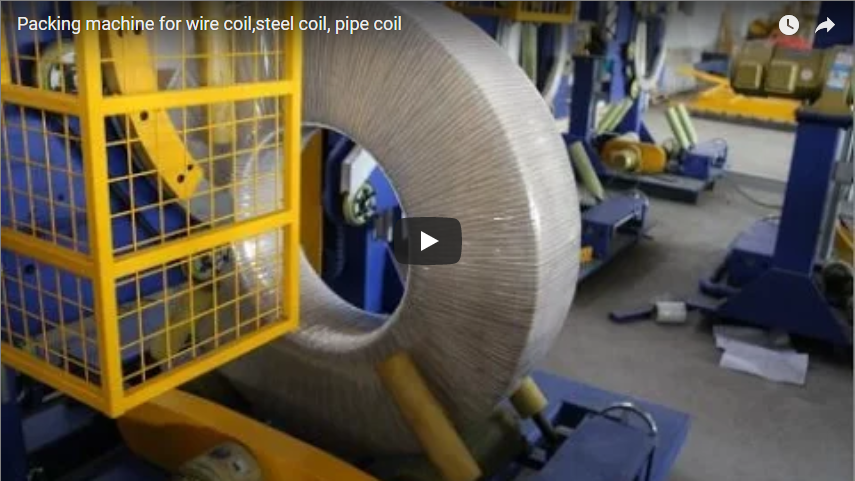
ワークピースは ring-shaped copper coil with a center hole, the kind used in electrical equipment manufacturing. A line of this type is a natural fit for copper wire and cable producers, and for transformer, motor, and reactor plants that receive or ship coil stock. This paragraph is interpretation based on the product seen in the frames, not a verified customer list.

The evident benefits are qualitative: 一貫した包装 compared with manual work, 手作業による取り扱いが少ない of heavy coils, and continuous transfer between stations instead of crane-and-trolley moves. The counterpoint is also visible in the design: the setup is built around one coil format, and a wide mix of coil sizes would likely require parameter changes or additional tooling — a point to confirm for your product range.

Why a two-stage wrapping process matters

The line’s logic is easy to read from the footage. ストレッチフィルム provides surface protection — it seals the coil against dust, moisture, and scuffing during internal handling. ストラッピング provides mechanical retention — it keeps the coil tight and stable for lifting and transport. A single stage rarely does both jobs well.

The later segment adds a further detail: the wrapping station makes two separate passes. Two passes build a more complete and even cover than one, especially around the coil’s edges and inner diameter. This is an interpretation of what the frames show, not a measured performance claim.

Controls and safety: what the frames reveal

On the control side, the footage clearly shows a タッチスクリーンHMI, multi-color indicator lights, and a pendant handle used by the operator at the first machine. Chinese-language wall signage reinforces safety awareness and quality culture — one banner warns that accidents stem from complacency.

何ですか clearly visible in the sampled frames: E-stop buttons, physical fencing, light curtains, or interlocks. That is an observation about the video, not proof about the machine — safety hardware is often mounted outside the camera’s angle. Because both arms sweep through large motion envelopes, the guarding and emergency-stop arrangement is one of the first things to verify on a site visit.

製造元に確認すべき事項

Use this checklist when you contact the supplier about a line like this:

  • Coil size and weight range the line accepts, and changeover effort between sizes
  • Rated throughput and a realistic cycle time for your coil mix
  • Stretch film and strap specifications the machines are configured for
  • Full safety package: E-stops, guarding, light curtains, interlocks, and applicable certifications
  • Control features: HMI functions, alarm history, remote monitoring and diagnostics
  • Scope of the stacking section: pallet sizes, stack pattern, and whether it is included in the standard supply

よくある質問

Does the same coil get both stretch film and strap? Yes in the first sequence: the coil is wrapped in film, transferred, and then strapped at the second machine. In the later segment the wrapping station makes two film passes, and strapping appears in an inset. The staged combination is evidently the line’s design.

どのようなサイズのコイルに対応できますか? Not shown. The coils appear large relative to the conveyor — roughly 80% of its width in the frames — but no dimensions are given. Check with the manufacturer for the accepted size and weight range.

Is pallet stacking included? A stacking arm placing wrapped coils onto a pallet appears only in a brief montage inset. Confirm with the manufacturer whether palletizing is part of the standard scope and request dedicated footage.

What consumables does the line use? Transparent stretch film and a strap material; the frames do not identify whether the strap is plastic or steel. Confirm material options, widths, and cost with the manufacturer.

Can an operator intervene manually? A worker holds a control handle at the first machine, which suggests manual jog or monitoring input is possible. The extent of manual modes is not demonstrated — check with the manufacturer.

関連する読書

次のステップ

If this configuration matches your product, send your coil dimensions, weight, monthly volume, and current packaging method through the コンタクトページ. Attach the verification checklist above to your inquiry so the quotation answers the questions the video cannot.

情報源と方法

  • 出典: the embedded video on this page. The audio is background music only, with no narration, so no speech transcription was possible or needed.
  • 分析方法: a vision-language model reviewed sampled frames from the video (34 frames at 2-second intervals) and produced the structured observation report on which this article is based.
  • 証拠規律: the “Direct observation notes” section stays close to that report’s factual statements. Sections on applications, benefits, and the two-stage rationale are labeled interpretations. No specifications, brands, prices, or throughput numbers have been added beyond what the frames show; anything uncertain is marked for confirmation with the manufacturer.