Résumé A flat rail transfer cart moves steel coils, dies, moulds, and structural machinery between plant bays along dedicated steel tracks. Before dispatch, each cart undergoes workshop load testing: the chassis is secured to the rail line and loaded with a calibrated test block to verify structural deflection, axle alignment, and braking performance under capacity. For cross-bay point-to-point transfer, a rigid flat cart provides high reliability without overhead crane dependence. When production requires automated coil lifting, tilting, or continuous rotation, dedicated coil transfer cars deliver up to 20 t capacity with integrated saddles and drive mechanisms.
Table des Matières
- Que fait le chariot à rail plat ?
- Pourquoi effectuons-nous des tests de charge avant l'expédition ?
- Transport des bobines sur un pont plat
- chariot à plateau ou chariot de transfert de bobines
- Dimensionnement des roues et des rails
- Commandes et sécurité
- Liste de contrôle de sélection
- FAQ technique
- Suivant
- Lecture connexe
- Références
Que fait le chariot à rail plat ?
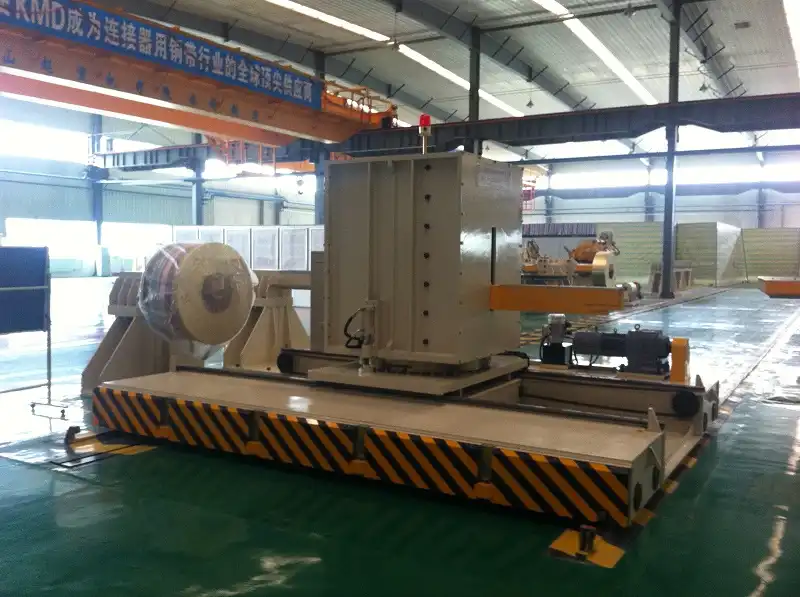
The flat rail transfer cart consists of a heavy-duty structural steel deck mounted on a welded box-girder chassis, driven by flanged rail wheels and an integrated geared electric motor. Operating on flush or surface-mounted steel rails embedded in the concrete floor, it maintains a fixed transfer path between production bays, eliminating the need for steerable running gear or manual path steering.
In typical metalworking and stamping plants, an overhead crane or heavy-duty forklift places the load onto the cart deck at one workstation. The powered cart then conveys the workpiece directly to the adjacent bay, slitting line, coil-wrapping cell, or shipping staging area.
Each cart is engineered to project requirements: deck dimensions, track gauge, travel distance, and nominal payload are adapted to specific facility constraints. In complex processing layouts, these transfer carts are integrated into automated master control architectures, linking raw coil storage, slitting machines, and secondary packing stations into a continuous handling flow.
Pourquoi effectuons-nous des tests de charge avant l'expédition ?
Every transfer cart is subjected to static and dynamic factory load testing prior to crating and transport. Calibrated solid steel test blocks are strapped and blocked to the structural deck, replicating the mass distribution, center of gravity, and contact pressures of real-world workpieces. Both structural frame members and the electromechanical drive train operate at full working load before leaving our manufacturing floor.
While an unladen dry run verifies motor wiring and basic limit-switch logic, pre-dispatch load testing validates three physical criteria that manifest exclusively under full mechanical stress:
| Vérifiez | Ce que nous recherchons |
|---|---|
| Déflexion du cadre | The deck stays flat under the test load, verifying that welded girder deflection remains strictly within engineering tolerances without plastic deformation |
| Roues et essieux | Flanged wheels maintain precise track tracking without mechanical binding, bearing overheating, or uneven rail head friction |
| Conduite et freinage | The geared motor and mechanical brake execute controlled acceleration, steady travel, and smooth deceleration without slip or drive chatter under load |
Transport des bobines sur un pont plat
Heavy cylindrical steel coils concentrate high point loads and exhibit natural rolling instability on flat surfaces. When handled with the eye horizontal (axial center line parallel to the deck), dynamic inertial forces during cart starting and braking can induce coil rolling. To secure cylindrical stock, the deck is equipped with removable or fixed V-shaped cradles (chocks) lined with protective polyurethane or hardwood, nesting the coil securely in a mechanical V-groove.
When transport occurs with the coil eye vertical (eye-to-sky), the coil rests on its flat end face. Although stable against rolling, eye-vertical coils must be centered on the deck to ensure symmetric weight distribution across both rail lines and avoid eccentric wheel overloads. For stamping dies, motor castings, and prismatic machinery, the bare steel flat deck accommodates direct placement using standard heavy-duty timber blocking and tensioned strapping.
chariot à plateau ou chariot de transfert de bobines
| Produit | chariot de transfert à rail plat | Chariot de transfert de bobines |
|---|---|---|
| Mouvement | Linear travel on track | Déplacez-vous sur le rail, soulevez et faites tourner la bobine |
| Charges | Bobines d'acier, moules, charges lourdes | Des bobines d'acier |
| Charge maximale | Construit selon le projet | 20 t [manufacturer rating] |
| Tournant | Aucun | 360° [manufacturer rating] |
| Contrôle | Boîtier de commande sur le chariot | Manual control box or remote, speed-regulating inverter [manufacturer rating] |
| En mode travail | Construit selon le projet | Semi-automatic [manufacturer rating] |
In complete heavy-duty coil packing lines, complex manipulation—such as 90° upending, tilting, multi-arm turnstile buffering, and through-eye stretch wrapping—is handled by specialized stationary line modules (coil loaders, turnstiles, and downenders).
A dedicated coil transfer car bridges these high-capacity machines, providing integrated hydraulic lift saddles and indexing rotation to interface directly with slitting car mandrels or turnstiles without crane intervention. If your workflow requires only point-to-point cross-bay transportation between crane bays, the standard flat-deck rail cart represents the mechanically simpler, lower-maintenance, and cost-effective selection.
Dimensionnement des roues et des rails
Static and dynamic wheel loads dictate wheel diameter, forging metallurgy, rail cross-section (e.g., standard crane rail profile), and underlying reinforced foundation requirements. Sizing calculations require combining the cart tare weight with the maximum payload, dividing across the total wheel count, and incorporating an off-center load allowance for asymmetric placement:
Illustrative sizing calculation for a 20 t coil on a cart weighing 5 t, supported by four forged steel wheels:
| Produit | Valeur |
|---|---|
| Charger (exemple) | 20 t |
| Poids du chariot (exemple) | 5 t |
| Total gross mass | 25 t |
| Part égale par roue, 25 ÷ 4 | 6.25 t |
| Avec une allocation hors centre de 25 % | environ 7.8 t |
Structural engineering specifies wheel tread profile and rail weight based on the peak corner load (approximately 7.8 t in this illustrative case). Concrete foundation slabs and sleeper embedments must be designed to withstand these concentrated wheel point loads under repetitive travel cycles, which our technical team verifies during site assessment.
Commandes et sécurité
Standard flat transfer carts are equipped with an on-board electrical control enclosure featuring an industrial emergency-stop circuit, continuous optical/acoustic warning alarms, and a dead-man pendant or push-button panel, enabling operators to control or halt cart movement safely along the rail path.
On powered coil transfer cars, motor control is governed by variable frequency drives (VFD) for controlled jerk-free acceleration and deceleration, operated via pendant or industrial radio remote. Integrated mechanical position locks secure the chassis firmly in place during coil transfer, while proximity sensors enable automatic position stopping at target loading and offloading terminals.
Compliance and functional safety architectures are engineered to target facility standards, utilizing ISO 12100 risk assessment methodologies for international industrial environments.
Liste de contrôle pour la sélection d'un chariot de transfert ferroviaire
- Charge la plus lourde et son encombrement sur le pont.
- Type de chargement : œillet de bobine horizontal, œillet de bobine vertical, moule ou autre.
- Longueur de la voie et gares qui la jalonnent.
- Faut-il soulever ou faire pivoter les chariots aux postes de travail ?
- Comment la charge est chargée et déchargée : grue, chariot élévateur ou câble.
- Plancher et fondations sous la voie ferrée.
- Comment le chariot est propulsé sur les rails.
- Alimentation électrique locale.
FAQ technique
Q: Flat deck or cradle for steel coils? A: An eye-horizontal coil requires a contoured V-cradle or heavy-duty chocks to prevent roll initiation during cart acceleration and deceleration. If the vehicle is cross-utilized for flat dies or structural moulds, removable drop-in chocks allow rapid conversion back to an unobstructed flush deck.
Q: How heavy a load can a rail cart carry? A: Standard flat carts are custom-engineered to project load specifications. Dedicated coil transfer cars equipped with internal hydraulic lifting and motorized saddle rotation are engineered for payloads up to 20 t [manufacturer rating].
Q: How do you stop a coil rolling on the deck? A: Horizontal-eye coils are nested within mechanical V-saddles fitted with damping surfaces. Vertical-eye (eye-to-sky) coils rest stably on their flat faces and are centered over the wheel base to ensure balanced axle loading.
Q: Why use rails instead of a free-steering vehicle? A: Steel rails establish a rigid, repeatable kinematic travel path with minimal rolling resistance. This guarantees millimetric positioning accuracy at loading stations, removes battery-steering drift, and eliminates vehicle collisions with personnel or plant infrastructure.
Q: Can it link to a coil downender or slitting line? A: Yes. Advanced coil transfer cars integrate mechanically with slitting exit cars, multi-arm turnstiles, and 90° downenders, matching pass-line elevations to transfer coils between processing machines automatically.
Suivant
To configure a rail transfer cart tailored to your facility:
- Soumettez votre plan d'aménagement detailing track routing, maximum payload weights, and station coordinates to info@fhopepack.com.
- Recevez une proposition sous 48 heures, including tailored cart geometry, mechanical drive specs, and calculated wheel load figures.
- Réservez une visite du site to inspect concrete slab integrity, embedment clearance, and track alignment paths.
Lecture connexe
- Chariot de transfert de bobines
- Ligne d'emballage verticale de bobines d'acier à chargement lourd
- Vidéo : renverseurs de bobines longues et de grande taille en conditions réelles d'utilisation
- Vidéo : machine d’emballage de bobines, emballage et manutention
Références
- Cart purpose (steel coils, moulds, heavy loads), workshop load testing verification, project-built auxiliary machines: FHOPE engineering documentation
- Heavy loading coil packing line & automated handling integration: heavy loading coil packing line technical page
- Coil transfer car technical specifications (20 t rating, 360° turning, semi-automatic, orbital rail transfer, inverter drive): page de voiture à transfert de bobine
- Wheel load calculation model: Engineering illustrative sizing example
- Safety design methodology: ISO 12100: 2010 Sécurité des machines — Principes généraux de conception — Évaluation et réduction des risques
Dernière mise à jour : 04/10/2026
Dernière mise à jour : 29/10/2026