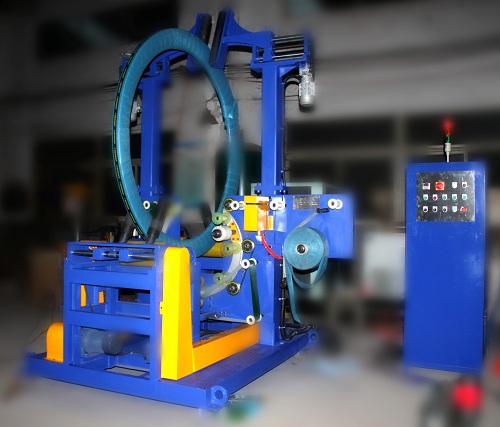
Resumen ejecutivo We pack wooden bars automatically on our E200 horizontal orbital wrapper. A belt conveyor feeds each bar through a rotating film ring while a top press holds it down, and the PLC cuts the film at the end. The E200 takes packages 50–200 mm across and 8–100 kg, at conveyor speeds of 6–12 m/min. A worked example sizes a pine beam and works out the fastest feed for a given film overlap.
Índice
- Why wrap wooden bars one by one
- Belt conveyors, ring and top press
- From infeed to cut film
- E200 specifications
- Worked example: a pine beam, film pitch and feed speed
- Supporting long and short bars
- Lista de selección: qué enviarnos
- Seguridad y EN 415-10
- Preguntas frecuentes sobre ingeniería
- El próximo paso
- Lectura relacionada
- Fuentes
Why wrap wooden bars one by one
Planed bars, beams, handrails and furniture parts reach the customer with their faces on show. Dust, scuffs and moisture pick-up in the warehouse all cost money. A spiral film wrap keeps each bar clean and lets it be handled and stacked without marking.
Wrapping long bars by hand is slow and uneven, because one person has to walk the film down the full length. On a horizontal orbital wrapper the bar moves and the film turns, so every bar gets the same overlap from end to end.
Belt conveyors, ring and top press
The machine sits between an infeed and an outfeed belt conveyor. The belts carry the bar with its long side in the direction of travel, and the belt surface protects the wood. A rotating ring in the white housing carries the film roll round the bar.
Above the infeed, a yellow top press with a handwheel comes down onto the bar. It stops a light wooden bar from lifting or twisting as the film pulls on it. The handwheel sets the press height for the bar size.
From infeed to cut film
- The operator places a bar on the infeed belt.
- A photocell detects the leading end and sets the start of the wrap.
- The top press holds the bar, the ring turns and the belts carry the bar through.
- The film overlaps itself in a spiral along the bar.
- At the trailing end, the automatic cutter and feeder cuts the film and holds the new tail.
- The wrapped bar runs out on the outfeed belt, and the ring resets to its start position.
E200 specifications
| Parámetro | E200 |
|---|---|
| Tamaño del paquete | 50–200 mm across |
| Longitud del paquete | Más de 1,000 mm |
| Peso del paquete | 8-100 kg |
| Transportadores de entrada y salida | 2,000 mm cada uno, accionados por motor. |
| Velocidad del transportador | 6–12 m/min, inverter adjustable |
| Velocidad de giro del anillo | adjustable, 10–120 r/min |
| Superposición de película | adjustable, 10%–90% |
| Rollo de película | OD 100–200 mm, width 100–200 mm, ID 50 mm |
| Potencia | alrededor de 2.5 kilovatios |
| Suministro | 380 V, 3 phase, 60 Hz; other voltages to order |
| Control | PLC with photocell positioning and fault alarms |
| Opciones | PVC, roller or chain conveyor; conveyor length; interlock; ABB or SEW motors |
Worked example: a pine beam, film pitch and feed speed
Take a planed pine beam 90 × 90 mm and 2,400 mm long, at about 500 kg/m³. These are illustrative customer figures.
Ajuste. The diagonal is √(90² + 90²) = 127 mm, inside the 200 mm limit. The volume is 0.09 × 0.09 × 2.4 = 0.0194 m³, so the beam weighs about 9.7 kg. That sits just above the 8 kg minimum, which is why the top press matters on light wood.
Terreno de juego. With 100 mm film at 50% overlap, each ring turn advances the bar by 100 × 0.5 = 50 mm.
Fastest feed. The ring must turn once every 50 mm of travel. At the top ring speed of 120 r/min that allows 120 × 50 = 6,000 mm/min, or 6 m/min. A faster belt at this overlap would open gaps in the spiral.
Wrap time and film. At 6 m/min the 2.4 m beam takes 2.4 ÷ 6 = 0.4 min, or 24 s, under the ring. It needs 2,400 ÷ 50 = 48 turns. Each turn lays about 4 × 90 = 360 mm round the beam, so about 17 m of film ends up on it.
To run the belt at 12 m/min, drop the overlap to 25%. The pitch becomes 75 mm, and 120 × 75 = 9,000 mm/min, or 9 m/min. That is still short of 12, so wider film is the next step.
Supporting long and short bars
The standard infeed and outfeed conveyors are 2,000 mm each. A 2.4 m beam overhangs the infeed by 0.4 m when it is placed, which is fine for a stiff bar. For bars of 4 m and more, order longer conveyors so the bar is supported on both sides of the ring.
Short pieces need care too. The E200 is built for packages over 1,000 mm, so the belts on both sides of the ring can hold the bar as it passes.
Lista de selección: qué enviarnos
- Bar cross-section: width and height, or diameter.
- Shortest and longest bar.
- Wood species, or the weight of the heaviest bar.
- Finish: rough sawn, planed or coated.
- Film width and overlap you want, or the protection level.
- Bars per hour, and manual or automatic infeed.
Seguridad y EN 415-10
We build our orbital wrappers to CE requirements, with EN 415-10 as the reference and an ISO 12100 risk assessment. The turning ring and the press are the main hazards.
Fixed electro-welded mesh guards cover the ring, and the moving parts sit behind guardrails. Where a guard has to open, for example to change the film roll, we fit an interlock so the ring stops when it opens. Keep hands off the bar while the press is down and the ring turns.
Preguntas frecuentes sobre ingeniería
Q: Can it wrap a bundle of bars instead of one? A: Yes, as long as the bundle fits the 50–200 mm size and 100 kg weight range. Larger bundles go on our bigger E-series models.
Q: Will the belt or press mark planed wood? A: The belts are chosen to protect the product surface. We agree the contact material on the press with you, so a planed or coated face is not marked.
Q: Can we use paper or another material instead of film? A: Tell us the material and roll size, and we check it against the roll holder.
Q: Which safety standards apply? A: For CE markets we work to EN 415-10, with an ISO 12100 risk assessment.
El próximo paso
- Email your bar sizes, lengths and bars per hour a info@fhopepack.com.
- Le responderemos en un plazo de 24 horas con una propuesta., with the model and conveyor lengths.
- Enviamos un plano de distribución. with the infeed and outfeed sides.
Lectura relacionada
- E200 horizontal orbital stretch wrapper for timber and aluminium
- Envolvedoras horizontales automáticas de film estirable
- Timber bundle packaging
- Envolvedora horizontal para listones
- Envolvedora automática de barras y envolvedora orbital pequeña
Fuentes
- Specifications: FHOPE E200 horizontal orbital stretch wrapper product page
- Video de la máquina: packing wooden bars automatically on YouTube
- Beam weight, pitch and feed speed: our worked example, illustrative bar figures
- Normas: EN 415-10 (máquinas de envasado, seguridad general); ISO 12100:2010
Última revisión: 17/10/2026