Resumen ejecutivo
In many end-of-line layouts the pallet strapping machine is the first of two stations: it straps the stack to the pallet, and a rotary arm wrapper downstream adds the stretch film. The two machines share one roller conveyor, so their cycle times, conveyor heights and guarding must be planned together. Our equivalent solution straps loads up to 1,300 mm wide and 1,800 mm high at about 15 s per strap. Below we balance the strapper against the wrapper, size the buffer between them and set out the guarding of the line.
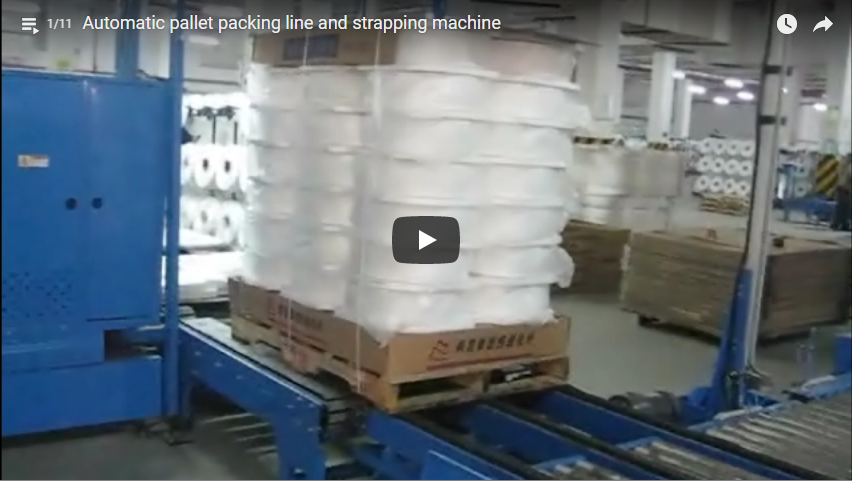
A stack of brown cartons on a green plastic pallet, already tied with two vertical yellow straps over the top and down both sides, runs along a galvanised roller conveyor past the yellow strapping frame. Yellow mesh fencing lines the conveyor, with the strap reel and a pale control cabinet beside the frame.
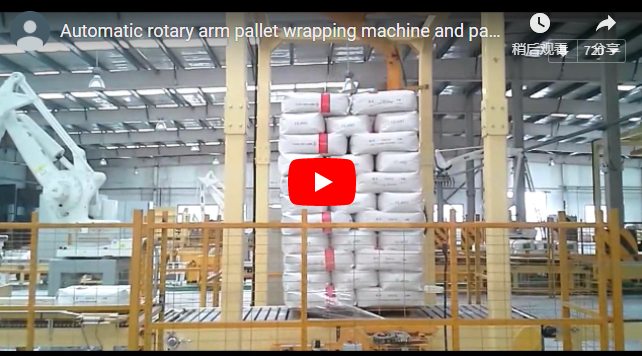
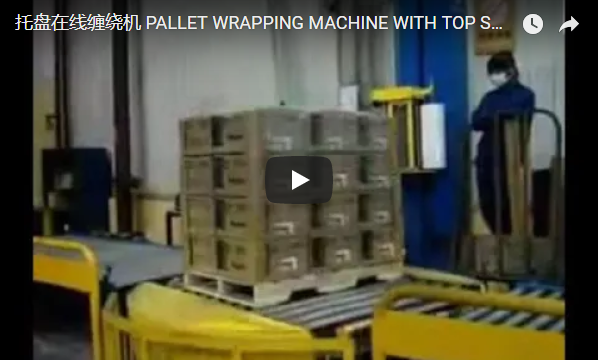
Downstream, inside an orange-fenced cell, a rotary arm wrapper with a yellow film carriage wraps the strapped pallets, and its film clamp grips and cuts the film tail at the end of each cycle.
Índice
- Strap first, then wrap
- Strapping station data
- Balancing the strapper and the wrapper
- Buffer between the stations
- One conveyor height for the whole line
- Film clamp and cut at the wrapper
- Signals between the machines
- Lista de verificación de selección
- Guarding the line
- Preguntas frecuentes sobre ingeniería
- El próximo paso
- Lectura relacionada
- Fuentes
Strap first, then wrap
The straps tie the cartons and the pallet into one unit; the film then holds the outer cartons in place and keeps out dust and moisture. Strapping first means the film covers the straps, so they do not snag in handling and the strap tension is not lost when the film is cut open at the customer. It also lets the wrapper run a lighter program, because the stack is already tied down.
Strapping station data
| Parámetro | Vertical pallet strapping machine |
|---|---|
| Maximum package height | 1,800 mm |
| Maximum package width | 1,300 mm |
| Altura del transportador | 300–600 mm, ajustable |
| Junta de correa | soldadura por fricción, longitud de sellado de 20 mm |
| Tensión | 50–5,000 N, ajustable |
| Ancho de la correa | 12–16 mm or 19 mm, on a 406 mm reel core |
| Ciclo con correa única | alrededor de 15 s |
| Cabeza robusta | floating; strap lance passage monitored |
| Potencia | 380 V, 50 Hz; 3 kW |
| Control | Siemens PLC and touch screen; Omron and Sick sensors |
Balancing the strapper and the wrapper
The slower station sets the line rate. Take a pallet with 2 straps, as on the carton stack above, and an automatic rotary arm wrapper rated at about 20–40 pallets an hour.
| Estación | Cálculo | Tiempo por palé |
|---|---|---|
| Strapper, 2 straps | 2 × 15 s | 30 s |
| Strapper, plus indexing and transfer (example) | 30 + 20 | 50 s |
| Wrapper at 40 pallets an hour | 3,600 ÷ 40 | 90 s |
| Wrapper at 20 pallets an hour | 3,600 ÷ 20 | 180 s |
Here the wrapper is the slower station, so the line runs at the wrapper’s rate. The strapper then has time for a third or fourth strap without slowing the line: 4 × 15 + 20 = 80 s is still under 90 s.
Buffer between the stations
The wrapper stops for each film roll change, and the strapper stops for each strap reel change. A short accumulation conveyor between them lets one keep running while the other is stopped. Buffer positions = longest stop ÷ time per pallet at the slower station. With an example 4-minute reel change and the wrapper at 90 s, that is 240 ÷ 90 ≈ 2.7, so three positions. Each position is one pallet length of conveyor plus a gap.
One conveyor height for the whole line
The strapper’s conveyor height is adjustable from 300 to 600 mm, so it can be set to the height of the wrapper and the rest of the line. Keep one passline height from the in-feed to the out-feed, so pallets transfer without steps. The strap passes under the load between rollers, so the strapper carries its own conveyor section, matched in roller pitch to the line conveyor.
The lance path must line up with the pallet’s bottom openings; the pallet drawing is checked at quote.
Film clamp and cut at the wrapper
For an unmanned line the wrapper needs the automatic film clamp, cut and wipe option. Scissors-like gripper bars hold the film tail at the start, and at the end of the cycle the film is cut and the tail wiped onto the load, pneumatically. Our quoted arm wrappers run this on 6–8 kgf/cm² clean, dry air. Without it an operator must tie on and cut every pallet, and the line rate then depends on the operator.
Signals between the machines
Each station has its own PLC. The line runs on simple ready and release signals. The wrapper tells the strapper it is ready for a pallet, and the strapper releases a pallet only when its straps are sealed and the lance is home. A fault at one station stops the pallet flow into it while the buffer upstream fills, instead of stopping the whole line.
Lista de verificación de selección
- Load size, height and weight.
- Strap count and positions per product.
- Wrapper rate and wrap program.
- Line conveyor height and roller pitch.
- Space for a buffer between the stations.
- Fencing and access points for the whole line.
Guarding the line
We design to EN ISO 12100:2010 for risk assessment, EN 415-10 for general packaging machine safety across the line, EN 415-8 for the strapping machine, EN 415-6 for the pallet wrapper and EN 60204-1 for the electrical equipment. Mesh fencing runs along both stations with interlocked access doors.
Muting light curtains at the conveyor openings let pallets pass and stop the machines if a person enters. Each station has its own emergency stop, wired to stop the conveyor feeding it. Guarding and CE documents are agreed per project.
Preguntas frecuentes sobre ingeniería
Q: Should the pallet be strapped or wrapped first? A: For most carton and board loads, strapped first, so the film covers the straps.
Q: How long does one strap take? A: Approximately 15 s per strap cycle, excluding the conveyor indexing to the next position.
Q: Can the strapper match the existing conveyor? A: Yes, its conveyor height adjusts from 300 to 600 mm.
Q: Does a fault at the wrapper stop the strapper? A: Only once the buffer between the stations is full.
Q: What strap widths can it run? A: 12–16 mm or 19 mm.
El próximo paso
- Send your pallet sizes, strap plan and line rate a info@fhopepack.com.
- Nosotros extendemos the strapper, the wrapper and the buffer.
- Respondemos dentro de las 24 horas. con una propuesta y un presupuesto.
Lectura relacionada
- Vertical pallet strapping machine (product)
- Auto pallet strapping machine: strap plan
- Rotate arm stretch wrapper for heavy drink pallets
- Máquina automática de flejado y embalaje de palets procedente de Shanghái, China.
- FHOPE R100 rotary arm pallet wrapper with film cutter
- Envolvedora de palets con plataforma giratoria en línea
Fuentes
- FHOPE product page: vertical pallet strapping machine
- FHOPE quotation: automatic rotating arm pallet wrapping machine, 2017-10-18 (wrapper rate, film clamp, cut and wipe)
- FHOPE quotations: automatic rotary arm pallet wrappers, 2022-03-30 (air supply)
- EN ISO 12100:2010; EN 415-10; EN 415-8; EN 415-6; EN 60204-1
Última revisión: 19/10/2026