Executive summary Our R100 is a semi-automatic rotary arm pallet wrapping machine. The load stands still on the floor while the arm carries the film round it, so tall, light or unstable stacks do not have to turn. It wraps loads up to 1,300 × 1,300 × 2,300 mm at 10 to 14 r/min. A worked example shows how arm speed and carriage speed set the film overlap and the wrap time.
Inhaltsverzeichnis
- Why the load stays still on the R100
- The R100 semi-automatic cycle
- How arm speed and carriage speed set the overlap
- R100 technical data
- Worked example: a 1,200 × 1,000 × 1,800 mm pallet
- Auswahlliste: Was Sie uns senden sollten
- Sicherheit und EN 415-6
- Häufig gestellte Fragen zur Technik
- Nächster Schritt
- Verwandte lesen
- Quellen
Why the load stays still on the R100
On a turntable wrapper the whole load spins. That suits compact, stable pallets, but a tall stack of light cartons or a top-heavy load can lean or shed boxes as it turns.
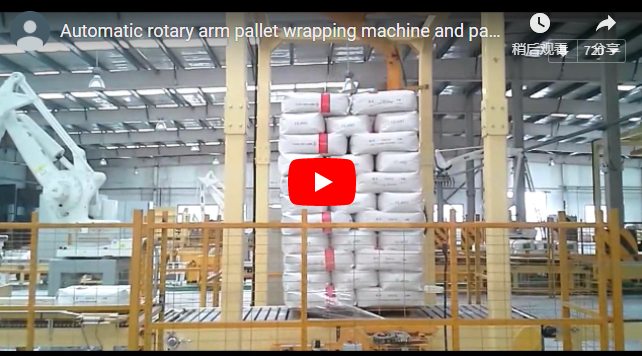
On our R100 the load does not move. The arm swings the film carriage round it, so the stack stays where the forklift put it. There is no turntable to load onto, and the floor position is the wrapping position.
The R100 semi-automatic cycle
- Platz. A forklift sets the pallet in the wrapping station under the arm.
- Anbinden. The operator fixes the film tail to the load. Where the film cutter option is fitted, its clamp holds the tail instead.
- Wickeln. The operator presses start. The arm turns round the load while the carriage climbs and descends. A photo-eye finds the top of the load.
- Fertig stellen. The arm returns to its home position by itself. On the standard R100 the operator cuts the film by hand; with the cutter option, the machine clamps and cuts it.
- Löschen. The forklift takes the wrapped pallet away.
Bottom, middle and top reinforcing wraps can each be set from 0 to 99 turns on the PLC.
How arm speed and carriage speed set the overlap
Each turn of the arm, the carriage climbs a set distance. That climb per turn is the carriage speed divided by the arm speed. Film width minus the climb is the overlap.
On the R100 the carriage travels at 2.9 m/min and the arm turns at 10 to 14 r/min, set by inverter. A faster arm at the same carriage speed lays the bands closer together, so the overlap grows. A slower arm spreads them out.
| Armgeschwindigkeit | Climb per turn | Überlappung mit 500-mm-Film |
|---|---|---|
| 10 r / min | 290mm | 42% |
| 12 r / min | 242mm | 52% |
| 14 r / min | 207mm | 59% |
R100 technical data
| Artikel | R100 |
|---|---|
| Arbeitsmodus | halbautomatisch |
| Ausgang | 35 Paletten pro Stunde |
| Armgeschwindigkeit | 10–14 U/min, einstellbar durch Wechselrichter |
| Maximale Lastgröße | 1,300 × 1,300 × 2,300 mm (L × B × H) |
| Dehnfolie | LLDPE, 500 mm wide, roll OD 250 mm, core ID 76 mm |
| Geschwindigkeit des Filmwagens | 2.9 m / min |
| Film force | controlled by separate motor |
| Reinforcing wraps | top, middle and bottom, 0–99 turns |
| Tuning | 380 V AC, 3 phase, 5 wire, 60 Hz, adjustable to site |
| Druckluft | 6–8 kgf/cm², sauber und trocken |
| Gewicht der Maschine | über 650 kg |
| Maschinenvolumen | ca. 4 m³ |
Worked example: a 1,200 × 1,000 × 1,800 mm pallet
Take a pallet load 1,200 mm long, 1,000 mm wide and 1,800 mm high. These are illustrative customer figures, inside the 1,300 × 1,300 × 2,300 mm limit.
Überlappung. At 12 r/min the carriage climbs 2,900 ÷ 12 = 242 mm per turn. With 500 mm film that leaves (500 − 242) ÷ 500 = 52% overlap.
Wrap time. The carriage climbs 1,800 mm in 1.8 ÷ 2.9 = 0.62 min, about 37 s, and takes the same to come down. That is about 74 s and 0.62 × 12 × 2 = 15 turns. With 2 extra turns at the bottom and 2 at the top, the wrap takes about 74 + 20 = 94 s and 19 turns.
Film. Each turn covers a perimeter of 2 × (1,200 + 1,000) = 4,400 mm. So 19 turns lay about 84 m of film on the load.
Paletten pro Stunde. Add the forklift and hand-cut time t of your station. Output is 3,600 ÷ (94 + t). If the forklift and operator take 60 s, an illustrative figure, that is 3,600 ÷ 154 = 23 pallets an hour. Lower loads with fewer turns run faster.
Auswahlliste: Was Sie uns senden sollten
- Load length, width and height range.
- How stable the stack is.
- Paletten pro Stunde.
- Platzbedarf und Zugang für Gabelstapler.
- Strom und Druckluft vor Ort.
Sicherheit und EN 415-6
We design the R100 to EN 415-6 for pallet wrapping machines and assess risks to ISO 12100. The turning arm and the film carriage are the main hazards. A yellow mesh fence closes off the wrapping area. An anti-collision loop on the carriage stops the machine if it meets an obstacle. A red mushroom-head emergency stop and a lockable electrical disconnect are fitted.
Häufig gestellte Fragen zur Technik
Q: Does the load turn on the R100? A: No. The load stays on the floor and the arm carries the film round it.
Q: How do I get more overlap? A: Raise the arm speed at the same carriage speed, as the overlap table shows.
Q: Is the film cut automatically? A: On the standard R100 the operator cuts it by hand. We also build the R100 with a film cutter, which clamps and cuts the tail at the end of the cycle. Pneumatic devices run on the 6–8 kgf/cm² air supply.
Q: Which safety standards apply? A: ISO 12100 for the risk assessment and EN 415-6 for pallet wrapping machines, in CE markets.
Nächster Schritt
- Email your load sizes and pallets per hour zu info@fhopepack.com.
- Wir antworten Ihnen innerhalb von 24 Stunden mit einem Angebot. for the R100 or an automatic model.
- Wir senden eine Layoutzeichnung with the arm sweep and fencing.
Verwandte lesen
- Semi-automatic rotary arm wrapper R100
- Rotationsarm-Wickelmaschinen
- FHOPE-R100 Dreharm-Palettenwickler mit Folienschneider
- Automatische Dreharm-Palettenwickelmaschine mit Deckblattabdeckung
- Stretchwickelmaschine mit Doppeldreharm
- Dreharm-Palettenwickler mit Oberfolienspender
Quellen
- Specifications: FHOPE R100 semi-automatic rotary arm wrapper product page
- Maschinenvideo: R100 rotary arm pallet wrapping machine on YouTube
- Overlap, time and film: our worked example, illustrative load figures
- Normen: EN 415-6 (Palettenwickelmaschinen); ISO 12100:2010
Letzte Überprüfung: 21.09.2026