Executive summary
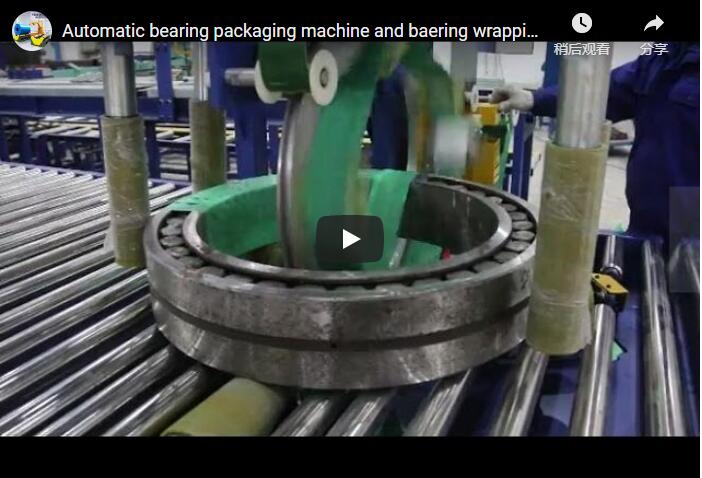
A large size bearing packaging machine wraps a big slewing or wind turbine bearing ring in protective film without lifting it off the line. The bearing lies flat on driven rollers that turn it, while an orbital ring wraps film through the bore and around the section. Our FPCA-6000 takes bearings of 2,900–5,000 mm OD and 500–12,000 kg, and can lay VCI film plus two stretch layers in one pass. A worked example checks a 6.4 t bearing.
Inhaltsverzeichnis
- Why big bearings need a dedicated wrapper
- How our big bearing wrapper works
- FPCA-6000-Daten
- Worked example: a 6.4 t slewing bearing
- Layers, oil spraying and loading
- Auswahl-Checkliste
- Sicherheit: EN 415-10 und ISO 12100
- Häufig gestellte Fragen zur Technik
- Nächster Schritt
- Verwandte lesen
- Quellen
Why big bearings need a dedicated wrapper
Slewing rings and wind turbine bearings are machined to fine tolerances and shipped long distances, often by sea. Rust or a dent on the raceway can scrap a part worth far more than its packing. Wrapping a ring of three or four metres by hand takes several people walking round it with rolls of film, and the layers come out uneven.
A dedicated wrapper turns the ring under a fixed wrapping head, so one person can pack it and every bearing gets the same layers and overlap.
How our big bearing wrapper works
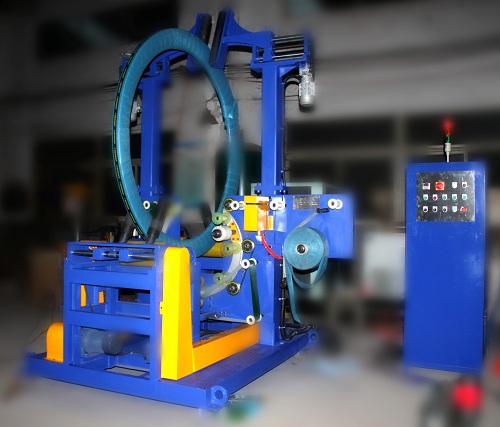
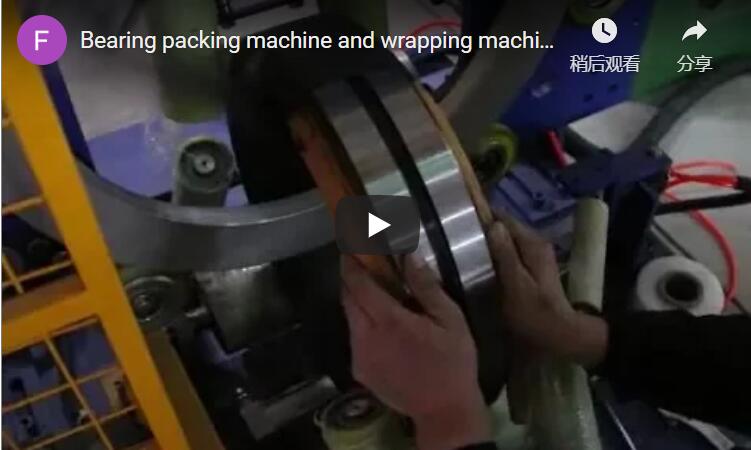
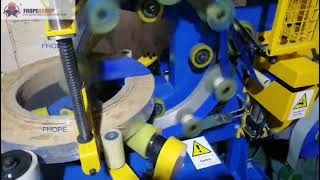
The bearing lies flat on a set of yellow polyurethane-faced rollers, some of them driven. An orbital ring stands across the bearing section, passing through the bore. As the rollers turn the bearing, the ring carriage lays film over the outer face, top, bore and bottom in a spiral. When the bearing has made one full turn, the cutter clamps and cuts the film and the ring stops.
The wrapping head moves to suit each bearing size, so the same machine covers a wide range of diameters.
FPCA-6000-Daten
| Artikel | Wert |
|---|---|
| Lager-Außendurchmesser | 2,900 – 5,000 mm |
| Lager-ID | 2,500 – 4,200 mm |
| OD − ID (twice the radial section) | unter 950 mm |
| Lagerbreite | 150 – 600 mm |
| Lagergewicht | 500-12,000 kg |
| Wickelzeit | approx. 60–110 s per bearing, three layers in one pass |
| Walzengeschwindigkeit | 2–4 m/Min |
| Überlappung | adjustable, 10–90% |
| Operator | eine Person |
| Tuning | ca. 4.5 kW |
| VCI film roll | core 50 mm, OD 100–300 mm, width 200 mm |
| Stretchfolienrolle | core 50 mm, OD 100–300 mm, width 300 mm |
The positioning adjustment lets the head reach bearings from 1,000 to 6,500 mm OD when the frame is built for it.
Worked example: a 6.4 t slewing bearing
Illustrative bearing: OD 3,200 mm, ID 2,600 mm, width 300 mm, steel.
| Einblick in das | Berechnung | Lösung |
|---|---|---|
| OD − ID | 3,200 - 2,600 | 600 mm, under 950 mm (radial section 300 mm) |
| Abschnitt | (3,200 − 2,600) ÷ 2 × 300 | 300 × 300 mm |
| Mass, solid section | π × 2.9 m × 0.3 × 0.3 m × 7,850 kg/m³ | ≈ 6.4 t |
| Wraps for one layer, 300 mm film at 50% overlap | π × 3,200 ÷ 150 | ≈ 67 at the OD |
| Film path per wrap | 2 × (300 + 300) mm | 1.2 m |
| Stretch film laid per layer | 67 × 1.2 m | ≈ 80 m² |
Ergebnis. The bearing is inside every limit of the FPCA-6000. Each stretch layer lays about 80 m of film, measured on the bearing. At the bore, where the circumference is smaller, the overlap is higher and the film builds up more. The bore is also where the raceway is, so the extra film there is welcome; the overlap is set for the outside.
The ring speed follows from the wraps and the cycle: n = N ÷ t, where N is the number of wraps and t the wrap time. We set N, t and the roller speed together on your first bearing.
Layers, oil spraying and loading
- Three layers in one pass. The head carries three rolls: VCI film next to the steel, then two stretch film layers over it.
- Oil spraying. A tank, pump and sprayer oil the bearing while it is being wrapped.
- Automatic cutter. It clamps and cuts the film, so nobody ties or cuts by hand.
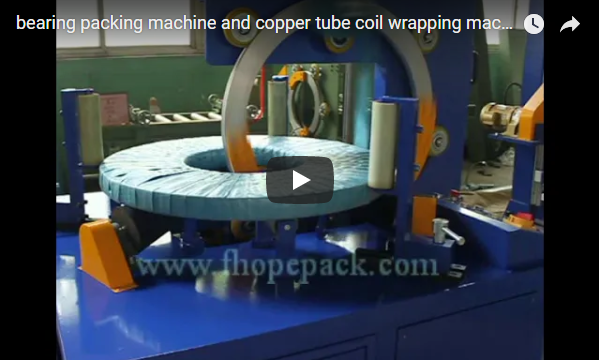
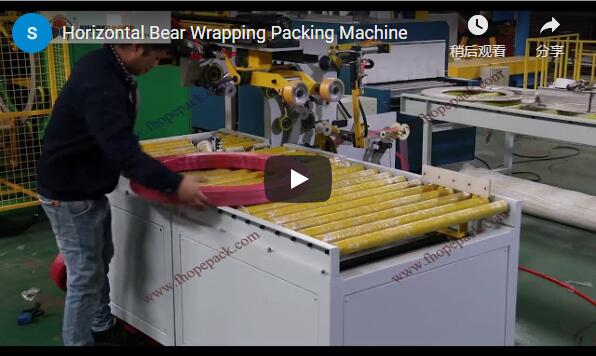
Before we quote, we ask three things. First, the bearing size range, so we know whether one machine covers it. Second, the layer order and materials. Third, how bearings are loaded and unloaded. For smaller bearings there is a more economic vertical wrapper, loaded from the top by crane or by trolley.
Auswahl-Checkliste
- Bearing OD, ID, width and weight, largest and smallest.
- Layer order: VCI, stretch film, paper, woven tape.
- Oil spraying needed or not.
- Loading: crane, manipulator or conveyor.
- Lager pro Schicht.
- Spannung und Frequenz.
Sicherheit: EN 415-10 und ISO 12100
We design the machine to EN 415-10 and assess its risks to ISO 12100. The hazards are the turning bearing on the rollers, the orbital ring and the cutter. The bearing is crane-loaded with the machine stopped, and the operator runs the cycle from the panel, clear of the ring. Where the layout allows people to reach the rollers, we add a perimeter fence with an interlocked gate or a light curtain. Guards and CE documents are agreed per project.
Häufig gestellte Fragen zur Technik
Q: Can one machine pack 3 m and 5 m bearings? A: Yes, inside 2,900–5,000 mm OD; the wrapping head moves to each size.
Q: How long does one bearing take? A: About 60–110 s per bearing, three layers in one pass.
Q: Which materials can it run? A: VCI film and stretch film as standard; we size the rolls to your materials.
F: Welche Norm ist anzuwenden? A: EN 415-10 für die Maschine, mit ISO 12100 für die Risikobewertung.
Nächster Schritt
- Send bearing sizes, weights and layer order an info@fhopepack.com.
- Wir haben Größe the frame, rollers and wrapping head.
- Wir antworten innerhalb von 24 Stunden mit Layout und Angebot.
Verwandte lesen
- Big size bearing packing machine (product)
- Bearing wrapping machine FPB-300 (product)
- Lagerverpackungsmaschine mit VCI und Folie
- Big bearing packing machine by VCI film
- Automatic bearing packaging machine
Quellen
- FHOPE product page: big size bearing packing machine FPCA-6000
- FHOPE project notes on bearing packing questions and the vertical alternative
- Our big bearing wrapper shown above
- Worked example: illustrative figures; steel density 7,850 kg/m³
- Normen: EN 415-10; ISO 12100:2010
Letzte Überprüfung: 21.09.2026