Executive Summary
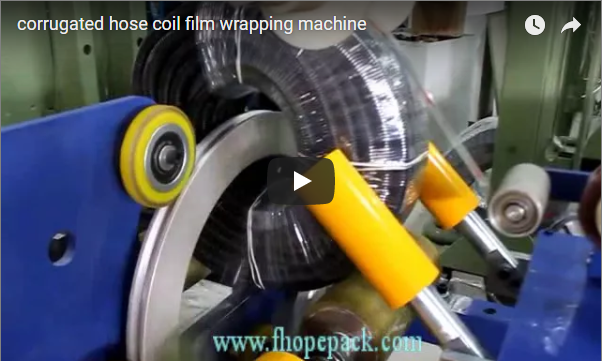
Packaging heavy industrial slewing rings, wind-turbine pitch bearings, and mill-stand raceways requires isolating precision-machined steel from marine humidity, airborne halides, and handling damage. Automated orbital wrapping secures these multi-ton components by guiding protective films continuously through the inner bore while motorized polyurethane support rollers drive the ring along its rotational axis. For heavy-duty rings from 500 to 12000 kg, determining production feasibility depends on four mechanical constraints: total weight, outer diameter, face width, and radial pass-through clearance. This technical brief details the four-stage machine qualification window, establishes kinematic cycle time calculations under variable ring drive speeds, and models stretch film consumption across standard overlap rates.
What makes a bearing hard to wrap
Large-diameter bearings present distinct mechanical packaging challenges compared to standard cylindrical coils or palletized freight:
- Micron-level raceway sensitivity: Ground ball and roller paths cannot tolerate manual handling marks, micro-condensation, or surface fretting. Uneven manual film application creates air gaps that trap moisture during intercontinental ocean transport.
- Severe aspect ratio and bore clearance: A wind-turbine slewing bearing can exceed 3500 mm in outer diameter (OD) while having a narrow face width of only 300 mm. Guiding multiple packaging webs through an internal bore manually presents severe pinch-point hazards for riggers.
- Rotational inertia of asymmetric masses: Internal gear teeth, grease ports, and non-concentric mounting hole arrays alter the center of gravity during horizontal rotation. Without rigid side support rollers, heavy rings risk lateral tilting or surface scuffing during orbital processing.
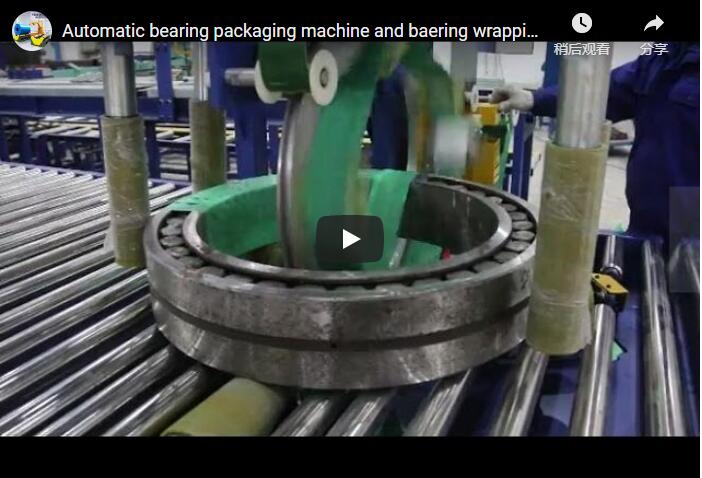
Automated orbital wrapping eliminates these risks by holding the ring in a vertical orientation while a counterbalanced rotating shuttle guides protective media continuously through the central bore.
Size window and load class
To prevent frame collision or drive overload, packaging engineers must evaluate candidate rings through a four-stage sequential gating process before placing a ring on the FPCA-6000 platform:
- Payload verification: Total ring mass must fall between 500 und 12000 kg. Under-mass rings (<500 kg) may lack sufficient friction on heavy-duty rollers without auxiliary clamping, while loads above 12000 kg overload the drive bearings.
- Outer diameter boundary: Ring outer diameter must measure between OD 2900 and 5000 mm.
- Width and cross-section envelope: Face width must clear the machine envelope spanning 2500 zu 4200 mm.
- Radial pass-through clearance: The radial cross-section defined by
(OD − ID) / 2must measure 950 mm. This ensures the rotating shuttle housing, film cores, and pretension rollers pass freely through the bore without impacting inner ground surfaces.
Four-Stage Qualification Sequence: [Gross Weight: 500–12000 kg] └──> [Outer Diameter: OD 2900–5000 mm] └──> [Width Clearance: 2500–4200 mm] └──> [Radial Section: (OD − ID) / 2 < 950 mm]
Out-of-Bounds Cases
- Scenario A (OD 2600 mm, Weight 4500 kg): This ring passes the weight limit but breaches the OD 2900 mm lower threshold of the FPCA-6000. It cannot be stably clamped by the main drive rollers. This part must be routed to intermediate machines such as the Lagerverpackungsmaschine FPB-400 (if within smaller capacity brackets) or processed on a custom-engineered chassis.
- Scenario B (OD 4200 mm, Weight 13000 kg): Although outer dimensions fit within the structural frame, the 13000 kg gross weight exceeds the 12000 kg structural rating. Loading this ring risks brinelling the polyurethane roller lagging and overloading the drive transmission; it is rejected as out-of-spec.
Zykluszeit pro Spule
Cycle time calculations determine overall line throughput and crane utilization schedules. Total floor-to-floor cycle time per bearing comprises mechanical orbital wrap duration plus handling overhead:
Cycle Time (t) = (Wrapping Turns × 60 / Ring Speed) + Auxiliary Loading and Unloading Time
Auf dem Verpackungsmaschine für große Lager, the shuttle rotation operates across a speed window of 60 to 110 s/turn, while the supporting cradle rollers drive peripheral line travel at 2 bis 4 m/min.
Worked Calculation: OD 3500 mm Ring
For an OD 3500 mm bearing requiring 4 complete orbital passes to establish baseline containment:
- Shuttle Wrap Duration (4 turns):
- At maximum shuttle rotational velocity (60 s/turn):
4 turns × 60 s = 240 s (4.0 min) - At standard preservation speed (110 s/turn):
4 turns × 110 s = 440 s (7.3 min) - Peripheral Advance Synchronization:
- Bearing circumference:
π × 3.5 m ≈ 11.0 m - At a cradle surface linear speed of 2.0 m/min, one complete bearing rotation requires
11.0 / 2.0 ≈ 5.5 min (330 s). - At 4.0 m/min linear speed, one complete rotation requires
11.0 / 4.0 ≈ 2.75 min (165 s). - Total Floor-to-Floor Time:
- Add crane staging, C-hook alignment, tail clamping and offloading — measured on your floor — to those figures; the wrap phase above is the only part the machine sets.
Film width and consumption
Film consumption directly governs operating expense. Standard wrapping media runs on Innendurchmesser 50 mm cores with outer roll diameters of AD 100 bis 300 mm, utilizing roll widths of 200 mm oder 300 mm.
Total un-stretched film length required per layer can be estimated using the baseline equation:
Film Length ≈ Wrapping Turns × π × OD / Prestretch Ratio
Linear film consumption scales with target overlap, which is adjustable via inverter drive between 10% und 90%:
Overlap Geometry Across Ring Face: |←— 300 mm Film —→| +———————+ | Layer 1 | +———-+———-+ | Layer 2 (50% Overlap = 150 mm Advance per pass) +———————+
Comparative Consumption: OD 3500 mm Ring (300 mm Film Width)
- Umfang:
π × 3500 mm ≈ 10996 mm (11.0 m) - Case 1: 10% Overlap (Economic Transit Wrap):
- Effective advance per orbit:
300 mm × (1 − 0.10) = 270 mm (0.27 m) - Turns required for single-layer coverage:
11.0 m / 0.27 m ≈ 41 orbital passes - At an average ring path of 2.2 m through the bore per orbit (assuming 1:1 mechanical stretch):
Film Length ≈ 41 × 2.2 m ≈ 90.2 m - Case 2: 50% Overlap (Heavy-Duty Marine Barrier):
- Effective advance per orbit:
300 mm × (1 − 0.50) = 150 mm (0.15 m) - Turns required for single-layer coverage:
11.0 m / 0.15 m ≈ 74 orbital passes - Total film deployed:
74 × 2.2 m ≈ 162.8 m
Technische Erkenntnisse: Across massive outer diameters, doubling overlap from 10% to 50% increases film consumption by approximately 80%, representing a nearly linear escalation in material demand. Overlap rates should be matched strictly to logistics risks—reserving 50% or higher overlaps for ocean break-bulk transit.
Three-layer option
Standard single-dispenser carriages apply individual materials sequentially, requiring separate machine indexing passes for rust inhibitors, inner barriers, and outer protective shells.
The FPCA-6000 integrates a synchronized three-layer delivery option. A multi-roll rotary shuttle carries:
- Innere Schicht: Volatile Corrosion Inhibitor (VCI) film (emits continuous vapor-phase passivating ions onto ground tracks).
- Zwischenschicht: Cast LLDPE stretch film (compresses the VCI barrier and exhausts air pockets).
- Außenhülle: Heavy-duty reinforced PE stretch wrap (provides tear and puncture resistance).
Dispensing all three media in one pass at 60–110 s/turn replaces three sequential wrapping routines. The saving is the two passes you no longer run: compare your current three-pass time with one pass at the same turn count before quoting a percentage.
Coil support and rotation
Heavy bearings cannot rest directly on bare steel rollers without causing raceway brinelling:
- Dual Motorized Cradle Rollers: The primary weight rests on paired heavy-duty forged steel cores sheathed in thick, heavy-duty polyurethane lagging (90–95 Shore A). This durometer cushions ground bearing lands while providing positive traction against slippage.
- Vertical Guide Columns: Twin adjustable side-support masts equipped with polyurethane-lagged rollers capture the vertical faces of the bearing. These rollers automatically track the OD to keep narrow rings upright and resist overturn moments during high-speed shuttle rotation.
- Variable Inverter Coordination: Planetary gearboxes driven by dual variable frequency drives synchronize cradle surface velocity (2–4 m/min) with shuttle rotation speed, maintaining consistent film overlap across irregular cross-sections.
Small bearings: FPB-400
For packaging facilities handling mixed product portfolios, running small-to-medium bearings on a large heavy-duty frame creates poor cycle efficiency and excessive film waste.
Das Lagerverpackungsmaschine FPB-400 targets rings below the FPCA-6000 envelope:
- Cycle Velocity: Rapid wrapping duration of 30 to 50 s/pce, drastically outperforming large shuttle movements on small geometries.
- Überlappungskontrolle: Programmed overlap adjustments between 20% und 90% via independent cradle and ring drives.
- Optimal Envelope: Handles bearing rings from 500 to 1200 mm OD, establishing a high-efficiency cell when paired with heavy-duty orbital equipment.
Versorgungseinrichtungen und Bewachung
Reliable operation requires proper utility infrastructure and rigorous personnel containment per European packaging machinery standards:
- Stromversorgung: the orbital drive rating and the supply it is built for are stated on the machine’s nameplate and in its quotation.
- EN 415-10-Konformität: Fixed perimeter fencing prevents operator ingress into the shuttle sweep path during automatic cycling. Breaching the perimeter optical envelope triggers an instantaneous Category 0 emergency stop, isolating all kinetic rotation.
- Pneumatic Isolation: Automated film cutting and tail-clamping jaws feature lockable air dump valves to ensure zero stored mechanical energy during film roll changeover.
Auswahl-Checkliste
Provide the following machine-room data points during initial line dimensioning:
- Minimum and maximum bearing weight (kg): Verify baseline within 500–12000 kg.
- Outer diameter (OD) and inner diameter (ID) range (mm): Confirm OD between 2900–5000 mm.
- Radial cross-section dimension: Prüfe das
(OD − ID) / 2does not exceed 950 mm. - Bearing face width range (mm): Confirm clear passage within 2500–4200 mm.
- Target packaging recipe: Single stretch film, VCI film plus stretch film, or simultaneous three-layer composite.
- Plant handling logistics: Overhead bridge crane C-hook, textile sling rigging, or powered floor-level transfer car.
- Electrical utility standard: Available line voltage, frequency, and transformer capacity (e.g., 200V/60Hz, 400V/50Hz).
Häufig gestellte Fragen zur Technik
Q: Can the FPCA-6000 wrap bearings with an OD smaller than 2900 mm? A: No. The machine geometry, lower cradle roller spacing, and vertical guide mast travel are optimized for massive rings. Rings with OD <2900 mm (such as OD 2600 mm) must be packaged on intermediate vertical units or specialized wrappers like the FPB-400.
Q: How does the three-layer option affect total film stretch? A: Each of the three film dispensers features an independent mechanical friction brake or powered pre-stretch carriage. This allows different elongation profiles—for example, low tension on sensitive VCI film combined with high pre-stretch on the outer LLDPE layer.
Q: How are film tails clamped and cut on irregular bearing ODs? A: The system incorporates a pneumatic scissor cutter and hot-seal or pneumatic press-down wiper. Once the final wrap cycle completes, the tail is clamped, cut cleanly, and pressed flat against the preceding layer while the ring completes a fractional index.
Q: What is the main cause of film tearing when wrapping through the bore? A: Film tears typically result from sharp, un-radiused corner chamfers on bearing rings or incorrect film tension tracking during shuttle entry. Setting the proper shuttle speed (within 60–110 s/turn) and using film rolls of 200–300 mm width minimizes edge neckdown and eliminates tear points.
Nächster Schritt
To evaluate your bearing packaging requirements, submit your dimensional envelope (OD, ID, face width, and maximum weight) to the FHOPE engineering desk:
- Layout & Clearance Verification: Our mechanical engineers simulate shuttle clearances and supply 2D/3D plant footprint models within 24 zu 48 Stunden.
- Angebotsabgabe: Receive a comprehensive technical proposal detailing cycle times, dynamic roller load calculations, and automation options.
Contact our packaging systems engineering group at info@fhopepack.com.
Letzte Überprüfung: 21.09.2026