**Zusammenfassung**
> Dies, moulds and other heavy blocks often have to be turned 90 degrees for maintenance, inspection or storage, and doing it with a crane and chains is slow and risky.
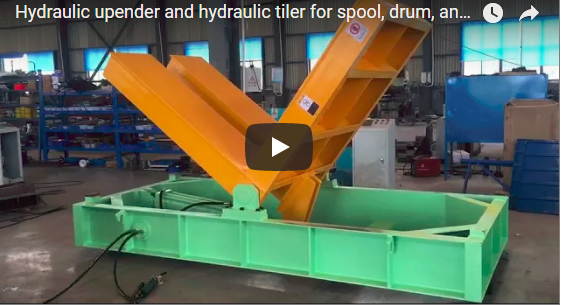
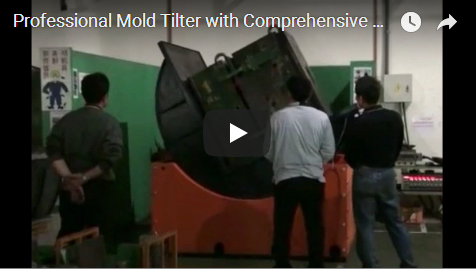
> Our die mould upender and tilter in this video takes the load on an orange tilting cradle on a green base and turns it toward vertical.
> Whether a load can be turned follows from its **weight** and **centre of gravity**. We check both per project.
Inhaltsverzeichnis
- Was das Video zeigt
- So funktioniert die Kippwiege
- Überprüfung der Ladung
- Wo ein Werkzeugwender hilft
- Kontrollen und Sicherheit
- Auswahlliste für einen Werkzeugwender
- Häufig gestellte Fragen zur Technik
- Nächster Schritt
- Verwandte lesen
- Quellen
Was das Video zeigt
Unser Kippständer steht in der Werkshalle: ein grünes Gestell mit einer orange-roten Kippvorrichtung und dem Logo der FHOPE GROUP. In der Vorrichtung ruht eine große, kastenförmige Ladung.
Die Wiege wird aus verschiedenen Winkeln gezeigt, zunächst geneigt, dann flach und leer abgesenkt. Im Hintergrund der Halle, abseits der Maschine, steht ein Arbeiter in blauem Overall. Das Logo der FHOPE GROUP wird ebenfalls als Einblendung im Video gezeigt.
So funktioniert die Kippwiege
| Schritt | Was passiert |
|---|---|
| Load | The load is set on the cradle |
| Secure | The load is held against the cradle faces |
| Tilt | The cradle turns the load toward vertical |
| Unload | The turned load is lifted off |
| Return | The cradle goes back to flat |
Die Last ruht während der Drehung auf zwei Seiten der Wiege, sodass sie durchgehend gestützt wird und nicht an einem Haken hängt.
Überprüfung der Ladung
Beispiel einer Stahlform:
| Artikel | Wert |
|---|---|
| Length × width × height (illustrative) | 1,200 × 800 × 600 mm |
| Volume, 1.2 × 0.8 × 0.6 | 0.576 m³ |
| Steel density | 7,850 kg/m³ |
| Weight if solid, 0.576 × 7,850 | about 4,522 kg |
Eine echte Form mit Hohlräumen wiegt weniger. Senden Sie uns das Gewicht der Form und die Zeichnung, und wir überprüfen die Größe der Halterung und den Schwerpunkt.
Wo ein Werkzeugwender hilft
| Use | What the turn does |
|---|---|
| Mould maintenance | Presents the parting face for cleaning and repair |
| Die change | Turns the die to the press orientation |
| Inspection | Shows the underside without a crane flip |
| Storage | Stands moulds upright to save floor space |
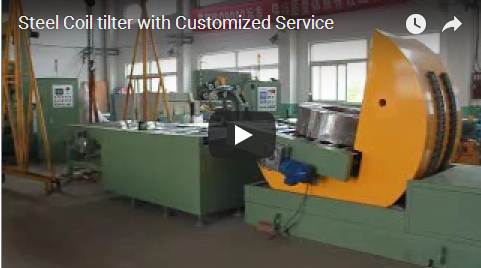
Turning on a cradle replaces crane flips, where the load swings and lands on its edge. For round loads, see our [multipurpose automatic coil tilter with slide table](https://www.fhopepack.com/videos/multipurpose-automatic-coil-tilter-with-slide-table/) and our [large and long coil upenders](https://www.fhopepack.com/videos/large-and-long-coil-upenders-in-real-world-operation/).
Kontrollen und Sicherheit
The cradle turns a heavy load. Keep people clear of the cradle and the load's path while it tilts, and stand away from the machine as the worker in our video does.
Die anzuwendenden Normen hängen vom Zielmarkt ab. Für CE-Märkte legt ISO 12100 die Risikobewertungsmethode fest und EN 415-10 die allgemeinen Anforderungen an Verpackungsmaschinen.
Auswahlliste für einen Werkzeugwender
- [ ] Heaviest die or mould weight.
- [ ] Length, width and height of the largest load.
- [ ] Centre of gravity position.
- [ ] Turning angle needed.
- [ ] How the load arrives: crane or forklift.
- [ ] Floor space and power supply.
Häufig gestellte Fragen zur Technik
Q: What does a die mould upender do?
A: It turns a heavy die or mould toward vertical on a tilting cradle instead of a crane flip.
Q: How do you estimate the weight of a solid steel mould block?
A: Volume times steel density: about 4,522 kg for 1,200 × 800 × 600 mm at 7,850 kg/m³ in our example; a mould with cavities weighs less.
Q: Why is a cradle safer than a crane flip?
A: The load rests on two faces during the turn instead of swinging on a hook.
Q: What should I send for sizing?
A: The heaviest mould weight, its drawing and centre of gravity.
Q: Does anyone stand at the machine during the tilt?
A: No. Keep clear of the cradle and the load's path.
Nächster Schritt
Wir planen Ihre Werkzeugwendemaschine in drei Schritten:
1. **Submit your layout drawing** with mould weights, sizes and drawings to **info@fhopepack.com**.
2. **Receive a proposal within 48 hours**, with the cradle size and load check.
3. **Book a site survey** to check crane or forklift access and floor space.
Verwandte lesen
- [Mould upender](https://www.fhopepack.com/mold-upender/)
- [Mould flipper](https://www.fhopepack.com/mold-flipper/)
- [Video: why 90-degree mould upenders are replacing overhead cranes](https://www.fhopepack.com/videos/the-roi-of-safety-why-90-degree-mold-upenders-are-replacing-overhead-cranes-in-industrial-toolrooms/)
Quellen
- Maschineninhalt: FHOPE-Entwicklungsteam, 04.10.2026
- Load example: our worked example, illustrative values; steel density 7,850 kg/m³
- Machine in action: [our video on YouTube](https://www.youtube.com/watch?v=AVza0eNbc7o)
- Geltungsbereich der Normen: [ISO 12100:2010](https://www.iso.org/standard/51528.html), [EN 415-10:2014](https://www.nen.nl/en/nen-en-415-10-2014-en-191845)
Letzte Überprüfung: 21.09.2026