Executive summary
Our automatic pallet strapping and wrapping machine straps the load and wraps it with stretch film in one station, under one PLC and touch screen. Friction-welded PET straps hold the stack together, and the film keeps out dust and moisture. The integrated machine takes loads up to 1,300 × 1,300 × 1,800 mm and 2,000 kg, with a strap cycle of about 15 s and strap tension adjustable from 50 to 5,000 N. Below we choose the sequence, budget the cycle and check heavy block loads against the turntable.
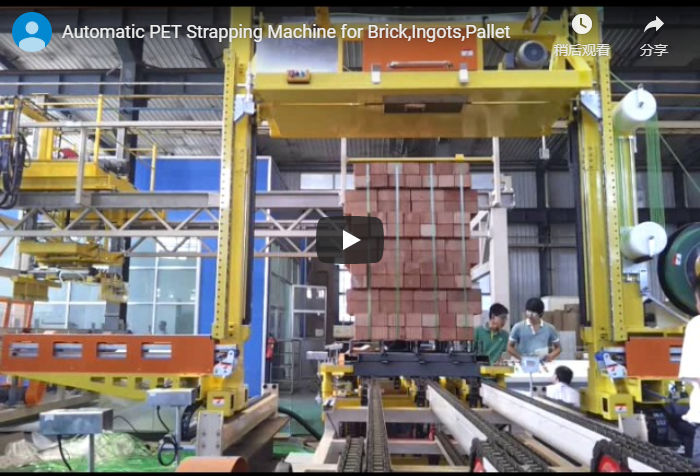
Pallets stacked with white building blocks ride along a chain conveyor on a long cream-coloured frame. They stop inside a red steel arch, where the strap runs over the top of the load and is tensioned and sealed, with the strap coil mounted on the arch beside the conveyor. A group of visitors in hard hats watches and films the run in our Shanghai workshop before the line ships.
Inhaltsverzeichnis
- Why strap and wrap in one station
- Integrated machine data
- Strap first or wrap first?
- Cycle budget per pallet
- Heavy block loads and the 2,000 kg limit
- Turntable height on a conveyor line
- Strap tension and edge protection
- Auswahl-Checkliste
- Sicherheit
- Häufig gestellte Fragen zur Technik
- Nächster Schritt
- Verwandte lesen
- Quellen
Why strap and wrap in one station
The strap and the film do different work. The strap carries the load: it ties heavy, rigid goods such as blocks, bricks or panels to the pallet so they cannot slide when a forklift brakes. The film holds small items in place and keeps rain and dust off.
Two separate machines need two stops, two operators’ attention and a buffer conveyor between them. One station does both on one stop, so the floor space is smaller and the pallet does not wait between machines.
Integrated machine data
| Artikel | Integrated pallet wrapper and strapper |
|---|---|
| Maximale Lastgröße | L 1,300 × B 1,300 × H 1,800 mm |
| Drehscheibe | 2,000 mm diameter, 80 mm high as a standalone floor machine |
| Maximale Belastung des Plattenspielers | 2,000 kg |
| Riemenverbindung | Reibschweißung, 20 mm Dichtungslänge |
| Riemenspannung | 50–5,000 N, einstellbar |
| Gurtvorschub- und -rückzugsgeschwindigkeit | bis zu 3.6 m/s |
| Bandbreite | 12–16 mm oder 19 mm |
| Strap coil core | 406mm |
| Fahrrad mit Einzelriemen | ca. 15 s |
| Strapping height | adjustable, set per load |
| Prallkopf | floating, for even tension round the load |
| Filmvordehnung | ratio confirmed at quote |
| Tuning | 380 V, 50 Hz; 5 kW nominal |
| Kontrolle | Siemens PLC, inverters and touch screen; Omron and Sick sensors |
| Drives and pneumatics | SEW motors; AirTAC pneumatics |
Strap first or wrap first?
| Reihenfolge | Verwenden Sie es, wenn | Achten Sie auf |
|---|---|---|
| Strap, then wrap | heavy, rigid loads such as blocks; film covers the straps against UV and snagging | the film must not trap water under the straps |
| Wickeln, dann festbinden | the strap must press the film to the load, such as tall carton stacks | straps over film can slip on smooth film, so tension and edge boards matter |
On a conveyor line the strap arch spans the conveyor and the straps run vertically over the top of the load. The pallet indexes forward and stops at each strap position. On the standalone integrated machine the strapping head is height-adjustable, so straps can also be set at chosen heights round the load.
For blocks and bricks we strap first: the straps make the stack one rigid unit, and the film then seals the sides. The program sets the order, the strapping heights and the wrap winds per load type on the touch screen.
Cycle budget per pallet
Strap time is the number of straps times about 15 s, plus the indexing move between strap positions; the wrap time depends on the load height and winds. As an example, a block pallet with 4 straps and a 60 s wrap:
| Schritt | Berechnung | Zeit |
|---|---|---|
| Uhrenarmbänder | 4 × 15 s | 60 s |
| Indexing between straps | 3 moves, example 5 s each | 15 s |
| einwickeln | from the wrap program | 60 s |
| Conveying in and out | Beispiel | 20 s |
| Total per pallet | 60 + 15 + 60 + 20 | 155 s |
| Paletten pro Stunde | 3,600 ÷ 155 | 23 |
Fewer straps or a shorter wrap raise the rate. Your actual wrap time and conveying time are worked out from your load and confirmed at quote.
Heavy block loads and the 2,000 kg limit
Block pallets get heavy quickly. Check the weight before choosing the machine:
Load weight = L × W × H × bulk density of the stack + pallet weight.
Take the block density from your block supplier and allow for the gaps in the stack. If the total exceeds the 2,000 kg turntable limit, split the stack or choose a reinforced turntable, confirmed at quote. The load size must also stay inside 1,300 × 1,300 mm in plan and 1,800 mm in height.
Turntable height on a conveyor line
The 80 mm turntable height applies to the standalone floor machine, loaded by forklift. On a conveyorised line the turntable carries its own conveyor section, and the deck sits at the same passline height as the in-feed and out-feed conveyors so the pallet runs straight through. The passline height and the roller or chain pitch are matched to your pallets and confirmed at quote.
Strap tension and edge protection
The 50–5,000 N range covers light carton loads at the low end and rigid block stacks at the high end. Set tension so the strap does not cut into the top edges: on blocks, use corner boards under the straps, and on cartons, keep tension low enough not to crush the top layer. The floating head spreads the tension evenly round the load, so one side is not tighter than the other.
The friction weld needs no metal seals and no heating, so there are no consumables apart from strap and film.
Auswahl-Checkliste
- Load size and weight, including the pallet.
- Product: blocks, bricks, panels or cartons.
- Number and position of straps, and strap width.
- Sequence: strap first or wrap first.
- Paletten pro Stunde.
- Förderbandhöhe und Linienführung.
Sicherheit
We design to EN ISO 12100:2010 for risk assessment, EN 415-10 for packaging machine safety, EN 415-8 for the strapping machine, EN 415-6 for the pallet wrapper and EN 60204-1 for the electrical equipment. The strap arch, the sealing head, the turntable and the conveyor are the hazards. Perimeter fencing with interlocked doors, light curtains at the conveyor openings and an emergency stop at the panel are agreed per project, together with the CE documents.
Häufig gestellte Fragen zur Technik
Q: What strap does it use? A: PET or PP strap, 12–16 mm or 19 mm wide, on a 406 mm core.
Q: How is the strap joined? A: By friction weld, with a 20 mm seal.
Q: How heavy can the load be? A: Up to 2,000 kg on the turntable.
Q: Can the strap height change between loads? A: Yes, the strapping height is set per load in the program.
Q: What power does it need? A: 380 V, 50 Hz, about 5 kW.
Nächster Schritt
- Send your load sizes, weights, strap pattern and pallets per hour an info@fhopepack.com.
- Legen wir fest the sequence, the strapping heights and the wrap program.
- Wir antworten innerhalb von 24 Stunden mit einem Vorschlag und einem Kostenvoranschlag.
Verwandte lesen
- Integrated pallet wrapping and strapping machine (product)
- Automatische Drehteller-Palettenumreifungsmaschine (Produkt)
- Automatische Palettenumreifungsmaschine
- Inline-Drehtisch-Palettenwickler
- Automatic pallet wrapping machine test run in the factory
Quellen
- FHOPE product page: integrated pallet wrapping and strapping machine
- EN ISO 12100:2010; EN 415-10; EN 415-8; EN 415-6; EN 60204-1
- Our strapping and wrapping line shown above, tested in Shanghai
Letzte Überprüfung: 21.09.2026