
My Perspective on the Task
Introduction
Coil packing machines are specialized industrial equipment meticulously engineered to wrap, package, and protect a diverse array of coiled products. These products range from steel and wire coils to cable coils, pipe and hose coils, and even bearings.1 The primary function of these machines is to automate the packaging process, a critical step in preserving product integrity during the rigors of storage and transportation. Beyond protection, automation through coil packing machines enhances packaging speed, improves consistency compared to manual methods, and contributes to overall operational efficiency.2
These machines are indispensable in numerous sectors, including the demanding environments of steel and aluminum processing, the precision-driven wire and cable manufacturing industry, and the versatile plastic and rubber production domain.2 The packaging solutions they provide serve as a barrier against detrimental environmental factors such as moisture, dust, and corrosion, while also mitigating the risk of mechanical damage during handling and transit.3 Given their strategic importance, understanding the cost drivers and pricing strategies for coil packing machines is crucial for us as manufacturers to effectively meet market needs and communicate value.
The purpose of this report is to provide a comprehensive analysis of the multifaceted factors that manufacturers consider when determining the price of coil packing machines. This analysis will dissect core machine specifications, varying levels of automation, construction quality, material handling versatility, advanced operational functionalities, the scope for customization, our own manufacturer profile, and the encompassing service ecosystems. By elucidating these elements, this report aims to clarify the cost structure from a manufacturing perspective and the value proposition we offer to our clients.
I. Core Machine Specifications and Their Price Impact
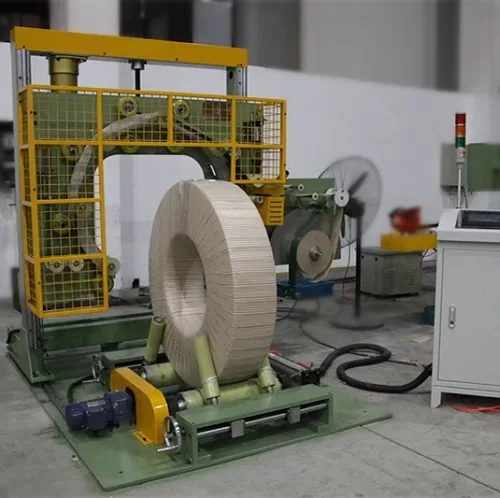
The fundamental physical and operational characteristics of coil packing machines are primary drivers of our manufacturing cost and thus the base price we set. The specific type of machine, its designed capacity to handle coils of varying dimensions and weights, and its inherent operational speed are foundational elements that dictate the engineering and material investment, and thus the cost base. These specifications reflect the core engineering and material investment embodied in the equipment.
A. Machine Type and Operational Mechanism
The configuration and working principle of a coil packing machine are pivotal in defining its capabilities and, consequently, the manufacturing costs that influence its price. Choices between horizontal and vertical orientations, alongside the specific wrapping or strapping mechanisms employed, cater to different product types, handling requirements, and protection levels, each impacting the engineering complexity and material usage.
Horizontal vs. Vertical Orientation:
Coil packing machines are broadly categorized by their operational orientation: horizontal or vertical.
- Horizontal Coil Packing Machines typically process coils that are lying flat, with their central opening (eye) facing upwards (eye to the sky). This orientation is often well-suited for integration into automated production lines or for handling specialized coils such as copper or hose coils. It can also be particularly beneficial for lightweight coils or those with small inner diameters (ID), as this position helps prevent deformation during the wrapping process.4 Examples within this category can include horizontal form fillers and horizontal form/seal machines designed for packaging products into bags.2 Some horizontal machines are specifically engineered for long products and profiles, extending their utility beyond traditional coil shapes.5 Indicative pricing for horizontal coil wrappers can vary; for instance, a machine with a 2000kg capacity might be priced around 290,000 INR (approximately $3,500 USD)6, while CE certified medium-sized horizontal wrappers are seen in the $7,900-$7,950 range.7
- Vertical Coil Packing Machines process coils that are standing upright, with their eye oriented horizontally or towards the wall. This configuration offers distinct advantages for certain applications, particularly for narrow slit coils, as it minimizes the risk of coil collapse or edge damage during handling and packaging.8 Vertical machines can also present an economical solution for operations involving manual loading of coils.9 Price points for vertical machines include examples such as 270,000 INR (approximately $3,250 USD) for models with motorized ring up/down systems6, and other automatic vertical machines for tyre/plastic tube/steel coil wrapping are listed between $3,720 and $4,290.7
The choice between horizontal and vertical orientation is not merely a design preference but is intrinsically linked to the type of coil being packaged, the preferred handling method (manual or automated), and the desired level of automation, all of which collectively influence the machine’s complexity and our manufacturing cost.8 For example, lighter coils (under 25kg) with smaller dimensions are often better suited for horizontal machines, whereas heavier coils (over 50kg) with larger dimensions may necessitate a vertical approach.9
Operational Mechanisms (Wrapping/Strapping):
The method by which the packaging material is applied is a crucial aspect of the machine’s design and function, directly impacting manufacturing complexity.
- Orbital Wrapping: This common mechanism, particularly for stretch wrapping, involves a ring or shuttle that carries the packaging material and orbits around the coil.10 The ring can be designed to revolve either horizontally or vertically, depending on the machine’s overall orientation and the coil’s presentation.11
- Through-Eye Wrapping (Toroidal): In this method, the packaging material is meticulously passed through the eye of the coil. This ensures comprehensive coverage of all coil surfaces, including the inner diameter, outer diameter, and the flat faces.8 Such thorough coverage is critical for protecting the coil against environmental factors like moisture and dust, which can lead to corrosion.10 Specialized technologies like Pesmel’s TEW (Through Eye Wrapping) are noted for their effectiveness in preventing corrosion, often utilizing materials like crêpe paper in conjunction with PE film.12
- Radial Wrapping: This technique involves applying the packaging material primarily around the coil’s circumference or outer diameter. It is often employed for products like paper rolls or fabric rolls, where the main objective is to wrap the cylindrical surface, leaving the sides potentially open or to be covered separately.8 Manufacturers like FB Balzanelli offer dedicated radial coil wrappers.13 The price for radial reel stretch wrappers can range from 6 to 10 lakh INR (approximately $7,200 – $12,000 USD).14
- Shrink Wrapping: This process uses a heat-shrinkable film that, after application, is exposed to heat, causing it to shrink tightly and conform to the shape of the coil.13 A shrink wrapping unit can be a standalone machine positioned downstream from a coiler in a production line.13
- Strapping: This method secures coils using PET (polyester) or steel straps. Straps can be applied either radially (around the circumference) or through the eye of the coil for added security.8 Automatic strapping machines can be integrated as components within a larger, more comprehensive coil packaging line.15
The selection of an operational mechanism is dictated by the required level of protection for the coil and the nature of the coil itself, directly impacting the machine’s inherent complexity and our manufacturing cost, which in turn influences market price. For instance, through-eye wrappers, which provide more complete coverage, are generally more mechanically complex to engineer and build than simpler radial wrappers. Consequently, machines that offer more thorough protection via these more intricate mechanisms will invariably command higher prices. This reflects a direct cause-and-effect relationship: a greater need for protection leads to the adoption of a more complex mechanism, which in turn results in a higher machine cost for us to produce and for the customer to purchase. Furthermore, some advanced systems integrate multiple packaging operations. For example, a vertical slitting coil packaging line might combine through-eye wrapping with an automated strapping function (either radial or through-eye).8 Such integrated systems, capable of performing sequential operations like wrapping and then strapping15, are inherently more sophisticated and thus more expensive to manufacture than standalone machines dedicated to a single packaging task. The necessity to precisely coordinate multiple mechanisms, manage different material feeds, and implement complex control logic significantly adds to the engineering and manufacturing costs of these hybrid machines.
B. Coil Handling Capacity (Physical Dimensions and Weight)
A machine’s capacity to handle coils of varying physical dimensions (Inner Diameter – ID, Outer Diameter – OD, width) and weights is a significant cost factor in its design and manufacture. Machines are meticulously designed and rated for specific ranges.4
Coil Dimensions:
Larger coil dimensions typically necessitate larger and more robust machine frames, extended travel for wrapping elements, and more powerful drive systems, all of which increase material and component costs for us. For example, Dixin Machinery offers various models where capacity clearly differs: the DP-300GD model is designed for coils with an OD of 350-800mm and a width of ≤300mm, while their DP-1000T model can handle coils with an OD >1000mm and a width of ≤1000mm.16
Coil Weight Capacity:
Machines are also rated for the maximum weight of the coil they can safely and efficiently process. This can range from under 100kg to 2000kg6, 3,000 kg17, or exhibit a spectrum from ≤100kg to ≤1000kg across different models from the same manufacturer.16 Handling heavier coils imposes greater structural demands on the machine, requiring stronger motors, more durable bearings, and reinforced construction throughout, leading to higher manufacturing expenses.
The direct correlation between machine size/capacity and price is explicitly noted in industry analyses: larger machines designed to handle higher volumes or heavier/larger coils inherently cost more due to the increased quantity and robustness of materials required, as well as more substantial engineering.18 The varying power requirements across models with different capacities (e.g., increasing from 1.5kW to 5.5kW for Dixin models as capacity increases16) also imply these cost differences. It is important to recognize that the relationship between coil handling capacity and machine price is often not linear. As coil sizes and weights escalate (e.g., from a 100kg capacity to a 1000kg capacity16, or up to 3000kg17), the demands on structural integrity, motor power, and component robustness increase substantially. This often means employing not just “more” material, but “stronger,” higher-grade, and more specialized materials and components. Consequently, the manufacturing cost for heavy-duty machines capable of handling very large or heavy coils tends to rise more steeply, a critical consideration for us when pricing such equipment for industries like heavy steel processing.
C. Packing Speed and Overall Throughput Efficiency
The rate at which a machine can process coils is a critical performance metric that significantly influences its manufacturing cost and thus its price. This is typically measured in coils per hour, wrapping speed in meters per minute, or cycle time in seconds per coil.4
Packing Speed:
Examples of packing speeds vary widely: some lines achieve 16 coils/hour15, others operate at 20-35 seconds per coil4 or 50-100 coils/hour.17 The ring speed in orbital wrappers can range from 20-80rpm16, and overall line speeds in cable packing can reach up to 300m/min.19 Achieving higher speeds generally necessitates more powerful motors, faster and more responsive control systems, and mechanical components engineered for high-speed precision and durability, all contributing to higher production costs.
Throughput Efficiency:
This broader measure encompasses the total time taken to process a coil, including loading, wrapping, material cutting/sealing, and unloading sequences.8 Automation level plays a paramount role in maximizing throughput efficiency. Machines designed for higher throughput are invariably more expensive for us to build due to the enhanced engineering and technology they incorporate.
Automation is a key enabler of increased packaging speeds, with some analyses suggesting it can boost speeds by over 50% compared to manual or less automated methods.8 Speed is consistently highlighted as a primary benefit of automated coil packing machines.2 Furthermore, the overall production volume a business needs to handle (e.g., coils per day or week) is a crucial factor when selecting the appropriate machine size and capacity, directly linking desired throughput to machine choice and, therefore, its price.4 Achieving higher packing speeds demands more than just installing faster motors. It requires a sophisticated, harmonized system comprising faster sensors for accurate coil detection and real-time parameter adjustment9, more powerful and responsive PLCs for precise control of high-speed operations8, and mechanical components robust enough to withstand sustained high-speed operation without succumbing to premature wear or failure. This intricate balance of speed, precision, and durability inherently drives up the design complexity and manufacturing cost of high-throughput machines. Additionally, minimizing cycle times for each discrete step in the packaging process—loading, wrapping, cutting, and ejection—at high operational speeds presents a significant engineering challenge that contributes to the premium pricing of such equipment.
Table 1: Overview of Coil Packing Machine Types and Key Price-Influencing Characteristics (From a Manufacturer’s Perspective)
| Machine Type/Orientation | Primary Operational Principle | Typical Coil Applications | Common Packing Materials | Key Capacity Drivers (Coil OD, Weight) – Impact on Mfg. Cost | Typical Speed/Throughput Range – Impact on Mfg. Cost | General Price Tier Indication (Reflecting Mfg. Cost & Value) |
|---|---|---|---|---|---|---|
| Horizontal Orbital Wrapper | Ring orbits horizontally around flat coil | Steel, wire, cable, hose, specialized coils | Stretch film, VCI paper, PE film | Larger/heavier = more robust materials, larger frame, powerful drives (High Cost) | Higher speed = advanced motors/controls (High Cost) | Mid to Premium |
| Vertical Orbital/Through-Eye Wrapper | Ring orbits/material passes through eye of upright coil | Steel, wire, cable, narrow slit coils | Stretch film, VCI paper, PE film | Larger/heavier = more robust materials, larger frame, powerful drives (High Cost) | Higher speed = advanced motors/controls (High Cost) | Mid to Premium |
| Radial Wrapper | Wraps OD (circumference) only | Paper rolls, fabric rolls, some pipe coils | Stretch film, paper | Varies, less demanding than orbital for heavy coils (Moderate Cost) | Moderate speed requirements (Moderate Cost) | Entry to Mid |
| Shrink Wrapper | Heat shrinks film tightly around coil | Various coils needing tight seal | Shrink film (POF, PE) | Varies by coil type, heat tunnel adds complexity (Moderate to High Cost) | Dependent on heat tunnel capacity (Moderate to High Cost) | Mid to Premium |
| Strapping Machine (Standalone/Auto) | Applies PET or steel straps radially or through-eye | Securing steel, wire, heavy coils | PET straps, Steel straps | Robust mechanisms for heavy loads (Moderate to High Cost) | Varies, auto lines more complex (High Cost for auto) | Mid to High (for auto lines) |
| Horizontal Form/Fill/Seal | Forms bag, fills with coil (often smaller items), seals bag | Smaller wire/cable coils, hose coils | Plastic/paper bags | Simpler mechanisms for smaller items (Low to Moderate Cost) | Variable, often for lower throughput (Low to Moderate Cost) | Entry to Mid |
This table provides a foundational understanding by categorizing the main types of coil packing machines. It helps to quickly grasp how different operational principles, typical applications, and material compatibilities align with machine types. By including capacity drivers, speed ranges, and a general price tier, it connects these core specifications directly to our manufacturing cost implications, setting the stage for more detailed discussions in subsequent sections. This structured overview is crucial for understanding the initial factors that segment the market by price from our perspective as manufacturers.
II. Level of Automation: A Pivotal Price Determinant

The degree of automation incorporated into a coil packing machine is one of the most significant factors influencing its manufacturing complexity and thus its price. Automation levels span a spectrum from entirely manual operations to semi-automatic systems offering partial assistance, and culminating in fully automatic, integrated lines that require minimal human intervention. This section will explore these levels and their impact on our production costs and the value we offer to customers.
A. Manual and Semi-Automatic Systems
These systems represent the lower end of the automation spectrum and, consequently, are less costly for us to produce and offer at lower price points.
Manual Systems:
In a manual setup, the operator is typically responsible for loading and unloading the coils onto the machine and manually initiating and guiding the wrapping process. The machine’s role is primarily to assist with the physical action of applying the packaging material. An “economic version” of a wire coil wrapper, for example, involves manual loading and unloading, often with the aid of a crane.4 While specific price points for manual coil wrappers are less detailed, analogous manual pallet wrappers, like the Fox FPS100, are priced around $4,72020, illustrating the cost profile of systems we can produce with simpler mechanics and controls.
Semi-Automatic Systems:
These machines offer a step up in automation, often featuring automated wrapping cycles once the coil is manually loaded onto the machine and the process is initiated by an operator, perhaps via a foot pedal or a push button. Some semi-automatic models may include features like automatic cutting of the packing material at the end of the cycle.4 The SHJLPACK GG200 is an example of a semi-automatic orbital stretch wrapper designed for lower requirement applications.5 Price indications for semi-automatic systems vary: pallet wrappers in this category can range from approximately $6,662 to $11,500.20 For coil wrappers, some sources suggest a range of $10,000 – $18,000 (e.g., EconWrap) or $20,000 – $30,000 (e.g., PackPro) for semi-automatic models.18 Maintenance costs for semi-automatic wrappers are generally lower than their fully automatic counterparts, typically estimated at $2,000-$5,000 annually.21 The reduced complexity in these systems translates to lower manufacturing costs for us.
The term “semi-automatic” itself encompasses a broad range of functionalities, which contributes to the variability in their manufacturing cost and subsequent pricing. A basic semi-automatic machine might only automate the wrapping cycle itself after the operator has manually loaded the coil and attached the packaging film. In contrast, more advanced semi-automatic systems4 could incorporate additional automated features such as automatic film clamping and cutting, powered pre-stretch mechanisms for film savings, and a degree of programmability for different coil types or wrapping patterns. This significant variance in the level of automated functions offered under the “semi-automatic” umbrella means that our production costs, and thus prices, can differ substantially. Simpler models will be priced closer to manual machines, while more sophisticated ones will approach the lower end of the price spectrum for fully automatic systems. We ensure prospective buyers understand the specific automated functions included with a semi-automatic machine.
B. Fully Automatic Systems
Fully automatic coil packing systems represent the highest level of automation, designed for efficiency, consistency, and high-volume operations with minimal human intervention. These systems incur the highest manufacturing costs for us due to their complexity.
Features:
These systems typically manage the entire packaging process automatically. This includes automatic coil feeding (often via integrated conveyor systems), precise coil positioning, the wrapping cycle itself, automatic cutting and sealing of the packaging material, and ejection of the packaged coil.8 They are commonly equipped with sophisticated PLC (Programmable Logic Controller) controls, intuitive HMI (Human-Machine Interface) touchscreens for parameter setting and monitoring, and are designed for seamless integration into existing production lines.8 Fully automatic machines can efficiently handle large volumes of coils and can be programmed with multiple packaging recipes for different coil specifications.8 Examples include comprehensive automatic vertical coil packaging lines8 and systems featuring automatic coilers that feed directly into downstream automatic wrappers.13
Price Range:
The initial investment for fully automatic systems is considerably higher, reflecting our increased manufacturing and development costs. Prices can start from $15,000-$25,000 for some automatic coil wrappers18, but more commonly range from $75,000 to $200,000 or even higher for complex, high-volume operations.21 Specific examples include an automatic slit steel coil packing machine listed at $20,0007, and an automatic wire coiling and wrapping machine priced around $42,000.22
The classification “fully automatic” often implies more than just the automation of the wrapping process itself; it usually signifies the machine’s capability for integration into a larger, continuous production flow. This level of automation typically requires ancillary systems such as infeed and outfeed conveyors, automated coil positioning mechanisms, and sophisticated communication protocols to interface with upstream (e.g., coilers, slitters) and downstream (e.g., palletizers, strapping machines) equipment.8 This system-level automation, as opposed to mere machine-level automation, is a major driver of the higher manufacturing costs associated with these machines. The extensive engineering required to ensure seamless material flow, reliable data exchange23, and comprehensive safety interlocks across multiple interconnected pieces of equipment contributes significantly to the premium price of fully automated packaging lines we produce.
C. Analyzing the Return on Investment (ROI) for Different Automation Levels (from a Manufacturer’s Sales Perspective)
While higher levels of automation entail a greater initial capital outlay for the customer, we emphasize the substantial long-term benefits that can lead to a favorable ROI, justifying the price.
Labor Cost Reduction:
Automation directly diminishes the need for manual labor in the packaging process. This can result in significant long-term savings for the customer, particularly in regions or industries where labor costs are high.18
Increased Throughput and Efficiency:
Automated machines operate at higher speeds and with greater consistency than manual or semi-automatic methods, leading to increased production output and overall operational efficiency for the customer.8
Material Savings:
The precise control afforded by automated systems can optimize the usage of packaging materials. For example, automated tension control and programmable overlap settings for stretch film can minimize material waste.8
Improved Consistency and Quality:
Automation ensures that each coil is packaged to the same standard, enhancing the reliability and repeatability of the packaging quality. This reduces the incidence of errors, improperly packaged goods, and potential product damage during transit or storage.2
Initial Investment vs. Long-Term Savings:
We guide customers in weighing the higher upfront cost of fully automated systems against the cumulative long-term savings they can generate. These savings accrue from reduced labor expenses, optimized material consumption, and increased efficiency. For some automated systems, the ROI can be realized within a relatively short period, often cited as 2 to 3 years.17
The calculation of ROI for automation is highly specific to the context of each customer’s business. The payback period is not a universal figure; it is heavily influenced by a confluence of factors including local labor costs24, the sheer volume of production18, the cost of packaging materials, and the financial value assigned to preventing product damage or ensuring consistent quality. For an enterprise characterized by high throughput and substantial labor expenses, a high-cost, fully automated machine21 might offer a rapid and compelling ROI. Conversely, an operation with low production volumes situated in a region with lower labor costs might find it challenging to justify the premium price of full automation based purely on financial ROI metrics. In such cases, a semi-automatic machine18 could represent a more economically sound and appropriate investment. Therefore, we often assist customers with a detailed, individualized ROI analysis, taking into account all pertinent operational and financial variables, as a critical prerequisite before they commit to a specific level of automation.
Table 2: Impact of Automation Level on Coil Packing Machine Price and Operational Benefits (Manufacturer’s View on Value Proposition)
| Automation Level | Illustrative Price Range (Reflecting Mfg. Cost & Value) | Key Features & Operator Involvement (Impacting Mfg. Complexity) | Customer Benefit: Labor Costs | Customer Benefit: Throughput/Efficiency | Key ROI Drivers (Justifying Price) |
|---|---|---|---|---|---|
| Manual | <$5,000 – $10,000 | Manual load, manual wrap initiation/guidance (Low Mfg. Complexity) | High | Low | Low initial cost |
| Semi-Automatic – Basic | $10,000 – $30,000 | Manual load, auto wrap cycle, manual film attach/cut (Moderate Mfg. Complexity) | Moderate | Medium | Balance of cost & some automation benefits |
| Semi-Automatic – Advanced | $25,000 – $70,000 | Manual load, auto wrap, auto film clamp/cut, powered pre-stretch (Higher Mfg. Complexity) | Moderate to Low | Medium to High | Improved efficiency, some labor savings |
| Fully Automatic – Standalone | $50,000 – $150,000 | Auto coil feed (simple), auto wrap, cut, eject; PLC/HMI (High Mfg. Complexity) | Low | High | Significant labor savings, speed, consistency |
| Fully Automatic – Integrated Line | $150,000 – $500,000+ | Conveyor feed, auto positioning, wrapping, strapping, palletizing; MES/ERP link (Very High Mfg. Complexity) | Minimal | Very High | Max throughput, system efficiency, data integration |
This table aims to clearly illustrate the trade-offs between initial investment and operational benefits at different automation levels from our perspective as manufacturers. By breaking down “Semi-Automatic” and “Fully Automatic” into sub-categories, it provides a more nuanced view of the manufacturing complexity and the value proposition we offer. Including “Key ROI Drivers” helps connect the features and our manufacturing costs to tangible business benefits for the customer, aiding them in the decision-making process regarding how much automation is economically justifiable for their specific operational context. This directly addresses how we determine price and communicate its implications.
III. Construction, Component Quality, and Durability: The Value of Robustness
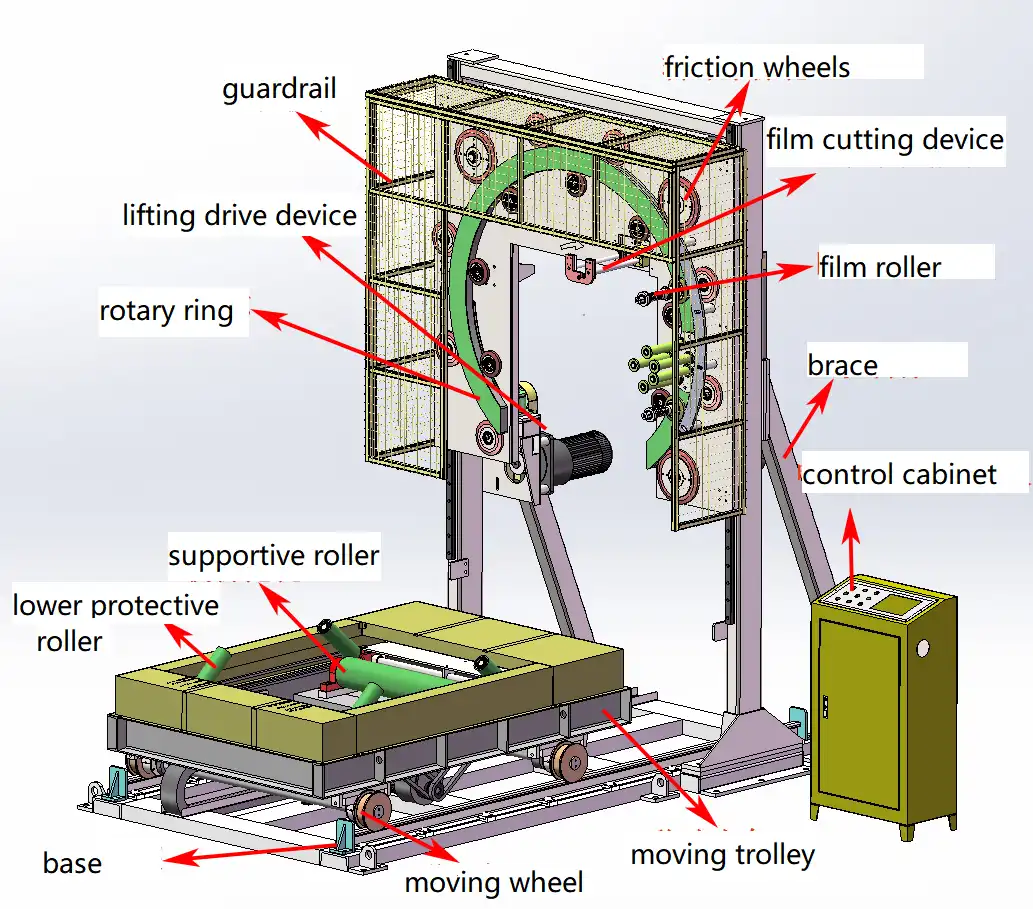
The physical construction of a coil packing machine, the caliber of its constituent components, and the overall engineering integrity are critical factors that not only influence our manufacturing costs and thus the initial price, but also profoundly affect its operational lifespan, reliability, and ultimately, its Total Cost of Ownership (TCO) for the customer. Investing in robust construction and high-quality components, though increasing our production cost, translates to enhanced durability and reduced long-term operational expenditure for the end-user.
A. Build Quality: Frame Construction Materials and Overall Engineering
The structural foundation of the machine plays a vital role in its longevity and ability to withstand the demands of industrial environments. The materials and engineering we invest in directly impact our costs.
Frame Materials:
The choice of material for the machine’s frame is a primary consideration in our design and costing.
- Mild Steel: This is a commonly used material in the construction of coil packing machines due to its cost-effectiveness for us and sufficient durability for many industrial applications.25 To protect against corrosion and wear, mild steel frames are typically painted.25
- Stainless Steel: For applications in harsh or corrosive environments, or where hygiene standards are paramount (such as in the food or pharmaceutical industries, though less common for typical coil packing), stainless steel offers superior corrosion resistance. However, it is generally more expensive for us to source and fabricate than mild steel.16 A stainless steel horizontal flow packaging machine, for example, might be listed in the $3,700-$3,800 range26, while stainless steel coil packing machines can be found from $2,800 to $5,500, depending on size and features.16
The adage “superior materials and construction enhance durability, leading to a higher price” holds true.18 The decision between carbon (mild) steel and stainless steel is often highlighted as a significant cost factor in bagging and packaging equipment.27 Sturdy materials like metal and aluminum are emphasized for enhancing the durability of packaging machinery.28 The choice of frame material is, therefore, a balance between the upfront manufacturing investment and the specific operational environment the machine will face. While stainless steel16 provides enhanced corrosion resistance and a longer lifespan in challenging conditions, it commands a premium price due to higher material and fabrication costs for us. The optimal choice is not solely about which material is inherently “better,” but rather which is “appropriate” for the intended application. For operations in dry, controlled environments, a well-painted mild steel frame may offer perfectly adequate performance and be more cost-effective for us to produce and for the customer to purchase. However, in settings characterized by high humidity, corrosive atmospheres, or stringent hygiene requirements, the higher initial cost of stainless steel can be readily justified to the customer by reduced long-term maintenance, an extended operational life, and the prevention of potential contamination, thereby favorably impacting the machine’s Total Cost of Ownership.
Overall Engineering and Design:
Beyond the frame material, the overall engineering and design contribute significantly to the machine’s robustness and performance, and to our development costs. This includes designing for heavy-duty applications where machines must handle substantial loads and operate continuously.25 Precision engineering is crucial for ensuring the consistent performance and accurate alignment of all moving parts, which is vital for reliable wrapping and minimizing wear. Furthermore, a modular design approach can facilitate easier maintenance, component replacement, and future upgrades, potentially impacting long-term operational costs and adaptability for the customer, though it may increase our initial design complexity.9
B. Quality and Sophistication of Critical Components
The performance, reliability, and lifespan of a coil packing machine are heavily dependent on the quality and sophistication of its critical components, which are a direct cost to us.
Motors and Drives:
The choice of motors and drives impacts both performance and operational cost for the customer. Energy-efficient motors, for instance, can contribute to reduced electricity consumption over the machine’s life.9 Servo motors are often employed for applications requiring precise control over movements, such as traversing systems that guide the wrapping material, thereby enhancing the aesthetic appearance of the packaged coil and ensuring coordinated operation.19 The quality, power rating (e.g., 1 HP, 3 HP, or smaller 0.25 HP motors for specific functions25), and type of motors (e.g., standard AC vs. servo) directly influence the machine’s capabilities and our component costs, thus its price.
Bearings:
High-quality bearings are essential for the smooth and reliable operation of rotating elements, such as wrapping rings or support rollers. They contribute significantly to the machine’s longevity and reduce the likelihood of premature failure.11 The emphasis on the importance of bearing quality for overall machine functionality and the prevention of premature failure suggests that manufacturers who opt for superior bearings will incur higher component costs, which are then reflected in the machine’s price.29
PLC (Programmable Logic Controller) / HMI (Human-Machine Interface):
The “brain” of the machine, the PLC, and its user interface, the HMI, are critical determinants of its intelligence and ease of use, and represent significant component costs for us. Sophisticated PLC systems enable complex automation sequences, management of multiple packaging recipes, intricate process monitoring, and advanced diagnostic capabilities.8 The brand of the PLC itself has a notable impact on cost: Siemens PLCs are generally considered mid-to-high range (with S7-1200 models starting around $500 and S7-1500 models exceeding $2,000), Allen-Bradley (Rockwell Automation) PLCs are positioned in the premium segment ($1,000-$5,000+), Mitsubishi Electric offers affordable to mid-range options ($300-$1,500), and Schneider Electric provides moderate solutions ($400-$2,000+).30 Machines incorporating Siemens PLCs are often highlighted for their capabilities.31 User-friendly HMIs, typically touchscreen interfaces, simplify machine operation, parameter adjustments, and access to diagnostic information, often supporting multiple languages.17 The cost of HMIs also varies, with a 4.3-inch HMI potentially priced around $137-$159, a 7-inch version at $165-$205, and a larger 10.1-inch HMI around $304.32
Sensors:
The type and number of sensors integrated into the machine contribute to its precision and safety, and also to our component costs. Advanced sensors, such as photoelectric, laser, or optical sensors, are utilized for precise coil positioning, accurate dimension detection, ensuring consistent packaging quality, and for safety interlocks.4 Sensors are also employed for functions like automatic end-of-roll detection for packaging materials and initiating automatic splicing where available.4 The sophistication and quantity of these sensors add to the machine’s overall cost.
The selection of PLC and HMI components is not an arbitrary decision for us; it directly reflects the machine’s intended level of control sophistication and, consequently, its price point. Premium PLCs such as the Siemens S7-1500 or Allen-Bradley ControlLogix series30 offer superior processing power, expanded memory capacity, advanced programming functionalities, and enhanced integration capabilities. These high-tier PLCs are often necessary for managing complex, high-speed operations or for machines that are part of highly integrated automated packaging lines.8 As a result, machines equipped with these more advanced control systems will command a significantly higher price compared to those that utilize more basic or budget-friendly PLCs suitable for simpler, standalone operations. The cost of the HMI also scales with its size, resolution, and the range of features it offers.32 This creates a clear price segmentation based on the “intelligence” and control capabilities embedded within the machine.Furthermore, while the incorporation of high-quality motors, durable bearings29, and precise sensors undoubtedly adds to the initial purchase price of the machine, these components are critical for ensuring long-term reliability and minimizing operational downtime for the customer.33 Opting for cheaper, lower-quality components may lead to more frequent breakdowns, increased maintenance expenditures, and costly interruptions in production. Therefore, we position the investment in superior components not merely as an upfront expense for the customer, but as a strategic investment in the machine’s overall lifecycle performance and its Total Cost of Ownership (TCO). The prevention of costly downtime through diligent maintenance, which is intrinsically linked to component quality and wear, underscores this long-term value proposition.33
C. Impact of Build and Component Quality on Machine Lifespan, Reliability, and Total Cost of Ownership (TCO) (Manufacturer’s Perspective on Value)
The initial investment we make in build and component quality has far-reaching implications for the machine’s operational life and the value we deliver.
Lifespan and Reliability:
Machines constructed with superior materials and equipped with high-quality components generally exhibit a longer operational lifespan and greater reliability for the customer. This translates to a reduced frequency of breakdowns and fewer unplanned maintenance interventions.18
Maintenance Costs:
Robust construction and the use of durable parts can lead to lower ongoing maintenance expenses for the customer.18 While a cheaper machine might offer initial savings, it could incur significantly higher repair and upkeep costs over time. It is noted that fully automated solutions might have higher maintenance costs ($5,000-$15,000 per year) compared to semi-automatic ones ($2,000-$5,000 per year) due to their increased complexity, but this is more related to the automation level than an inherent use of lower quality parts in semi-automatic machines.21
Total Cost of Ownership (TCO):
The TCO provides a holistic view of all costs associated with the machine over its entire lifecycle for the customer. This includes the initial purchase price, installation and training costs, energy consumption, packaging material costs, routine maintenance, spare parts, and the often-underestimated costs associated with potential downtime.18 Investing a larger sum upfront in a high-quality, durable machine we produce can often lead to a lower TCO for the customer due to reduced operational issues and extended service life.
The financial repercussions of machine downtime for a customer, often stemming from component failure or inadequate build quality, can far exceed the replacement cost of the failed part or the initial saving on a cheaper machine.33 An illustrative example suggests that just one hour of downtime on a production line can result in losses of $10,000.33 This “hidden multiplier” effect means that opting for a less expensive machine with potentially lower-quality components can be a false economy. The cumulative losses from unscheduled production stops, missed output targets, and emergency repair interventions can rapidly erode any initial price advantage, making a higher-priced, more reliable machine a more prudent long-term investment for the customer. This is a key part of our value communication.
Table 3: Influence of Component Quality and Build on Machine Cost and Longevity (Manufacturer’s Cost vs. Customer Value)
| Aspect/Component | Standard/Basic Option (Lower Mfg. Cost) | Premium/Heavy-Duty Option (Higher Mfg. Cost) | Estimated Impact on Initial Machine Price (Our Pricing Strategy) | Key Long-Term Benefits (Customer Value Proposition) | Impact on TCO (Customer Perspective) |
|---|---|---|---|---|---|
| Frame Construction | Painted Mild Steel | Stainless Steel / Heavy-gauge reinforced mild steel | Baseline / +10-20% (SS) | Standard lifespan / Extended lifespan, corrosion resistance, structural rigidity | Higher potential maintenance / Lower maintenance |
| Main Drive Motors | Standard AC Motors | High-Efficiency AC Motors / Servo Motors | Baseline / +5-15% | Basic control / Higher precision, energy savings, better dynamic response | Standard energy use / Reduced energy costs |
| Control System PLC | Basic PLC (e.g., budget brand) | Advanced PLC (e.g., Siemens S7-1500, Allen-Bradley ControlLogix) | Baseline / +15-30% | Basic automation / Advanced diagnostics, complex recipes, integration capabilities | Higher risk of obsolescence / Future-proof |
| HMI | Small, button-based or basic touchscreen | Large, high-resolution touchscreen with advanced graphics & features | Baseline / +5-10% | Limited interaction / Intuitive operation, better diagnostics, recipe management | Longer learning curve / Easier operation |
| Sensors | Standard Photoelectric Sensors | Laser/Optical Sensors, Vision Systems | Baseline / +5-15% | Standard accuracy / Higher precision, reliability, advanced detection capabilities | More prone to errors / Fewer errors |
| Bearings & Transmissions | Generic or lower-tier brands | Premium brands (e.g., SKF, FAG), oversized for load | Baseline / +5-10% | Standard wear life / Longer life, smoother operation, reduced friction | More frequent replacement / Less downtime |
| Overall Engineering | Standard design practices | Robust design for 24/7 operation, precision assembly, modularity | Baseline / +10-20% | Adequate for intended use / Higher reliability, easier maintenance, potential upgrades | Higher risk of failure / Increased uptime |
This table directly addresses the trade-off between our manufacturing cost, the initial price for the customer, and the long-term value related to build and component quality. It helps to understand that paying more for certain features or component brands 18, 27, 30 is not just an added expense but an investment in durability, reliability, and potentially lower TCO for the customer.33 By providing estimated price impacts and outlining tangible long-term benefits, it empowers users to make more informed decisions beyond just the initial price tag, and helps us justify our pricing for higher-quality machines.
IV. Versatility in Packing Materials and Methods

A coil packing machine’s adaptability to handle a diverse range of packing materials and to employ various packaging techniques significantly influences our design and manufacturing complexity and, consequently, its market price. Greater versatility often translates to a more sophisticated and, therefore, more expensive piece of equipment for us to produce.
A. Capability to Handle Different Packing Materials
Coil packing machines can be designed to work with one or multiple types of protective materials, each suited for different applications and levels of protection. Offering this versatility impacts our design and costs.
Common Materials:
- Stretch Film (LLDPE – Linear Low-Density Polyethylene): This is a very common material due to its cost-effectiveness, ability to create a sealed package, excellent tension control properties, and inherent moisture resistance.4
- VCI (Volatile Corrosion Inhibitor) Paper/Film: Specifically designed to provide corrosion protection for metal coils. VCI materials are often used in conjunction with stretch film to create a multi-layer wrapping system, particularly for steel coils intended for export or storage in humid environments.8
- HDPE/PE (High-Density/Polyethylene) Film (non-glue type): This type of film is used to protect coil surfaces from scratches and abrasions, helping to maintain surface integrity during handling and transport.9
- Woven Fabric/Knit Tape (typically Polypropylene – PP): These materials are known for their strength and flexibility, making them suitable for applications involving rough handling or for coils that require enhanced abrasion protection, such as razor wire or heavy steel coils.8
- Paper (Kraft, Crepe): Various types of paper can be used for wrapping. Crepe paper, for instance, has moisture-absorbing properties and can be used in conjunction with other materials like PE film in through-eye wrapping systems.4
- Strapping (PET or Steel): While not a wrapping material in the traditional sense, straps are often used to secure coils, frequently in combination with wrapping materials for enhanced load stability and security.8
Machine Requirements for Multi-Material Capability:
A machine designed to handle multiple types of packaging materials needs to be more complex for us to engineer and build. It typically requires separate or adaptable dispensing units, distinct tension control systems tailored to the properties of each material, different cutting mechanisms, and potentially varied sealing or joining methods.34 Furthermore, the machine’s control system must be capable of managing adjustable parameters to suit the unique characteristics of each material, such as its thickness, elasticity, and required application force. Our machine specifications often list a range of suitable materials including “Stretch film, Knit tape, woven fabric, HDPE, paper tape etc.,” indicating that multi-material capability is an available and often desirable feature.16 The ability to handle these diverse materials inherently increases design complexity and our manufacturing cost due to the need for more versatile or multiple dedicated handling systems.4 While the direct cost impact of adding, for example, VCI paper application capability isn’t always itemized for the customer, the added functionality and the systems to support it contribute to the overall price we set.
A machine designed to handle a variety of materials, such as stretch film9, VCI paper8, and woven fabric8, cannot rely on a single, universal dispensing and application mechanism. Stretch film, for example, requires specific tensioning rollers and a pre-stretch system. Paper may necessitate different guiding mechanisms and specialized cutters. Woven fabric might require yet another distinct handling system. This functional diversity means the machine must either incorporate a modular design, where different dispensing units can be swapped out (which can add to changeover times and potentially increase our costs due to the need for multiple modules), or feature a more complex, integrated system equipped with multiple dedicated dispensers for each material type.34 Both of these design approaches lead to increased engineering effort, a higher component count, and consequently, a higher machine price when compared to a machine dedicated to handling only a single type of packaging material.
B. Support for Various Packing Methods
Beyond material versatility, machines may be designed to employ one or more distinct packing methods, each adding to our design and production costs.
- Orbital Wrapping: As previously discussed, this involves a ring or shuttle applying material around the coil.
- Shrink Wrapping: This method requires not only the application of a shrinkable film but also a heat source, such as heat tunnels or blowers, to activate the shrinking process.13 The price of shrink wrapping equipment can vary significantly. For instance, a basic heat tunnel oven might cost around $1,50335, whereas fully automatic shrink wrappers for specialized applications like mosquito coils can range from $15,000 to $25,000.7
- Strapping: This involves securing the coil with PET or steel straps and requires dedicated strapping heads, dispensers for the strap material, and mechanisms for tensioning and sealing (welding or mechanical crimping) the straps.8 Standalone electric strapping tools can be purchased for prices ranging from $159 to over $651.36 However, automatic strapping machines designed for integration into packaging lines are considerably more expensive for us to produce and for the customer to buy.15
- Multi-layer Composite Packaging: This advanced technique involves the sequential application of different types of packaging materials (e.g., a layer of film, followed by a layer of paper, then perhaps another layer of fabric) to achieve a specific protective outcome.23 This process demands a sophisticated control system capable of managing the precise sequence of material application and the specific parameters (like tension and overlap) for each layer, increasing our engineering costs.
The integration of multiple packing methods, such as orbital wrapping, shrink wrapping, and strapping, into a single machine or a coordinated line necessitates a more intricate overall design, often involving multiple distinct modules and highly sophisticated control systems. This increased complexity directly translates to higher manufacturing costs for us and a higher final price for the equipment.34 The capability to perform “sequential composite of multiple materials” is recognized as an advanced and desirable feature, indicating its contribution to a higher value and price point.23 Comparing stretch wrapping with shrink wrapping, it’s noted that shrink wrapping often requires more specialized and costly equipment, such as heat tunnels, in addition to the film application system.37A machine that only performs wrapping (e.g., applying stretch film) is fundamentally different in complexity and cost for us to build from one that also incorporates a strapping function.8 Strapping involves entirely distinct mechanical actions—feeding the strap, tensioning it to the correct degree, and then sealing or welding it—and requires different material handling systems for the straps themselves.36 Integrating these two disparate functions into a single, automated packaging line15 demands a significantly higher level of mechanical engineering and control system sophistication from our side. This often means, in effect, having two specialized machine sections working in tandem, which can almost double the core machinery involved. Such a combined system would naturally be positioned in a much higher price bracket compared to a standalone wrapping machine or a standalone strapping machine.
C. Design Complexity and Cost Implications of Multi-Material/Multi-Method Machines
The drive for versatility in handling multiple materials and employing various packing methods inevitably leads to increased machine complexity and manufacturing cost for us.
- Increased Component Count: A greater number of dispensers, applicators, cutters, sensors, actuators, and other specialized mechanical parts are required to manage the different materials and processes, increasing our bill of materials.34
- Sophisticated Control Systems: The PLC and associated software must be capable of managing a wider range of variables, more complex operational sequences, and a greater number of potential fault conditions that can arise from the interaction of multiple systems, adding to our programming and testing costs.34
- Larger Machine Footprint: Accommodating multiple material handling systems and processing units may necessitate a larger overall machine size, impacting factory floor space requirements for the customer.
- Higher Engineering and Manufacturing Costs: The design, assembly, and rigorous testing of more complex, multi-functional machines are inherently more time-consuming and resource-intensive for us, leading to higher development and production costs.34
- Price Premium: Consequently, machines that offer enhanced versatility in terms of the materials they can handle and the packing methods they can employ will command a higher market price, reflecting their increased capability, the complexity we manage in production, and the broader range of packaging solutions they can provide.4
For each additional type of packaging material a machine is designed to handle (e.g., adding VCI paper capability to a machine already equipped for stretch film8) or for each distinct packing method it incorporates (e.g., adding a strapping function to a wrapping machine8), there is an incremental increase in our design complexity, the number of required components, and the sophistication of the control system programming.34 This is not a flat “versatility fee” but rather a cumulative cost for us. A machine engineered to handle three different types of materials and perform two distinct packing methods will be substantially more expensive for us to build, and thus for the customer to purchase, than a machine designed for a single material and a single method. This price difference arises from the compounded engineering challenges and the additional hardware requirements. Therefore, we help buyers carefully assess whether the operational flexibility and the ability to cater to a diverse range of products and packaging specifications justify the added investment for such versatile machinery.
Table 4: Cost Implications of Packing Material and Method Versatility (Manufacturer’s Cost & Pricing View)
| Machine Capability Level | Key Design Additions/Complexities (Our Mfg. Effort) | Estimated Relative Price Impact (vs. Basic Single Material/Method) (Our Pricing) | Primary Benefit of Added Capability (Customer Value) | Considerations for Justifying Cost (Customer Decision) |
|---|---|---|---|---|
| Single Material – Stretch Film Only | Standard dispenser, tension control, cutter (Baseline Mfg. Cost) | Baseline | Basic protection, containment | Low-cost, high-volume applications with standard protection needs |
| Dual Material – Stretch Film + VCI Paper | Additional dispenser for paper, specific guides/cutters, potential for dual-head application (Increased Mfg. Cost) | +15-30% | Corrosion protection in addition to containment | Export shipments, long-term storage, products susceptible to corrosion |
| Multi-Material – Film, Paper, Woven Fabric | Multiple specialized dispensers, complex material feed paths, advanced tension/cutting for each (High Mfg. Cost) | +30-60% | Versatile protection for varied surfaces, abrasion resistance, moisture control | Diverse product range with different protection needs, demanding handling conditions |
| Single Method – Orbital Wrap Only | Standard wrapping unit (ring/shuttle) (Baseline Mfg. Cost) | Baseline | Standard containment and surface protection | General coil packaging, palletizing (for pallet wrappers) |
| Dual Method – Orbital Wrap + Strapping | Integrated strapping head(s), separate material feed for straps, synchronized controls (Significant Mfg. Cost Increase) | +50-100% | Securement against uncoiling/shifting, plus surface protection | High-value coils, heavy coils needing robust securement, prevention of telescoping |
| Multi-Method – Wrap, Shrink, Strap (Integrated Line) | Multiple distinct processing stations (wrapping, heating/shrinking, strapping), complex conveying & sequencing logic (Very High Mfg. Cost) | +100-200% or more | Ultimate protection: containment, tamper evidence, robust securement | High-value products, retail presentation needs, maximum protection against all transit hazards |
This table helps to understand the direct link between a machine’s versatility and its price from our manufacturing standpoint. By breaking down capabilities from simple to complex and associating them with design implications and relative cost increases 4, 34, it provides a clearer picture of how much “extra” manufacturing cost is incurred for added functionalities like VCI paper application 8, 9, 38, 39 or integrated strapping 8, 15, which then influences our pricing. The “Benefit” and “Considerations” columns assist customers in weighing if the added cost aligns with their specific packaging requirements and product characteristics.
V. Advanced Functionalities and System Intelligence
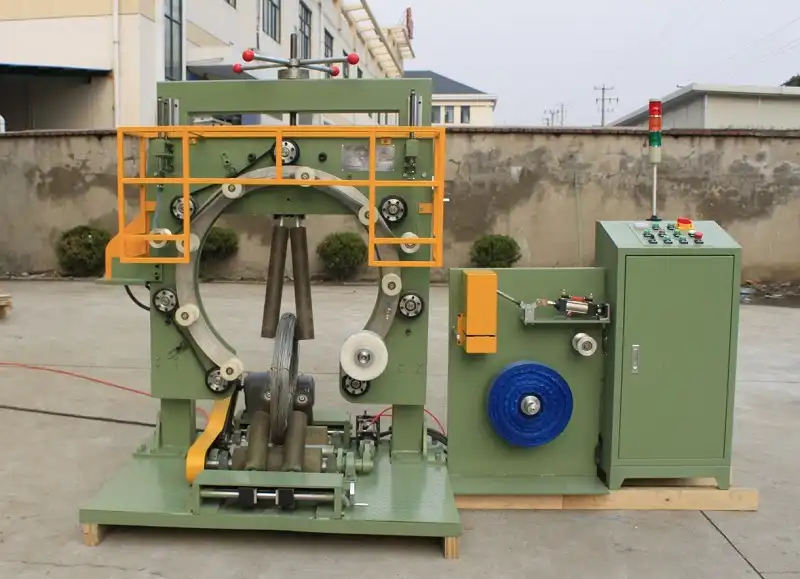
The sophistication of a coil packing machine’s software, the capabilities of its control system, and the inclusion of value-added intelligent features significantly contribute to our development and production costs, and thus to its overall price. These advanced functionalities can offer substantial benefits to the customer in terms of improved operational efficiency, easier troubleshooting, enhanced safety, and data-driven insights for process optimization.
A. Sophistication of Control Systems (PLC Programming, HMI User Interface) and Sensor Technology
The level of intelligence embedded in the machine is largely determined by its control system and sensor array, which are key cost components for us.
PLC Programming Complexity:
The heart of the machine’s automation, the PLC, can range from basic units executing simple sequences to highly advanced controllers capable of managing multiple complex packaging recipes, intricate wrapping patterns, seamless integration with other machinery, and comprehensive diagnostic functions.8 For instance, intelligent adjustment of wrapping material tension systems based on the changing diameter of the coil during wrapping requires sophisticated PLC logic we develop.23 Similarly, machines that can automatically adjust wrapping parameters according to the detected size of the incoming coil demonstrate a higher level of programming complexity on our part.5
HMI User Interface:
The interface between the operator and the machine can vary from simple arrays of buttons and indicator lights to intuitive, graphical touchscreen HMIs. Advanced HMIs offer features like clear visualization of machine status, easy management of packaging recipes, detailed diagnostic information, and support for multiple languages, all of which simplify operation and reduce the likelihood of operator error.17 As expected, more advanced HMIs, typically characterized by larger screen sizes, higher resolution, and more extensive software features, contribute to a higher machine cost due to higher component and development expenses for us.32
Sensor Technology:
The type and sophistication of sensors employed are crucial for precise and reliable operation, and represent a cost for us. Basic sensors might be used for simple presence/absence detection of coils. In contrast, advanced sensor technology, including laser scanners or optical systems, can be used for precise coil positioning, accurate measurement of coil dimensions (ID, OD, width), and ensuring the consistency of the applied packaging.8 Furthermore, specialized sensors are used for functions like the automatic detection of the end of a roll of packaging material, which can trigger an alarm or even an automatic splicing process in highly automated systems.4 The number, type, and sophistication of these sensors directly add to the machine’s cost but also to its autonomous capabilities and operational precision.
Features often marketed as “smart,” such as automatic size adjustment based on coil dimensions5, intelligent tension control that adapts to the coil’s characteristics23, and real-time parameter adjustments driven by sensor feedback9, inherently require greater processing power and more sophisticated algorithms within the PLC. This, in turn, necessitates our use of higher-tier PLCs, like the Siemens S7-1500 or Allen-Bradley ControlLogix series30, and more advanced, accurate sensors.8 These higher-grade components are intrinsically more expensive for us to procure, thus driving up the cost of machines equipped with such intelligent capabilities. The HMI must also be capable of effectively displaying and allowing operator interaction with these advanced functions, further contributing to the overall system cost.32
B. Value-Added Features (e.g., Automatic Fault Diagnosis, Remote Monitoring, Data Logging)
Beyond core operational controls, many modern coil packing machines we design offer advanced features that enhance maintainability, oversight, and data utilization for the customer, adding to our development costs.
Automatic Fault Diagnosis:
Systems equipped with automatic fault diagnosis can detect operational errors or component malfunctions, immediately alert the operator (often via the HMI), and, in some advanced cases, pinpoint the likely location or cause of the fault. This capability significantly reduces troubleshooting time and minimizes production stoppages for the customer.19
Remote Monitoring and Control (RMM):
The integration of IoT (Internet of Things) connectivity allows for off-site monitoring of the machine’s operational status, key performance indicators (KPIs), and diagnostic information. This can enable remote technical support from us, facilitate proactive maintenance scheduling, and in some cases, allow for remote adjustments or software updates.40
Data Logging and Reporting:
Advanced machines can collect and log a wide range of production data, such as the number of coils packaged, cycle times per coil, consumption of packaging materials, and instances of errors or downtime. This data can be invaluable for performance analysis, quality control documentation, and identifying areas for process improvement for the customer.40
Predictive Maintenance:
By utilizing data from various sensors (monitoring parameters like vibration, temperature, or motor current), some systems can employ algorithms to predict potential equipment failures before they occur. This allows maintenance to be scheduled proactively, preventing unexpected breakdowns and optimizing maintenance resources for the customer.40
These value-added features, while increasing our initial development and component costs, and thus the machine’s price, are increasingly seen as significant differentiators. Advanced diagnostics, remote connectivity, and predictive maintenance capabilities are moving beyond being luxury add-ons to becoming key value propositions for modern industrial machinery. They promise tangible benefits such as reduced operational downtime, optimized maintenance schedules, and improved Overall Equipment Effectiveness (OEE) for the customer. While these functionalities require a greater initial investment, the potential savings derived from preventing a single major breakdown or from consistently optimizing machine performance can quickly justify the higher upfront cost for many manufacturing operations. As manufacturers, offering these intelligent features allows us to position our machines as “smarter,” more reliable, and better prepared for the future demands of interconnected manufacturing environments.
C. Cost and Benefits of Integration with Higher-Level Systems (MES/ERP)
For businesses operating within a digitally integrated manufacturing environment, the ability of a coil packing machine to communicate with higher-level enterprise systems is a critical factor, and a capability we can offer at an additional cost.
MES (Manufacturing Execution System) Integration:
Connecting the coil packing machine to the factory’s MES allows for real-time exchange of data. This can include sending production status updates from the machine to the MES, and receiving production orders or packaging specifications from the MES to the machine. Such integration enables better production scheduling, more accurate tracking of work-in-progress, improved performance monitoring, and enhanced quality management for the customer.23
ERP (Enterprise Resource Planning) Integration:
Linking the packaging operation to the company’s ERP system facilitates the alignment of packaging activities with broader business processes. This can include updating inventory levels of packaged goods in real-time, linking packaging material consumption to procurement systems, and associating packaging operations with specific customer orders for improved traceability and fulfillment.23
Cost of Integration:
The process of integrating a machine with MES or ERP systems is often a complex undertaking for us and the customer. It typically involves software development for Application Programming Interfaces (APIs) or custom connectors, ensuring robust network infrastructure, and potentially implementing middleware solutions to facilitate communication. The costs can be substantial, encompassing hardware, software licenses for the integration modules, and significant service fees for implementation, testing, and validation.41
Benefits of Integration:
Despite the costs, successful integration yields numerous benefits for the customer, including improved operational visibility across the enterprise, better-informed decision-decision based on real-time data, streamlined workflows between production and business functions, reduced waste through better coordination, and enhanced traceability for compliance and quality assurance purposes.42
It is crucial for customers to understand that integrating a [coil packing machine](Coil Packing Machine “coil packing machine”) with enterprise-level MES or ERP systems23 is rarely a simple “plug-and-play” addition that is included in the machine’s base price. More often, it constitutes a separate and significant project that requires careful planning and budgeting. This project typically involves contributions from the company’s IT department, process engineers, and potentially external system integrators. While the coil packing machine itself must be “integration-ready”—meaning it possesses the necessary communication protocols (e.g., OPC UA, MQTT) and a PLC capable of such data exchange (which we ensure in such models)—the bulk of the cost and effort usually lies in the enterprise-level system integration work, as illustrated by the MES cost breakdown example.41 Therefore, buyers considering such integration must allocate a distinct and often substantial budget for this scope of work, above and beyond the purchase price of the coil packing machine itself.
VI. Customization, Integration, and Auxiliary Systems
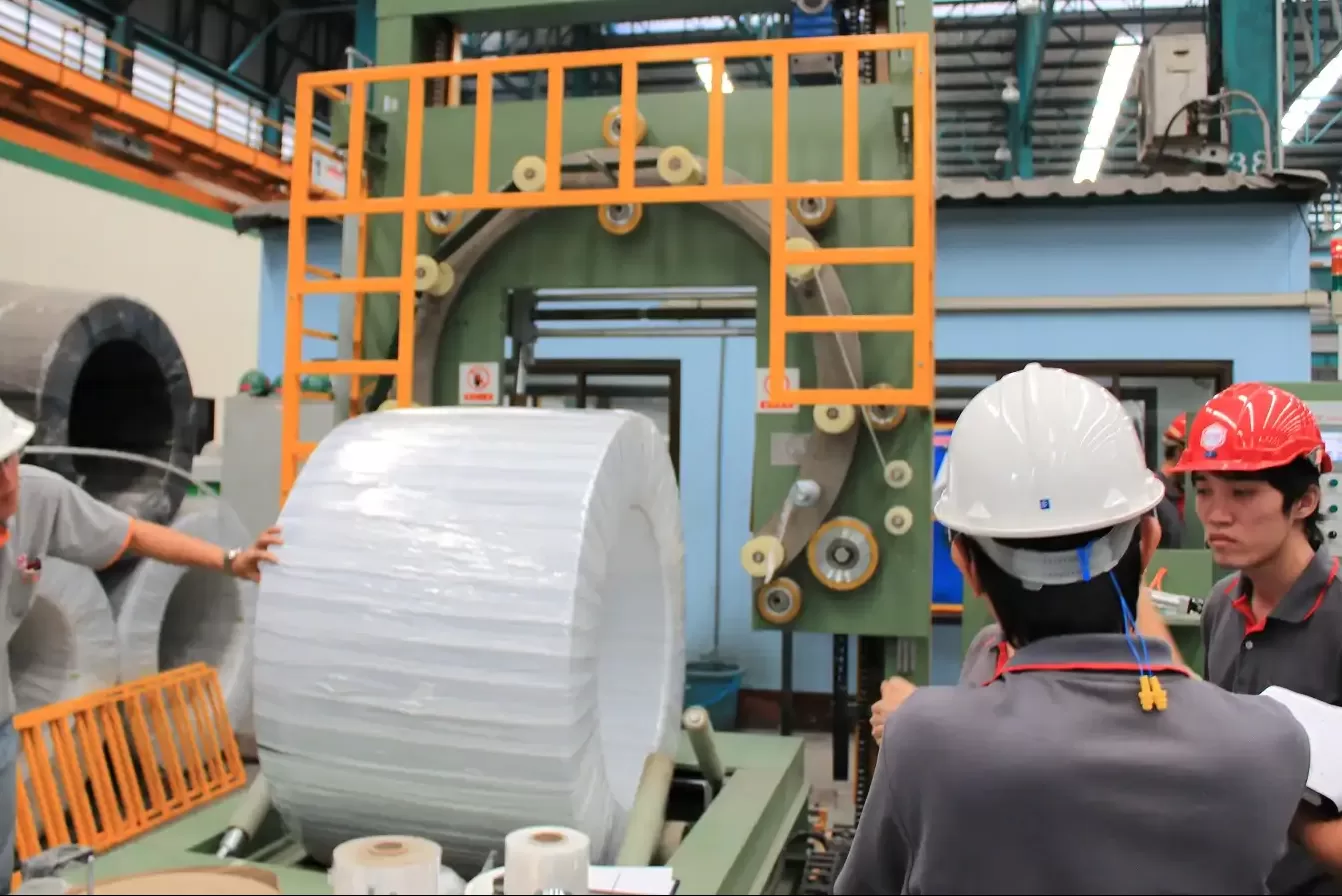
The final price we set for a coil packing machine is significantly influenced by the extent to which it is tailored to unique operational needs, how seamlessly it can be fitted into existing production workflows, and the array of necessary support equipment (auxiliary systems) required for its optimal functioning. These elements often transform a standard machine into a bespoke solution, with corresponding cost implications for us and the customer.
A. Customization to Meet Specific Production Needs
While we offer standard models, many production environments have unique requirements that necessitate customization, which impacts our engineering and manufacturing costs.
Tailoring to Coil Specifications:
Adjustments are often needed for coils with non-standard dimensions (ID, OD, width), unusual weights, or specific material characteristics, such as very delicate surfaces that require gentle handling or unusually shaped coils that demand specialized support or wrapping approaches.4
Specialized Wrapping Patterns or Requirements:
Businesses may require unique packaging outcomes, such as specific overlap percentages for the wrapping material to ensure a certain level of protection, precise placement of additional protective materials (e.g., edge protectors), or the integration of labeling or marking devices that apply identification directly during or immediately after the packing process.2
Environmental Considerations:
The operating environment can dictate modifications. For example, machines intended for use in extreme temperatures (hot or cold), high humidity conditions, or controlled cleanroom environments may require special materials, seals, or electronic enclosures from our side.
Cost Impact:
Customization invariably involves additional design and engineering effort from our team, and potentially the sourcing or fabrication of specialized components, all of which lead to higher prices compared to standard, off-the-shelf models.4 Some manufacturers explicitly state that machine dimensions, weight, and critical features like arch size can be customized to meet specific requirements.43 Furthermore, personalized layout customization, such as designing the packaging line in a U-shape or L-shape to fit a specific factory floor plan, is also a form of value-added customization that impacts our costs and thus the price.23
Our standard coil packing machines are typically designed to accommodate common coil types and a predefined range of sizes. When a buyer’s requirements deviate significantly from these norms—for instance, if they need to process extremely large or unusually small coils, handle coils with unconventional shapes, implement a very specific multi-material layering sequence not offered as a standard feature, or integrate the machine into a unique factory layout with tight spatial constraints23—we must undertake bespoke design and engineering work.4 This process moves beyond simple parameter adjustments on a standard machine and often involves re-engineering core components or developing entirely new control logic. This “specificity premium” can be substantial because it encompasses non-recurring engineering (NRE) costs for us. Unlike mass-produced components where development costs are amortized over a large number of units, NRE costs for custom solutions are typically spread over a single machine or a very small batch, thus significantly increasing the price of the tailored equipment.
B. Costs Associated with Integrating the Coil Packing Machine into Existing Production Lines
Integrating a new coil packing machine into an established production line is often more complex than a standalone installation and carries associated costs, which we may quote as part of a larger project.
Physical Integration:
This involves ensuring the new machine physically fits within the available factory footprint and aligns correctly with the existing material flow from upstream processes and to downstream stations.4 In some cases, modifications to the existing line layout may be necessary to accommodate the new equipment.
Control System Integration:
A critical aspect is synchronizing the operation of the coil packer with upstream equipment (such as coilers, slitters, or decoilers) and downstream systems (like palletizers, strapping stations if separate, or further conveying systems).4 This requires compatible communication protocols between the different machines’ PLCs and may involve custom programming to ensure smooth handoffs and coordinated operation.
Safety System Integration:
It is imperative that safety systems, such as emergency stops and protective guarding, are integrated and coordinated across all connected machinery to ensure operator safety throughout the entire line.
Cost Factors:
The costs associated with integration include fees for specialized engineering services for planning and execution, the deployment of skilled technicians for installation and commissioning, and potentially the cost of production downtime on the existing line during the integration process.4 Prices for fully integrated lines can be significant; for example, an “Integrated System Production Line Automatic Packaging Line” is listed with a starting price of $20,000 per piece44, and a more specialized coiling and film wrapping integrated machine can cost between $39,000 and $42,000.45
The complexity and cost of integrating a new coil packing machine can escalate significantly if there is a substantial “age gap” or “brand diversity” within the existing production equipment.4 Attempting to integrate a state-of-the-art coil packing machine, likely equipped with modern PLCs and standard communication protocols like Ethernet/IP, into an existing line that comprises older machinery using outdated or proprietary control systems, or equipment from various manufacturers employing disparate communication standards, presents a considerable challenge. Such scenarios may necessitate our development of custom “translation” gateways or protocol converters, the reverse-engineering of existing interfaces, or even the partial upgrade of older equipment on the line to ensure compatibility. This disparity in technology and vendor standards can transform a seemingly straightforward integration task into a complex and expensive systems integration project, adding unforeseen costs and delays for the customer.
C. Price Impact of Necessary Auxiliary Equipment
For a coil packing machine to function effectively, especially in automated or semi-automated environments, various pieces of auxiliary equipment are often required. The cost of this support equipment, if supplied by us, can be substantial and must be factored into the overall project budget.
Conveyors:
Used for the automatic transport of coils to the packing station and for moving packaged coils away to the next stage (e.g., storage or shipping). Conveyor costs vary based on type (e.g., roller, belt, chain), length, width, load-bearing capacity, and the level of control and automation integrated into them.4
Tilters/Upenders:
These devices are used to change the orientation of coils, for example, from an “eye-to-sky” position (common after some coiling processes) to an “eye-horizontal” position required for certain types of through-eye wrappers, or vice-versa for subsequent handling or palletizing.4 The price for coil upenders and tilters varies widely depending on their capacity, mechanism (mechanical, hydraulic, electrical), and degree of automation. Simpler mechanical upenders might start from around $1,000-$3,00046, while automatic electrical coil tilters can range from $10,000 to $20,000. Heavy-duty hydraulic units capable of handling very large coils can cost from $35,000 up to $70,000 or more.46 A broader price spectrum for upending equipment is indicated from $0 (likely for very simple manual aids) up to $35,163.47
Loading/Unloading Systems:
These can range from manual aids, such as designated areas for crane or forklift loading (as mentioned in4), to semi-automated systems like lift tables, or fully automated robotic loading and unloading systems integrated with conveyors.4
Strapping Units:
If strapping is required for additional security and is not an integrated function of the main wrapping machine, a separate standalone or inline strapping machine will be needed. Automatic strapping machines designed for coil applications can be integrated into a packaging line.15 For less automated needs, handheld electric strapping tools are available, costing approximately $159 to $652+.36
Palletizers/Stackers:
For operations requiring the automatic stacking of wrapped coils onto pallets for storage or shipment, dedicated palletizing or stacking machines are necessary. These can range from simple stacking aids to sophisticated robotic palletizers.4
In the context of fully automated or highly integrated packaging lines4, the cumulative cost of the necessary auxiliary equipment—which can include robust conveyor systems, heavy-duty upenders or tilters (with some models costing up to $70,00046), automated strapping stations, and robotic palletizing cells48—can often rival or even surpass the price of the core coil packing machine itself. Buyers frequently concentrate on the quoted price of the primary wrapping unit but must adopt a holistic budgeting approach that encompasses the entire system required to achieve their desired level of automation and seamless material flow. The indicative price of $20,000 for an “Integrated System Production Line”44 likely includes several such auxiliary components, underscoring their significant contribution to the total investment.
VII. Manufacturer Profile and Service Ecosystem
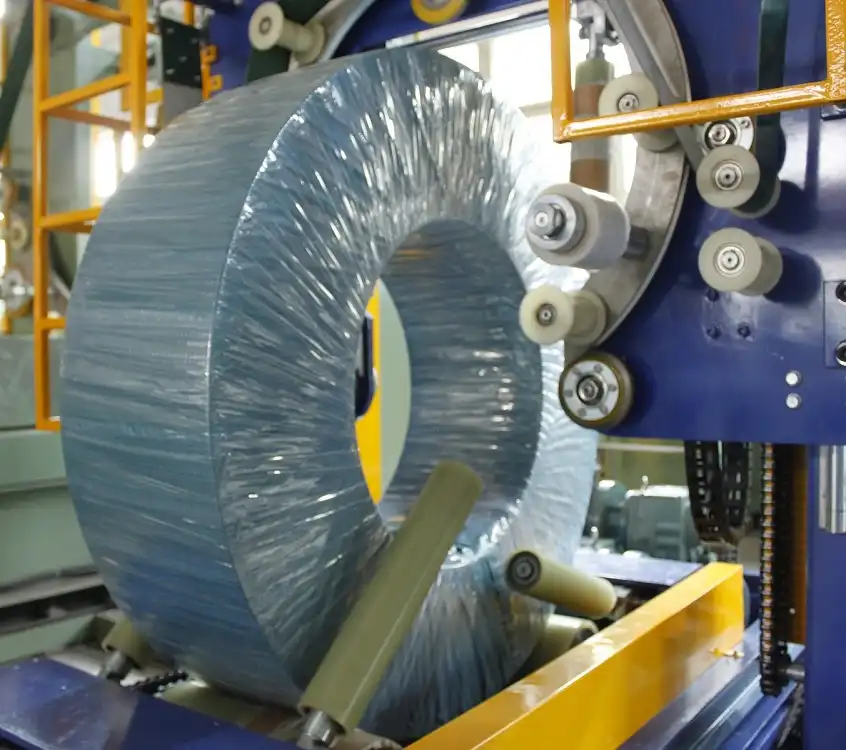
Beyond the tangible specifications of the machine itself, factors related to us as the manufacturer—such as our brand reputation, market standing, and country of origin—along with the comprehensiveness of the services we offer, can exert a considerable influence on the price of coil packing machines. These elements often reflect intangible value, such as trust, reliability, and long-term support, which we build into our pricing structure.
A. Influence of Manufacturer’s Brand Reputation, Market Presence, and Country of Origin on Pricing
Our identity and background play a significant role in shaping price expectations and actual costs.
Brand Reputation:
As well-established brands that have cultivated a strong reputation for quality, reliability, technological innovation, and customer satisfaction, we often position our machinery at higher prices.18 Customers are frequently willing to pay a premium for the perceived lower risk, assurance of consistent performance, and the expectation of better long-term value associated with renowned names in the industry, such as Fhopepack and Shjlpack, which are noted as dominant market leaders.49 Market analyses suggest that top industrial brands can often charge price premiums ranging from 5 to 10 percent over lesser-known competitors.50
Market Presence:
Our robust global or significant regional market presence may allow us to benefit from economies of scale in production, potentially enabling more competitive pricing on standard models. However, our strong market position, established demand for our products, and extensive service networks also provide us with the leverage to price advanced or customized solutions accordingly.49
Country of Origin:
Our geographical origin of manufacturing impacts price. Machines produced in countries known for high engineering standards, advanced technology, and higher labor costs (e.g., Germany, Italy, the United States) have historically been priced higher than those manufactured in regions with lower labor and production costs (e.g., China, India).51 The “Made in [Country]” label influences perceptions of quality and, consequently, the price a machine can command.51 Furthermore, international trade policies, such as tariffs, can directly affect the landed cost of machinery imported from specific countries, irrespective of their intrinsic manufacturing cost, which we must factor into our pricing for different markets.52 For example, the U.S. has imposed varying tariffs on packaging machinery from different countries, which buyers must factor into their overall investment.52
Buyers are often prepared to pay a premium for machines from highly reputable manufacturers like us18 not solely for the tangible features and specifications of the equipment, but also for a range of intangible benefits we provide. These include a greater level of trust in the machine’s reliability and expected operational lifespan, confidence in the quality of our after-sales service, and the assurance of readily available spare parts and technical support. This “brand premium” effectively acts as a form of insurance against the significant business risks associated with operational downtime, subpar performance, or a lack of adequate support from the supplier. These risks can prove far more costly in the long run than the initial price difference for a machine from a leading brand. The 5 to 10 percent premium that top industrial brands can command, as noted by McKinsey50, is a quantifiable reflection of this value perception.Concurrently, the influence of a machine’s country of origin on its pricing is becoming increasingly nuanced. While historically, machinery from certain Western industrialized nations was often priced higher due to perceptions of superior quality and higher manufacturing costs for us, and machines from some Asian countries were generally cheaper, this distinction is becoming less clear-cut. The globalization of supply chains means that components for a machine may be sourced from multiple countries, with final assembly occurring in yet another.51 This “hybrid model” can make it more challenging to determine the true “origin” and its direct impact on quality and cost. Moreover, geopolitical factors, such as the imposition of tariffs52, can artificially inflate the prices of machines from specific countries, regardless of their inherent manufacturing cost or quality. These dynamics make direct price comparisons based solely on the stated country of origin more complex and require a deeper investigation into the manufacturer’s overall value proposition.
B. Impact of Included Services: Installation, Operator Training, Warranty Terms, and After-Sales Support
The scope and quality of services we bundle with the machine purchase are significant value components that also affect the overall cost we charge.
Installation:
Professional installation services, which can include machine setup, connection to power and other utilities, and initial integration with existing line components, may be included in our quoted price or offered as an optional add-on. The complexity of the installation directly impacts its cost to us and thus the price.53
Operator Training:
Comprehensive training for machine operators and maintenance staff is crucial for ensuring efficient operation, adherence to safety protocols, and maximizing the machine’s lifespan. We may provide this training on-site at the customer’s facility or remotely. The inclusion and extent of such training programs affect the overall value and potentially the price of the package.53
Warranty Terms:
The duration and comprehensiveness of our manufacturer’s warranty (e.g., 1-year, 2-year, or even longer warranties are sometimes offered, as seen in various equipment listings7) can influence the machine’s price. A more extensive warranty provides greater peace of mind and protection against unforeseen defects or failures but may be factored into a higher initial purchase cost.54
After-Sales Support:
The availability and quality of ongoing technical support we provide (via phone, email, video conferencing, or on-site service calls), the presence of local or regional service centers, and the offering of preventative maintenance agreements are key considerations for buyers.4 Manufacturers like us with robust and responsive support networks typically offer greater value, and this level of service infrastructure may be reflected in our pricing. Relying on a single vendor like us for both equipment and consumables, along with a unified service team, can potentially reduce long-term operational costs and improve efficiency for the customer, even if the initial system cost is higher.55
We often “bundle” services such as installation, basic operator training, and a standard warranty period into the machine’s quoted price.53 While this approach can simplify the initial quotation and purchasing process for the buyer, it can also make it more challenging to discern the true “machine-only” cost for direct comparison purposes with other vendors who might itemize these services separately. However, these bundled services, particularly from reputable manufacturers like us with strong support networks9, provide significant intrinsic value. They help to reduce implementation risks, ensure a smoother and quicker startup phase, and provide a baseline of support. A seemingly cheaper machine from a supplier offering minimal or unbundled services might ultimately end up costing more once essential services like installation, comprehensive training, and an adequate warranty are procured separately. Therefore, prospective buyers should always seek clarity from vendors regarding precisely which services are included in the base price versus those that are considered optional extras.
C. Availability and Cost of Spare Parts and Ongoing Maintenance
The long-term operational viability and cost-effectiveness of a coil packing machine are heavily influenced by the availability and cost of spare parts we provide, as well as the nature of its ongoing maintenance requirements.
Spare Parts Availability:
Easy and timely access to genuine (OEM) spare parts from us is crucial for minimizing machine downtime in the event of a component failure.25 Manufacturers like us with well-stocked local or regional distribution centers, or those with efficient global logistics for spare parts, are generally preferred.
Cost of Spare Parts:
The price of common wear parts (such as belts, rollers, sensors, cutting blades) and major components will significantly impact the long-term operational costs of the machine for the customer.53 Some equipment listings may mention the inclusion of “free spare parts”56, though this is typically for an initial period or a limited set of specific components.
Maintenance Requirements and Costs:
Machines designed with user-friendliness in mind for routine maintenance tasks, such as those featuring centralized lubrication points or automatic lubrication systems, can help reduce the labor costs associated with upkeep for the customer.23 Regular maintenance activities typically include cleaning, lubrication, inspection, and the periodic replacement of worn parts.9 Indicative annual maintenance costs for semi-automatic wrappers are cited in the range of $2,000-$5,000, while more complex fully automatic machines might incur maintenance costs of $5,000-$15,000 per year.21
A potential long-term cost trap can arise if a machine relies heavily on highly proprietary spare parts that are only available from the original equipment manufacturer (OEM) at a significant markup, or if the manufacturer has a limited or poorly responsive service network.4 In such scenarios, buyers can face not only high costs for replacement parts but also extended periods of machine downtime while waiting for parts to arrive or for service technicians to become available. This represents a hidden cost that is not apparent in the initial purchase price of the machine. As manufacturers, we aim to mitigate this by ensuring reasonable availability and pricing for our spare parts and by maintaining a responsive service network. Opting for machines that utilize some standardized, readily available components where appropriate, or choosing manufacturers known for their strong, accessible support infrastructure and efficient parts distribution49, can help mitigate this risk for the customer. This might be a prudent strategy even if the initial price of the machine is slightly higher, as it can lead to lower overall TCO and improved operational resilience.
VIII. Navigating the Price Spectrum: From Basic to Advanced Solutions

The price we set for coil packing machines can span a very wide range, reflecting the vast differences in our manufacturing costs, the capabilities we build in, their complexity, and the value they deliver to the customer. This section aims to provide an overview of typical price ranges one might encounter, linking these ranges to the various determining factors discussed previously, and emphasizing how we help customers balance upfront costs with long-term operational value.
A. Illustrative Price Ranges for Different Categories of Coil Packing Machines
It is important to note that prices can vary significantly based on specific configurations, manufacturer (including us), and market conditions. The following ranges are indicative and aim to provide a general perspective on how we position our products.
Entry-Level / Manual / Basic Semi-Automatic:
These machines are typically suited for operations with lower production volumes, smaller or lighter coils, or where the initial capital investment is the primary purchasing driver. We produce these with simpler mechanics and controls, leading to lower manufacturing costs.
Prices in this category can range from a few hundred dollars for very basic manual strapping tools36 or simple wrapping aids, up to approximately $8,000 – $12,000 for entry-level coil wrappers (e.g., “BudgetWrap” models mentioned in18). Some listings on online B2B platforms like Alibaba show machines marketed for tyre, PE pipe, or cable coil wrapping for as low as $880-$995.7 However, these ultra-low prices likely correspond to very basic, light-duty machines, or may not include all necessary components or services. For comparison, a manual pallet wrapper is priced around $4,720.20
Mid-Range / Semi-Automatic / Basic Automatic:
This category generally offers a balance between the level of automation, included features, and overall cost. These machines are often suitable for businesses with moderate production volumes that require more efficiency than manual methods but may not need full-scale, high-speed automation. Our manufacturing costs are moderate for these.
Prices in this tier might range from approximately $15,000 to $30,000 for semi-automatic wrappers21, or for some automatic coil wrappers like those from FHOPEPACK in the $15,000-$25,000 bracket.18 Certain Dixin Machinery models (e.g., DP-300GD to DP-600GW), designed for coils up to 500kg, are listed with prices between $2,800 and $5,50016; this price point seems low for “automatic” machines unless it refers to a very specific type or a very basic level of automation. Vertical automatic packaging machines for tire and coil wrapping have been seen in the $3,250-$4,500 range.57 An MS Wire Coil Stretch Wrapping Machine, described as “Automatic Grade,” is priced at 340,000 INR (approximately $4,100 USD).25
High-End / Fully Automatic / Integrated Lines:
These solutions are designed for high-volume, demanding industrial applications that require robust construction, advanced features, sophisticated control systems, and often, seamless integration into existing or new production lines. These represent our most complex and costly machines to produce.
Prices for such systems typically start from $30,000 and can go significantly higher.18 Fully automated wrapping machines can range from $75,000 to $200,000 or even more for very high-volume or specialized operations.21 Specific examples include an Automatic Slit Steel Coil Packing Machine listed at $20,0007, and integrated automatic packing lines also starting around $20,000.44 High-speed wire coiling and wrapping integrated machines can be priced from $39,000 to $50,000 or more 22. Comprehensive steel coil packing lines from major, reputable manufacturers can easily range from $30,000 to $80,000 and upwards, depending on the scale and complexity.58
A notable observation when researching prices is the potential discrepancy between figures found on broad B2B online marketplaces (such as Alibaba and Made-in-China7) and indicative prices derived from more specialized industry analyses or direct discussions with established manufacturers like us. Online platform listings often showcase machines at significantly lower price points (e.g., a “Stretch Film Wrapping Packing Wrapper Machine for Tyre/PE Pipe/Cable Coil” for $8807) compared to the ranges suggested for semi-automatic ($15,000-$30,000) or fully-automatic ($75,000-$200,000+) machines in other contexts.21 This disparity can arise from several factors: the listed online prices might be for very basic models with limited functionality, they could be FOB (Free on Board) prices that exclude shipping, installation, and commissioning, they might be applicable only for minimum order quantities, or in some instances, they could be promotional or “clickbait” prices. Therefore, prospective buyers should treat these online marketplace prices as very rough initial indicators and always endeavor to obtain detailed, formal quotations directly from manufacturers like us. Such quotes should clearly specify all included features, components, capabilities, warranty terms, and service provisions to allow for a realistic and comparable assessment of the true investment required.
B. Balancing Initial Purchase Price with Long-Term Operational Costs and Value (Our Guidance to Customers)
A prudent investment decision extends beyond merely comparing initial price tags. We encourage customers to conduct a careful evaluation of long-term operational costs and the overall value delivered by the machine over its lifespan.
Total Cost of Ownership (TCO):
It is crucial to reiterate that the machine with the lowest upfront purchase price may not necessarily be the most cost-effective solution in the long run.18 A comprehensive TCO analysis should consider all relevant cost factors, including initial purchase and installation, energy consumption, packaging material usage and waste, routine maintenance and repair expenses, spare parts costs, labor requirements, and the potential financial impact of machine downtime. We often help customers with this analysis.
Value of Reliability and Uptime:
For operations where packaging is a critical bottleneck or where production continuity is paramount, the premium paid for a highly reliable machine from a reputable manufacturer like us, with robust support, can be easily justified by the avoidance of costly production stoppages and associated losses.33
Scalability and Future Needs:
When making an investment, it is wise to consider not only current production requirements but also anticipated future needs. Investing in a machine that offers some degree of scalability, perhaps through modular design or a capacity that slightly exceeds current demand, can be more prudent than purchasing a machine that only just meets today’s minimal needs, thereby avoiding the need for premature replacement or costly upgrades if production grows.4 We design some of our machines with this in mind.
The concept of “value” in this context is multifaceted. Businesses often face the challenge of selecting machines that are not only affordable in terms of initial outlay but are also reliable in performance and durable over their expected service life, without compromising on essential functionalities.18 The “right price” for a coil packing machine is not an absolute figure but is intrinsically tied to its “fit-for-purpose” within a specific operational context and its alignment with the company’s broader strategic objectives. There is no single “best price” that applies universally. The optimal investment is one that matches the buyer’s specific operational parameters (such as production volume, types and sizes of coils handled, availability and cost of labor53), their strategic goals (e.g., expansion into new markets, leadership in product quality), and their tolerance for the risks associated with operational downtime.33 A high-end, expensive machine21 represents a poor investment if its advanced capacity is consistently underutilized or if its sophisticated features remain unused. Conversely, an entry-level, low-cost machine18 that frequently breaks down, produces inconsistent packaging quality, or cannot meet essential production demands is also a poor investment, irrespective of its attractive initial price. Therefore, the “right price” is ultimately for a machine that is demonstrably “fit-for-purpose,” reliably meets the defined operational needs, and aligns with the company’s strategic direction, thereby offering the best overall value rather than simply the lowest upfront cost. This is the value we strive to deliver.
Table 5: Summary of Key Price Determinants and Their General Influence (Manufacturer’s Cost & Pricing Strategy)
| Price Factor (Our Cost Driver) | General Influence on Our Price | Key Consideration for Buyer (Value Proposition) |
|---|---|---|
| Machine Type & Operational Mechanism | High (Mechanism complexity is key to our mfg. cost) | Match mechanism (orbital, through-eye, radial, shrink, strap) to coil type and protection needs. |
| Coil Handling Capacity (Size/Weight) | Very High (Especially for large/heavy coils, increasing our material/engineering costs) | Ensure machine robustly handles maximum anticipated coil dimensions and weight. |
| Packing Speed & Throughput Efficiency | High (Requires advanced components, increasing our mfg. cost) | Must meet current and projected throughput requirements to avoid bottlenecks. |
| Level of Automation | Very High (Manual to Fully Integrated Line – significant mfg. cost variation) | Balance initial investment against long-term labor savings, efficiency gains, and consistency. |
| Build Quality (Frame Materials, Engineering) | Medium to High (e.g., Mild Steel vs. Stainless Steel – direct material cost for us) | Consider operational environment; invest in durability for harsh conditions or heavy-duty use. |
| Quality of Critical Components (PLC, Motors, etc.) | High (Premium brands/specs add to our component cost) | Prioritize reliability and precision for critical operations; affects TCO and uptime. |
| Versatility (Multi-Material Capability) | Medium to High (Each added material adds complexity and cost for us) | Assess if the need for handling diverse packing materials justifies the added cost. |
| Versatility (Multi-Method Capability) | High to Very High (e.g., Wrapping + Strapping – significantly increases our mfg. complexity) | Evaluate if combined methods are essential; significantly increases machine complexity and price. |
| Advanced Functionalities (Diagnostics, Remote) | Medium to High (Adds to our development/component cost) | Consider the value of improved uptime, predictive maintenance, and data integration for operational efficiency. |
| Customization Level | Variable (High for significant bespoke engineering by us) | Determine if standard models suffice or if unique application needs demand custom solutions. |
| Integration with Existing Lines | Variable (High for complex or dissimilar systems – service cost for us if included) | Plan for seamless physical and control system integration; can be a major project cost. |
| Auxiliary Equipment (Conveyors, Tilters, etc.) | Variable (Can be Very High for full automation – adds to system cost if we supply) | Budget comprehensively for the entire system, not just the core packer, to achieve desired material flow. |
| Manufacturer Brand Reputation & Market Presence | Medium to High (Our investment in brand/support reflected in price) | Factor in perceived reliability, support quality, and risk reduction associated with established manufacturers. |
| Country of Origin | Variable (Influences our manufacturing costs, tariffs affect landed price) | Consider landed cost including tariffs, and evaluate actual quality beyond simple origin labels. |
| Included Services (Warranty, Training, Support) | Medium (Our service costs are bundled, adding value) | Clarify what is included vs. optional; comprehensive service packages can reduce costs elsewhere. |
Works cited
-
www.shjlpack.com, accessed May 18, 2025, https://www.shjlpack.com/products-and-production/coil-packing-machine/#:~:text=The%20coil%20packaging%20machine%20is,feeders%20according%20to%20different%20requirements. ↩
-
What are the key features and benefits of a coil packing machine …, accessed May 18, 2025, https://www.shjlpack.com/cn/news/What-are-the-key-features-and-benefits-o.html ↩ ↩ ↩ ↩ ↩ ↩
-
Buy Coil wrapping Machine – Innovative WrapTech, accessed May 18, 2025, https://www.innovativewraptech.com/product/coil-wrapping-machine/ ↩
-
Markets / Coil Wrapping Machine – SHJLPACK, accessed May 18, 2025, https://www.shjlpack.com/Coil-Wrapping-Machine/ ↩ ↩ ↩ ↩ ↩ ↩ ↩ ↩ ↩ ↩ ↩ ↩ ↩ ↩ ↩ ↩ ↩ ↩ ↩ ↩ ↩ ↩ ↩ ↩ ↩ ↩ ↩ ↩ ↩ ↩ ↩ ↩
-
Coil packing machines & Automatic coiler | Shjlpack, accessed May 18, 2025, https://www.shjlpack.com/products-and-production/ ↩ ↩ ↩ ↩
-
Buy Horizontal Coil Wrapping Machine at an Attractive Price – Mild Steel, Automatic, 415 Volt, accessed May 18, 2025, https://www.rvpackagingmachinery.org/horizontal-coil-wrapping-machine-10045894.html ↩ ↩ ↩
-
Automatic Coil Wrapping Packing Machine(1445+) – Alibaba, accessed May 18, 2025, https://m.alibaba.com/showroom/automatic-coil-wrapping-packing-machine.html ↩ ↩ ↩ ↩ ↩ ↩ ↩ ↩ ↩
-
Innovations in Automatic Vertical Slitting Coil Packaging Solutions, accessed May 18, 2025, https://www.fhopepack.com/videos/slitting-coil-packing-line-in-vertical-from-fhope-team/ ↩ ↩ ↩ ↩ ↩ ↩ ↩ ↩ ↩ ↩ ↩ ↩ ↩ ↩ ↩ ↩ ↩ ↩ ↩ ↩ ↩ ↩ ↩ ↩ ↩ ↩ ↩ ↩ ↩ ↩ ↩ ↩
-
COIL WRAPPING MACHINE – FHOPEPACK, accessed May 18, 2025, https://www.fhopepack.com/Coil-Wrapping-Machine/ ↩ ↩ ↩ ↩ ↩ ↩ ↩ ↩ ↩ ↩ ↩
-
Steel coil, copper Coil packaging machine for eye through film wrapping – FhopePack, accessed May 18, 2025, https://www.fhopepack.com/videos/steel-coil-copper-coil-packaging-machine-for-eye-through-film-wrapping/ ↩ ↩
-
Design and Fabrication of Orbital Wrapping Machine, accessed May 18, 2025, https://www.irjweb.com/Design%20and%20Fab%20rication%20of%20Orbital%20Wrapping%20Machine.pdf ↩ ↩
-
PESMEL COIL PACKING, accessed May 18, 2025, https://pesmel.com/wp-content/uploads/2020/05/Pesmel_Metal_Coil_Packing_lowres-1.pdf ↩
-
Automatic coil wrapping machines – FB Balzanelli, accessed May 18, 2025, https://www.fb-balzanelli.it/wrapping-machine/ ↩ ↩ ↩ ↩ ↩
-
Radial Type Paper Roll Packing Machine – Innovative Wraptech, accessed May 18, 2025, https://www.innovativewraptech.com/product/radial-type-paper-roll-packing-machine/ ↩
-
Simplified Automatic Steel Coil Packaging Line – tradeKorea.com, accessed May 18, 2025, https://www.tradekorea.com/product/detail/P737533/Simplified-Automatic-Steel-Coil-Packaging-Line.html ↩ ↩ ↩ ↩ ↩ ↩ ↩
-
Stainless Steel Coil Packaging Machine/Steel Coil Pack/Steel Coil Packing Machine – Coil Wrapping Machine, Copper Coil Wrapping Machine | Made-in-China.com – Anhui Dixin Machinery Technology Co., Ltd, accessed May 18, 2025, https://dixinmachine.en.made-in-china.com/product/JQLYKnPZJXRB/China-Stainless-Steel-Coil-Packaging-Machine-Steel-Coil-Pack-Steel-Coil-Packing-Machine.html ↩ ↩ ↩ ↩ ↩ ↩ ↩ ↩ ↩ ↩
-
Coil Wrapping Machine For Pipe Coil – SHJLPACK, accessed May 18, 2025, https://www.shjlpack.com/coil-wrapping-machine/Coil-Wrapping-Machine-For-Pipe-Coil.html ↩ ↩ ↩ ↩ ↩ ↩
-
How to Find the Best Coil Wrapping Machine for Your Budget – FhopePack, accessed May 18, 2025, https://www.fhopepack.com/zh/how-to-find-the-best-coil-wrapping-machine-for-your-budget/?amp=1 ↩ ↩ ↩ ↩ ↩ ↩ ↩ ↩ ↩ ↩ ↩ ↩ ↩ ↩ ↩ ↩ ↩ ↩ ↩
-
Cable Coiling Wrapping Machine – YouTube, accessed May 18, 2025, ↩ ↩ ↩
-
Pallet Wrappers & Wrapping Machines: From Manual to Fully Automatic – Stapler Warehouse, accessed May 18, 2025, https://www.staplerwarehouse.com/category/30/pallet-wrapping-machines ↩ ↩ ↩
-
Costs of Semi vs. Fully Automated Wrapping Machines – InkJet, Inc., accessed May 18, 2025, https://inkjetinc.com/blogs/default-blog/cyklop-comparing-costs-of-semi-vs-fully-automated-wrapping-machines ↩ ↩ ↩ ↩ ↩ ↩ ↩ ↩ ↩
-
90 M/Coil Wire Coiling Machine and Wrapping Machine, accessed May 18, 2025, https://hoohaco.en.made-in-china.com/product/psyGnJqzHFto/China-90-M-Coil-Wire-Coiling-Machine-and-Wrapping-Machine.html ↩ ↩
-
How To Choose The Right Coil Packing Line, accessed May 18, 2025, https://www.shjlpacking.com/info/how-to-choose-the-right-coil-packing-line-102896431.html ↩ ↩ ↩ ↩ ↩ ↩ ↩ ↩ ↩ ↩ ↩
-
What is the ROI of automated packaging? – Sparck Technologies, accessed May 18, 2025, https://sparcktechnologies.com/what-is-the-roi-of-automated-packaging/ ↩
-
Cable Coil Wrapping Machine – Automatic, Blue, Mild Steel, 1-Year Warranty, Best Price, accessed May 18, 2025, https://www.rvpackagingmachinery.org/cable-coil-wrapping-machine-10045898.html ↩ ↩ ↩ ↩ ↩ ↩
-
Stainless Steel High Quality Horizontal Flow Packaging Machine Horizontal Packaging Machine – Flow Packing Machine and Flow Wrap Packing Machine – Luohe Tianheng Machinery Co., Ltd., accessed May 18, 2025, https://tianhengjx.en.made-in-china.com/product/aGzUnHbcmQkP/China-Stainless-Steel-High-Quality-Horizontal-Flow-Packaging-Machine-Horizontal-Packaging-Machine.html ↩
-
What Does a Valve Bag Packaging Machine Cost? – Magnum Systems, accessed May 18, 2025, https://www.magnumsystems.com/2018/05/valve-bag-packaging-machine-cost/ ↩ ↩
-
Super-Efficient shanghai coil packing machine – Alibaba.com, accessed May 18, 2025, https://m.alibaba.com/showroom/shanghai-coil-packing-machine.html ↩
-
Bearing Packing: Analysis and Trends – FHOPEPACK, accessed May 18, 2025, https://www.fhopepack.com/zh/bearing-packing-analysis-and-trends/ ↩ ↩
-
Top PLC Brands Ranked: Features, Costs, and Benefits – Industrial Automation Co., accessed May 18, 2025, https://industrialautomationco.com/blogs/news/top-plc-brands-ranked-features-costs-and-benefits ↩ ↩ ↩ ↩
-
Efficient and Versatile packing machine with siemens plc for Seamless Packaging Solutions – Alibaba, accessed May 18, 2025, https://www.alibaba.com/showroom/packing-machine-with-siemens-plc.html ↩
-
Human Machine Interface – Kinco Automation, accessed May 18, 2025, https://www.kincoautomation.com/marketing/hmi/ ↩ ↩ ↩ ↩
-
Industrial Packaging Machine Maintenance | ATS – Advanced Technology Services, accessed May 18, 2025, https://www.advancedtech.com/blog/industrial-packaging-machine-maintenance/ ↩ ↩ ↩ ↩ ↩ ↩ ↩
-
Coil Packing Machine | coil wrapping machine | FhopePack, accessed May 18, 2025, https://www.fhopepack.com/Coil_packing_machine.html ↩ ↩ ↩ ↩ ↩ ↩ ↩ ↩
-
Copper Coil Shrink Wrapping Machine – Shanghai Chengqi Packing Machinery Co., Ltd., accessed May 18, 2025, https://cqjx2007.en.made-in-china.com/product/EaWRBgnCJmkw/China-Copper-Coil-Shrink-Wrapping-Machine.html ↩
-
Automatic Strapping Machine for PP PET Straps Electric Strapping Tool Battery Powered for Packaging Strapping Box Pallet Portable Baler – Amazon.com, accessed May 18, 2025, https://www.amazon.com/Automatic-Strapping-Electric-Packaging-Portable/dp/B0CN8NMZ12 ↩ ↩ ↩ ↩
-
Shrink vs Stretch Wrap: Key Differences Unpacked – – Alibaba.com Reads, accessed May 18, 2025, https://reads.alibaba.com/shrink-vs-stretch-wrap-key-differences-unpacked/ ↩
-
Volatile Corrosion Inhibitor Vci Paper, Anti-Corrosion Packaging Paper, Steel Coil Wrap Vci Crepe Paper or Raffia Laminated Vci Paper – Vci Paper, Vci Packaging Paper | Made-in-China.com – Shenyang Rustproof Packaging Material Co., Ltd., accessed May 18, 2025, https://syfxbz.en.made-in-china.com/product/dnaYWMXOhRpU/China-Volatile-Corrosion-Inhibitor-Vci-Paper-Anti-Corrosion-Packaging-Paper-Steel-Coil-Wrap-Vci-Crepe-Paper-or-Raffia-Laminated-Vci-Paper.html ↩
-
Anticorrosive VCI paper. Anti rust. VCI – Sercalia, accessed May 18, 2025, https://sercalia.com/en/vci-paper/ ↩
-
Factory of the Future: Technology Early Wins | Alvarez & Marsal | Management Consulting, accessed May 18, 2025, https://www.alvarezandmarsal.com/thought-leadership/factory-of-the-future-technology-early-win ↩ ↩ ↩
-
Justifying Investment in Manufacturing Execution Systems | Pharmaceutical Engineering, accessed May 18, 2025, https://ispe.org/pharmaceutical-engineering/november-december-2020/justifying-investment-manufacturing-execution ↩ ↩
-
MES vs ERP: Understanding Key Differences and Benefits for Manufacturers, accessed May 18, 2025, https://www.top10erp.org/blog/mes-vs-erp ↩
-
Automatic Coil wrapping Machine – Amar Packaging, accessed May 18, 2025, https://amarpackaging.com/product/automatic-coil-wrapping-machine/ ↩
-
Integrated System Production Line Automatic Packaging Line, Online Packaging Machinery, I – Made-in-China.com, accessed May 18, 2025, https://usam.made-in-china.com/product/Integrated-System-Production-Line-Automatic-Packaging-Line-Online-Packaging-Machinery-I-2035877322.html ↩ ↩ ↩
-
2023 Swan Best Price 1246 coiling and film wrapping integrated machine, accessed May 18, 2025, https://swanwire.en.made-in-china.com/product/kGmYqzWDJEVd/China-2023-Swan-Best-Price-1246-coiling-and-film-wrapping-integrated-machine.html ↩
-
Efficient Coil Upenders – Hydraulic Tilter Machines for Steel – Alibaba.com, accessed May 19, 2025, https://www.alibaba.com/showroom/coil-upender.html ↩ ↩ ↩
-
Upenders | Barron Equipment | Order Now!, accessed May 18, 2025, https://www.barroneq.com/product-category/ergonomic-equipment/lift-tables-and-stackers/upenders/ ↩
-
Cable Coiling and Packing | Cable Packaging Machinery Supplier | S&A, accessed May 18, 2025, http://wirecable-solution.com/3-cable-packaging-machines.html ↩
-
The Top Leading Coil Wrapping Machine Manufacturer – SHJLPACK, accessed May 18, 2025, https://www.shjlpack.com/info/the-top-leading-coil-wrapping-machine-manufacturer/ ↩ ↩ ↩
-
The rising value of industrial brands – | McKinsey, accessed May 18, 2025, https://www.mckinsey.com/industries/industrials-and-electronics/our-insights/the-rising-value-of-industrial-brands ↩ ↩
-
Country of Origin Rules Every Manufacturer Should Know – Kinyu, accessed May 18, 2025, https://www.kinyu.co.uk/country-of-origin-rules-every-manufacturer-should-know/ ↩ ↩ ↩
-
Packaging machinery faces the challenge of tariffs – PACKMEDIA, accessed May 18, 2025, https://www.packmedia.net/index.php/market/packaging-machinery-faces-challenge-tariffs ↩ ↩ ↩
-
What Are the Advantages of Coil Wrapping Machines in Reducing …, accessed May 18, 2025, https://www.shjlpack.com/blog/what-are-the-advantages-of-coil-wrapping-machines-in-reducing-labor-costs/ ↩ ↩ ↩ ↩ ↩
-
Heavy Equipment Warranties: Attract Buyers & Increase Resale Prices – Boom & Bucket, accessed May 19, 2025, https://www.boomandbucket.com/blog/heavy-equipment-warranties-attract-buyers–increase-resale-prices ↩
-
Why One Vendor is the Key to Packaging Efficiency and Cost Savings, accessed May 18, 2025, https://www.bestpack.com/why-one-vendor-is-the-key-to-packaging-efficiency-and-cost-savings/ ↩
-
Automatic Alloy Steel Coil Packing Machine Bear Bearings Coil Packing Wrapping Machine Gw400 – Coil Packing Machine, Bear Coil Wrapping Machine | Made-in-China.com – Anhui Dixin Machinery Technology Co., Ltd, accessed May 18, 2025, https://dixinmachine.en.made-in-china.com/product/cEIYugZHgvRD/China-Automatic-Alloy-Steel-Coil-Packing-Machine-Bear-Bearings-Coil-Packing-Wrapping-Machine-Gw400.html ↩
-
Vertical Automatic Packaging Machine for Tire and Coil Wrapping Efficiency, accessed May 18, 2025, https://sapphirepackaging.en.made-in-china.com/product/ymZrDloGbIUq/China-Vertical-Automatic-Packaging-Machine-for-Tire-and-Coil-Wrapping-Efficiency.html ↩
-
Steel Coil Packing Machine – Made-in-China.com, accessed May 18, 2025, https://www.made-in-china.com/products-search/hot-china-products/Steel_Coil_Packing_Machine.html ↩








