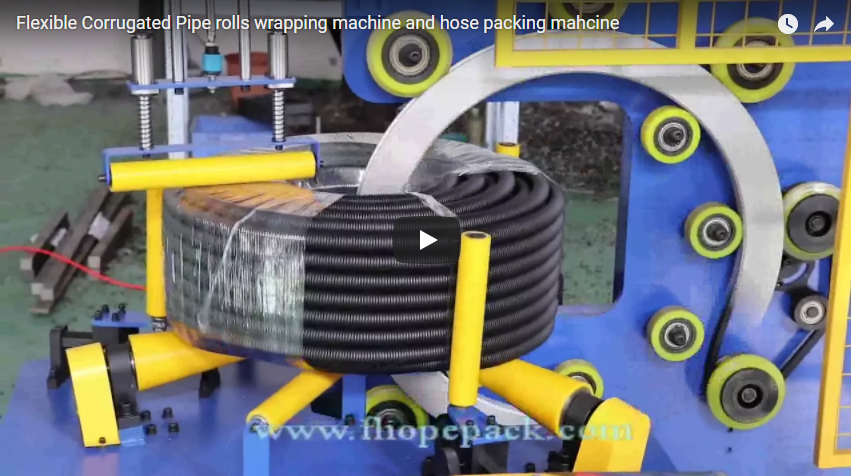
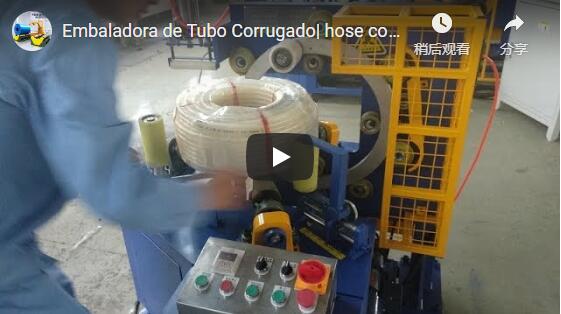
A PVC hose packing machine and flex pipe wrapping machine are designed to wrap soft, springy coils of garden hose, corrugated conduit, and flexible pipes in a spiral of film. Unlike rigid hydraulic hoses that hold their shape, these flexible products require gentle tension, guiding rollers, and low coil weights to prevent squashing or sliding apart during the wrapping process. The machine ensures the coil arrives clean, round, and ready for retail or installation.
Descriere
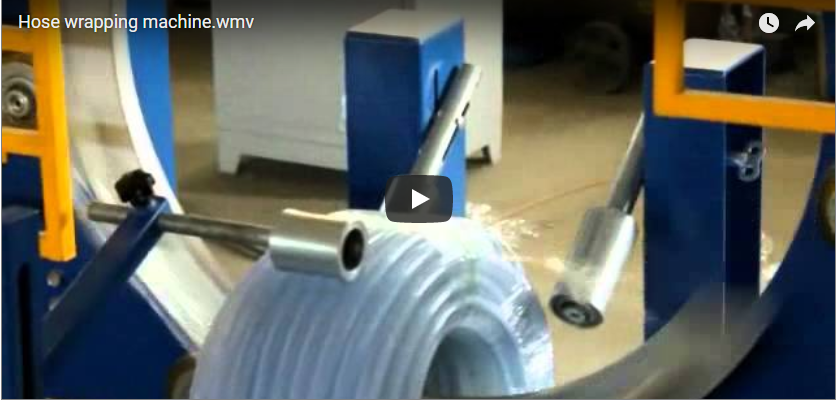
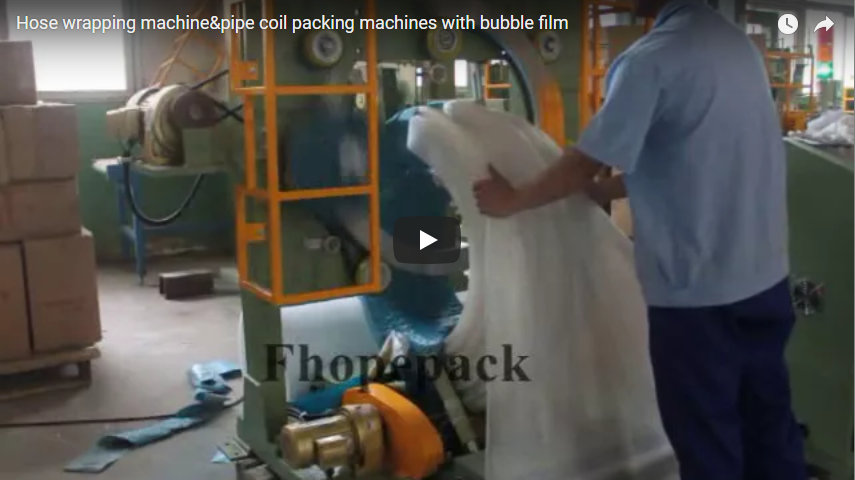
The video demonstrates the core wrapping cycle. An operator places a silver-gray coiled hose onto the rotating platform, threading the ring through its eye. The machine’s ring arm rotates, spiraling clear film over the coil’s cross-section while guiding rollers support the coil to maintain its round shape. The process concludes with the operator manually pressing the film tail and cutting it.
Why flexible coils need specific handling
Rigid hydraulic hose holds its shape, but PVC hose and flex pipe do not. A light coil can squash if the film is pulled too tightly, and its turns can slide apart if handled loosely. Therefore, the wrapper for these products is smaller and lighter than one designed for heavy rubber hose. It runs the ring and rollers at speeds adjusted by an inverter and supports the coil on guiding rollers. This support ensures the coil keeps its round shape while the film is applied.
Ambalarea unei bobine de țeavă flexibilă, pas cu pas
The wrapping process follows a consistent five-step sequence observed in the machine’s operation.
- Cravată: The coil arrives from the coiler already secured with a few straps. This initial tying holds the coil’s shape on the machine, preventing the turns from separating during the wrapping cycle.
- Sarcină: The operator places the coil onto the yellow guiding rollers. The machine’s ring is threaded through the eye of the coil, positioning it for the spiral wrap.
- Start the film: The operator threads the end of the film onto the coil and initiates the cycle.
- Înfășurare: The ring turns, spiraling clear film over the coil’s cross-section. Simultaneously, the rollers turn the coil slowly, ensuring the film covers the entire circumference.
- Finish: The ring stops. The operator presses the film tail onto the pack to secure it and then cuts the film.
- Tie first: Straps or ties are essential to hold the coil turns in place while the film is applied. Without this initial securing, the coil may lose its shape.
- Low tension: The film brake should be set just tight enough to lay flat. Excessive tension will squash a soft PVC coil, resulting in poor aesthetics and potential kinking.
- Suprapune: The overlap is settable from 20% to 90%. Higher overlap percentages are recommended for outdoor storage to provide greater protection against weather and handling damage.
- film: Clear film allows the product and label to be visible, which is ideal for retail. PVC film is also an option and is often suitable for retail packs where specific film properties are required.
- Coil dimensions: Verify that your coil ID, OD, width, and weight fall within the FPH-200 window (300–600 mm ID, 400–900 mm OD, 50–200 mm wide, 5–50 kg). If weights exceed 50 kg or OD exceeds 900 mm, the FPH-300N is required.
- Tip produs: Confirm the product is garden hose, braided PVC hose, conduit, or flex pipe. Rigid hydraulic hoses have different handling requirements.
- Cerințe de ieșire: Determine the required coils per hour. The cycle time varies based on coil size and overlap settings.
- Film and labeling: Decide on the film type (LLDPE, PE, or PVC) and whether a label needs to be placed under the film.
- Integrare: Assess whether manual loading is sufficient or if a link to the coiler is needed for automation.
- Coil ID, OD, width, and weight range.
- Product type (e.g., garden hose, corrugated conduit).
- Required output (coils per hour).
- Preferred film type and labeling requirements.
The machine features a blue metal frame with yellow components, including the guiding rollers. Control buttons are located on the blue base, though specific interface details are not visible in the operational footage.
Date FPH-200
The FPH-200 is the primary model for handling standard flexible coils. The specifications below are manufacturer-provided data points that define the machine’s operational window.
| Articol | FPH-200 |
|---|---|
| Coil ID | 300 – 600 mm |
| bobina OD | 400 – 900 mm |
| Lățimea bobinei | 50 – 200 mm |
| Greutatea bobinei | 5-50 kg |
| Ciclu | 15–35 s pe bobină |
| Viteza soneriei | 20–90 r/min, inverter adjusted |
| suprapune | 20-90% |
| Film | LLDPE, PE stretch film or PVC |
| Alimentare | 1.5 kW; AC 380 V, 50 Hz, or to requirement |
For heavier and larger coils, specifically those up to 100 kg and 1,000 mm OD, the FPH-300N is the recommended configuration. The FPH-200 is optimized for the lower weight and size range typical of soft PVC and flex pipes.
Exemplu de lucru: o bobină de țeavă flexibilă
The following calculation illustrates how cycle time and film consumption are derived from coil geometry. This example uses an illustrative coil to demonstrate the arithmetic, not a measured test result.
Illustrative coil: 600 mm OD, 350 mm ID, 120 mm wide; 100 mm film at 40% overlap.
| Verifica | Calcul | Rezultat |
|---|---|---|
| Circumferința exterioară | π × 600 | ≈ 1,885 mm |
| Rotiri ale inelului | 1,885 ÷ 60 = 31.4, rounded down for this estimate | ≈ 31 |
| Timp la 90 r/min | ÷ 31 90 | ≈ 0.35 min ≈ 21 s |
| Perete radial | (600 − 350) ÷ 2 | 125 mm |
| Film pe rotație | 2 × (125 + 120) | 490 mm |
| Film per coil, relaxed | 31 0.49 × | ≈ 15 m |
Rezultat. The calculation suggests approximately 21 seconds and 15 meters of film. This falls within the 15–35 second range specified for the machine. For very soft hose, the ring speed is slowed and tension is lowered, which moves the cycle time toward the upper end of the range.
Tension, tying and film selection
Proper configuration of tension and film type is critical for soft products.
Listă de verificare a selecției
When evaluating this machine for your production line, consider the following parameters to ensure a match.
Siguranță: EN 415-10 și ISO 12100
The machine is built to EN 415-10, with the risk assessment conducted according to ISO 12100. These standards serve as design references for safety. The primary hazards are the turning ring and the driven rollers. The perimeter fence is the manufacturer’s guarding specification; the footage here was shot with the machine open for demonstration, so the delivered guard panels, fence layout and emergency-stop circuit are confirmed in the ordering technical agreement. The cycle is designed to run to a complete stop before the operator reaches in to press down and cut the film tail.
On the FPH-200 model, the film cut is manual. An automatic cutter is available on the larger FPH range. Certification of a delivered machine is confirmed in the project ordering agreement; the machine itself is designed in accordance with the referenced standards.
Întrebări frecvente despre inginerie
Î: Folia va strivi furtunul din PVC moale?
A: Not if tension is set low. The ring and roller speeds are inverter-adjusted to accommodate soft products, allowing for gentle wrapping.
Î: Ce dimensiuni de bobine se potrivesc cu FPH-200?
A: The FPH-200 handles coils with 300–600 mm ID, 400–900 mm OD, 50–200 mm width, and 5–50 kg weight.
Î: Ce decide dacă o bobină are nevoie de 15 secunde sau 35 secunde?
A: The coil OD and overlap determine the number of ring turns. The ring speed (20–90 r/min) determines how fast they are laid. Soft hose runs at low speed with high overlap, nearing 35 s. A small coil at full speed may approach 15 s.
Î: Bobinele trebuie legate mai întâi?
A: Yes, a few ties are required to keep the coil round on the machine before wrapping begins.
Q: Is the film cut automatic?
A: On the FPH-200, the cut is manual. Automatic cutters are available on larger models in the FPH range.
Urmatorul pas
To receive a real configuration and quotation, please send the following data to the supplier:
Răspundem cu o propunere după ce confirmăm detaliile.