Descriere
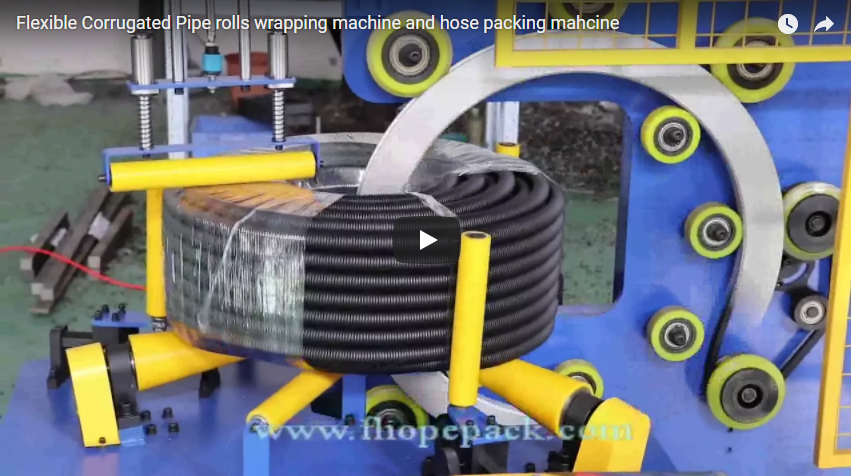
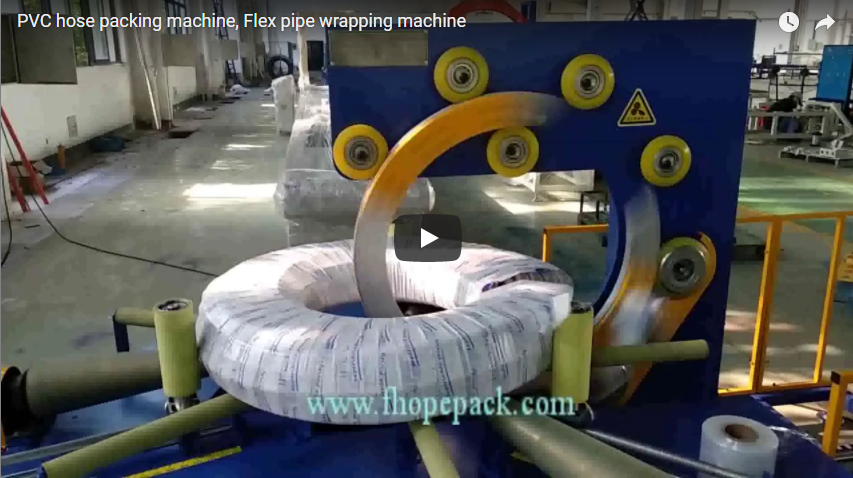
An automatic coiler for hose and pipe with wrapping machine is a linked cell: one machine winds the hose or pipe to length and cuts it, a transfer unit hands the finished coil to a ring wrapper, and the wrapper closes the coil in film — all inside one fenced, guarded footprint, paced to the output of your extruder. The purpose of linking the two machines is to remove the gap that appears when a coiler and a wrapper are bought separately: a person carrying coils from one machine to the other. That gap sets the real pace of the line, not the extruder.
This article is written for plant and production engineers and purchasing decision-makers who are specifying such a cell. The key decision condition is simple: the wrap time plus transfer time must be shorter than the coil winding time at your top line speed, and the coil size you wind must sit inside the size range of both machines. Everything below — the cell sequence, the machine data, the takt calculation, the film consumption estimate and the acceptance checks — exists to let you verify those two conditions for your own product before you commit.
How the linked cell works, step by step
The cell runs as a repeating six-step sequence:
- Bobinărul înfășoară furtunul la lungimea setată și îl taie.
- Bobina este ținută și mutată în înveliș.
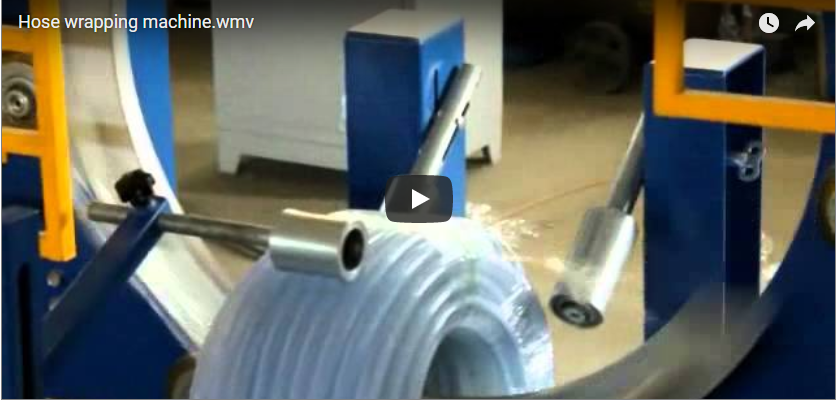
- The wrapper ring passes film through the eye of the coil and around it.
- The film is cut and the tail is pressed down.
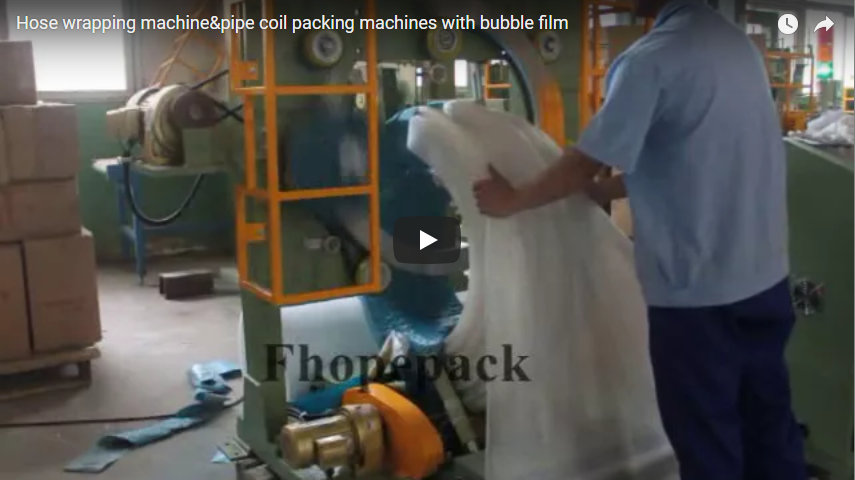
- The wrapped coil tips out of the cell onto the out-feed tray.
- While the wrapper is working, the next coil is already winding on the second coiler station.
The two-station coiler is what makes the cell continuous. While station one is being transferred and wrapped, station two is already building the next coil, so the extruder never has to stop for packaging. The out-feed tray means no operator needs to enter the fence: finished, film-wrapped coils leave the cell on their own, ready for a tray, conveyor or palletiser downstream.
The machine data intersection
Because the coil is wound by one machine and wrapped by another, its dimensions must fit inside atât machines’ ranges simultaneously. This is the single most common selection error, and it is why the two data sets are best read side by side.
| Articol | coiler | Înfășurător (FPCA-200H) |
|---|---|---|
| Coil ID | 350 – 550 mm | 200 – 350 mm |
| bobina OD | 500 – 800 mm | 500 – 650 mm |
| Lățimea bobinei | 150 – 300 mm | 150 – 300 mm |
| Greutatea bobinei | 5-35 kg | 10-50 kg |
| Viteză | 1–60 m/min | până la 100 r/min |
| Alimentare | 4.5 kW | 2.0 kW |
Read the table as an intersection, not as two independent limits. A coil with ID 350 mm and OD 500–650 mm sits inside both columns and is the basis of the worked examples below. Note that coil ID 350 mm is the single-point intersection of this standard coiler/wrapper combination: the coiler’s ID range starts at 350 mm exactly where the wrapper’s ID range ends at 350 mm, so 350 mm is the one ID both machines share. For a non-standard tube coil beyond this standard boundary, the wrapping ring size enlargement or a larger wrapper model must be confirmed per project. A coil with ID 550 mm would wind fine on the coiler but would not fit the FPCA-200H wrapper’s 200–350 mm ID range — that combination needs a larger wrapper, confirmed at quote. The same applies at the top of the OD range: beyond 650 mm OD, the wrapper must be resized to the coil.
Takt matching: the timing engineering of the cell
The cell is paced by the extruder, so the governing question is whether the wrapper can keep up. Two formulas answer it:
- Coil time = coil length ÷ line speed
- Timp de înfășurare + timp de transfer ≤ timp de bobinare
If the inequality holds at your top line speed, the wrapper never becomes the bottleneck and the coiler never waits.
Worked example (illustrative figures): a 50 m coil wound at 30 m/min takes 100 s to build. If the wrapper needs about 25 s to wrap and the transfer about 15 s, the cell needs 40 s per coil — a comfortable 60 s margin. But wind the same 50 m coil at 60 m/min and the coil time drops to 50 s; the same 40 s of wrap and transfer leaves only a 10 s margin. That is why transfer speed, film overlap and ring speed settings are checked at the top line speed, not at the average. A cell that looks comfortable at half speed can be marginal at full speed.
The dancer or buffer. The extruder does not pause while the coiler cuts and changes station. A dancer arm or buffer takes up the hose that keeps arriving during the cut and the station change. Its required capacity is a direct function of your line speed — the faster the line, the more hose arrives during the changeover window — so the buffer size is set to your line speed and confirmed at quote. Undersizing the buffer is the classic cause of a linked cell that forces the extruder to slow down.
Film per coil: estimating consumption
Film consumption drives running cost, so it is worth estimating before purchase. For a ring wrapper with overlap:
Film per bobină ≈ (π × diametru exterior ÷ avans) × 2 × (lățimea bobinei + (diametru exterior − diametru interior) ÷ 2)
Unde avansa is how far the ring moves along the coil per revolution — with 50% overlap of a 90 mm film, the advance is 45 mm.
Worked example (illustrative figures): OD 600 mm, ID 350 mm, coil width 200 mm, 90 mm film at 50% overlap (45 mm advance):
- Coil outer circumference: π × 600 ≈ 1,885 mm
- Number of wraps: 1,885 ÷ 45 ≈ 42 wraps
- Film per wrap: 2 × (200 + 125) = 650 mm
- Total: ≈ 42 × 0.65 = 27.3 m of film per coil
Use this to compare film quotes and to sanity-check the payback of overlap settings: tightening overlap raises film use roughly in proportion to the number of wraps. The actual consumption for your coil geometry is confirmed at quote and then measured during commissioning.
Listă de verificare a selecției
Confirm these parameters before a layout is drawn:
- Diametrul exterior și materialul furtunului sau țevii.
- Lungimea, diametrul interior, diametrul exterior și lățimea bobinei.
- Viteză maximă.
- Folie de folie sau hârtie.
- Out-feed method: tray, conveyor or palletiser.
- Etichete și cântărire.
Items 1–3 determine the takt calculation and the buffer size; item 2 is checked against the machine-data intersection above; items 4–6 shape the wrapper specification and what happens after the out-feed tray.
Safety and standards approach
The cell is fenced with mesh guards and an interlocked door, operated from a panel outside the fence. The design reference for the project is EN ISO 12100:2010 (risk assessment), EN 415-10 (packaging machine safety) and EN 60204-1 (electrical equipment). These are used as design reference and risk-assessment method for the project — not as a certificate for a single machine. Compliance is confirmed in the project purchase agreement, which is where your acceptance criteria should also be written.
Întrebări frecvente despre inginerie
Does the wrapper slow the coiler? No, provided wrap time plus transfer time is less than the coil winding time at your top line speed — the condition checked in the takt section above.
Can the cell run pipe as well as hose? Yes, within the coil size ranges in the comparison table. Check both the coiler and wrapper columns for every product you plan to run.
Is an operator needed inside the fence? No. Coils leave the cell on the out-feed tray, and the interlocked door stays closed during production.
Can paper be used instead of film? Yes, paper wrap is available as an option on the wrapper.
Urmatorul pas
- Send your hose OD, coil length, coil size and line speed to info@fhopepack.com.
- We lay out the coiler, transfer and wrapper cell.
- We send a proposal and quotation.
Citire conexă
- Mașină de bobinat furtun și de curele
- Coil wrapper FPCA-200H
- Mașină automată de fabricare a bobinei de furtun
- Mașină de împachetat cu bobine de furtun
Surse
- Pagini de produse FHOPE: mașină de înfășurat și legat furtunuri; mașină de înfășurat bobine FPCA-200H
- EN ISO 12100:2010; EN 415-10; EN 60204-1