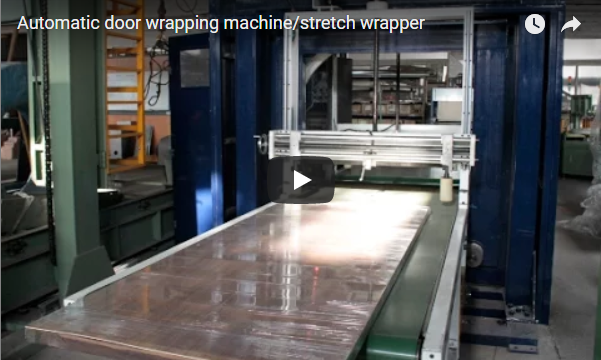
Rezumat This video shows a sandwich panel wrapping line in operation: stacked panels travel along roller conveyors, pass through a large blue ring-shaped frame where film is applied around the whole stack, and exit as sealed, film-wrapped bundles. The footage covers feeding, wrapping, and discharge over roughly 76 seconds of continuous, automatic transport.
Why this footage matters
If you buy or operate sandwich panel production, the last step before shipment — wrapping and packing — is easy to underestimate. Loose stacks of panels arrive scratched, dusty, and moisture-stained. This video shows how a dedicated wrapping machine turns a loose stack into one protected unit without manual handling. Below you will find what the footage actually shows, what it cannot tell you, and what to confirm with a supplier before you buy.
Mașina în acțiune
The video is a single continuous view of an L-shaped line inside a factory: an infeed roller conveyor, a central blue steel frame with a large circular opening sized roughly to the panel stack, and an outfeed roller conveyor leading deeper into the plant.
- 0–4 de ani: A worker in blue workwear and a hard hat stands beside a stack of light-colored long panels at the left conveyor. The right side of the line already holds several film-wrapped, vertically stacked bundles — evidence of repeat cycles.
- 6–10 de ani: A stack of white sandwich panels (roughly 10–20 panels, with dark ribbed core edges visible) is fed onto the rollers and moves into the circular opening of the blue frame.
- 12–18 de ani: Panels pass through the ring. A translucent film is applied around the stack inside the frame; red printed text becomes visible on the film surface.
- 20–28 de ani: The fully wrapped bundle exits to the right, still vertical and in the same orientation. No turning or flipping occurs at any point.
- 30–58 de ani: A second stack follows the same path. The film is stretched tight, showing wrinkles and sheen, and transport remains continuous with no pauses.
- 60–76 de ani: A long wrapped package moves through the ring again. A yellow overhead crane hook hangs idle above the line, apparently on standby. The package continues down the line toward downstream handling.
The wrapping film carries printed red text, including handling instructions such as “keep dry and ventilated”, “do not step”, and “handle with care” — typical protective packaging labeling. Each wrapped bundle stays square and undamaged throughout the footage.
Note de observație directă
- Blue painted steel frame with a large circular front opening; vertical columns with vent-style grilles.
- Double-sided roller conveyors with evenly spaced metal rollers, motor-driven; left line aligned with the frame entrance, right line extending away.
- Sandwich panels: white or light-grey outer metal faces, dark ribbed core edges, stacked vertically with aligned edges and no visible deformation.
- Film wrapping occurs inside the frame; the film is translucent and stretched, forming one integral bundle per stack.
- No rotation, tilting, or re-orientation of the product during the entire cycle.
- A control cabinet with a small display, buttons, and indicator lights is visible behind the frame in early frames; screen content is not legible.
- A yellow overhead crane hook and cable hang above the line in later frames, not in contact with the product.
- No operator intervenes once feeding begins; the process runs continuously.
Ce arată videoclipul (cu referințe temporale)
- În jurul t≈0–4s the left roller conveyor is empty while a worker in blue overalls handles light long panels beside a pallet stack, and a stack of white sandwich panels stands at the right.
- În jurul t≈6–10s a stack of about 10–12 white sandwich panels (with dark transverse ribs) is conveyed to the right into a round opening in the central blue frame.
- În jurul t≈12–18s the panel stack advances into the machine and starts being wrapped; a semi-transparent film layer begins to cover the panel sides.
- În jurul t≈20–28s the fully wrapped stack emerges from the right of the machine as one integral film bundle, and the conveyor pushes it onward to the next stage.
Ceea ce nu arată videoclipul
- Machine model, rated capacity, cycle time, or line speed.
- Motor power, voltage, or control system brand and model.
- Film material, thickness, and tension settings.
- Safety certifications, e-stop locations, light curtains, or interlock details — none are clearly visible.
- Maintenance procedures, spare parts, or operator training requirements.
- Whether the machine handles multiple panel sizes, and how changeover works.
Treat all of these as open items to verificați cu producătorul înainte de orice decizie de cumpărare.
Cum funcționează procesul de ambalare
Based on the sequence, the line follows four stages:
- Sarcină: An operator sets a vertical stack of panels at the infeed end.
- Convey: Rollers carry the stack into the ring frame at a steady pace.
- Înfășurare: Inside the frame, film is wound around the full cross-section of the stack, covering all exposed edges in one pass.
- Descărcarea de gestiune: The finished bundle rolls out on the outfeed conveyor toward the next step — strapping, stacking, or loading.
Because the panels stay vertical and the ring wraps the whole stack at once, edge protection is continuous. That is the weak point of manual wrapping, where corners and ends are usually missed first.
Manual vs. machine wrapping
| Aspect | Ambalare manuală | This type of ring wrapping line |
|---|---|---|
| Manipularea | Panels moved by hand repeatedly | One load, automatic transport |
| Acoperire | Corners and ends often missed | Full cross-section in one pass |
| consecvență | Depinde de operator | Uniform coverage per bundle |
| Protecție împotriva prafului și umezelii | Parțial | Complete enclosure per stack |
| Cel mai potrivit pentru | Volum foarte mic | Loturi de producție regulate |
Who should consider this machine
- Sandwich panel producers shipping to construction sites, where panels face rain, dust, and rough handling during transit.
- Factories where manual wrapping is the bottleneck before loading and dispatch.
- Lines that already use roller conveyors and want a wrap station integrated inline without extra transfers.
If your product is an unusual shape, very small, or requires bagging rather than stretch wrapping, confirm compatibility with the manufacturer before specifying a ring-type wrapper.
Ce trebuie verificat cu producătorul
- Maximum and minimum stack size, weight, and panel dimensions the ring can accept.
- Cycle time per bundle and whether line speed matches your production output.
- Film specification: material, thickness, pre-stretch ratio, and how film rolls are changed.
- Control system: HMI availability, fault diagnostics, and remote monitoring options.
- Safety provisions: e-stop placement, guarding at the ring opening, and interlocks.
- After-sales support, commissioning, and spare parts supply.
FAQ
Does the machine rotate or turn the panels? No. In the video the panels stay vertical and travel straight through the ring. No rotation is shown.
Este procesul complet automat? Once a stack is placed on the infeed conveyor, the footage shows no further manual intervention through wrapping and discharge.
What film is used, and at what thickness? Not shown in the video. Check with the manufacturer for film type, thickness, and stretch ratio.
Can it handle different panel sizes? The video shows one stack size only. Size flexibility is not demonstrated — verify with the manufacturer.
Ce caracteristici de siguranță sunt incluse? Not visible in the footage. Confirm e-stop placement, guarding, and any interlock system directly with the manufacturer.
Citire conexă
- Customized orbital wrapping machines
- Mașini de ambalat orizontal
- Linii automate de ambalare a bobinelor
- Mașini de înfășurat bobine de oțel
- Mașini de înfășurat bobine de sârmă
Urmatorul pas
Want to know whether this wrapping solution fits your panel sizes and line layout? Contactează-ne with your product dimensions and daily output, and our engineers will recommend a matching configuration.
Source and method: This article is based solely on the video above. Analysis was performed by a vision model on sampled frames. The video contains background music only — no narration or speech was transcribed.