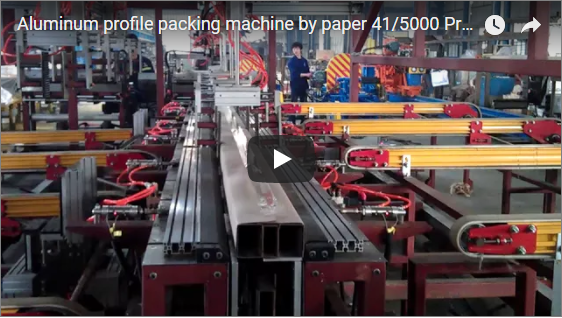
Rezumat Aluminum extrusions leave the press with delicate anodized or powder-coated surfaces highly susceptible to transit abrasion. Protecting finished bundles requires a synchronized, end-to-end line: infeed, protective paper or protective film wrapping, longitudinal strapping, orbital ring wrapping, and automated stacking. Sizing the line depends directly on production capacity: extrusion output per shift împărțită la lungimea fasciculului, then divided by active shift hours. In an 8-hour shift producing 3,600 m of 6 m profiles, the packaging system must sustain 75 de pachete pe oră, yielding a strict 48-second gross station cycle per pachet.
Cuprins
- The packaging line, station by station
- Stația de înfășurare a inelelor
- Published reference figures for the aluminum profile wrapping machine class
- Bundles per hour from your extrusion output
- What to verify before you specify
- What the cover does — and does not — do
- Siguranță și standarde
- Întrebări frecvente despre inginerie
- Urmatorul pas
- Citire conexă
- Surse
The packaging line, station by station
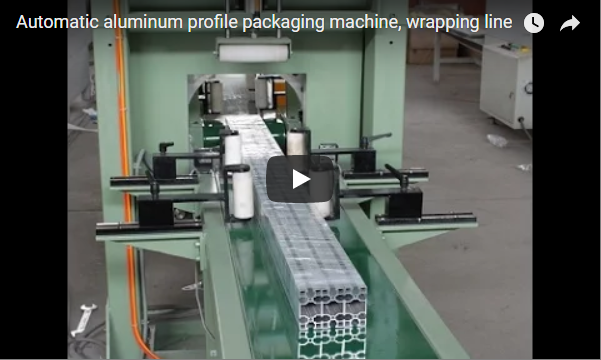
An automated extrusion packaging line integrates multiple operations onto a common roller conveyor bed, eliminating the manual transfers that cause surface scuffing:
| Stație pentru lacăte | Funcția primară |
|---|---|
| Transportor de alimentare | Transports profiles into the packaging zone |
| Film / paper application | Applies direct surface-masking material under controlled tension |
| Legare cu banda / legare în pachet | Secures multiple profiles into a structural unit |
| Înfășurarea inelului orbital | Applies spiral transport wrap over the bundle cross-section |
| Evacuare și stivuire | Transfers completed bundles to storage or logistics bays |
Each station serves a distinct protection role. Surface protection must precede strapping; unmasked aluminum extrusions vibrating against each other during transit develop rapid fretting corrosion and micro-scratches. The layer sequence must match your logistics environment: for export sea containers, strapping typically compresses the wrapped unit onto wooden dunnage, while domestic logistics can run strapping after the full wrap.
Stația de înfășurare a inelelor
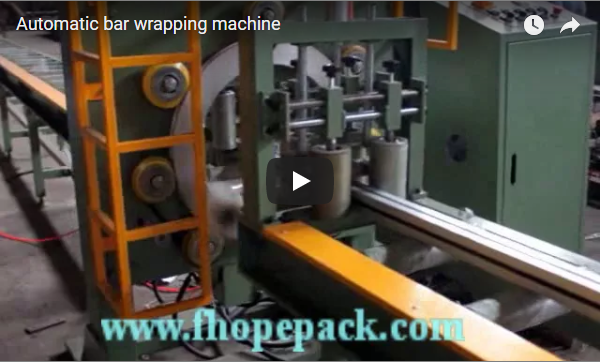
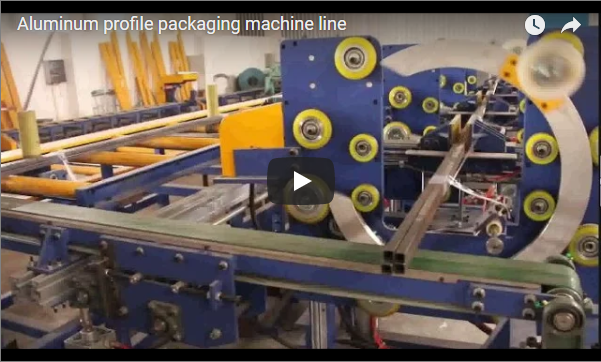
The core station of this packaging system is the horizontal orbital ring wrapper. The bundle travels axially along the conveyor through a circular rotor ring without rotating. The ring rotates continuously around the passing bundle, laying stretch film or protective wrap in an overlapping spiral across the entire perimeter.
This orbital geometry delivers significant advantages over rotary turntable wrappers:
- Unlimited profile length — the workpiece passes linearly through the center opening, so bundle length is governed by conveyor travel, not machine frame dimensions.
- Stable load dynamics — fragile or asymmetrical profile bundles remain stationary on the rollers, preventing collapse during high-speed packaging.
- Consistent tension distribution — centering the cross-section within the ring orbit prevents localized film neck-down and uneven tension peaks.
Line throughput typically operates between 2–16 m/min during active wrapping cycles, depending on ring diameter, linear feed rate and film overlap.
Published reference figures for the aluminum profile wrapping machine class
The horizontal orbital wrapping systems engineered for aluminum extrusion bundling operate within the following standardized mechanical envelope:
| Parametru | Standard engineering envelope |
|---|---|
| Tensiunea de alimentare | 3-Phase AC 380 V / 50 Hz (configurable) |
| Putere instalată | 4.8 kW – 7.5 kW |
| Secțiune transversală a fasciculului | 300–1,500 mm (diagonal) |
| Profile processing length | 2,000 – 8,000 mm |
| Capacitatea de greutate a pachetului | 100-2,500 kg |
| Materiale de ambalare | PE stretch film, knit belt, paper, VCI film |
| Viteza de rotație a inelului | 30-60 rpm |
| Viteza liniei transportoare | 2–16 m/min |
| Raport de suprapunere | 10% - 90% |
Read this envelope as a class description, not as the specification of the line in the video. Extrusion bundles are commonly square, rectangular or hexagonal packs, so the 300–1,500 mm rating is best read as the circumscribed diagonal diameter of the pack. The ring’s inner clearance must exceed that diagonal with a margin of 100–150 mm on all sides to prevent collision with film carriages or uneven tail ends — confirm the exact figure against your pack pattern.
Bundles per hour from your extrusion output
Sizing an extrusion packaging line requires calculating backwards from your press output. The worked example below illustrates a balanced production rate:
| Sizing variable | Pasul de calcul | Valoare de referință |
|---|---|---|
| Extrusion press output per shift | Specified plant capacity | 3,600 m |
| Active shift duration | Shift schedule | 8 ore (480 minute) |
| Average hourly extrusion rate | 3,600 m ÷ 8 h | 450 m / h |
| Average linear line speed | 450 m/h ÷ 60 min | 7.5 m / min |
| Individual bundle length | Project bundle specification | 6.0 m |
| Bundles produced per shift | 3,600 m ÷ 6.0 m | 600 pachete |
| Required line throughput | 600 bundles ÷ 8 h | 75 mănunchiuri/oră |
| Gross station cycle budget | 3,600 s ÷ 75 bundles | 48.0 seconds / bundle |
A 7.5 m/min average speed sits comfortably inside the 1–20 m/min packing-speed range quoted in the video’s description, but the 48-second figure is brut cycle time. Non-wrapping overhead — bundle indexing gaps, roller acceleration and deceleration, infeed centering, and the film clamp-cut-wipe sequence — typically consumes several seconds per bundle, leaving a net wrapping window of roughly 25 to 30 seconds. Every station must complete its step within that window or it sets the pace for the whole line.
What to verify before you specify
When submitting an RFQ for an automated profile packaging line, verify the following baseline criteria:
| Technical specification point | Cerință de verificare |
|---|---|
| Dimensional envelope | Min/max profile length, width, height, pack diagonal |
| Limitele de greutate | Maximum package weight per linear meter |
| Film delivery system | Core size, roll OD, pre-stretch ratio |
| Strapping parameters | PP or PET material, number of straps per bundle |
| Film tail sealing method | Mechanical press wiper, air tucking, or thermal heat seal |
| Validarea ciclului | Station-by-station timing breakdown at maximum output |
Because the demonstration clip has no narration and does not state specifications, every figure above should come from the supplier in writing and be confirmed against your profile program per project.
What the cover does — and does not — do
A spiral orbital wrap provides mechanical bundling, surface scratch protection, and dust deflection. However, a înfășurat bundle is not a închis ermetic pachet:
- Pătrunderea umezelii — spiral wrapping creates overlapping seams; without a dedicated longitudinal sheet underlay and end-sealing, water can reach the profiles during outdoor yard storage.
- Capcane de condens — if damp profiles are wrapped tightly in non-breathable stretch film, diurnal temperature swings cause sweating and chemical staining on bare aluminum.
- Rezistență la UV — standard PE stretch film degrades under direct sunlight; export packaging requiring extended yard storage must specify UV-inhibited or VCI anti-corrosion film.
Any water-resistance or barrier claim has to be proven with material and packaging tests.
Siguranță și standarde
Automated orbital packaging lines integrate rotating high-inertia rings, active conveying, and pneumatic cutting assemblies. Modern systems must comply with international packaging machinery safety requirements, including ISO 12100: 2010 for risk assessment of industrial machinery, EN 415-6 for packaging and wrapping machines, and ISO-13849 1 for safety-related parts of control systems.
Interlocked perimeter fencing and optical safety light curtains must remain active during automated cycling. Operators should clear film cut-offs or perform roll changeovers only under lock-out / tag-out (LOTO) conditions, and confirm the emergency stop, guarding and certification documentation with the supplier.
Întrebări frecvente despre inginerie
Q: Does the aluminum profile bundle rotate during orbital wrapping? A: No. The bundle remains level and travels axially along the conveyor while the wrapping ring rotates around it on a stationary vertical frame.
Q: How is the required packaging line throughput calculated? A: Throughput (bundles/h) = Shift output (m) ÷ Bundle length (m) ÷ Shift duration (h). For 3,600 m of 6 m profiles in an 8-hour shift, that is 600 ÷ 8 = 75 bundles per hour.
Q: Can orbital wrappers apply paper and plastic film simultaneously? A: Yes. Dual-material ring carriages can support stretch film and crepe paper or woven material simultaneously, providing internal cushioning and external abrasion resistance in a single pass.
Q: Does stretch wrapping prevent water stain during ocean transit? A: Not on its own. Stretch film wrap is water-resistant but not vapor-tight. For ocean shipping, combine the orbital wrap with internal VCI (Vapor Corrosion Inhibitor) paper or fully heat-sealed end wraps.
Q: What safety equipment does the line include? A: The demonstration shows fencing around the processing zone. Confirm the emergency stop, guarding and certification documentation with the supplier.
Urmatorul pas
To receive an engineering layout and cycle time simulation tailored to your extrusion press output, submit your package specifications — min/max cross-section dimensions, bundle length distribution, maximum bundle weight, and press output per shift — to our engineering team at info@fhopepack.com for a technical review and custom layout proposal.
Citire conexă
- Mașină de ambalat și linie de ambalare a profilelor din aluminiu: Stații și ritm
- Mașină de înfășurat profile de aluminiu pentru profile individuale și pachete mici
- Linie automată de ambalare a profilelor din aluminiu pentru ambalarea și stivuirea hârtiei
Surse
- Station sequence, checklist and video description: our post 324 REST record and the video on YouTube
- Machine class specification envelope: aluminum profile wrapping machine product page (mirrored in the company knowledge base)
- Standards scope: ISO 12100:2010, EN 415-6, ISO 13849-1
Ultima recenzie: 21.09.2026