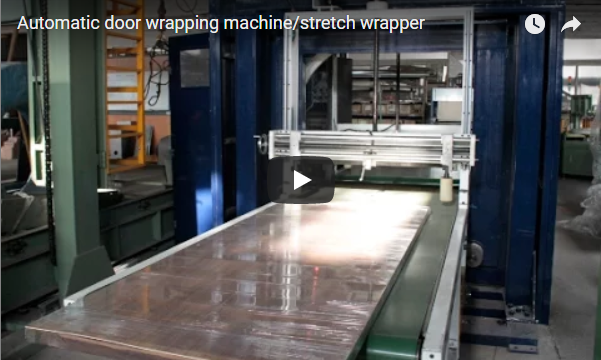
Samenvatting This video shows an automatic wrapping line applying white protective film around bundles of copper sheets on a conveyor. The bundle is fed in, wrapped inside a guarded station, and exits fully covered — a continuous, hands-off process. No cycle time, capacity, or model data is shown; those points should be confirmed with the manufacturer before purchase.
Why copper sheet bundles need dedicated wrapping
Copper sheet bundles are heavy, valuable, and easy to damage. Edges scratch, surfaces tarnish, and moisture or handling during transport can leave marks that reduce the value of an otherwise perfect product. That is why manufacturers in the copper and non-ferrous metals industry invest in dedicated bundle wrapping lines rather than relying on manual wrapping.
The video on this page is a showcase of exactly that kind of line. It captures a complete pass of a copper sheet bundle through an automatic wrapping machine: the bundle arrives on a conveyor, white protective film is applied around it inside a guarded station, and the wrapped bundle continues down the line. Everything you need to judge whether this type of equipment fits your operation is visible in the footage — and we also flag clearly what the footage does niet show, so you know what to confirm before requesting a quotation.
Wat de video laat zien: de machine in actie.
The footage runs for about 16 seconds and follows one bundle through the line:
- 0: 00-0: 04 — The video opens close to a large cylindrical bundle being moved by the machine. A yellow safety railing is visible on the right of the frame as the camera pans across the industrial setting.
- 0: 04-0: 08 — The view widens to a long conveyor system with multiple tracks. A long, flat, light-colored bundle — consistent with a bundle of copper sheets — is transported along the line. Overhead cranes and other factory machinery are visible in the background, confirming this is a production environment, not a staged demo booth.
- 0: 08-0: 12 — The camera moves to the wrapping station itself. White flexible material, a protective film, is being applied around the bundle as it feeds into the machine. The station is enclosed by a yellow safety cage with mesh screening.
- 0: 12-0: 16 — The angle shifts, and an operator in a blue hard hat and light blue shirt observes the machine. The wrapped bundle — now clearly a long rectangular object covered in white material — exits the machine and continues along the conveyor.
In het kort: feed → wrap → exit. The bundle passes through once, and the wrapping is complete when it emerges on the other side.
Directe observatie-aantekeningen
The following observations are kept close to the factual video record, with only light grammar-level editing:
- A large white cylindrical object, likely a bundle of material, is moved by a machine; a yellow safety railing is visible on the right.
- A wider view shows a long conveyor system with multiple tracks, transporting a long, flat, light-colored object consistent with a copper sheet bundle. The setting is a large factory floor with overhead cranes and other machinery in the background.
- At the wrapping station, white flexible material (likely a protective film) is applied to the bundle. The machine has a yellow safety cage with a mesh screen; the bundle is fed into the machine.
- A worker in a blue hard hat and light blue shirt observes the machine while the bundle is actively wrapped. The bundle is a long rectangular object covered in white material and exits the machine along the conveyor.
- The machine is predominantly painted metal in white, grey, and yellow; yellow is used for safety features such as railings and guards. Conveyor belts are green and yellow.
- The system consists of a long conveyor line with multiple tracks, a central wrapping machine, and a control panel. The wrapping mechanism includes rollers and a film-applying mechanism inside the mesh safety cage.
- The control panel is a grey box with a yellow front, featuring a grid of buttons (likely start, stop, and other functions) and several indicator lights.
- The product is a bundle of copper sheets; after wrapping, its surface is smooth and slightly wrinkled from the wrapping process.
- A watermark reading “HOPE GROUP” appears in the bottom right corner at 0:00, 0:04, 0:08, 0:12, and 0:16. No other readable text or labels are visible.
Wat de video niet laat zien
Being upfront about gaps is part of evaluating equipment honestly. The footage does niet laten zien:
- Nominale capaciteit of doorvoer — no cycle time is visible or stated.
- Machine dimensions or model designation — no nameplate or model label appears.
- Stroomvoorziening — niet waarneembaar.
- Technische Specificaties — none are visible in the footage.
- Emergency stop buttons, warning labels, or interlocks — none are visible in the recorded frames.
- Handling of different bundle sizes or product types — only one bundle format appears.
- Final packaging for shipping — the video ends with the wrapped bundle on the conveyor; palletizing, strapping, and loading are not shown.
Each of these items is a legitimate question to raise with the manufacturer during a quotation or site-visit discussion.
What the footage does demonstrate
Even within 16 seconds, the video supports several meaningful conclusions:
- Automation of the wrapping step. The film application happens inside the machine without manual handling of the bundle, which points toward consistent wrap tension and coverage — advantages that are hard to achieve with hand wrapping.
- Integration into a production line. The wrapping station sits within a longer conveyor system, meaning bundles can flow in and out without forklift intervention at this step. This matters for plants that already run conveyor-fed handling.
- Guarded operation. The yellow mesh safety cage around the wrapping mechanism shows that moving parts are enclosed — a positive indication of safety-minded design, though full safety features (e-stops, interlocks) should be verified directly.
- Supervised, not manually driven, operation. The operator in the footage observes rather than handles the product, consistent with a machine whose role is to remove manual labor from the wrapping task.
Waar dit type lijn past
| Toepassingsgeschiktheid | Geschiktheid |
|---|---|
| Copper sheet bundles needing surface protection for storage and transport | Strong fit — this is the process shown |
| Long, flat metal profiles or similar bundle formats | Likely suitable — confirm dimensional range with the manufacturer |
| Very short or irregularly shaped products | Not demonstrated in the video — verify separately |
| Complete end-of-line packaging (palletizing, shipping prep) | Only partially covered — wrapping is shown, downstream steps are not |
If your plant handles copper, aluminum, or other non-ferrous bundles where surface quality has direct commercial value, a dedicated wrapping line of this type is worth evaluating against manual wrapping on consistency, labor cost, and protection quality.
Wat moet je controleren bij de fabrikant?
Before committing to a purchase, we recommend confirming:
- Compatible bundle dimensions and weight range for your products.
- Acceptable wrapping material types and film quality.
- Wrapping speed and achievable cycle time for your bundle sizes.
- Safety features in full: emergency stops, interlocks, and warning signage.
- Technical support availability and spare parts supply.
- Installation, commissioning, and operator training arrangements.
FAQ
Does the machine wrap only copper sheet bundles? The video shows a copper sheet bundle, but similar lines typically handle other long bundle formats. The exact range of compatible products — check with the manufacturer.
Is any manual work needed during wrapping? The footage shows the bundle being wrapped automatically inside the guarded station, with an operator observing. Routine feeding appears to be conveyor-driven, though startup, changeover, and film roll replacement procedures are not shown.
Hoe snel wordt het ingepakt? Cycle time is not observable in the video. Confirm throughput for your bundle dimensions with the manufacturer.
Welke veiligheidsvoorzieningen heeft het? A yellow mesh safety cage encloses the wrapping mechanism. Emergency stops, interlocks, and warning labels are not visible in the footage — request full safety documentation.
Is this suitable for an existing conveyor line? The wrapping station sits within a longer conveyor system in the video, indicating line integration is part of the design. Compatibility with your specific line layout should be assessed by the manufacturer’s engineers.
Gerelateerd lezen
Explore more wrapping solutions on our site:
- Rekwikkelmachines
- Automatische palletwikkelmachines
- Semi-automatische palletwikkelmachines
- Draaiarm-wikkelmachines
- Draaiende ring-rekfoliemachines
Volgende stap
If this copper sheet bundle wrapping line looks relevant to your operation, the fastest way to move forward is a direct conversation. Share your bundle dimensions, target throughput, and factory layout, and we will confirm feasibility, provide specifications, and quote accordingly.
Bezoek onze contact pagina to request more information or a tailored proposal.
Bron en methode: This article is based on the video embedded above, which is the sole factual source. The footage was analyzed frame-by-frame using a local vision-language model on sampled frames. The video contains background music only — no narration or speech — so no transcript analysis was performed. All claims in this article trace back to what is visible in the footage; anything not observable is explicitly marked as requiring confirmation from the manufacturer.
Gepubliceerd: 2026-09-03