kopsavilkums
Combining inline bubble-film covering with orbital stretch wrapping provides heavy-duty surface cushioning and structural retention for architectural door panels, furniture boards, and engineered timber. The system integrates a dual-stage workflow: an automated top/bottom bubble-film sheeting station with transverse heat sealing, followed by a continuous-feed orbital rotating ring. Proper specification requires matching the effective ring clearance envelope
D_ring ≥ √(W² + H²) + 2 × C_clearanceagainst panel cross-sections, synchronizing conveyor advance velocity with orbital ring rotation to govern overlap ratios, and deploying non-marking pneumatic top-press stabilizers to prevent panel shifting under wrapping tension.
For architectural door panels, finished millwork, and composite furniture boards, packaging speed cannot be specified in isolation from load retention and surface protection requirements. An automated inline packaging line for these profiles relies on two distinct mechanical stages: an initial bubble-film covering station that delivers impact dampening, and a subsequent horizontal orbital stretch wrapper that applies tensioned film to bind the package. A complete technical specification must define the physical envelope, the synchronization between product transfer and ring rotation, and the mechanical handover between stations.
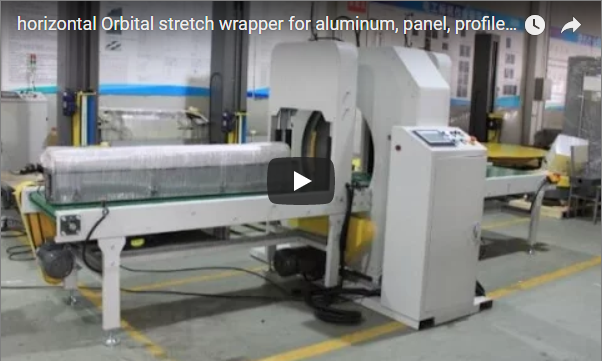
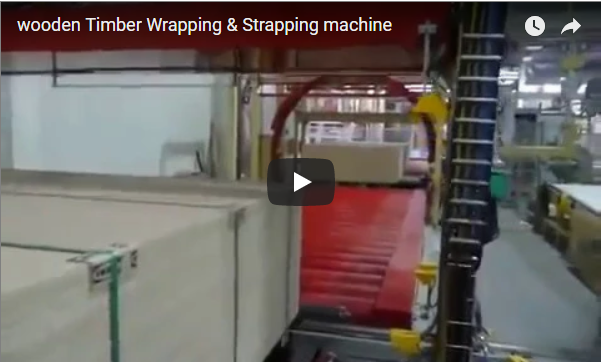
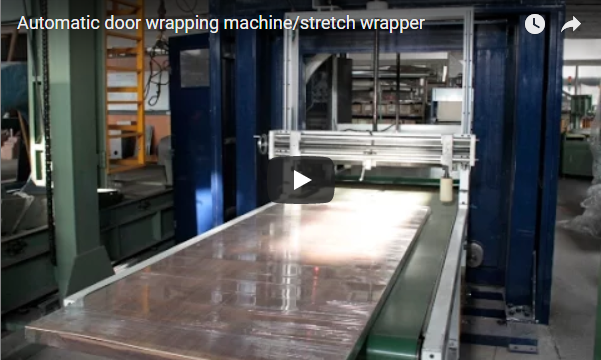
The factory floor configuration shown in the technical demonstration relies on a pass-through architecture: the door panel moves continuously along a powered conveyor while an orbital carriage drives the film roll around a horizontal axis. A “non-rotating” workpiece does not mean stationary handling; it indicates that the product travels linearly along the X-axis while the wrapping ring rotates in the Y-Z plane.
[Infeed Conveyor] ──> [Bubble Film Covering & Heat-Seal] ──> [Orbital Ring Wrapper] ──> [Outfeed Conveyor]
        │                                  │                                  │
  Photoeye Align                    Top-Press Clamps                   Dual-Tension Ring
1. Package Protection Criteria and Surface Defense
Before establishing ring speeds or line capacity, engineers must map the panel surface tolerance and end-use shipping risks:
- Virsmas integritāte: High-gloss laminates, primed wood veneers, and pre-hung metal skins require zero relative motion between the protective cushioning and the workpiece. Conveyor rollers must use non-marking polyurethane or NBR sleeves to avoid surface scuffing.
- Corner and Edge Defense: The leading and trailing edges of solid-core and hollow-core panels represent primary damage points during freight handling. Edge coverage requires either transverse bubble-film folding or dedicated extra orbital wraps at both extremities.
- Dust and Moisture Barriers: While open-ended spiral wraps provide lateral containment, preventing dust intrusion requires sealed bubble-film envelopes at leading and trailing ends prior to the orbital wrap.
Engineers must decouple cushioning thickness from outer wrap tension. Increasing stretch wrap tension cannot compensate for insufficient bubble padding; excessive hoop stress on sharp rectangular profiles will crush the bubble cells at the perimeter corners.
2. Decouple the Covering Station from the Orbital Wrapper
The production system splits operations into two discrete mechanical modules:
+----------------------------------------------------+
| 1. BUBBLE FILM COVERING MODULE                     |
|    - Dual roll dispensers (Top + Bottom sheet)     |
|    - Pneumatic clamp & transverse hot-knife cut    |
|    - Photoelectric edge detection sensors          |
+----------------------------------------------------+
                         │
                         ▼
+----------------------------------------------------+
| 2. ORBITAL STRETCH WRAPPING MODULE                 |
|    - Rotating structural ring (40–80 RPM)          |
|    - Mechanical core-brake or power pre-stretch    |
|    - Pneumatic vertical hold-down assemblies       |
+----------------------------------------------------+
Station Handover and Material Flow
- Infeed & Sheeting: Photoelectric sensors detect the leading edge of the oncoming door panel. Top and bottom bubble-film layers feed concurrently, sandwiching the panel as it advances.
- Transverse Sealing & Cutting: An impulse hot knife or pneumatic shear seals the bubble film ahead of and behind the workpiece, creating a loose envelope.
- Orbital Station Entry: The enveloped panel crosses the bridge between stations. Pneumatic top-press rollers clamp down on the workpiece to secure the loose bubble wrap and resist the rotational pull of the orbit ring.
- Spiral Wrapping & Tail Clamping: The ring accelerates, winding stretch film over the bubble sleeve. Once the trailing edge clears the wrapping zone, an integrated pneumatic cut-and-clamp unit severs the stretch film and retains the tail for the next cycle.
3. Product Dimension Envelopes and Pass-Through Geometry
Specifying ring diameter requires accounting for the panel cross-section, conveyor clearance, and the dynamic sweep of the film carriage.
       ┌───────────────────────────────┐
       │         Orbital Ring          │
       │     ╭───────────────────╮     │
       │   ╭─╯     W_panel       ╰─╮   │
       │  │    ┌───────────────┐    │  │  <-- H_panel
       │   ╰─╮ └───────────────┘ ╭─╯   │
       │     ╰───────────────────╯     │
       │        Conveyor Bed           │
       └───────────────────────────────┘
The minimum inside diameter of the orbital ring (D_ring) must satisfy:
D_ring ≥ √(W² + H²) + 2 × C_clearance
kur:
W= Maximum panel width (mm)H= Maximum panel thickness or stack height (mm)C_clearance= Radial clearance margin (typically ≥ 150–200 mm) accounting for film roll carriage clearance, guide assemblies, and pneumatic hold-down brackets.
Standard Door Panel Dimensional Matrix
| Parametrs | Standard Interior Door | Exterior Pre-Hung Core | Stacked Multi-Panel Pack |
|---|---|---|---|
| Width Range (W) | 600 - 950 mm | 800 - 1100 mm | Līdz 1200 mm |
| Height / Thickness (H) | 35 - 50 mm | 70 - 150 mm | Līdz 400 mm |
| Maksimālais sagataves svars | 25 - 45 kg | 60 - 120 kg | Līdz 500 kg |
| Required Ring ID | 1200 - 1400 mm | 1600 - 1800 mm | 2000 - 2200 mm |
| Hold-Down Type | Single pneumatic cylinder | Twin-cylinder linked bridge | Heavy-duty floating overhead belt |
4. Wrap Pattern Kinetics and Production Rates
Ring RPM alone does not dictate production throughput or wrapping coverage. Overlap percentage is an engineered function of ring rotational velocity, conveyor travel speed, and applied film width:
Overlap (%) = [1 - (V_conveyor) / (W_film × ω_ring)] × 100
kur:
V_conveyor= Conveyor advance rate (m/min)W_film= Effective film web width after neck-down (m)ω_ring= Orbital ring rotational speed (RPM)
Overlap Spiral Layout:
Panel Movement ─────────>
┌─────────┬─────────┬─────────┬─────────┐
│ Wrap 1  │ Wrap 2  │ Wrap 3  │ Wrap 4  │
│    ┌────┼────┐    │    ┌────┼────┐    │
│    │ Overlap │    │    │ Overlap │    │
└────┴────┴────┴────┴────┴────┴────┴────┘
Kinematic Overlap Calibration
- Reinforced End Wrapping: Standard operating sequence must include a programmable dwell time (
V_conveyor = 0kamērω_ring > 0) at the leading edge (2–3 full rotations) and trailing edge to secure the package caps. - Intermediate Body Wrap: A consistent 30% to 50% overlap secures typical panels during domestic distribution. Ocean freight or multi-drop delivery often dictates a 60% to 75% overlap pattern.
- Line Speed Reality: Quoting a line at “20 m/min conveyor speed” is invalid if the film carriage acceleration, photoeye indexing, bubble-sheeting cycle, and tail-cut sequences limit cycle completion to 3 panels per minute. Line evaluations must use finished, accepted units per hour.
5. Film Consumption and Tension Mechanics
Film optimization requires verifying both the primary cushioning bubble film and the secondary LLDPE stretch web:
Pre-Stretch Roller Mechanics:
[Film Roll] ──> [Slow Roller 100%] ──> [Fast Roller 250%] ──> [Applied to Panel]
                      │                       │
└────── Gear Ratio ─────┘- Bubble-Film Specifications: Low-density polyethylene (LDPE) cushioning with typical bubble diameters of 10 mm (3/8 in) or 25 mm (1 in). Core dimensions and outer roll diameters must match the unwinding brake tension limits to avoid web tearing.
- Powered Pre-Stretch System: High-performance orbital rings feature dual-motor or geared power pre-stretch carriages delivering 150% to 300% elongation. This elongates the film prior to panel application, lowering resin usage per wrapped unit.
- Corner Tension Damping: Because rectangular door panels have high aspect ratios, the film carriage experiences cyclic tension spikes as it sweeps across the thin edge versus the flat face. Mechanical dancer arms or load-cell compensators reduce film breakages at panel corners.
6. Functional RFQ Specification Architecture
Procurement teams should base equipment proposals on structural parameters rather than generic machine classifications. Submit the following structured schedule:
+-------------------------------------------------------------------------+
|                  TECHNICAL RFQ SCHEDULE: DOOR PANEL WRAPPER             |
+-------------------------------------------------------------------------+
| [1] Dimensional Schedule                                                |
|     - Min/Max Panel: L × W × H (mm)                                     |
|     - Finished weights & center of gravity variations                   |
|                                                                         |
| [2] Surface Tolerance & Handling Directives                             |
|     - Finished material: UV lacquer, melamine, natural veneer, steel     |
|     - Allowable roller contact materials (NBR rubber, PU, nylon)         |
|                                                                         |
| [3] Packaging Layer Criteria                                            |
|     - Bubble film gauge (GSM / micron) and roll core ID/OD              |
|     - Stretch film pre-stretch rating (target: 200–250%)                |
|     - Target overlap ratio (lead, body, tail)                           |
|                                                                         |
| [4] Plant Layout & Transfer Interfaces                                  |
|     - Infeed/Outfeed conveyor heights (e.g., 800 ± 50 mm)               |
|     - Upstream edge-bander/sander cycle link: Dry contact / Profinet    |
|                                                                         |
| [5] Operational Verification Requirements                               |
|     - Factory Acceptance Test (FAT) sample runs: 30 continuous panels   |
|     - Cycle-time validation: seconds per finished unit including cuts   |
+-------------------------------------------------------------------------+
7. Machine Safety and Maintenance Architecture
Industrial orbital wrappers fall under statutory machinery safety requirements, notably EN 415-6 (Packaging machines: Pallet and product wrapping machines) and ISO 12100.
Safety & Maintenance Perimeter:
┌────────────────────────────────────────────────────────┐
│ Perimeter Fence with Interlocked Access Gate (LOTO)    │
│  ┌──────────────────────────────────────────────────┐  │
│  │ [Light Curtain]  [Wrapping Hazard Zone]  [Curtain]│  │
│  │       │                    │                 │   │  │
│  │   Infeed Bed          Ring & Cutters    Outfeed  │  │
│  └──────────────────────────────────────────────────┘  │
│ Emergency Stop Circuit (Category 4 / PL e)             │
+────────────────────────────────────────────────────────+
Safety Integration Points
- Perimeter Fencing & Optical Safeguarding: Infeed and outfeed zones require Type 4 safety light curtains configured with muting functions, allowing the door panel to break the optical barrier while halting operation if personnel step into the transfer track.
- Lockout/Tagout (LOTO) & Pneumatic Isolation: All pneumatic lines feeding the top hold-down cylinders, transverse heat cutters, and orbital tail clamps must feature dump valves with verifiable zero-energy verification.
- Hot-Knife Cutter Precautions: Impulse or constant-heat cutting bars require thermal shielding and mechanical spring-return guards to prevent accidental contact during film changeovers or jam clearance.
8. Factory Acceptance Trial (FAT) Record Sheet
Before signing off on line delivery, production teams should record and sign off on a formal trial run using actual manufacturing stock:
| Run # | Panel Dimensions (L×W×H mm) | Substrate / Surface Finish | Ring RPM / Conveyor Speed | Pārklāšanās (%) | Bubble Envelope Closure | Stretch Film Tail Condition | Vizuālās pārbaudes rezultāts |
|---|---|---|---|---|---|---|---|
| 01 | 2040 × 820 × 40 | White Primed Hollow-Core | 65 RPM / 9.5 m/min | 52% | Sealed leading/trailing | Wiped & secured | PASS (Zero scuffing) |
| 02 | 2400 × 920 × 45 | Natural Oak Veneer | 60 RPM / 7.2 m/min | 65% | Sealed leading/trailing | Cut clean, tail tucked | PASS (Edges protected) |
| 03 | 2100 × 1050 × 60 | Steel-Faced Security Door | 50 RPM / 5.5 m/min | 70% | Dual-end reinforced wrap | High-tension secure | PASS (No corner splits) |
Engineering Contact and Custom Sizing
To submit your panel schedule, dimensional range, and line layouts for tailored orbital wrapping integration, contact FHOPE engineering at info@fhopepack.com. Provide exact maximum/minimum envelope requirements and target units-per-hour for a detailed kinematic evaluation.