Santrauka Integrating an articulated robotic palletizer directly with an inline turntable stretch wrapper eliminates forklift transfer of uncontained pallet loads, preventing layer slippage and bag deformation at the end of bagging lines. To guarantee uninterrupted continuous operation, system integration depends on three rigid engineering boundaries: maintaining stable pallet stack heights within the standard 1800 mm wrapper envelope, matching the 20–40 pallets/hour (90–180 s/pallet) wrapper cycle time against upstream robotic bag placement, and aligning heavy roller conveyor beds onto a Ø2000 mm turntable deck with sub-millimeter concentricity. Below is an engineering guide to cycle balancing, mechanical handover constraints, load stabilization, and wrapping cell specification.
From Bag Line to Wrapped Pallet
Bagging operations for bulk granular products, powders, and plastics generate unit loads that are inherently prone to shifting before external containment is secured. When an articulated robotic palletizer stacks valve bags or poly bags, internal air entrapment and low inter-layer friction leave the unsecured pallet vulnerable to shear displacement.
Manual forklift pick-up between stacking and stretch wrapping introduces sudden acceleration, mast vibration, and floor level bumps that cause corner bags to slide or pitch off-center.
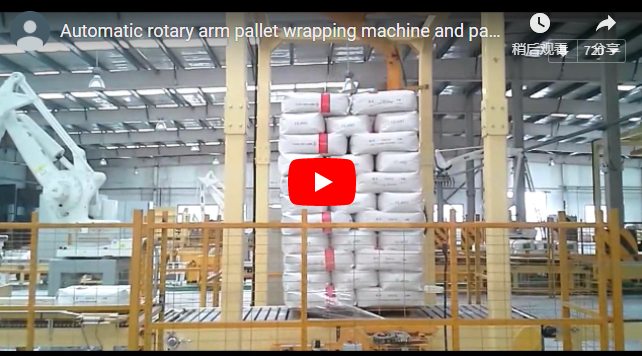
An automated in-line transfer layout eliminates this vulnerability entirely:
- Filled and sealed bags transfer along an infeed roller conveyor into the robot pick station.
- The robotic end-effector (mechanical clamp, bottom comb fork, or vacuum array) places bags onto a pallet positioned on a powered accumulation roller conveyor.
- Once the target stacking layer count is satisfied, the unsecured stack moves across a powered roller interface directly onto the turntable deck conveyor.
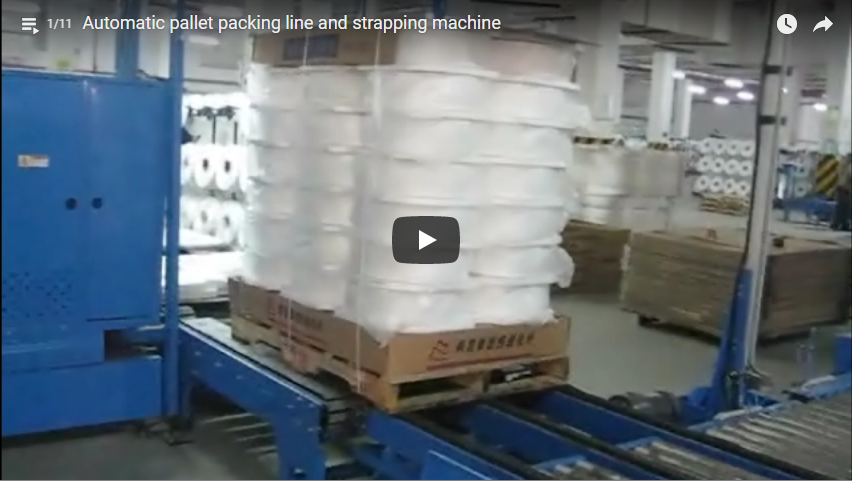
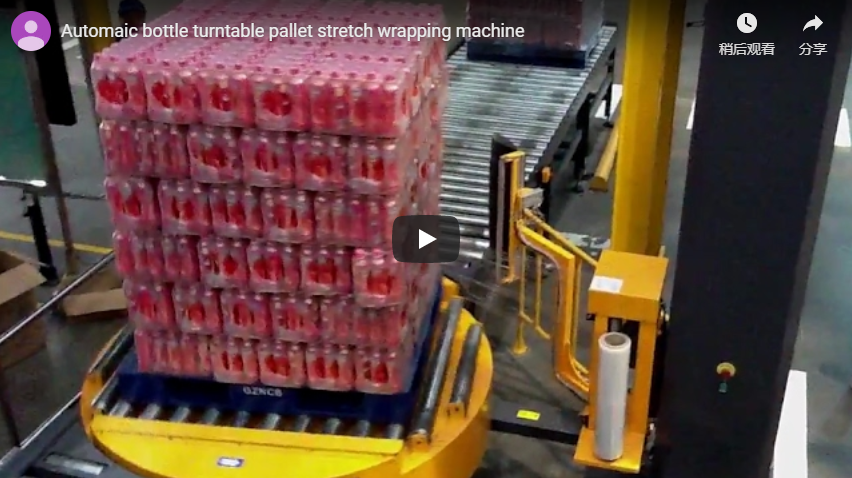
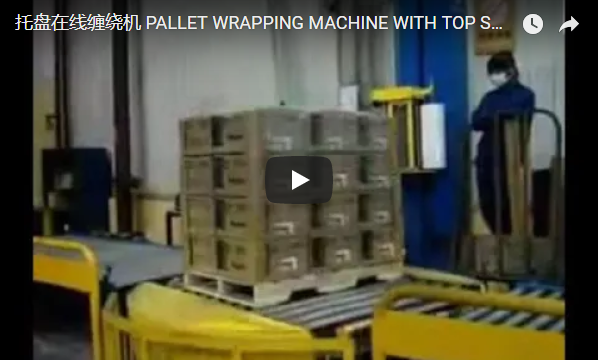
- The turntable completes multi-layer helical stretch wrapping and tail film heat-sealing.
- The unitized, weather-tight pallet discharges to downstream pickup buffer conveyors where standard forklifts or AGVs retrieve it safely.
By datuming the robotic stacking bed, intermediate roller transfers, and the stretch wrapper turntable conveyor along an identical horizontal plane, the unstable pallet remains supported across its entire base throughout all transfer stages.
The Four Handover Points
A reliable cell integration requires continuous mechanical and control alignment across four physical transition zones:
[ Bag Infeed Conveyor ] │ (Point 1: Bag Orientation & Grip Datum) ▼ [ Robotic Palletizing Station ] │ (Point 2: Pallet Roller Bed Discharge) ▼ [ Transfer Roller Bed ] │ (Point 3: Turntable Ingress & Concentric Positioning) ▼ [ Inline Turntable Stretch Wrapper ] │ (Point 4: Discharge Buffer & Forklift Pickup) ▼ [ Warehousing / Logistics Staging ]
- Point 1 (Bag Arrival to Pick Interface): Upstream bags must be flattened, squared, and registered against a mechanical stop to allow the robot gripper to maintain repeatable center-of-mass picks.
- Point 2 (Stacking Bed to Intermediate Conveyor): The palletizing base conveyor discharges the raw pallet load. Motorized soft-start acceleration ramps keep horizontal G-forces below 0.05 G to prevent top-layer inertial shifting.
- Point 3 (Intermediate Conveyor to Turntable Conveyor): Chain-driven roller gaps must not exceed 50 mm. The pallet must be positioned within ±10 mm of the turntable rotational center to avoid eccentric rotational mass imbalances during high-speed wrapping.
- Point 4 (Turntable to Outfeed Buffer): Following automatic film cutting, wiping, or sealing, the unit load discharges across the outfeed transition, clearing the wrapper perimeter safety curtain for the next cycle.
Stack Height and the 1800 mm Ceiling
Standard industrial turntable stretch wrappers—such as the heavy-duty A400 Pallet Stretch Wrapping Machine—are engineered with a standard vertical wrap envelope designed for load heights up to 1800 mm on pallets up to 1500 mm × 1500 mm.
Stacking bagged materials beyond this 1800 mm baseline introduces two critical engineering challenges:
- Structural Mast and Chain Mechanics: Wrapping stacks above 1800 mm requires an extended vertical mast and reinforced carriage lift chains. The film delivery carriage drive (rated at 0.4 kW on the A400 platform) experiences amplified cyclic torsional loads over taller stroke paths.
- Top-Heavy Centrifugal Instability: Bags are non-rigid bulk packages. As stack height increases past 1800 mm, the natural frequency of the stack drops. When spun at rotational speeds up to 13 r / min, top-layer bags experience outward centrifugal acceleration:
Centrifugal Acceleration: a_c = ω² × r Where:
ωis the rotational angular velocity (rad/s)ris the distance from the center of rotation to the outer corner of the bag
At 13 r/min (ω ≈ 1.36 rad/s) on a 1500 mm × 1500 mm footprint, the pallet corner radius r equals 1.06 m, yielding an outward radial acceleration of approximately 1.96 m/s² (0.2 G). For slick or aerated bags, this is sufficient to cause severe top-layer lean or complete stack collapse before the film web applies sufficient containment force.
When product stacks exceed 1800 mm, the system layout must incorporate an engineered mast extension and a heavy-duty pneumatic top platen to hold the top layers down during turntable ramp-up.
Takt: The Wrapper is Usually the Bottleneck
In high-speed bulk packaging lines, the packaging cycle balance must be calculated as a serial throughput budget. A standard inline turntable station operating at 13 r/min delivers a typical throughput of 20-40 padėklų per valandą, which translates directly to a single-pallet processing window of 90–180 s.
Serial Line Takt Budget
For an end-of-line configuration producing 40-bag pallets (25 kg bags, 1000 kg total payload) at the upstream rate your bag line actually delivers:
- Upstream Pallet Build Time:
40 bags ÷ 16 bags/min = 2.5 min (150 s) - Turntable infeed transfer: measured on your floor
- Stretch wrapping cycle:
t = revolutions × 60 / turntable speed, with revolutions from height and pitch - Film cut, seal and discharge: measured on your floor
- Total wrapper occupancy: must sit inside the 90–180 s takt
- Veikimo riba:
150 s (Robotic build) - 125 s (Wrapper takt) = 25 s surplus
Turntable, Conveyor and Handover Position
Heavy-duty turntable stations utilize a Ø2000 mm turntable deck vairuojamas a 0.75 kW gearmotor with variable frequency drive (VFD) regulation, rated for maximum payloads of 2000 kg.
| +——————————————————————-+ | Ø2000 mm Turntable | |
|---|---|---|
| +————————————-+ | ||
| 1500 mm × 1500 mm Pallet Footprint |
Film, Pre-Stretch and Top Sheet
Active film tension control isolates the palletized bag corners from direct strain, preventing puncture or bag gusset deformation.
| Parametras | Inžinerinė specifikacija |
|---|---|
| Kino medžiaga | Machine-grade cast Linear Low-Density Polyethylene (LLDPE) |
| Plėvelės storis | kaip liepta |
| Roll Core & Outer Diameter | ID 76 mm (3 inches), OD 150–250 mm |
| Standard Roll Web Length | 500 m per ritinį |
| Pre-Stretch Drive | 0.35 kW independent powered pre-stretch motor |
| Power Pre-Stretch Performance | Fixed-gear ratio (up to 200% yield: 1 m virgin film yields 3 m applied film) |
Top Sheet and Film Sealing Selection
For bagged chemicals, cementitious compounds, and food ingredients, standard helical wrapping leaves the pallet top exposed to moisture ingress and powder contamination.
- Film Tail Heat Sealing (A400 vs. Entry Systems): Unlike entry-level wrappers (such as the base A100 series) that leave a trailing film tail secured merely by friction or wiped tack, the A400 Series incorporates automatic power pre-stretch with integrated film clamp, cutting, and heat-sealing. Sealing the film end firmly against the under-layer prevents film unraveling during outdoor transit or AGV handling.
- Top sheet dispenser: when a weather-tight top cover is specified, an overhead applicator lays a polyethylene sheet before the wrap starts.
- Top Bag Stabilization: If top-sheet dispensing is omitted on slick bags, the upper layers require cross-corner banding or a pneumatic top platen holding the load down through the first base revolutions, with pressure set on a trial pallet.
Guarding and Interfaces
Automated robotic wrapping cells are guarded to the site risk assessment, which covers the turntable, the palletizer and the conveyor interfaces.
- Suderinti standartai:
- LT-415 6: Specific safety requirements for pallet stretch wrapping machines.
- EN ISO 12100: 2010: General principles for mechanical risk assessment and risk reduction.
- LT-60204 1: Electrical safety of industrial machines (single-phase 220V or three-phase line feeds).
- EN ISO 10218-2: Industrial robot cell integration and system safety guarding.
| +─────────────────────────────────────────────────────────────+ | Perimetro apsauginės tvoros | |||
|---|---|---|---|---|
| +──────────────────+ +──────────────────+ | ||||
| Robotinis krovimas | Perkelti | Inline Turntable | ||
| Stotis | ────────────► | Stretch Wrapper | ||
| +──────────────────+ Conveyor +──────────────────+ | ||||
| │ |
+────────────────────────────────────────────────┼────────────+ ▼ (Safety Muted guarding set by the site risk assessment) [ Discharge Buffer ]
Safety and Control Integration
- Dedicated dual-beam optical muting sensors distinguish between an exiting pallet (which allows pass-through) and personnel entry (which instantly triggers an emergency stop).
- An upstream fault stops the turntable infeed conveyor without aborting active wrapping cycles.
Atrankos kontrolinis sąrašas
When specifying an inline robotic palletizing and turntable stretch wrapping cell, verify your line parameters against this six-point matrix:
- 1. Bag Morphology & Mass: Record single bag mass (e.g., 25 kg vs. 50 kg), outer dimensions, bag material (polyethylene, multi-wall paper, woven polypropylene), and aeration characteristics.
- 2. Maximum Unit Load Stack Height: Confirm total height including pallet timber. If gross height exceeds 1800 mm, mandate an extended mast design and top platen stabilizer.
- 3. Footprint & Diagonal Clearance: Measure maximum pallet footprint (e.g., 1500 mm × 1500 mm). Verify that turntable diameter (Ø2000 mm) and surrounding fence clearance (≥2400 mm dynamic diameter) tolerate outer corner overhang.
- 4. Total System Takt Budget: Calculate total bag output per hour. Confirm that the pallet build time exceeds the stretch wrapper cycle time (90–180 s/pallet, Atitinka 20-40 padėklų/val).
- 5. Electrical & Motor Loading Profiles: Ensure local supply matches wrapper specifications (220V single-phase / 380V three-phase; tower drive 0.4 kW, pre-stretch 0.35 kW, turntable 0.75 kW).
- 6. Containment and Sealing Specification: Determine whether the application requires mechanical tail wiping, top-sheet dust protection, or full thermal film-tail sealing to withstand downstream distribution vibration.
Inžinerijos DUK
Does an inline turntable wrapper require forklift handling between the robot cell and wrapping station?
No. Powered chain-driven roller conveyors directly bridge the robotic palletizing station and the turntable wrapper deck, fully automating load transfer and eliminating forklift transit of uncontained pallets.
What happens if the pallet stack height exceeds the standard 1800 mm wrapper limit?
Standard vertical masts handle up to 1800 mm. Loads exceeding this height require an engineered mast extension and high-ratio vertical carriage lift chains. In addition, tall stacks of non-rigid bags generally demand an integrated pneumatic top platen to suppress centrifugal deflection at rotational speeds up to 13 r/min.
How is the stretch wrapping bottleneck addressed if the robot palletizer outpaces a single wrapper?
When upstream takt demands cycle times below 90 s per pallet, lines can either implement a dual-turntable shuttle configuration to wrap two pallets alternately, or optimize carriage kinematics and pre-stretch settings—provided the bag surface friction can tolerate higher rotational speeds without layer shear.
Why is automatic film sealing critical on bagged products compared to friction wiping?
Bagged pallet loads experience surface shifting during intermodal transport. Standard tail wipers rely on film cling, which can fail under ambient dust and wind. Powered cutting and thermal heat-sealing fuse the film end directly to the underlying wrap layer, providing structural containment that prevents unraveling.
Kitas žingsnis ir pasiūlymų užklausos
To evaluate your end-of-line integration, submit your production requirements to the application engineering team:
- Line Data Submission: Send incoming bag rates (bags/min), individual bag dimensions and weights, pallet footprints, and target stack heights to info@fhopepack.com.
- Layout and Takt Analysis (24–48 Hours): Receive a 2D/3D integration layout drawing, conveyor synchronization schedule, electrical specifications, and formal equipment proposal configured for your floor plan.
Paskutinį kartą peržiūrėta: 2026-11-05