Sintesi We pack steel wire rod for sea shipping by compacting each coil, tying it with four binding wires while it is held under pressure, and then protecting the surface. Our wire rod compactor presses with an adjustable 60–400 kN and ties four wires at once in a 30–40 s cycle. The binding wire has to hold the coil's spring-back once the press opens. A worked example checks that holding strength and the volume a compacted coil saves.
Sommario
- What sea freight does to a loose wire coil
- Pressing and tying in one station
- Horizontal wire rod compactor data
- Binding wire: size and strength
- Worked example: spring-back and coil volume
- After strapping: rust and handling protection
- Lista di controllo per la selezione: cosa inviarci
- Sicurezza e norma EN 415-10
- FAQ di ingegneria
- Passo successivo
- Lettura correlata
- fonti
What sea freight does to a loose wire coil
A wire rod coil leaves the laying head as loose rings. On a ship it is lifted by crane hook, stowed in a hold or container and shaken for weeks. Loose rings shift, tangle and spring open at the ends, and a tall loose coil wastes space.
Compacting squeezes the rings together before they are tied. A shorter, tighter coil stacks better, stays square on its end and does not open up during the voyage.
Pressing and tying in one station
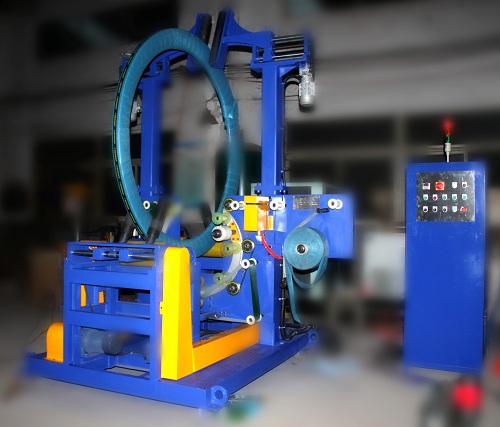
The press here is a vertical type. The coil stands with its eye upright on a yellow base, and a yellow press head with vertical press plates comes down from above until the rings are tight. Strapping heads stand round the coil, and a crane hook overhead brings coils in and out.
While the press holds the coil down, the heads draw the binding wire, stretch it, twist it and knot it. Four wires go on at once. Only then does the press lift, so the wire takes the coil's spring-back.
Our horizontal wire rod compactor works on the same principle, with two pressing stands and a C-hook crane. Its data are below.
Horizontal wire rod compactor data
These are the published data for our horizontal, C-hook-fed compactor. For a vertical station like the one here, we set press force, opening and head layout to your coil in the proposal.
| Articolo | Compattatore per vergella |
|---|---|
| diametro esterno della bobina | 1,000–1,800 mm |
| peso della bobina | 500–2,000 kg maximum |
| Press stand opening | 650–4,700 mm |
| Forza di compattazione | adjustable, 60–400 kN |
| Pressione idraulica | 210 bar |
| Fili di legatura per bobina | 4, da 4 teste di reggiatura |
| Filo di legatura | 6.3–8 mm, unalloyed wire rod |
| Tempo di ciclo | 30-40 s |
| C-hook overall length | 3,500 mm |
| Rifornimento d'aria | 5.0–6.0 bar |
| Potenza | 150kW |
The compactor connects to the end of the wire rod mill line. Rollers support the coil while it is strapped.
Binding wire: size and strength
The binding wire is uniform unalloyed wire rod with 380–450 MPa tensile strength and 28%–32% elongation. The elongation lets the knot form and the wire give a little under shock without snapping.
The wire size sets how much spring-back the four ties can hold. The twisted knot is weaker than the plain wire, so the real holding force is 4 × A × Rm × η, where η is the knot efficiency. We measure η on trial coils for your wire and head setting.
Worked example: spring-back and coil volume
Take a 2,000 kg wire rod coil, 1,250 mm OD and 850 mm ID. Loose it stands 1,800 mm tall, and the plant wants it at 1,400 mm. These are illustrative customer figures.
Holding strength, 6.3 mm wire. The cross-section is π ÷ 4 × 6.3² = 31.2 mm². At 380 MPa one plain wire breaks at 31.2 × 380 = 11.9 kN, so four reach about 47 kN before the knot efficiency η.
Holding strength, 8 mm wire. The cross-section is π ÷ 4 × 8² = 50.3 mm². Four wires at 380 MPa hold 4 × 50.3 × 380 = 76.4 kN, and at 450 MPa 90.5 kN.
Cosa significa. The press can push up to 400 kN, but the ties only need to hold what the coil pushes back once the press opens. If your coil springs back with more than 47 × η kN, 6.3 mm wire is at its limit, so go to 8 mm. We confirm the setting on trial coils.
Volume saved. The coil envelope is π ÷ 4 × (1.25² − 0.85²) × height. That is 0.66 m³ per metre, so 1.19 m³ loose and 0.92 m³ compacted. Each coil takes about 22% less space in the hold.
Ritmo. The 30–40 s figure is the press-and-tie cycle. On its own that would allow 3,600 ÷ 40 = 90 to 3,600 ÷ 30 = 120 coils an hour. The net rate also depends on how fast the C-hook or conveyor brings coils in and takes them out, so add that transfer time t: coils per hour = 3,600 ÷ (cycle + t).
After strapping: rust and handling protection
Sea air and condensation in a container cause rust and water spots. After compacting and strapping, a coil can be wrapped through the eye with stretch film, paper or PVC. Wrapping keeps dust and moisture off and protects the surface in transit.
For long voyages, buyers often ask us to combine a woven raffia layer for handling with VCI stretch film against rust. Tell us how long the coils travel and how they are stored at the port, and we match the wrap to the trip.
Lista di controllo per la selezione: cosa inviarci
- Coil OD and ID.
- Loose height and target compacted height.
- Bobina più pesante.
- Mill output in coils per hour.
- Binding wire or strap you use now.
- How coils arrive: C-hook, conveyor or basket.
Sicurezza e norma EN 415-10
We build our compactors to CE requirements, with EN 415-10 as the reference and an ISO 12100 risk assessment. The press closing on the coil and the binding wire under tension are the main hazards.
Fence the press and strapping heads, with interlocked access gates or light curtains chosen in the risk assessment, so the cycle stops if someone enters. Wire rod ends and tensioned wire can whip if a tie fails. Lock out the hydraulics and air before working on a strapping head.
FAQ di ingegneria
Q: Can it tie with PET strap instead of wire? A: Yes. Our basket-type compactor ties wire coils with 19 mm polyester strap.
Q: How many ties does a coil get? A: Four binding wires, all tied in one press cycle by four heads.
Q: Does the press mark the rod? A: On our basket compactor, the press supports and strapping head touch the coil through HDPE contact pads. We fit the same kind of pads to suit your rod.
D: Quali norme di sicurezza si applicano? R: Per i mercati CE lavoriamo secondo la norma EN 415-10, con una valutazione del rischio secondo la norma ISO 12100.
Passo successivo
- Email your coil sizes, weights and target height a info@fhopepack.com.
- Rispondiamo entro 24 ore con una proposta, with press force and wire size.
- Inviamo un disegno di progetto for the end of your mill line.
Lettura correlata
- Compattatore vergella con reggiatrice in filo d'acciaio
- Macchina per la compattazione e la reggiatura di bobine di filo metallico
- Compressione automatica di coil di vergella d'acciaio con reggiatrice
- Macchine avvolgitrici per bobine di filo
- Come eseguire automaticamente la compattazione e la reggiatura del filo d'acciaio
- Horizontal wire coil compactor
fonti
- Specifications: FHOPE wire rod compactor and wire coil compacting and strapping product pages
- Video della macchina: steel wire coil compacting on YouTube
- Holding strength and coil volume: our worked example, illustrative coil figures
- Norme: EN 415-10 (macchine per l'imballaggio, sicurezza generale); ISO 12100:2010
Ultimo aggiornamento: 17/10/2026