Vezetői összefoglaló: This page is for the buyer who ships slit or non-ferrous coils and cannot afford one that arrives with telescoping layers, surface scratches or a buckled edge. It explains what causes those three defects, how a packing line goes about preventing each of them, and what to check before you commit. The video further down is a working coil line, useful as a picture of the stations rather than as a performance record.
https://www.fhopepack.com/orbital-stretch-wrapper.html
Ezen az oldalon: What this page helps you decide · Teleszkópos · Felületi karcolások · Edge buckling · How the line addresses them · What the clip shows · Vevő ellenőrzőlistája · FAQ · Kapcsolódó olvasmány · Következő lépés
What this page helps you decide
A packed coil leaves the line carrying three risks: layers that slide out of line, marks on the outer wrap, and a crushed edge. All three are decided long before the coil ships. Winding tension decides the first, whatever touches the strip decides the second, and how the straps are fitted decides the third.
This page walks through each defect and turns it into something you can check with a supplier. For each one you get the design detail that prevents it, and the acceptance test that shows the detail is real.
Telescoping: layers that slide out of line
The layers of a wound coil hold each other by radial pressure. Telescoping happens when that pressure is lost, and the inner wraps slide sideways so the coil face goes stepped or conical. It is a one-way defect. Once the layers have moved, no downstream wrapping or strapping puts them back, and the coil usually has to be rewound.
Slitting is the usual starting point. Camber, or a heavy middle, carried in from the slitter leaves the strip longer along one edge, and that imbalance works its way out as layer drift. Winding tension that is low, or uneven across the width, does the same thing more directly. Either way, the coil is stable only while something supports it.
Storage and transport decide the rest. A coil standing eye-vertical sits its own weight on the inner wraps, and without full-width support the lower layers slump. Stacking an unsupported coil adds pressure in the same direction. A drop or a hard grab can lose the alignment in one movement.
How a line prevents it:
- Orientation. Keep the coil eye-horizontal through conveying and stacking, so the layers stay stacked instead of sliding.
- Wrapping. Film presses the outer wraps inward and adds radial confinement, which is real pressure against layer slip.
- Banding. A band tightens the layers before the coil leaves the line, and holds them while the coil is handled.
- Edge guides. Guides at the line entry keep the strip tracking straight as it feeds, rather than drifting across the width.
What to check with a supplier:
- Coil orientation through the line. Ask whether the coil is held eye-horizontal from conveyor to pallet, and whether any station turns it upright.
- Order of wrapping and stacking. Film applied before stacking protects a coil that is still being handled. Film applied after leaves the coil unprotected while it is stacked.
- A shipped-coil photograph. The verdict on telescoping is a coil that arrives flat-faced. Ask for a photograph taken at destination.
- Winding tension control. Ask whether tension is set and tapered, and how it is measured.
Surface scratches: marks in the outer wrap
The outer wrap of a coil is the first thing to touch anything else, so it takes the marks. Longitudinal scratches come from dragging a coil along a hard surface. Arc scratches come from a coil rubbing a fixed object while it turns. Either way the mark is in the metal, and anyone who inspects the top wrap will find it.
Most of the causes are contact and sequence. An unguarded edge — a roller end, a guard lip, the tip of a fork — meeting the coil body. Swarf or debris trapped between the coil and a roller. Tooling that travels across a bare coil during banding or wrapping, before any film is there to take the damage. A bare coil set down on concrete rather than going straight onto the line.
Prevention is mostly about surfaces and order. Rollers and guides are coated or padded, the conveying path is kept clean, and the coil is wrapped or side-protected before it is handled again. Lifts use vacuum pads or padded clamps rather than hard grapples, and bare coils stay off hard floors.
What to check with a supplier:
- Contact surfaces. Walk the line and look for coated rollers, padded guides and soft fork contact points.
- How far bare metal travels. Every metre a bare coil moves is a chance to mark it. Ask how short that distance is.
- A run on your own coil. Take a coil off after each station and inspect the top wrap under a light.
Edge buckling: when the rim gives way
The rim is the thinnest and most exposed part of a wound coil, and it fails differently from the face. Buckling is local crushing or spreading at the edge, most often right where a strap crosses it. The band pulls inward with real force, and if that force lands on the strip edge with nothing to spread it, the edge gives.
Thin or soft strip makes it worse, because there is less material to carry the load. So does stacking coils edge to edge, where one rim presses on the next, and any impact during lifting or transfer.
Prevention here is a design detail, and it is visible if you know to look for it. An edge protector sits under each strap, so the band presses on the protector instead of cutting into the strip edge. Strap positions are set back from the rim, and tension is set to a target rather than to whatever feels tight. Coils on a pallet sit on separators, so the rims do not bear on each other.
Where film is applied before the straps, it also leaves a cushion layer under the band. That is one reason the order of wrapping and banding matters more than the equipment list.
What to check with a supplier:
- Edge protectors, and where they sit. Ask how many strap positions get a protector, and look for them in the acceptance run.
- Strap tension, in writing. Ask for the target value and the point at which it is measured.
- The pallet interface. Ask what separates the coils, and whether the stack loads the faces or the rims.
How the packing line addresses them
Read the three defects together and the job of the line becomes clear. It has to keep the coil off hard surfaces, hold the wound layers together, and spread the strap load before it reaches the edge.
- Szállítás. Roller beds and platforms carry the coil eye-horizontal, and their contact points are where scratches are won or lost.
- Sávozás. A band locks the wound layers so they cannot drift, and with a protector under it, spreads its own load.
- Csomagolás. Film seals the body, adds pressure against layer slip, and gives the coil a surface that can take the rest of the journey.
- Halmozás. The pallet and its separators decide whether the bottom coil carries the stack on its face or on its rim.
Order matters as much as equipment. Wrapping before stacking means the coil is already protected while it is lifted into the stack. Banding before wrapping keeps the layers locked while the film goes on. Ask which order the line uses, and what decided it.
What the machine-line clip shows
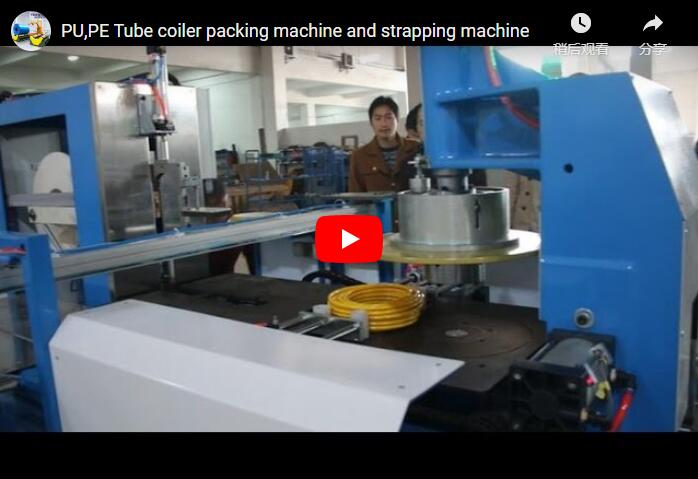
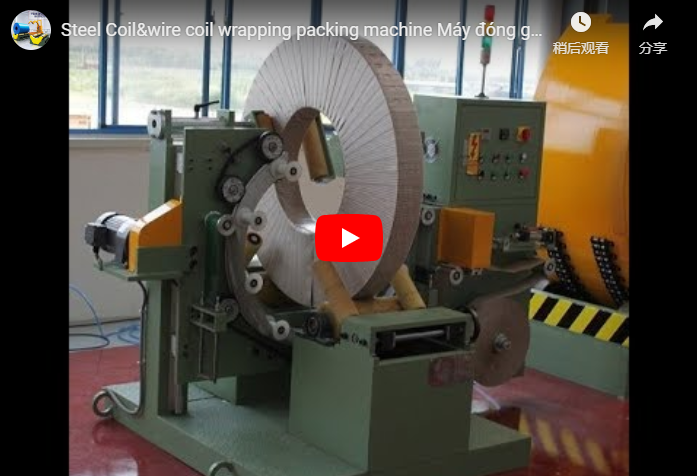
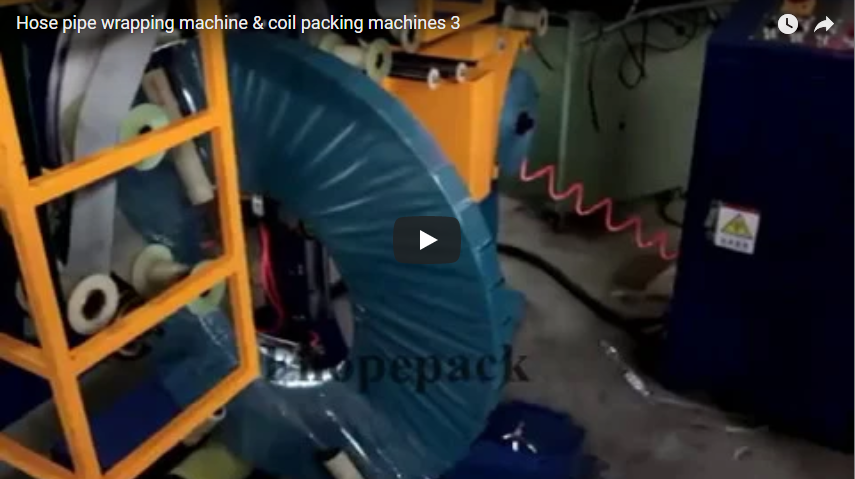
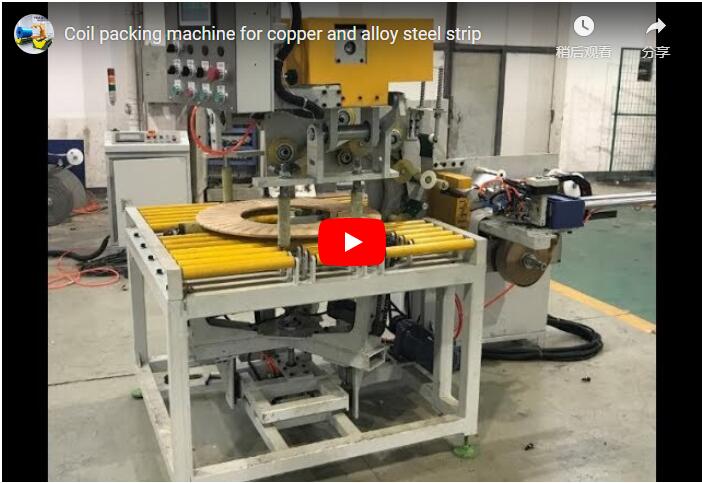
What the video shows is a working coil line. Coils lie horizontal on yellow roller conveyors, a band sits around a coil body, clear stretch film covers the coil, and one frame shows coils stacked. The last part of the clip is a single continuous camera view. Direct observation notes from the sampled frames, not a performance test.
The clip does not show a legible cycle time, an edge protector being fitted, or a completed wrap cycle. Two limits are worth knowing before you read anything into it. The first 82 seconds are a multi-panel edit, so the panel order is not proof of process order, and no clock runs across the cut.
Nothing on screen carries a legible figure either, so no rate, tension or capacity can be read from it. The line is real and the coils are real; the numbers are not in the video.
Vevő ellenőrzőlistája
Six questions decide whether a line will protect your coils. Ask them in writing, and keep the answers with the quotation.
| Kérdezze meg a szállítót | Miért dönt a vásárlásról |
|---|---|
| The edge-protection design: protector type, and how many strap positions get one | The strap load has to be spread, or the rim buckles under it |
| Strap tension target and its measurement point, in writing | Tension set by feel is how coil edges get crushed |
| Film order and specification: before or after banding, type, wraps per coil | Film under the straps cushions them; film over the top does not |
| Coil envelope: OD range, bore, strip width, thickness, grade and weight | Decides whether your most delicate coil fits the line at all |
| Egy vágatlan ciklus, egy kamera, látható óra | The only footage that shows sequence and timing |
| Elrendezési rajz és vezérlési architektúra | Megjeleníti, hogy az állomások egy vonalat alkotnak-e, vagy különálló egységeket alkotnak-e |
Send this to the supplier, and copy it as it stands:
- For each strap position, the protector used, the tension target, and where you measure it.
- The film: applied before or after banding, type, stretch, and wraps per coil.
- The coil envelope you are quoting for: OD, bore, strip width, thickness, grade and weight.
- One uncut cycle on one camera with a clock running, plus the layout drawing.
- Where bare coil travels unprotected, and what the rollers and guides are coated with.
- A shipped-coil photograph from a reference installation in our material.
- The acceptance test you would run on our coil, and how we measure the result.
FAQ
Do straps alone stop telescoping?
No. A band holds the layers while it is tight, but telescoping starts with winding tension and with how the coil is stored and stacked. Banding helps; it is not the cure. If a supplier treats the strap as the answer, ask what sets the winding tension.
Can I judge a supplier’s protection from a line video?
Not from an edited one. A video can show you the stations and the equipment, which is genuinely useful. It cannot show you a strap tension, a protector at every position, or a coil arriving intact. Those come from documents and from a run on your own coil.
Does a coil have to travel eye-horizontal?
For most coils, yes. Eye-vertical storage puts the coil’s weight on its inner wraps, which is where telescoping begins. If your process needs vertical coils, the upender has to support the coil across its full width. If it does not need them, a line without an upender is not a gap.
Kapcsolódó olvasmány
- Orbitális sztreccs borítás — the film stage that adds radial confinement against layer slip.
- Automata tekercs csomagolósor — the line configurations these stations belong to.
- Acéltekercs pántológépek — banding equipment, and where edge protectors sit.
- Acél tekercs csomagoló gép — the wrapping stage shown through the middle of the clip.
- Automata pántoló gép — azonos osztályba tartozó pántológépek.
- Tekercs fel- és billenő — re-orientation equipment, for buyers who need vertical coils.
Következő lépés
Send the supplier your coil mix: outer diameters, bores, strip widths, thicknesses, grades and daily volumes. The clip on this page carries none of those figures, so the envelope has to come from them.
Then send the seven questions above, and ask for the edge-protection design, the strap tension target and the film order in writing.
Then book one uncut cycle with the clock running, and have them run your most delicate coil as the acceptance sample. Use the Elérhetőség oldalon hogy elkezdődjön az a csere.
Utolsó felülvizsgálat: 2026-09-21
Közzétéve: 2026-09-21