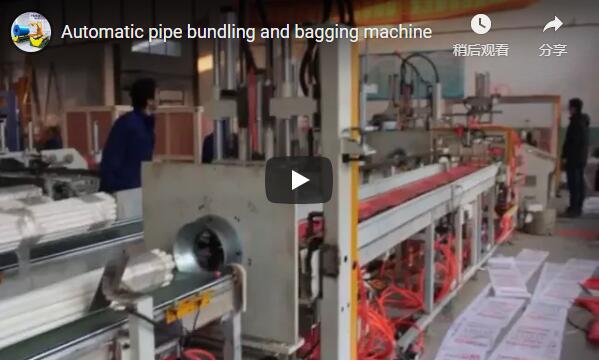
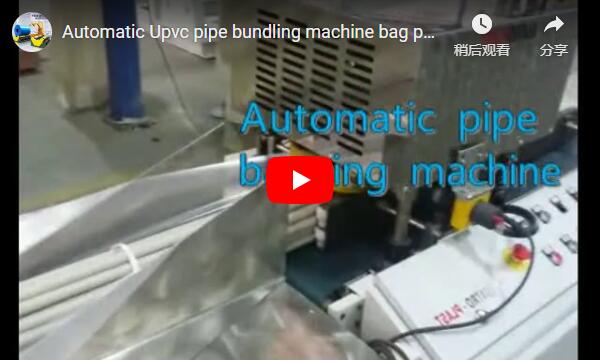
> **Resumen ejecutivo**
> Our pipe bagging line makes a bag from PE or PP film, pushes a pipe bundle into it and seals it, all on the line. It bags bundles from **110 to 260 mm** across at about **1–3 bundles per minute**, and the bag can be changed to suit single pipes. We size the bag from the bundle diameter and check the bagging rate against your extruder output.
Índice
- Cómo funciona la línea de ensacado
- Determina el tamaño del paquete
- El tamaño de la bolsa
- Tasa de embolsado contra la extrusora
- Datos de línea
- Servicios públicos y seguridad
- Lista de verificación de selección
- Preguntas frecuentes sobre ingeniería
- El próximo paso
- Lectura relacionada
- Fuentes
Cómo funciona la línea de ensacado
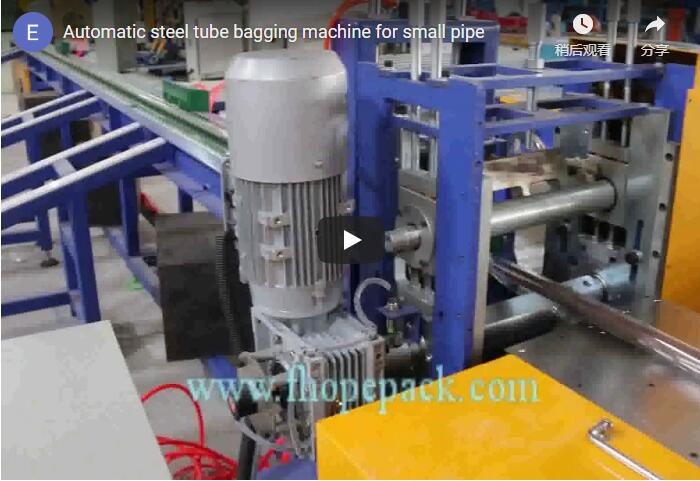
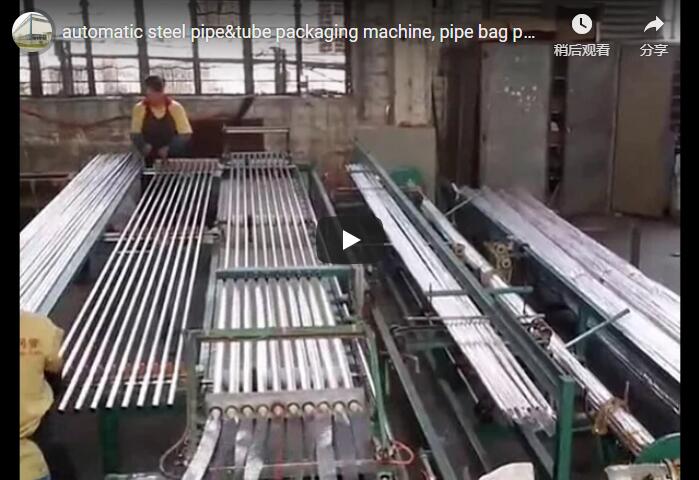
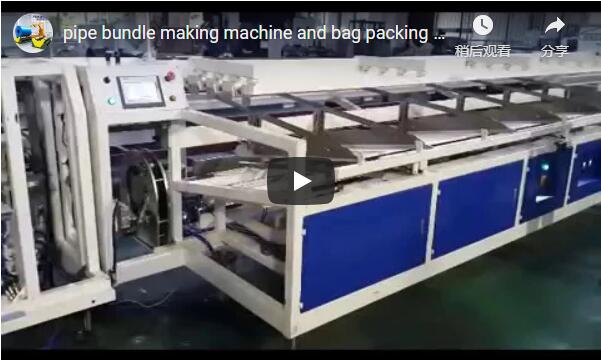
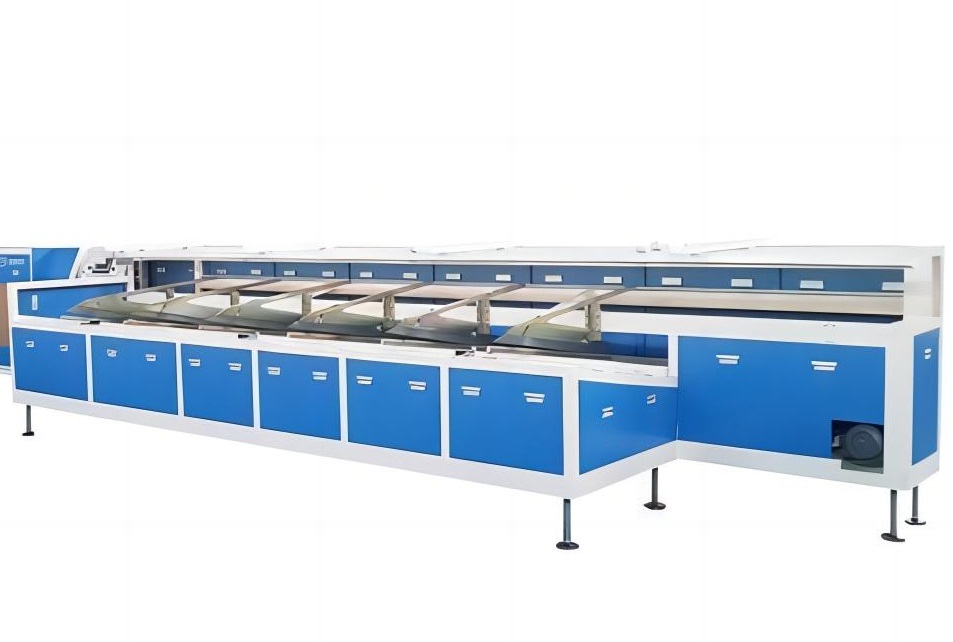
1. **Feed.** The pipe bundle is fed in automatically and conveyed to the bag station.
2. **Make the bag.** The machine welds PE or PP film into a bag sized to the bundle.
3. **Fill.** A pusher drives the bundle into the open bag.
4. **Seal and discharge.** The bag is sealed, carried to the end of the line and tilted out.
En la etapa previa al proceso, una máquina de conteo y empaquetado cuenta las tuberías según un programa preestablecido y sujeta el paquete con film estirable de LLDPE antes de embolsarlo. Una máquina flejadora puede realizar el flejado, y una etiquetadora puede añadir una etiqueta de código de barras después del sellado.
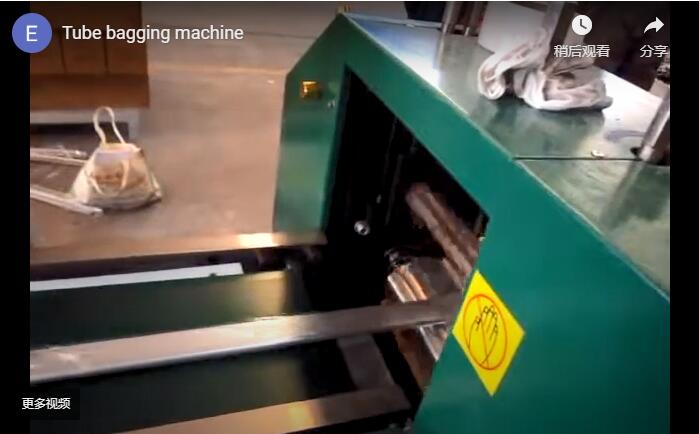
En nuestro vídeo, la bolsa se abre alrededor del paquete y una línea láser roja marca el centro, de modo que el paquete entra recto y el precinto queda alejado de los extremos de los tubos.
Determina el tamaño del paquete
Los tubos redondos se encajan formando un hexágono. Un haz de 19 tubos tiene 5 tubos en su fila más ancha, por lo que su diámetro es aproximadamente 5 veces el diámetro de los tubos.
| Pipe | Pipes per bundle | Bundle diameter |
|---|---|---|
| 20 mm | 19 | about 100 mm |
| 32 mm | 19 | about 160 mm |
| 50 mm | 19 | about 250 mm |
El paquete de 20 mm queda por debajo del rango de ensacado de 110 mm, por lo que se necesitan más tubos por paquete para tuberías pequeñas. Con 37 tubos, hay 7 de ancho, lo que da aproximadamente 140 mm. El peso del paquete también debe mantenerse entre 10 y 50 kg para la máquina de empaquetado.
El tamaño de la bolsa
La bolsa debe rodear el paquete dejando cierto espacio libre:
Ancho de la bolsa plana ≥ π × diámetro del paquete ÷ 2 + espacio libre.
Para el haz de 160 mm, π × 160 ÷ 2 es aproximadamente 251 mm antes del espacio libre. Un espacio libre demasiado pequeño provoca que la bolsa se arrastre durante la carrera del empujador, por lo que lo ajustamos a modo de prueba con sus haces. La longitud de la bolsa es la longitud del tubo más el espacio necesario para sellar al final. Los tubos tienen una longitud de 3 a 6 m, y la película de la bolsa es de PE, PP o HDPE, con un espesor de 30 a 80 µm.
Tasa de embolsado contra la extrusora
Ejemplo ilustrativo para tubería de 32 mm en tramos de 4 m, 19 tuberías por paquete:
| Bagging rate | Pipes per minute | Pipe per minute |
|---|---|---|
| 1 bundle/min | 19 | 76 m |
| 3 bundles/min | 57 | 228 m |
Si su extrusora produce menos tubería por minuto de la que la línea de ensacado puede procesar, una sola ensacada puede abastecer la línea sin problemas. Si varias extrusoras alimentan una sola ensacada, sumamos su producción y la comparamos con la tasa de producción para el tamaño de su paquete. Una estación de almacenamiento y amortiguación de tuberías ubicada antes de la máquina de ensacado mantiene la línea funcionando sin interrupciones, por ejemplo, mientras se cambia un rollo de película.
Datos de línea
| Artículo | Valor |
|---|---|
| Bundle diameter for bagging | 110–260 mm |
| Bagging speed | About 1–3 bundles per minute |
| Bag film | Welded PE or PP; PE, PP or HDPE, 30–80 µm |
| Film roll diameter | 200–500 mm |
| Longitud de la tubería | 3–6 m |
| Pipe diameter for bundling | 20–65 mm |
| Peso del paquete | 10–50 kg |
| Counting | Automatic, by program |
| Options | Strapping before bagging, labelling after sealing |
Servicios públicos y seguridad
La línea de ensacado requiere aire comprimido a 7-8 bares y una alimentación trifásica de 380 V, que adaptamos a la frecuencia local. Las mordazas de sellado y el empujador están protegidos, y la línea se detiene si un paquete se atasca en la estación de ensacado.
Las normas aplicables dependen del mercado de destino. Para los mercados CE, la norma ISO 12100 establece el método de evaluación de riesgos y la norma EN 415-10 establece los requisitos generales para las máquinas de envasado.
Lista de verificación para la selección de una línea de ensacado de tuberías
- [ ] Pipe diameter and length range.
- [ ] Pipes per bundle and bundle diameter.
- [ ] Single pipe or bundle bagging.
- [ ] Bag film type and thickness.
- [ ] Extruder output per line, and lines per bagger.
- [ ] Strapping or labelling needed.
- [ ] Local power supply and compressed air.
Preguntas frecuentes sobre ingeniería
Q: What bundle sizes can it bag?
A: Bundles from 110 to 260 mm across. A smaller bundle needs more pipes per bundle to reach the range.
P: ¿Qué tan rápido es?
A: About 1–3 bundles per minute.
Q: Can it bag single pipes?
A: Yes. The bag can be changed for a single pipe or a bundle; we confirm on your drawing that the pipe diameter suits the bag station.
Q: What film does it use?
A: Welded PE or PP film, 30–80 µm thick.
Q: How wide should the bag be?
A: Flat width at least π × bundle diameter ÷ 2, plus clearance.
El próximo paso
Planificamos su línea de ensacado de tuberías en tres pasos:
1. **Submit your layout drawing** with pipe sizes and extruder output to **info@fhopepack.com**.
2. **Receive a proposal within 48 hours**, with the bundle and bag plan.
3. **Book a site survey** to check the link to your extrusion line.
Lectura relacionada
- [Pipe bag packing machine](https://www.fhopepack.com/Pipe-packing-machine/bagging-machine.html)
- [PPR and PVC pipe bagging line](https://www.fhopepack.com/PPR%20PVC-pipe-bagging-packing-line.html)
- [Online pipe bundling line](https://www.fhopepack.com/Plastic-Pipe-Packing-Line/on-line.html)
- [Video: full automatic orbital bagging machine for aluminum profile and stainless steel pipe](https://www.fhopepack.com/videos/full-automatic-orbital-bagging-machine-for-aluminum-profile-and-stainless-steel-pipe/)
Fuentes
- Bagging line data: [PPR and PVC pipe bagging line page](https://www.fhopepack.com/PPR%20PVC-pipe-bagging-packing-line.html)
- Bundling and bag film data: [pipe bag packing machine page](https://www.fhopepack.com/Pipe-packing-machine/bagging-machine.html)
- Machine in action: [our pipe bundle bag packing video on YouTube](https://www.youtube.com/watch?v=Al7kvt3EWyg)
- Alcance de las normas: [ISO 12100:2010](https://www.iso.org/standard/51528.html), [EN 415-10:2014](https://www.nen.nl/en/nen-en-415-10-2014-en-191845)
Última revisión: 04/10/2026