Resumen ejecutivo
High-density and acoustic fibre panels are prone to surface scuffing, edge chipping, and interlayer fretting wear when loose stacks vibrate during transit. This automated horizontal orbital wrapping machine applies continuous tension-controlled stretch film around the panel bundle, consolidating individual boards into a rigid, monolithic pack. By eliminating relative micro-movement between panels without crushing delicate profile edges, the system ensures dust-proof, moisture-resistant packaging directly integrated into continuous production lines. Engineering specifications, ring diameters, and conveyor configurations are matched to production throughput and panel dimensions.
Índice
- ¿Por qué se desgasta la superficie del panel de fibra?
- Qué hace la máquina
- Envolviendo la pila de paneles
- Sujetar sin frotar
- En la línea del panel
- Una pila que se envía limpia
- Configuración típica
- Lo que muestra el vídeo
- Lista de verificación de selección
- Operación y seguridad
- Preguntas frecuentes sobre ingeniería
- El próximo paso
- Lectura relacionada
- Fuentes y estándares
¿Por qué se desgasta la superficie del panel de fibra?
A fibre panel’s decorative face, whether pre-painted, acoustic-perforated, or textured, represents the critical commercial value of the finished board. During material handling and road transit, dynamic acceleration forces cause micro-slippage between adjacent boards. When panels shift within an unsecured stack, surface friction creates cosmetic burnishing, abrasive scratches, and edge spalling.
A single loose panel compromise downgrades the entire bundle from prime grade to factory scrap. Manual strapping or loose poly-bagging fails to arrest internal shear forces. Automated orbital wrapping neutralises dynamic bundle movement by imparting balanced, multi-axis containment force across the full stack periphery, anchoring each layer securely against vibration.
Qué hace la máquina
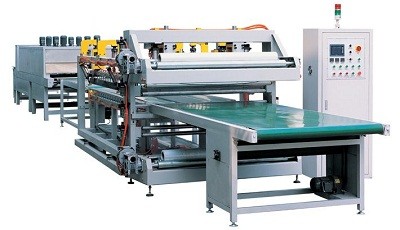
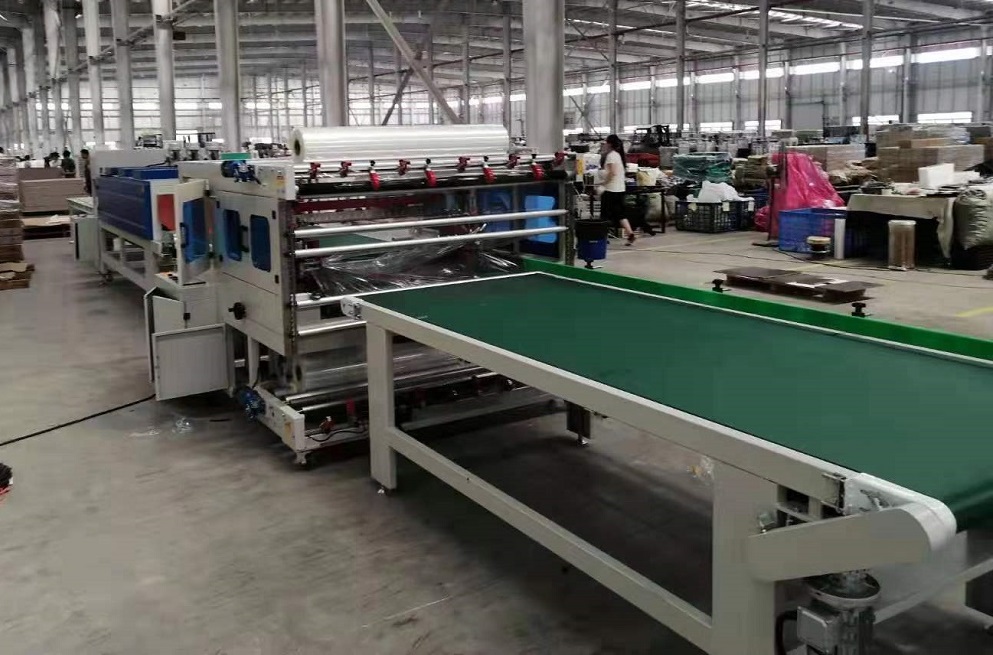
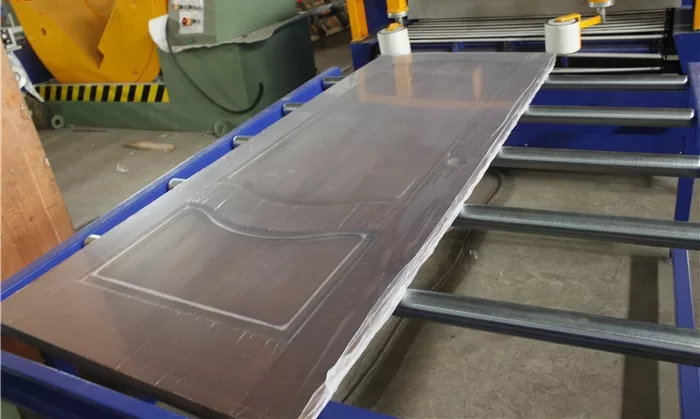
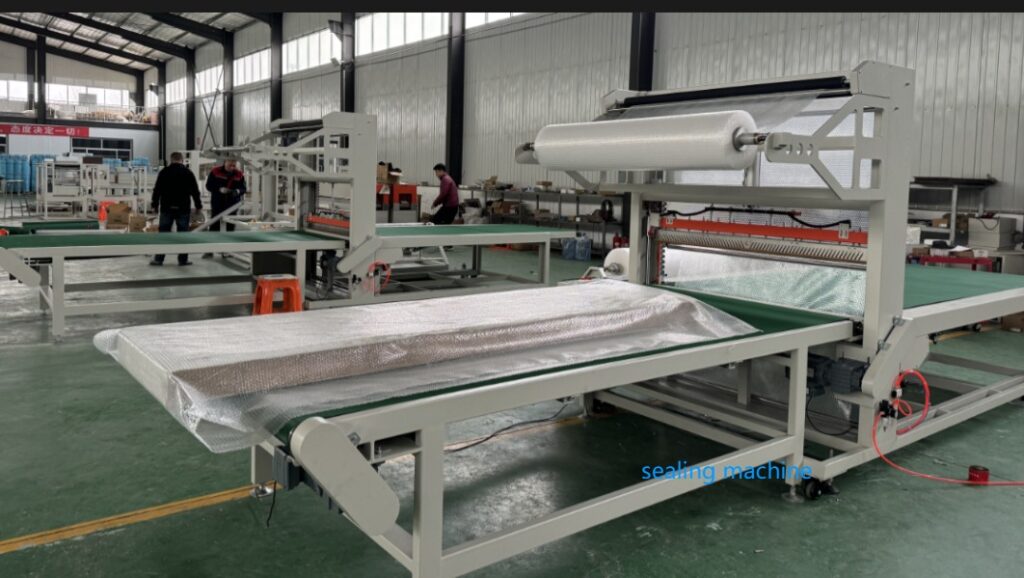
The machine automates the secondary packaging of stacked medium-density fibreboard (MDF), high-density fibreboard (HDF), mineral wool boards, and composite cladding panels. As the stack enters the wrapping station, a high-speed rotating orbital ring drives an external film carriage around the product in a helical path while powered conveyors advance the load horizontally.
By pre-stretching the film and applying continuous hoop tension, the machine draws out mechanical slack between individual boards. The resultant tensile matrix unifies the bundle, sealing out atmospheric humidity, airborne sawdust, and handling grit while safeguarding precision-machined tongue-and-groove or bevelled edges.
Envolviendo la pila de paneles
The orbital wrapping sequence encapsulates the panel bundle across its full longitudinal envelope:
- Entrada y alineación: Powered side-guide rollers centre the stack, while pneumatic overhead hold-down rollers prevent top-board shifting during infeed acceleration.
- Leading-End Clamping: An automated mechanical clamp holds the film tail as the ring accelerates, initiating the primary overlapping wraps at the front edge.
- Continuous Helical Wrap: The ring rotates synchronously with conveyor feed speed, maintaining a programmable film overlap (typically 30% to 60%) along the bundle length.
- Tail-End Reinforcement & Cut: Additional reinforcement wraps secure the trailing end before an automated hot-wire or pneumatic blade cuts the film, followed by a pneumatic wipe-down brush to seal the film end.
Sujetar sin frotar
Consolidating fragile fibre panels requires a precise equilibrium between containment force and edge pressure. Excessive film tension concentrates high compressive loads on the panel corners, causing edge crushing or core fracturing on low-density boards. Insufficient tension allows interlayer slippage under transit vibration.
The carriage utilizes an independent mechanical brake or closed-loop electronic pre-stretch carriage (150% to 250% elongation ratio). This distributes uniform membrane tension around the stack profile. The elastic memory of the stretched linear low-density polyethylene (LLDPE) film generates consistent inward containment pressure without creating localised stress risers on finished surfaces.
En la línea del panel
The horizontal wrapping system integrates directly downstream of panel sizing, edge-banding, sanding, and automated stacking cells. Infeed flat-belt or roller conveyors receive completed bundles directly from automated stacking gantries or scissor lifts, eliminating interim manual handling.
The system communicates with upstream production cells via standard PLC handshakes (interlocking dry contacts or industrial Ethernet), automatically detecting stack presence via optical sensors, verifying bundle length, adjusting wrap programmes on the fly, and discharging wrapped units onto downstream accumulation or robotic palletising stations.
Una pila que se envía limpia
Wrapped bundles leave the production cell completely sealed against environmental exposure and handling hazards. The tight secondary film envelope provides essential shipping protections:
- Integridad de la superficie: Zero interlayer abrasion or scuffing across delicate coatings.
- Sellado Ambiental: 5- or 6-sided barrier resistance against rain, worksite humidity, and dust contamination.
- Handling Rigidity: Rigid structural integrity that prevents stack deformation, fanning, or shifting during forklift transport and multi-tier container racking.
Configuración típica
The operational specifications below reflect standard engineering boundaries for industrial horizontal panel packaging lines.
| Parámetro | Standard Operational Specification |
|---|---|
| Rango de ancho del panel | 300 mm a 1300 mm |
| Panel Stack Height | 50 mm a 600 mm |
| Longitud mínima del paquete | 1000 mm (shorter lengths handled with auxiliary bridge rollers) |
| Velocidad de rotación del anillo | 20 to 80 RPM (frequency-inverter controlled) |
| Velocidad de alimentación de la cinta transportadora | 3 to 18 m/min (synchronized with ring rotation) |
| Compatibilidad con film estirable | LLDPE cast / blown film; Width: 150–250 mm; Core: 76 mm; Thickness: 20–50 µm |
| Relación de pre-estiramiento | 150% to 250% motorized power pre-stretch |
| Pneumatic Hold-Down | Dual pneumatic overhead stabilization rollers (0.4–0.6 MPa) |
| Arquitectura de control | Siemens / Mitsubishi PLC with 7-inch colour touch-screen HMI |
| Suministro eléctrico | 380 V / 415 V three-phase, 50/60 Hz (optional 220 V single-phase for light duty) |
Lo que muestra el vídeo
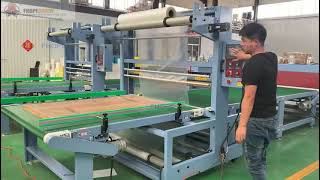
The demonstration video illustrates the continuous operation of an automated horizontal ring wrapper processing dense panel bundles:
- Infeed Stabilization: Overhead pneumatic rollers engage the top board to prevent top-layer displacement prior to ring entry.
- Automatic Film Capture: The pneumatic mechanical gripper releases and anchors the film tail seamlessly during startup rotation.
- Dynamic Ring Tracking: Inverter-driven orbital rotation maintains consistent film overlap pitch across variable stack cross-sections.
- Cut and Wipe Cycle: The trailing edge triggers an automated cutting and thermal/pneumatic film tail wipe-down, producing a clean, tag-free exterior wrap.
Lista de verificación de selección
To determine the correct machine frame size, ring diameter, and conveyor configuration, confirm the following project parameters:
| Parámetro de ingeniería | Detalles de la línea de producción |
|---|---|
| Panel Cross-Section | Minimum and maximum stack dimensions (Width × Height, mm) |
| Board Density & Mass | Total stack weight (kg) and surface hardness / fragility |
| Tiempo de ciclo de la línea | Required throughput in bundles per hour or linear metres per minute |
| Edge Profile Sensitivity | Tongue-and-groove, square cut, chamfered, or painted acoustic face |
| Clase de protección | Dust wrap, transit containment wrap, or full 6-sided water-resistant wrapping |
| Integración de fábrica | Conveyor pass-line height, direction of flow, and PLC communication protocols |
| Energía en el sitio | Supply voltage, frequency, and available compressed air capacity (Nm³/min) |
Operación y seguridad
The wrapper operates under full PLC control via a recipe-driven operator touch panel. The operator selects the appropriate wrap profile based on panel dimensions, setting end reinforcement wraps, overlap percentages, and conveyor speeds.
- Vigilancia de seguridad: The orbital ring and feed conveyors are fully enclosed by interlocked mesh perimeter guards complying with ISO 14120. Access doors feature dual-channel safety limit switches tied to safety relays (PLd / Cat 3).
- Protección de Personal: Optical safety light curtains guard machine infeed and outfeed openings. Breaking the optical beam initiates an immediate Category 0 emergency stop.
- Maintenance & LOTO: All energy isolation points (electrical isolators and lockable pneumatic dump valves) follow standard OSHA LOTO protocols. Daily maintenance involves inspecting carriage guide rollers, checking film cutter blade cleanliness, and verifying pneumatic system pressure.
Preguntas frecuentes sobre ingeniería
Q: How does the machine prevent edge crushing on soft mineral fibre panels? A: Through an independent power pre-stretch system combined with precision pneumatic hold-down pressure regulators. Pre-stretching the film before it leaves the carriage relieves direct corner stress while retaining the film’s continuous elastic recovery force across the flat surfaces.
Q: Can this system handle different panel dimensions consecutively? A: Yes. Optical photocells detect the leading and trailing edges of each stack automatically. The orbital ring adjusts its acceleration and conveyor travel speeds according to selected recipes, wrapping mixed lengths and widths within the machine’s maximum ring opening without mechanical re-tooling.
Q: What provides full 6-sided weather resistance for outdoor storage? A: For complete 6-sided protection, an optional in-line top/bottom polyethylene sheet feeder is positioned upstream of the orbital wrapper. The orbital film then binds the protective sheet over the top, sides, and ends of the stack.
Q: How are thin or flexible panels kept flat during high-speed wrapping? A: Full-length overhead idle roller tracks or synchronised top-driven belt hold-down conveyors suppress upward board deflection throughout the wrapping zone.
Q: What maintenance is required for the orbital drive mechanism? A: The main ring rotates on high-grade polyurethane support wheels and is driven by reinforced timing belts or high-torque friction wheels. Weekly checks include inspecting belt tension, lubricating carriage guide tracks, and cleaning dust from optical sensors.
El próximo paso
- Enviar datos del producto: Send your panel dimensions (min/max W × H × L), maximum stack weights, and line output targets to
info@fhopepack.com. - Revisión del diseño de ingeniería: Our application engineering team delivers an optimized equipment layout drawing and budgetary proposal within 48 hours.
- Integration Alignment: We schedule a technical conference to confirm conveyor pass-line heights, PLC interface requirements, and safety interlocking protocols.
Lectura relacionada
- Máquina de empaquetado de bolsas de paneles
- Máquina de embalaje de placas de yeso
- Máquina de envoltura horizontal para puertas y paneles.
- Líneas de productos de maquinaria de embalaje FHOPE
Fuentes y estándares
- ISO 12100:2010 Seguridad de las máquinas, principios generales para el diseño y la evaluación de riesgos.
- EN 415-10:2014 Seguridad de las máquinas de envasado, requisitos generales
- EN ISO 13849-1:2023 Seguridad de las máquinas, partes de los sistemas de control relacionadas con la seguridad.
FHOPE fibre panel horizontal orbital stretch wrapping machine technical specification and operational overview.
Última revisión: 10/10/2026