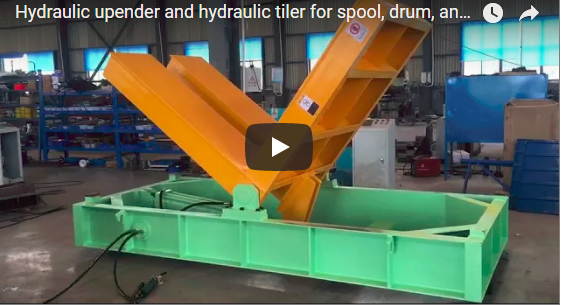
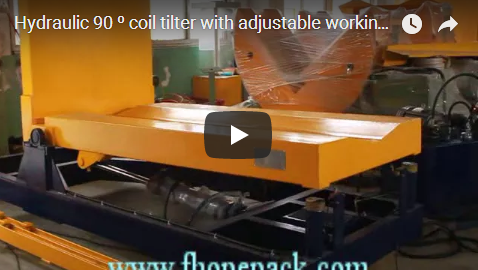
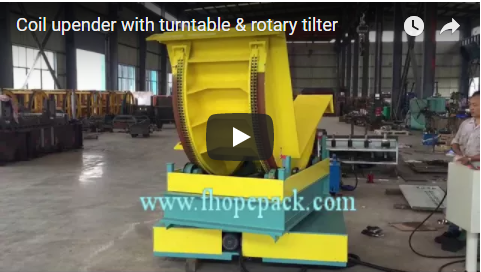
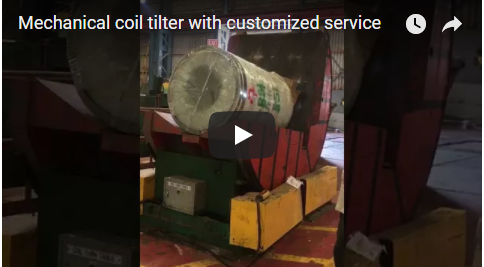
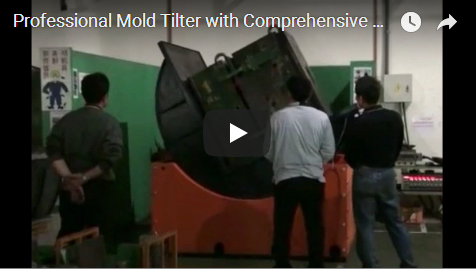
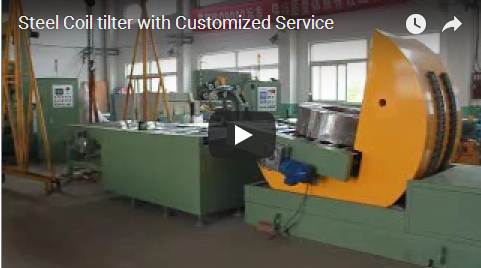
Resumen ejecutivo This clip shows our coil tilter with a rotary base in our workshop. The orange V-cradle tilts through 90 degrees to turn a coil from eye-horizontal to eye-vertical or back, and the black base slews the whole tilter through 180 degrees. That way the coil is loaded from one side and leaves facing the next conveyor or the crane, without a second handling move.
Índice
- Lo que muestra el vídeo
- ¿Por qué añadir una base giratoria?
- Ciclo por bobina
- Lo que establecemos por planta
- Lista de verificación de selección
- Seguridad
- Preguntas frecuentes sobre ingeniería
- El próximo paso
- Lectura relacionada
- Fuentes
Lo que muestra el vídeo
| Paso | Lo que ves |
|---|---|
| Máquina | An orange V-cradle tilter with an L-shaped table on a black rotary base |
| Inclinación | The cradle tilts through 90 degrees, from V-cradle up to the flat table |
| Girando | The base turns the whole tilter round through 180 degrees |
| Devoluciones | The cradle tilts back and the base returns to the load side |
| Taller | Other FHOPE coil machines stand in the background |
¿Por qué añadir una base giratoria?
- One less move. The coil is tilted and turned in one station, so no crane move is needed to face it the right way.
- Flexible layout. Load and discharge can be on opposite sides of the tilter.
- Fits existing lines. The base points the coil at an existing conveyor or stacker.
- Safer handling. Operators stay outside the cell while the coil turns.
Ciclo por bobina
Ejemplo resuelto (ilustrativo).
| Parámetro | Valor |
|---|---|
| Tilt 90 degrees (illustrative) | 40 s |
| Slew 180 degrees (illustrative) | 30 s |
| Load, unload and return moves (illustrative) | 50 s |
| Cycle, 40 + 30 + 50 | 120 s |
| Bobinas por hora, 3,600 ÷ 120 | 30 bobinas |
Lo que establecemos por planta
| Configuración | Depende de |
|---|---|
| Cradle size | Coil OD, ID and width |
| CAPACIDAD | Bobina más pesada |
| Ángulo de giro | 180 degrees, or set per layout |
| Accionamiento | Hydraulic or electric, per plant |
Lista de verificación de selección
- Peso de la bobina, diámetro exterior, diámetro interior y ancho.
- Tilt direction: eye-horizontal to eye-vertical or back.
- Slew angle needed.
- Load and discharge sides.
- Bobinas por hora.
- Pit or floor mounting.
Seguridad
- Fence the cell; keep clear of the slewing base and the cradle.
- Lock out before entering the cell.
- Use PU or rubber pads where the coil surface must not be marked.
- Para los mercados de la CE, la máquina está diseñada conforme a las normas ISO 12100 y EN 415-10.
Preguntas frecuentes sobre ingeniería
Q: What does the rotary base add? A: It slews the tilter through 180 degrees, so the coil leaves facing the next station.
Q: How far does the cradle tilt? A: Through 90 degrees, turning the coil from eye-horizontal to eye-vertical or back.
Q: How many coils per hour? A: About 30 coils per hour with an illustrative 120 s cycle that includes the return moves; real output depends on coil handling and layout.
Q: Can the slew angle be other than 180 degrees? A: Yes, we set it to suit the layout.
Q: Is the drive hydraulic? A: We supply hydraulic or electric drive, per plant.
P: ¿Qué normas se aplican? R: Para los mercados CE, ISO 12100 y EN 415-10.
El próximo paso
We match a coil tilter with rotary base in three steps:
- Envíe su plano de distribución with coil weights and sizes, tilt direction and layout, to info@fhopepack.com.
- Reciba una propuesta en 48 horas. con los datos y el diseño de la máquina.
- Solicitar una visita al sitio so we confirm the floor and crane layout.
Lectura relacionada
- Volteador de bobinas de 90 grados con base giratoria
- Inclinador hidráulico de bobinas para giros de 90°
- Volteador de bobinas con carro de transferencia
- Coil upender and tilter range
Fuentes
- Contenido de la máquina: Equipo de ingeniería de FHOPE, 4 de octubre de 2026
- Acortar: el vídeo en YouTube
- Ciclo por bobina: nuestro ejemplo práctico, valores ilustrativos
- Ámbito de aplicación de la norma: ISO 12100:2010; EN 415-10: 2014
- Plazos de presentación de propuestas: solicitud de aprobación de la CTA (propuesta en un plazo de 48 horas)
Última revisión: 10/10/2026