Resumen ejecutivo
An automatic steel wire binding machine wraps steel wire around a bundle of pipes, bars or a coil and twists the ends into a tight knot, with no strap seals or buckles. Wire binding is cheap, tolerates rough mill conditions and suits rusty or oily stock. This page explains the binding cycle, wire grade, how wire compares with steel strap and how much wire a bundle uses.
A blue C-shaped wire track closes around a bundle of steel pipes in the mill hall. Wire is fed around the track, pulled tight and twisted by the head, leaving several bright turns of wire knotted around the bundle.
Índice
- Why bind with wire
- The binding cycle
- Binding wire grade
- Wire or steel strap
- Wire use per binding
- Lista de verificación de selección
- Seguridad
- Preguntas frecuentes sobre ingeniería
- El próximo paso
- Lectura relacionada
- Fuentes
Why bind with wire
Steel mills bind pipes, bars and wire rod coils in large numbers and in dirty conditions. Wire costs less than strap and needs no seals, and a twisted knot does not slip on rusty or oily stock. Hand binding with wire is slow and the knots vary, so the binding machine feeds, tensions and twists every tie the same way.
The binding cycle
- Cargo: the bundle or coil stops at the binding station.
- Cerrar: the C-shaped wire track closes around the bundle, or passes through the coil eye.
- Alimentar: wire runs around the track for the set number of turns.
- Tension and twist: the head pulls the wire tight and twists the ends into a knot.
- Cut and release: the wire is cut, the track opens and the bundle moves to the next tie position.
Our coil binding lines can tie each coil in two or four places; on wire rod compactors, four heads tie four wires at once in a 30–40 s cycle.
Binding wire grade
| Parámetro | Wire rod binding (FHOPE compactor page) |
|---|---|
| Diámetro del cable | 6.3 – 8 mm |
| Material | unalloyed wire rod, uniform quality |
| Resistencia a la tracción | 380–450 MPa |
| Alargamiento | 28-32% |
| Ties per coil | 4 |
| Cycle | 30–40 s |
| Aire | 5.0-6.0 bares |
Soft, ductile wire like this twists without cracking. Pipe and bar bundles often use thinner wire; the size is set by bundle weight and confirmed at quote. PET or PP can replace steel wire where rust marks matter.
Wire or steel strap
Wire break load = π/4 × d² × tensile strength. A 6.3 mm wire has 31.2 mm² cross-section; at 380 MPa it breaks at about 31.2 × 380 ≈ 11,900 N. With 2 strands across each side of the knot, the tie carries about 23,700 N (example only). A twisted knot holds less than straight wire, so the knot efficiency factor is confirmed at quote. A 32 × 0.9 mm steel strap at 950 N/mm² breaks at about 28.8 × 950 = 27,360 N. Wire is close in strength, cheaper and seal-free; strap gives a flatter tie and higher, measured tension.
| Parámetro | Alambre trenzado | Correa de acero |
|---|---|---|
| Conjunto | twisted knot | seal or notch |
| Consumibles | solo cable | strap and seals |
| Control de tensión | by twist | measured, 7,000–18,000 N on our tube strappers |
| Ideal para | rough mill stock, wire rod coils | finished tube, export bundles |
Wire use per binding
Wire per tie = turns × π × bundle diameter + twist tail. A 400 mm round bundle has π × 400 ≈ 1,257 mm per turn. Three turns plus a 200 mm tail use 3 × 1,257 + 200 ≈ 3,971 mm, about 4.0 m per tie (example only). Multiply by ties per bundle and bundles per shift to size wire coil stock.
Lista de verificación de selección
- Product: pipe, bar or coil, and bundle size?
- Bundle or coil weight?
- Wire size and grade, or PET/PP?
- Ties per bundle and positions?
- Line takt time?
- Mill environment: dust, scale, temperature?
Seguridad
The machine is designed to EN ISO 12100:2010 for risk assessment, EN 415-10 for packaging machine safety and EN 60204-1 for electrical equipment. The closing track, wire feed and twisting head are the main hazards; cut wire ends are sharp. Fence the station, interlock access and keep the emergency stop in reach.
Preguntas frecuentes sobre ingeniería
Q: What wire does it use? A: On our wire rod compactors, 6.3–8 mm unalloyed wire rod; pipe bundles often use thinner wire, confirmed at quote.
Q: Can it use plastic instead of wire? A: Yes, PET or PP can be used where rust marks matter.
Q: How many ties per coil? A: Two or four on our binding lines.
Q: Is wire as strong as strap? A: Close: a two-strand 6.3 mm tie is about 23,700 N against about 27,360 N for a 32 mm strap.
El próximo paso
- Send your product, bundle size, weight and takt time a info@fhopepack.com.
- Nosotros dimensionamos the binding head, wire feed and track.
- Respondemos dentro de las 24 horas. con una propuesta y un presupuesto.
Lectura relacionada
- Máquina automática para flejar y empaquetar tubos de acero (vídeo)
- Wire rod compactor (product)
- Wire coil compactor strapping machine (product)
- Máquina flejadora automática de tubos de acero (producto)
Fuentes
- FHOPE product pages: wire rod compactor; automatic steel wire winding and binding machine; automatic steel tube strapping machine
- EN ISO 12100:2010; EN 415-10; EN 60204-1
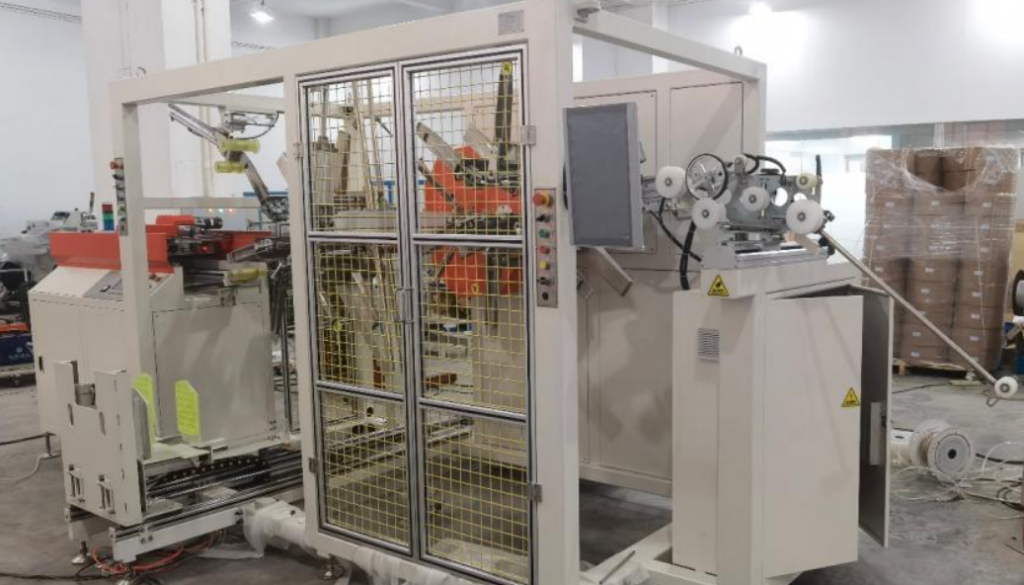
- The steel wire binding machine shown above
Última revisión: 20/10/2026