Executive summary Our horizontal wire coil compactor presses a loose wire coil along its axis before it is strapped, so the turns sit tight and the coil stays dense in transport. A hydraulic press applies an adjustable force of up to 400 kN to coils of 500 to 2,000 kg. HDPE-faced supports protect the wire where they touch it. A worked example shows what the press force means as pressure on the coil and how compacting fits the line pace.
Inhaltsverzeichnis
- Why wire coils are compacted before strapping
- Horizontal or eye-to-sky compacting
- The compacting and strapping cycle
- Compactor line specifications
- Worked example: press force, coil pressure and line pace
- How many straps, and where
- Auswahlliste: Was Sie uns senden sollten
- Sicherheit und EN 415-10
- Häufig gestellte Fragen zur Technik
- Nächster Schritt
- Verwandte lesen
- Quellen
Why wire coils are compacted before strapping
Drawn wire, from Φ1.2 to 8.0 mm on our line, leaves the take-up as a loose, springy coil. Strapped like that, the turns keep moving. The straps slacken in transport, the coil sags and the outer turns snag on forks and hooks.
Compacting presses the turns together first. The straps then lock in a short, dense coil. It holds its shape in the stack, takes less space in the truck and loses fewer turns to damage.
Horizontal or eye-to-sky compacting
In a horizontal compactor the coil lies with its eye horizontal and the press closes along the coil axis. It suits lines that carry coils on hooks or C-shaped carriers, since the coil arrives already on its side. In an eye-to-sky layout the coil stands with its eye vertical, often on a basket, and the press works top to bottom.
We design either layout to fit your floor and your coil handling. The coil sits on a carrier or rotary table, so straps can be placed round the coil at set angles.
The compacting and strapping cycle
- Übertragung. Motorised chain conveyors at the entry and exit of the strapping table link it to your own conveyors at plant floor level. They move the coil into the compacting position, centred on the press.
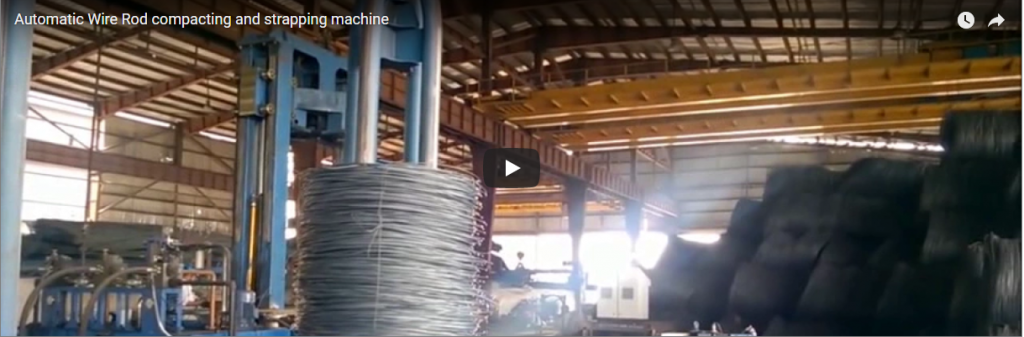
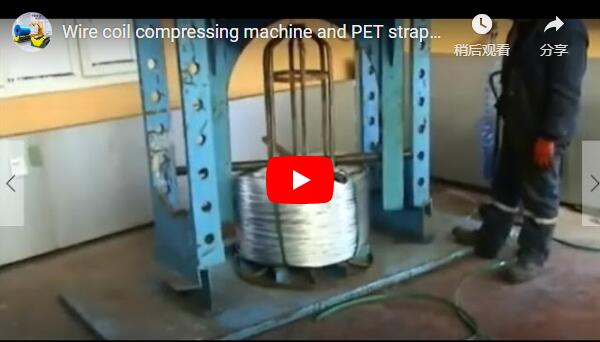
- Compact. A hydraulic cylinder drives the press supports against the coil to a set force. HDPE material on the supports keeps the wire surface from being marked.
- Gurt. With the coil held compressed, the strapping head puts radial straps through the eye in PET, steel strap or annealed wire.
- Index. The strapping head stays at a fixed point. The rotary table and the compactor turn together, carrying the clamped coil to the next strap angle. A variator sets the speed and detectors set each stop.
- Veröffentlichung. After the last strap, the press opens and the strapped coil moves on to wrapping or stacking.
Soft start and stop, multiple limit switches and an automatic stop protect the coil and the machine through each cycle.
Compactor line specifications
| Artikel | Wire coil compacting and strapping line |
|---|---|
| Wire grades | low, medium and high carbon, galvanised, annealed |
| Kabeldurchmesser | Φ1.2–8.0 mm |
| Coilgewicht | 500-2,000 kg |
| Spulengröße | OD 400–1,200 mm, ID 340–900 mm |
| Verdichtungskraft | adjustable, up to 400 kN |
| Compacting cycle | ca. 40 s |
| Leitungsausgang | 16–18 Spulen/Stunde |
| Uhrenarmbänder | 3–6, set on the HMI |
| Umreifungsmaterial | PET, steel strap, steel wire |
| Steuerelemente | Siemens SPS und HMI |
| versorgung | AC 380 V or 480 V, 50/60 Hz, 3 phase |
Worked example: press force, coil pressure and line pace
Take a coil of 1,200 mm OD and 800 mm ID. These are illustrative customer figures inside the line's range.
Coil face area. The ring-shaped face is π ÷ 4 × (1.2² − 0.8²) = 0.785 × 0.80 = 0.628 m².
Average pressure. If the full 400 kN spread evenly over that face, the pressure would be 400,000 ÷ 0.628 = 0.64 MPa. The supports touch the coil at a few points, not the whole face, so the local pressure there is much higher. Pressure equals force divided by contact area. That is why the supports are HDPE-faced and why we set force per wire grade rather than at maximum.
Line pace. At 16 coils an hour each coil has 3,600 ÷ 16 = 225 s. At 18 coils an hour it has 200 s. Compacting takes about 40 s of that, leaving 160–185 s for transfer, strapping and indexing. Check your mill's coil rate against those figures.
How many straps, and where
Straps go through the eye at equal angles round the coil. The spacing is 360° divided by the number of straps.
| Uhrenarmbänder | Angle between straps |
|---|---|
| 3 | 120 °C. |
| 4 | 90 °C. |
| 6 | 60 °C. |
Fine wire and heavy coils hold better with more straps. Steel strap or annealed wire suits hot or heavy coils; PET suits drawn wire and cleaner handling.
Auswahlliste: Was Sie uns senden sollten
- Wire grade and diameter.
- Spulenaußendurchmesser, Innendurchmesser, Höhe und Gewicht.
- Coils per hour from the mill or drawing line.
- How coils arrive: hook, carrier, basket or conveyor.
- Material und Anzahl der Riemen.
- Whether you also need wrapping, weighing or labelling.
- Stromversorgung vor Ort.
Sicherheit und EN 415-10
We design the compactor to EN 415-10 for packaging machines and assess risks to ISO 12100. The press stroke and the indexing table are the main hazards. We enclose the press zone with interlocked fencing so the press stops when a gate opens. Limit switches end each stroke, and the machine stops automatically at the end of the cycle.
Häufig gestellte Fragen zur Technik
Q: Does compacting damage the wire? A: The supports are HDPE-faced, and we set force per wire grade to keep it below what marks the surface.
Q: Can the compactor feed a wrapping station? A: Yes. Our line can add film wrapping, paper or woven fabric wrapping and a down-ender for stacking.
Q: Can I change the number of straps per coil? A: Yes, from 3 to 6 on the HMI.
F: Welche Sicherheitsstandards gelten? A: ISO 12100 für die Risikobewertung und EN 415-10 für die Maschine, in CE-Märkten.
Nächster Schritt
- Email your wire grades, coil sizes and coils per hour zu info@fhopepack.com.
- Wir antworten Ihnen innerhalb von 24 Stunden mit einem Angebot. naming the layout and strap plan.
- Wir senden eine Layoutzeichnung linking the compactor to your coil handling.
Verwandte lesen
- Wire coil compacting and strapping line
- Wire coil compactor and strapping machine
- Steel wire coil compactor and strapping solution
- Automatisches Zusammenpressen von Stahldrahtspulen mit Umreifungsmaschine
- Automatisches Verdichten und Umreifen von Stahldraht
- Wickelmaschine für Stahldrahtspulen
Quellen
- Specifications: FHOPE wire coil compacting and strapping line and wire coil compactor product pages
- Maschinenvideo: horizontal wire coil compactor on YouTube
- Pressure and pace: our worked example, illustrative coil figures
- Normen: EN 415-10 (Verpackungsmaschinen, allgemeine Sicherheit); ISO 12100:2010
Letzte Überprüfung: 21.09.2026