Executive Summary
Loose plastic pipes and extruded tubes are highly prone to surface abrasion, deflection bending, and atmospheric contamination during transit. Automated orbital stretch wrapping solves this by spirally encapsulating rigid or semi-rigid bundles within high-tension polyethylene stretch film as they traverse a motorized rotary ring at 20–90 RPM. This engineering guide details bundle preparation criteria, OEM equipment specifications for the E400 series, mathematical derivations for spiral film overlap, comparative packaging methodologies, and structural selection protocols required for quotation.
Inhaltsverzeichnis
- Why Wrap Pipe and Tube Bundles
- Packaging Machine Kinematics and Sequence
- OEM Technical Specifications (E400 Platform)
- Film Overlap Kinematics and Production Speed
- Methodology Comparison: Wrapping vs. Strapping vs. Bagging
- Engineering Sizing and Procurement Checklist
- Maschinensicherheits- und Konformitätsstandards
- Häufig gestellte Fragen zur Technik
- Quotation and Solution Architecture
- Verwandte Verpackungslösungen
- Technische Referenzen
Why Wrap Pipe and Tube Bundles
Unrestrained tubes and extruded profiles inevitably experience inter-layer friction, scuffing, and dynamic shifting during transit. While manual strapping or localized tape banding secures the profiles at discrete intervals, it leaves vulnerable extruded walls directly exposed to road particulate, UV exposure, and moisture ingress.
A continuous spiral stretch film envelope yields multiple operational advantages:
- Unitized Radial Rigidity: Constant-tension encapsulation converts individual flexible pipes into a structurally rigid composite prism, preventing longitudinal sag and bundle deformation.
- Surface and Contamination Barrier: Continuous surface contact eliminates dust, oil, and moisture deposition while preventing surface scuffs caused by adjacent vibration.
- Optical Inspection Integrity: High-clarity cast LLDPE/PE film permits direct optical scanning of extruded barcodes, batch printing, and product dimensions without disturbing package integrity.
- Count Retention: Eliminates the risk of individual pipe slippage or loss during intermediate forklift handling and flatbed transport.
Packaging Machine Kinematics and Sequence
The orbital wrapping system automates bundle stabilization and packaging via an integrated, programmable sequence:
[Bundle Forming] ➔ [Powered Infeed] ➔ [Pneumatic Clamping] ➔ [Orbital Spiral Wrap] ➔ [Automated Cut & Clamp] ➔ [Outfeed Transfer]- Bundle Forming and Indexing: Individual pipes are grouped into uniform square, rectangular, or hexagonal cross-sections via manual fixtures or upstream automated bundling arms.
- Conveyor Infeed and Alignment: The bundle enters the powered roller bed. Vertical polyurethane-coated guide rollers prevent lateral wander, while an adjustable top pneumatic press roller exerts controlled downward force (100–300 N) to suppress rotational vibration.
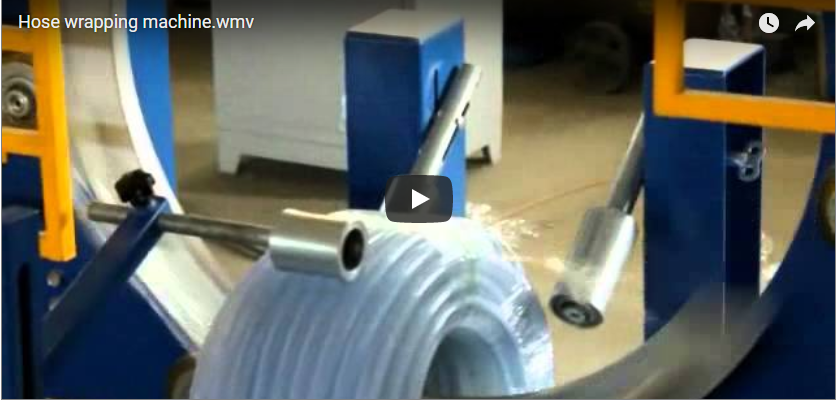
- Orbitale Einkapselung: The structural aluminum wrapping ring accelerates to the pre-set rotational speed (20–90 RPM). The carriage dispenses stretch film around the bundle circumference as the longitudinal conveyor drives the product forward.
- End Reinforcement and Cut: Programmable logic initiates reinforcement wraps (2–4 stationary turns) at bundle leading and trailing edges. A pneumatic clamp-and-cut scissor mechanism catches the tail, severs the web, and presses the film end smoothly onto the package.
- Abfluss: The fully stabilized bundle discharges onto the powered outfeed conveyor for automated print-and-apply labeling or cross-transfer to downstream storage racks.
OEM Technical Specifications (E400 Platform)
The E400 horizontal orbital stretch wrapper is engineered specifically for rigid and semi-rigid profiles, electrical conduits, and industrial pipe clusters.
| Technischer Parameter | E400 Standard Specification | Design Clearance / Process Limits |
|---|---|---|
| Max Bundle Cross-Section (W × H) | 310 mm × 310 mm | Min bundle envelope: 100 mm × 100 mm |
| Mindestbündellänge | 1,500mm | Supported through continuous powered rollers |
| Maximales Bündelgewicht | 50 kg pro laufendem Meter | Structural rating up to 150 kg total load |
| Ringrotationsgeschwindigkeit | 20–90 U/min | Inverter-controlled stepless vector acceleration |
| Conveyor System Configuration | 3,000 mm powered + 1,000 mm idle | Dual-sided infeed and outfeed roller conveyors |
| Installed Electrical Rating | 2.5 kW, 380 V, 3-phasig, 50/60 Hz | Standard industrial supply (220V/480V configurable) |
| Pneumatikversorgungsbedarf | 0.5–0.7 MPa dry, filtered air | Consumption: ~60 Nl/min per cycle |
| Film Roll Dimensional Envelope | Width: 100–150 mm; Core: 50 mm (2 in) | Outer Diameter (OD): 50–180 mm; 17–35 µm thickness |
Geometric Clearance Formula
To verify that a bundle cross-section passes through the rotating ring without mechanical interference, the clear ring opening D_ring must accommodate the diagonal envelope plus radial clearance for the rotating carriage:
D_ring ≥ √(W² + H²) + 2 × (OD_roll + C_radial)
Kennzahlen:
W= Bundle width (mm)H= Bundle height (mm)OD_roll= Outer diameter of the film roll (mm)C_radial= Dynamic mechanical clearance margin (minimum 50 mm recommended)
For an E400 processing a maximum 310 mm × 310 mm bundle with a 150 mm OD film spool, the minimal theoretical ring inner bore requires: √(310² + 310²) + 2 × (150 + 50) = 438.4 + 400 = 838.4 mm. Bundles exceeding these dimensions require the E600 or E800 chassis platform.
Film Overlap Kinematics and Production Speed
Spiral overlap percentage determines both the containment force and the total linear throughput of the packaging line.
+-------------------------------------------------------------+
|                      Bundle Direction ➔                     |
|                                                             |
|   +---------------+                                         |
|   | Film Wrap N   |                                         |
|   +-------+-------+---------+                               |
|           | Overlap | Film    |                             |
|           | Region  | Wrap    |                             |
|           | (O_v)   | N+1     |                             |
|           +---------+---------+                             |
+-------------------------------------------------------------+
Governing Mathematical Equations
-
Conveyor Linear Velocity (
V_c):V_c = N_ring × W_film × (1 - O_v)Kennzahlen:V_c= Infeed conveyor speed (m/min)N_ring= Ring rotational frequency (RPM)W_film= Effektive Folienbahnbreite (m)O_v= Target fractional overlap (e.g., 0.50 for 50%)
-
Total Cycle Wrap Time (
T_wrap):T_wrap = (L_bundle ÷ V_c) + [(n_head + n_tail) ÷ N_ring] + t_auxKennzahlen:L_bundle= Bundle length (m)n_head,n_tail= Programmed reinforcement turns at extremitiest_aux= Indexing, clamping, and cut-off delay (~0.1–0.15 min)
Operational Calculation Example
A production line requires wrapping 6.0 m pipe bundles using a 125 mm (0.125 m) film roll, operating at a ring speed of 60 RPM and an overlap target of 50% (O_v = 0.50):
- Fördergeschwindigkeit:
V_c = 60 × 0.125 × (1 - 0.50) = 3.75 m/min - Dynamic Traversing Duration:
6.0 ÷ 3.75 = 1.60 min (96 seconds) - End Reinforcement & Cut Factor: Adding 2 head wraps and 2 tail wraps at 60 RPM adds
(4 ÷ 60) = 0.067 min (4 seconds). With 6 seconds auxiliary clamp/cut response, total net cycle time equals 106 seconds per bundle.
Higher overlap percentages provide enhanced puncture resistance and torsional rigidity, but reduce linear process throughput proportionally.
Methodology Comparison: Wrapping vs. Strapping vs. Bagging
Selecting the correct secondary packaging approach depends on bundle geometry, surface sensitivity, and logistics profiles.
| Bewertungsmetrik | Spiral Stretch Wrapping | Automatische Umreifung | Polyethylene Sleeve Bagging |
|---|---|---|---|
| Primärschutz | 100% continuous dust/moisture barrier | High-tension structural bundling | Environmental dust shield |
| Oberflächenkonservierung | Zero marring; soft film interface | Risk of localized corner indentation | Non-abrasive, loose contact |
| Material Cost / Cycle | Low (micrometer-gauge LLDPE) | Low (PP or PET strap) | Medium-High (pre-formed tubular roll) |
| Bundle Unitization Rigidity | Excellent; high radial compression | High tensile load integrity | Poor; loose sleeve requires heat shrink |
| Ideale Anwendung | Bundled conduit, PVC pipes, profiles | Heavy steel tubing, timber bundles | Single high-gloss tubes, architectural trim |
Bewährte Verfahren im Ingenieurwesen: High-throughput automated lines often pair strapping and orbital wrapping in series—applying 2–3 intermediate PET straps for lifting integrity, followed by full-length orbital film wrapping for surface preservation.
Engineering Sizing and Procurement Checklist
To enable precise mechanical sizing, conveyor spacing, and carriage motor rating calculations, prepare the following parameters prior to requesting a formal quotation:
- Tube Profiles and Materials: Substrate type (PVC, HDPE, PPR, aluminum, carbon steel), outer diameter (OD), and wall thickness.
- Bundle Envelope Dimensions: Minimum and maximum cross-sectional width, height, diagonal measurement, and bundle weight per meter.
- Längenverteilung: Shortest and longest batch lengths to define infeed/outfeed conveyor center-to-center roller distances.
- Zieldurchsatz: Desired bundles per hour to calculate necessary ring RPM, acceleration curves, and conveyor synchronization.
- Line Integration Scheme: Standalone offline operation with manual loading vs. fully automated inline integration coupled directly to the extrusion puller and saw.
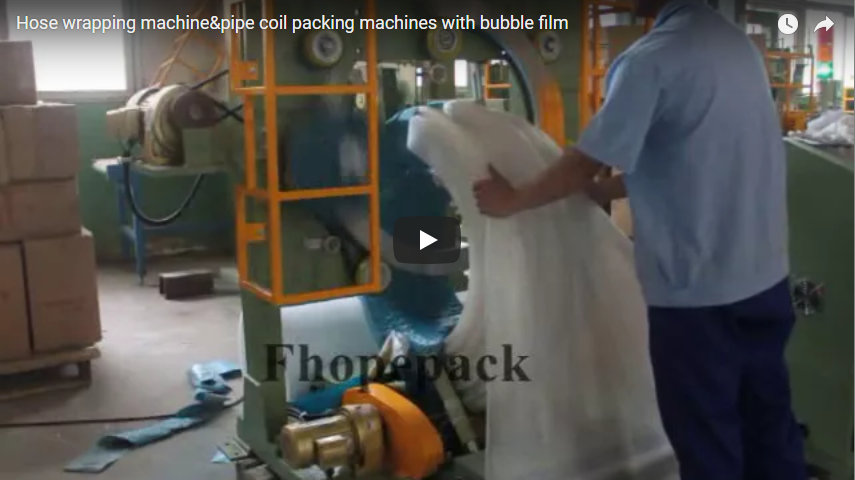
- Ancillary Options: Dual film roll carriages (for twin-roll high-speed wrapping), top and bottom bubble-sheet or kraft paper dispensers, and automated outfeed bundle kickers.
Maschinensicherheits- und Konformitätsstandards
All FHOPE orbital packaging machinery is designed, built, and evaluated in strict conformance with harmonized international industrial safety directives:
- EN ISO 12100:2010: Risk assessment and risk reduction methodology across all operational machine stages.
- UND 415-10: 2014: Safety of packaging machines — Specific requirements for modular horizontal orbital wrapping machinery.
- UND 60204-1: 2018: Electrical safety of industrial machines, including low-voltage control circuits, emergency stop relays, and insulation ratings.
- Physische Bewachung und Verriegelungen: Heavy-gauge welded mesh enclosure surrounding the entire rotational sweep of the ring. All inspection doors feature Category 4 / PLe dual-channel safety interlock switches that trigger an immediate regenerative dynamic brake stop within 0.8 seconds of door opening.
Häufig gestellte Fragen zur Technik
Will film tension crush thin-walled or corrugated plastic pipes?
No. The uncoiling carriage is equipped with a mechanical friction damping hub or optional magnetic particle brake, permitting precise tension modulation from 5 N to 40 N. In addition, pneumatic top hold-down rollers use proportional pressure regulators to secure thin-walled conduit without wall collapse.
Can the system accommodate non-symmetrical profiles and hexagonal bundles?
Yes. The orbital trajectory wraps symmetrically around any cross-section that falls within the ring clear bore. For loose hexagonal bundles, optional lateral V-shaped vertical guide rollers maintain nested tube geometry throughout the infeed transition.
How does the machine secure the film without human operator intervention?
The automated system utilizes a pneumatic clamp-and-cut arm. At the start of a cycle, the clamp holds the film tail while the ring performs its initial wraps. At bundle completion, the arm extends, traps the film against a pneumatic anvil, severs it with a heated impulse wire or serrated blade, and uses an air-wipe jet or brush roller to secure the trailing tail cleanly to the bundle surface.
What minimum bundle dimensions can the E400 platform reliably process?
Standard roller spacings and guide geometries handle bundles down to 100 mm × 100 mm. For micro-bundles below this range (e.g., small batches of capillary tubing), custom close-pitch polyurethane rollers and extended pneumatic stroke arms are required.
Quotation and Solution Architecture
Accelerate your line automation by providing your process parameters directly to our technical engineering group:
- Produktdaten einreichen: Forward your tube dimensions, bundle weights, and target line velocity to info@fhopepack.com.
- Technische Überprüfung: Our project engineers verify ring bore clearances, conveyor bed layout, and drive dynamics.
- Formale Spezifikation: Receive a customized 2D/3D layout proposal, formal quotation, and cycle-time validation within 24 hours.
Verwandte Verpackungslösungen
- Profile Orbital Wrapping Machine (Product Architecture)
- Aluminum Profile Bundle Bag Packing Machine (Application Video)
- Offline PVC Pipe Strapping and Bagging System (Production Video)
- Horizontal Orbital Wrapping Machine for Industrial Pipes (Application Video)
- Economic Horizontal Orbital Stretch Wrapper Platform (System Video)
Technische Referenzen
- FHOPE E400 Platform Technical Quotation and Drive Calculation Register (Spec. E400-REV3).
- EN ISO 12100:2010 — Maschinensicherheit – Allgemeine Konstruktionsgrundsätze – Risikobewertung und Risikominderung.
- EN 415-10:2014 — Sicherheit von Verpackungsmaschinen – Teil 10: Allgemeine Anforderungen.
- EN 60204-1:2018 — Sicherheit von Maschinen — Elektrische Ausrüstung von Maschinen — Teil 1: Allgemeine Anforderungen.
Document Revision: 2026-10-20 | Prepared by FHOPE Packaging Systems Engineering Group