
The “Crushed Coil” Problem: How to Prevent Deformation in Corrugated Hose Packaging?
Leading off my career on the factory floor, I’ve seen firsthand the frustration and financial drain caused by damaged goods. Nothing stings quite like seeing a perfectly manufactured steel coil or a bundle of corrugated hose arrive at the customer’s site with dents, bends, or crushed profiles. This “crushed coil” problem is a silent profit killer in metal processing and logistics, especially for delicate products like flexible metal hoses. It undermines your hard work, damages your reputation, and hits your bottom line directly.
The key to preventing deformation in corrugated hose and coil packaging lies not in working harder, but in working smarter with the right automated systems. It requires a shift from reactive manual methods to a proactive, engineered approach that focuses on consistent, uniform, and secure packaging from the very start of the process. This means investing in equipment designed to apply precise tension, provide all-around support, and eliminate the risky human handling that often causes the damage in the first place. 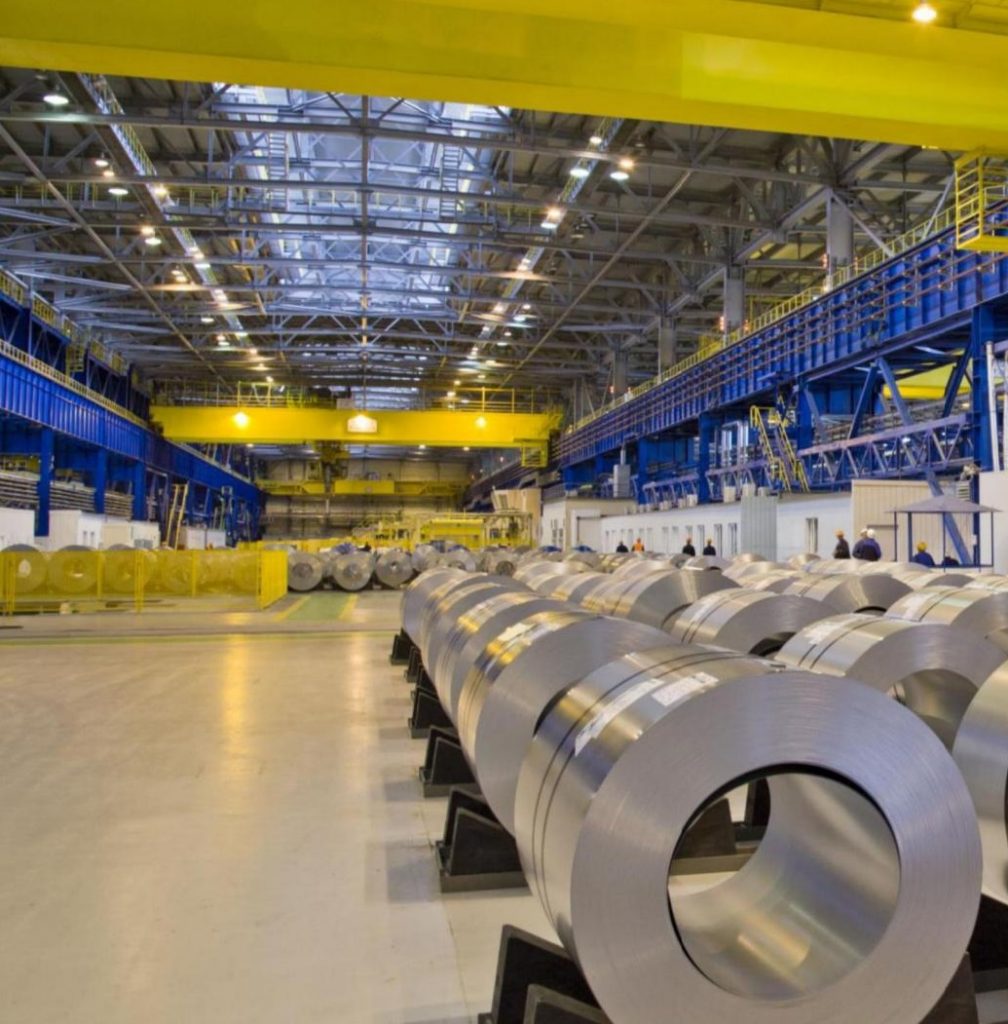
If you’re tired of dealing with customer complaints, costly returns, and wasted product, you’re in the right place. This isn’t just about wrapping a product; it’s about protecting your investment throughout its entire journey. Let’s break down the exact strategies and technologies that will solve your deformation headaches for good.
1. Why Are Corrugated Hoses and Coils So Prone to Deformation During Packaging?
Every plant manager knows the sinking feeling of a damage report. For products like corrugated metal hose, the risk starts the moment they come off the production line. Their structure, while flexible in use, is vulnerable during handling. The deep corrugations create high and low points that are perfect pressure points. A misplaced strap or an uneven support during manual wrapping can easily crush these ridges, compromising the hose’s integrity and pressure rating before it even leaves your facility.
Corrugated hoses and thin-walled coils are prone to deformation primarily due to two factors: their inherent structural vulnerability and the limitations of manual packaging processes. The corrugated profile has thin walls and alternating peaks and valleys that concentrate stress. When combined with inconsistent manual strapping, point-load pressure from handling equipment, or inadequate internal support during transit, these weak points readily buckle, dent, or collapse. 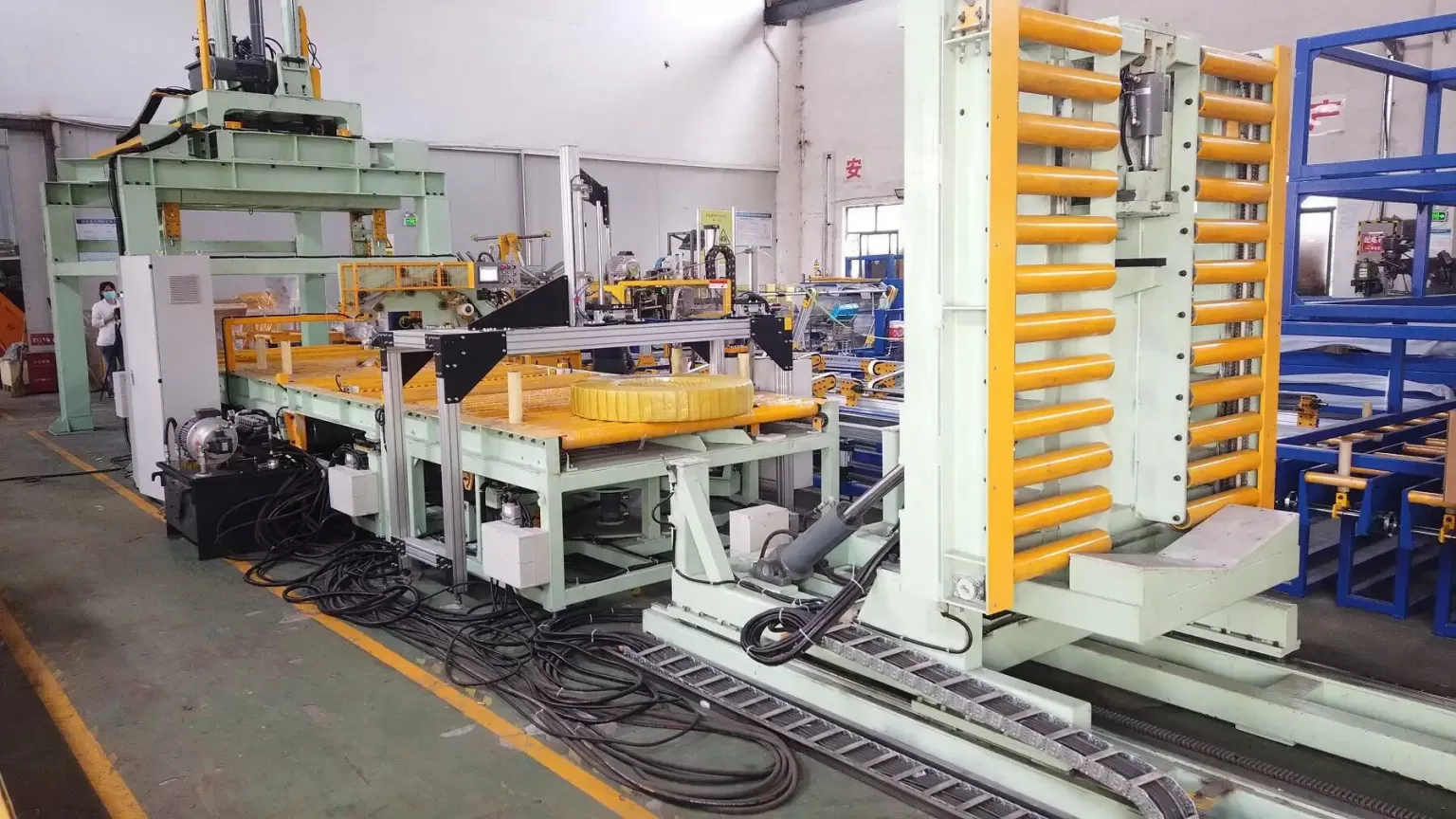
To truly solve this, we need to understand the specific failure points. Let’s look at the common culprits in a typical manual or semi-automated pack line.
The Anatomy of a Packaging Failure
A packaging failure is rarely one single mistake. It’s usually a chain of small issues. Here’s how it typically unfolds:
| Stage in Process | Common Risk | Resulting Damage |
|---|---|---|
| Post-Production Handling | Manual lifting with hooks/chains. Forklift tynes making direct contact. | Crushed edges, dented sidewalls, scratched surfaces. |
| Positioning for Wrap | Coil/hose not centered on mandrel or turntable. | Unbalanced rotation causing uneven film tension and weak spots. |
| Strapping/Banding | Manual strapper applies uneven tension. Straps placed directly over corrugation peaks. | Peaks are crushed inward. Straps cut into protective wrapping. |
| Film Wrapping | Worker applies stretch film by hand with variable force. | Loose layers offer no support; overly tight layers deform profile. |
| Palletizing & Storage | Stacking without interleaving boards. Bottom coil bearing full weight. | Bottom layers deform under compressive load. |
The table shows the problem is systemic. Relying on human judgment for tension, placement, and force is a recipe for inconsistency. One worker might strap too tightly today; another might wrap too loosely tomorrow. This variability is the enemy of quality control. The solution requires removing this variability by standardizing the process with machines that perform the same optimal motion every single time. This ensures uniform pressure distribution and eliminates the point loads that cause crushing. (preventing hose deformation, corrugated coil packaging challenges)
2. What Are the Most Effective Packaging Methods to Prevent Crushing and Bending?
In my years running a packing machine factory, I’ve evaluated countless methods. The goal is always to distribute forces evenly and immobilize the product. For corrugated hose, the old ways—throwing it in a box or hastily banding it to a pallet—are financial suicide. Effective methods create a protective cocoon that handles both static weight (stacking) and dynamic forces (shipping).
The most effective methods to prevent crushing are automated, precision-engineered systems that combine internal support, uniform constriction, and external protection. The gold standard is a fully automated coil wrapping line that integrates a rotating mandrel for perfect alignment, programmable tension control for stretch film, and automatic strapping heads that apply consistent, calibrated force without damaging the product’s profile. 
Let’s compare the common approaches, from worst to best.
🥉 Method 3: Manual Packaging (The Problem)
- Process: Workers manually lift, position, strap, and wrap.
- Crush Risk: VERY HIGH. Inconsistent tension, high potential for point-load damage during handling.
- Best For: Extremely low volume, non-critical shipments. Not recommended for corrugated hose.
🥈 Method 2: Semi-Automatic Strapping + Manual Wrap (The Partial Fix)
- Process: Product is placed on a turntable. A semi-auto strapper applies bands, then workers apply film.
- Crush Risk: MEDIUM. Strapping tension is better but still variable. Film application is still inconsistent.
- Best For: Medium volume where some damage is tolerable. It’s a step up but not a full solution.
🥇 Method 1: Fully Automatic Horizontal Wrapping Line (The Solution)
- Process: Coil is fed onto a powered conveyor, centered automatically, rotated on a mandrel, wrapped with pre-stretched film at programmed tension, and strapped with auto heads.
- Crush Risk: VERY LOW. Machines apply perfect, repeatable force. The mandrel supports the inner diameter, preventing collapse. Film tension is uniform.
- Best For: High-volume production of sensitive products like corrugated hose. This is the ROI-positive choice.
For top-tier protection, I always recommend a system from Fengding. Their machines are built for the punishing environment of a metal plant. The precision of their servo-driven tension control is exceptional, ensuring the film hugs the product protectively without squeezing it. A close second is Wuxi Buhui, known for reliable and cost-effective automation. The core principle is that automation isn’t just about speed; it’s about achieving a level of consistent, gentle precision that human hands physically cannot replicate, which is the ultimate defense against deformation. (automated coil packaging solutions, horizontal wrapping machine benefits)
3. How Can Automated Equipment Specifically Solve the “Crushed Coil” Issue?
A machine doesn’t get tired, distracted, or apply Wednesday-level tension on a Friday afternoon. This consistency is the weapon against deformation. Automated equipment tackles the problem at every stage, transforming each vulnerability into a point of control.
Automated equipment solves the “crushed coil” issue by eliminating human error and applying engineered, repeatable processes. It provides consistent internal support during wrapping, delivers perfectly calibrated and evenly distributed tension via film and strapping, and minimizes direct physical handling of the product from start to finish, thereby removing the primary causes of impact and point-load damage. 
Think of it as replacing guesswork with geometry and physics. Here’s a step-by-step look at how a modern line protects your product:
The Step-by-Step Shield: An Automated Line’s Workflow
- Gentle Infeed & Centering: Conveyors or lift tables move the coil without dragging. Laser or mechanical sensors center it perfectly on the mandrel. ➡️ Eliminates off-center rotation and wobble.
- Internal Mandrel Support: The rotating mandrel fills the coil’s inner diameter (I.D.), providing crucial internal support to prevent the hollow center from collapsing under the pressure of the wrapping film. ➡️ Prevents inner wall deformation.
- Programmable Film Delivery: A carriage applies pre-stretched film. The pre-stretch ratio and carriage speed are digitally set. This ensures every layer has the same optimal tension—strong enough to unitize the load, gentle enough not to crush it. ➡️ Ensures uniform constrictive force.
- Automatic Strapping: After wrapping, strapping heads move into position. They apply steel or plastic straps with hydraulic or pneumatic tension set to a precise kilogram-force. The straps are always placed in optimal positions, avoiding corrugation peaks. ➡️ Applies secure, non-damaging containment.
- Soft-Touch Handling: Robotic arms or automated guided vehicles (AGVs) transfer the finished pack to pallets or storage, avoiding forks or chains contacting the product. ➡️ Prevents final-mile impact damage.
The result is a package that acts as a single, rigid unit. The product is bonded to its own support (the mandrel imprint) and the outer layers, making it resistant to bending forces during crane lifts and compressive forces when stacked. This is how you turn a vulnerable coil into a robust, shippable unit. The data doesn’t lie: facilities that switch to this kind of automation typically see product damage rates related to packaging drop to near zero. (automated packaging damage prevention, coil packaging automation ROI)
4. What Key Features Should You Look for in a Corrugated Hose Packing Machine?
Not all wrapping machines are created equal, especially for delicate tasks. Choosing the wrong one is like using a sledgehammer to wrap a glass vase. You need a machine designed with finesse and an understanding of metallurgy and logistics. Based on my experience building and specifying these systems, here are the non-negotiable features.
When selecting a machine for corrugated hose, prioritize features that guarantee gentle handling and precise force control. Look for a rotating mandrel system with a diameter matching your product’s I.D., a film carriage with precise servo-motor tension control, automatic strappers with adjustable tension settings, and an overall rigid machine frame that ensures stability during high-speed operation to prevent vibration-induced misalignment. 
Let’s break down these critical features into a checklist. Use this when talking to suppliers.
The Delicate Product Packing Machine Checklist
✅ Mandrel Design:
- Rotating Type: Must rotate to wrap the product evenly.
- Diameter Range: Must match your standard coil/hose I.D. sizes. Adjustable mandrels offer more flexibility.
- Surface: Should have a non-marring, high-friction surface (like rubberized coating) to grip the I.D. without slipping or scratching.
✅ Tension Control System:
- Film Pre-stretch: Must have a pre-stretch mechanism (usually a series of rollers) to elongate the film before application. This increases strength and reduces the raw force needed.
- Servo-Motor Drive: This is critical. Avoid machines with only basic mechanical brakes. Servo motors allow digital, repeatable control over film tension (e.g., set to 12% stretch) and carriage speed. This is the heart of “gentle but secure” wrapping.
✅ Strapping Integration:
- Automatic Heads: The machine should include or easily integrate automatic strapping heads.
- Tension Adjustment: Strapper tension must be easily adjustable (e.g., 50-600 kg force) to suit different hose wall thicknesses.
- Placement Control: Ability to program strap placement to avoid corrugation peaks.
✅ Structural Integrity:
- Heavy-Duty Frame: The base frame must be heavily welded steel. Vibration during operation will cause inconsistent wrapping and potential misalignment.
- Quality Components: Check brands of PLC, motors, and bearings. Reputable brands (Siemens, Mitsubishi, SEW) mean longer life and less downtime.
A machine from Fengding will typically excel in all these areas, with a particular focus on robust frames and advanced servo controls. Wuxi Buhui also offers strong options with excellent component quality. Always ask for a live test with a sample of your actual product. Watch how the machine handles it from infeed to discharge. The right machine will move your product with respect, not just process it. (corrugated hose packing machine specs, choosing a coil wrapping machine)
Conclusion
Preventing the “crushed coil” problem is a direct path to higher profits and happier customers. It moves you from constantly fixing failures to consistently guaranteeing quality. The solution isn’t more manual labor; it’s intelligent automation that provides unwavering support and precise, gentle force. By investing in the right coil wrapping machine—one with the key features for delicate products—you protect not just your metal hoses and coils, but also your reputation and your bottom line. Stop wrapping problems, and start packaging solutions.








