
Comprehensive Analysis of Handling and Transport Systems for Steel Wire
1. Introduction
Purpose: Steel wire, in its myriad forms, constitutes a fundamental material across diverse industries, including construction, manufacturing, automotive, energy, and consumer goods. The journey of steel wire from the mill to the end-user involves critical stages of handling and transportation. The efficiency, safety, and cost-effectiveness of these processes are paramount, directly impacting operational productivity, supply chain integrity, product quality, and personnel safety. Steel wire presents unique challenges due to its inherent properties: significant weight concentrated in coils or bundles, varied form factors (coils, spools, straight lengths), susceptibility to surface damage and corrosion, and the potential for unwinding or kinking if handled improperly.1 Therefore, specialized systems and meticulous procedures are indispensable for managing this material effectively.
Scope: This report provides an expert-level analysis of the systems, equipment, and practices employed for handling and transporting steel wire. It encompasses a detailed examination of the common forms and packaging methods used for steel wire, the specialized equipment utilized for in-facility handling (including overhead cranes, forklifts, and conveyors), and the techniques for loading, securing, and transporting wire via truck, rail, and sea. Furthermore, the report explores the role of automation through Automated Guided Vehicles (AGVs) and robotic systems, delves into pertinent safety standards and regulations (such as those from OSHA and AAR), analyzes the inherent challenges and innovative solutions, compares different system approaches based on key performance criteria, and outlines critical considerations for designing or selecting appropriate handling and transport systems.
Importance: Optimizing steel wire handling and transport systems yields substantial benefits. Efficient systems reduce cycle times, minimize labor requirements, and lower operational costs. Safe practices, mandated by regulations and driven by best practices, prevent costly material damage, equipment failure, and, most importantly, personnel injuries.2 Preserving the integrity of the wire—maintaining its shape, surface finish, and mechanical properties—ensures it meets the specifications required for its final application, safeguarding product quality and downstream processes.2 Consequently, a thorough understanding of these systems is crucial for professionals involved in logistics, operations, engineering, and procurement within the steel wire supply chain.
2. Steel Wire: Forms, Packaging, and Characteristics
2.1 Common Forms
Steel wire is supplied in several primary forms, tailored to production processes, transport efficiency, and end-use requirements:
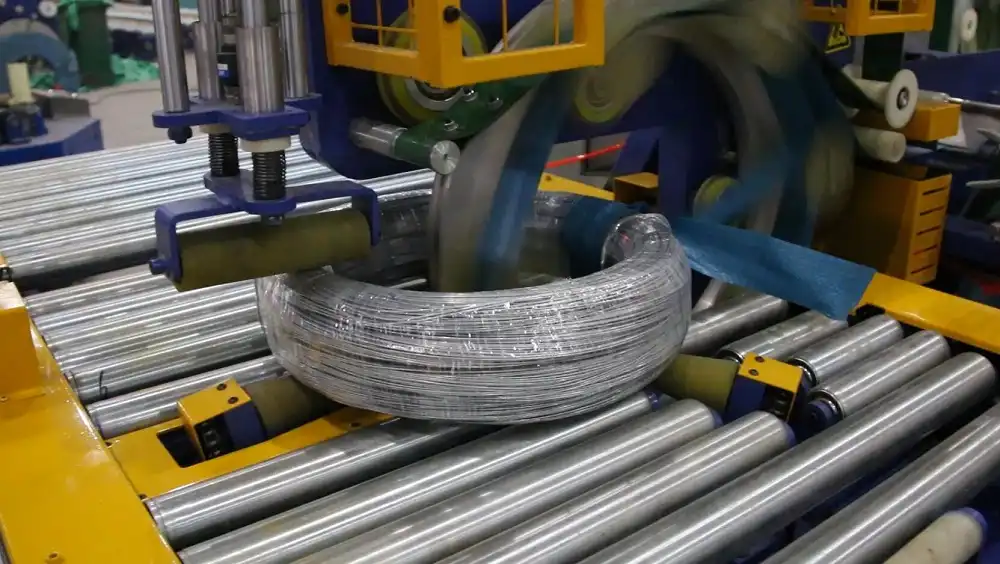
- Coils: This is perhaps the most prevalent form, representing a continuous length of wire, bar, or rod wound into a cylindrical shape.3 Coils vary significantly in size and type, encompassing hot-rolled wire rods used for further drawing 3, galvanized steel coils 4, welding wire coils 5, high-tensile prestressed concrete (PC) strand coils 6, razor wire coils 7, and coils of various carbon, alloy, and stainless steel wires.3 The term “coil” serves as a general descriptor for cylindrically wound continuous lengths.3 They can be shipped as individual units or grouped together.3
- Spools/Reels: To provide structural support, facilitate unwinding, and protect the wire, coils are often wound onto spools or reels.2 These can be constructed from various materials:
- Metal (Iron/Steel): Offer enhanced durability and safety, often preferred for industrial applications or when buyers require them for their production processes.2
- Wood: Used similarly to steel reels, but particularly advantageous for larger diameter wire ropes where the larger inner diameter of wooden reels helps preserve the rope’s structure compared to potentially smaller-diameter steel reels.2
- Plastic (Bobbins/Spools): A less robust option typically used for smaller quantities and lighter-gauge wire, popular for retail or smaller industrial applications due to convenience and manageability.2 Standard sizes, often following DIN specifications (e.g., DIN 160, DIN 355), are common.6
- Straight Lengths: For applications requiring pre-cut pieces, wire is processed through straightening and cutting machinery to produce specific lengths.8 These can range from very short segments (e.g., 0.5 inches) to long bars (e.g., 10 feet or up to 7 meters).8 Straightened wire rod is also available.9 Packaging typically involves boxing or bundling.8
- Bundles: Defined as two or more pieces secured together 3, bundling is common for straight lengths of wire or pipe.10 Smaller coils, like razor wire, may also be compressed into bundles for easier loading.7 Bundling typically involves securing the items with steel straps or wire ties.11 For effective handling and transport, bundles often adhere to specific requirements, such as containing only items of the same type and specification and having weight limits (e.g., 3000-5000 kg for pipe bundles).12








