
How Can Pallet Changers Improve Load Stability During Thawing and Tempering?
Imagine a vital part of your cold chain breaking down. You have valuable, temperature-sensitive products moving from frozen storage to a controlled thawing or tempering process. Any shift, tilt, or damage to these loads can mean ruined products, costly delays, and unhappy customers. The pressure to maintain product integrity is immense, especially when dealing with delicate goods.
Pallet changers significantly boost load stability during thawing and tempering by securely transferring goods between pallets, preventing product shifts, minimizing manual handling, and maintaining consistent orientation, which safeguards product quality and reduces damage risks in temperature-controlled environments. They are not just about swapping pallets; they are about protecting your investment and ensuring smooth processes.
I have spent many years in the packing machine industry, starting from the factory floor and building FHOPEPACK. I have seen firsthand how critical small improvements can be. Understanding these challenges helps me and my team develop solutions that really make a difference for businesses like yours. Let’s look closer at how this simple yet powerful technology can transform your operations.
Why is Load Stability Critical in Thawing and Tempering Processes?
Are you struggling to keep your products safe during crucial temperature changes? The journey from a freezer to a tempering room, or from tempering to packing, is full of potential hazards. Products often soften or become more fragile as they thaw, making them highly vulnerable to damage if not handled correctly. This vulnerability means any instability in the load can quickly lead to costly problems.
Load stability is critical during thawing and tempering because changing temperatures can alter product consistency, making items more prone to shifting, deforming, or breaking if not properly secured. This is especially true for foods, pharmaceuticals, or delicate chemicals that soften, condense, or change form. Without proper stability, the entire batch could be compromised, leading to significant financial losses and compliance issues.

The integrity of your goods during thawing and tempering is not just about keeping them in one piece. It is also about maintaining their quality and meeting regulatory standards. When a frozen product starts to thaw, its internal structure can become less rigid. This makes the stacked items more susceptible to leaning, falling, or crushing under their own weight. Think about large blocks of frozen meat, delicate baked goods, or pharmaceuticals in bulk containers. If these shift, even slightly, they can be damaged or become unsafe for use. For instance, a stack of frozen dough that leans and deforms during thawing might not fit into subsequent processing machinery, or its quality could be compromised. This is a common problem I have seen in the food industry. We often help clients realize that the small investment in proper handling equipment prevents much larger losses down the line. We aim to share knowledge so businesses can avoid these common pitfalls. (product quality preservation, temperature-sensitive goods handling)
What Challenges Arise from Unstable Loads During Thawing and Tempering?
Do you frequently face product damage or operational delays when moving items through temperature transitions? Unstable loads during thawing and tempering present a range of serious challenges that go beyond simple inconvenience. These issues can impact your bottom line, staff safety, and overall reputation. Dealing with shifting products requires extra labor and often leads to damaged goods, creating bottlenecks in your production line.
Unstable loads during thawing and tempering lead to product damage, increased waste, safety hazards for workers, and operational inefficiencies, including slower processing times and higher labor costs due to manual intervention. These issues collectively threaten profitability and customer satisfaction, as compromised products or delayed shipments are unacceptable in today’s demanding market.
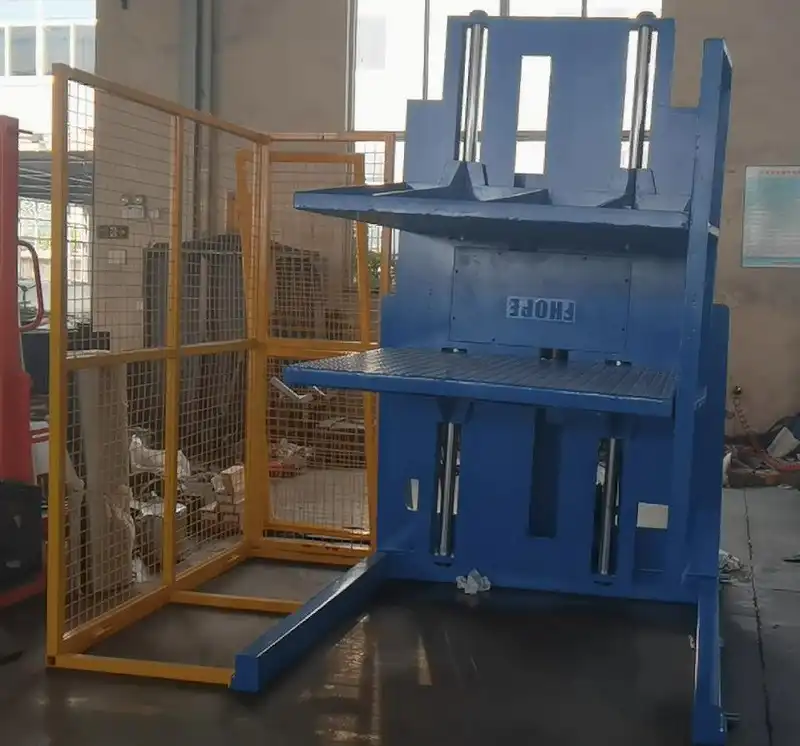
When loads become unstable, several problems can quickly arise. First, there is the immediate risk of product damage. Items can fall, break, or become deformed, leading to waste and reduced usable inventory. This is particularly problematic for high-value or fragile goods. Second, worker safety becomes a major concern. Manual handling of unstable or partially thawed loads can lead to injuries, such as strains from trying to stabilize heavy pallets or cuts from falling products. I have heard many stories from clients where workers were injured trying to manually adjust shifting loads. Third, instability creates significant operational inefficiencies. When a load shifts, it might need to be restacked by hand, which is time-consuming and labor-intensive. This slows down the entire thawing or tempering process, causing delays in subsequent production stages and missed deadlines. For businesses operating with tight schedules, like those in the food and beverage industry, these delays are very costly. Moreover, inconsistent product quality due to damage can lead to customer complaints and potential contract penalties, similar to the challenges faced by Carlos Rodríguez in managing diverse pallet needs and ensuring timely deliveries for his food and beverage group. My focus at FHOPEPACK is on providing solutions that address these real-world pain points. (operational bottlenecks, worker injury risks, product spoilage)
How Do Pallet Changers Ensure Load Integrity Before and After Temperature Changes?
Are you wondering how a machine can keep your delicate loads perfectly intact during temperature shifts? Pallet changers are specially designed to maintain load integrity by offering a secure, automated way to transfer goods between pallets. This process is crucial when products are most vulnerable, like during thawing or tempering. They protect your goods by holding them firmly in place.
Pallet changers ensure load integrity by gripping the product firmly while changing or replacing the pallet, preventing any shifting, tilting, or stress on the goods, thereby preserving the original stack configuration and minimizing damage during critical temperature transitions. They provide a stable platform for transferring loads without manual handling, which is a major benefit.

Dive deeper Paragraph: Pallet changers work by using various clamping and rotation mechanisms to secure the load. This ensures that the product itself does not move or shift during the pallet exchange process. For thawing and tempering, this is vital. Imagine a pallet of frozen pizzas. As they thaw, the boxes might become slightly damp and less rigid. If you manually tip or move this pallet, the stack could easily collapse. A pallet changer, like our FHOPEPACK models, gently but firmly clamps the entire load. It then rotates or lifts the stack, allowing the original pallet to be removed and a new one inserted from underneath. This means the individual items in the stack never experience sudden movements or pressure points that could cause damage. This controlled handling is especially important for goods that are soft, sticky, or prone to condensation during temperature changes. The machine handles the entire stack as one solid unit. This way, the product keeps its original shape and stacking pattern. It reduces any risk of items slipping or falling off. It also prevents the need for manual restacking, which is often less precise and more error-prone. This method ensures that the product stays in perfect condition, even when its physical properties change due to temperature. (secure clamping mechanisms, controlled load handling, temperature transition protection)
Which Pallet Changer Features Are Best for Delicate or Temperature-Sensitive Loads?
Are you unsure which pallet changer features are most important for protecting your fragile or temperature-sensitive inventory? Choosing the right pallet changer involves looking beyond just the basic function. Specific features can make a significant difference in how effectively these machines protect your products during thawing and tempering. These features are designed to handle your goods with the utmost care.
For delicate or temperature-sensitive loads, the best pallet changer features include adjustable clamping pressure, 90-degree or 180-degree tilting capabilities, smooth hydraulic operation, and options for specialized grip surfaces to prevent product marking or crushing. These features ensure that the load is handled gently yet securely, adapting to various product shapes and sensitivities without causing damage during temperature-induced changes.
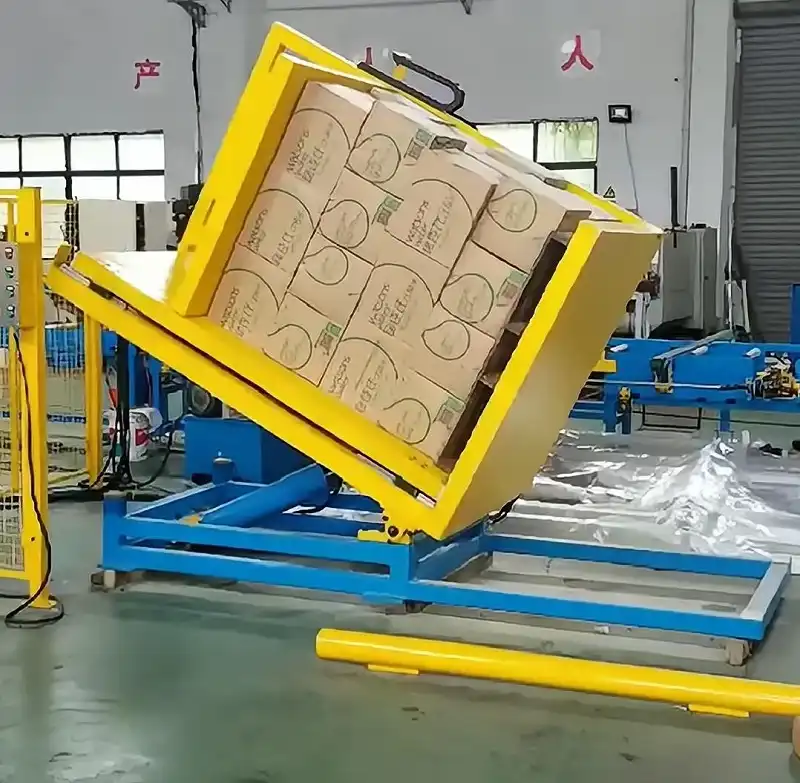
Dive deeper Paragraph: When selecting a pallet changer for sensitive applications, several features stand out. First, adjustable clamping pressure is crucial. This allows operators to set the clamping force based on the product’s fragility, ensuring a firm grip without crushing delicate items. For example, a light pressure for soft bakery products and a firmer grip for solid blocks of cheese. FHOPEPACK machines often include precise control over this, allowing for fine-tuning. Second, smooth hydraulic operation ensures that movements are gradual and controlled, avoiding sudden jerks that could destabilize a load. This is especially important for products that might wobble or shift easily. Third, 90-degree or 180-degree tilting capabilities offer flexibility. A 90-degree pallet inverter is excellent for situations where you need to access the top of the load or simply replace a bottom pallet. A 180-degree option is ideal for completely inverting a load, which might be useful for certain tempering processes or when inspecting the underside of a pallet. Fourth, specialized grip surfaces (like rubber pads) are important to prevent scuffing or marking of product packaging, maintaining presentation quality. Finally, automation and integration capabilities mean these machines can seamlessly fit into an existing automated line, reducing manual interaction and potential human error. We at FHOPEPACK design our machines, including pallet inverter systems, with these critical features in mind, understanding that every product has its unique handling requirements. (precision clamping, gentle handling solutions, automated pallet exchange)
What Operational Efficiencies and Safety Benefits Do Pallet Changers Offer in These Environments?
Are you looking for ways to boost efficiency and safety in your temperature-controlled warehouse? Implementing pallet changers brings significant operational efficiencies and enhances safety, especially in demanding environments like those involving thawing and tempering. They automate a labor-intensive and risky task, freeing up your workforce and reducing the chance of accidents.
Pallet changers deliver substantial operational efficiencies by automating the pallet exchange process, reducing labor costs, speeding up throughput, and minimizing product damage, while simultaneously improving workplace safety by eliminating hazardous manual handling and reducing the risk of worker injuries. This combined benefit makes them an indispensable asset for modern logistics.
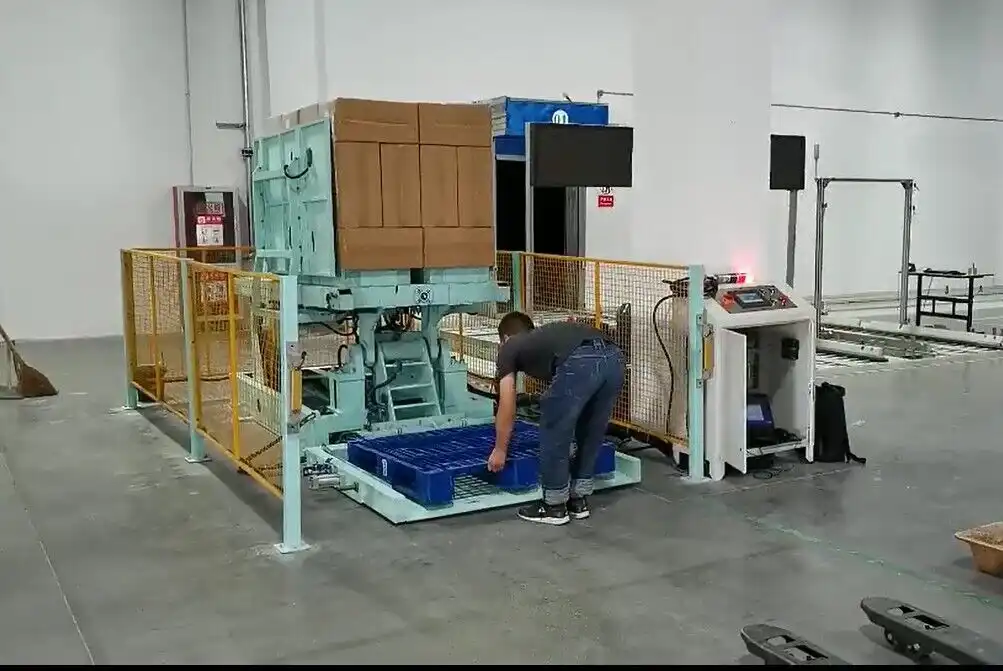
Dive deeper Paragraph: The benefits of pallet changers extend far beyond just protecting individual products. Operationally, they dramatically improve efficiency. Manual pallet changing is slow, labor-intensive, and prone to error. A pallet changer can complete a transfer in a fraction of the time, often in just minutes. This means faster throughput, less waiting time between stages, and ultimately, a more streamlined production process. This speed is crucial for meeting tight delivery schedules and keeping up with high demand from customers like those in e-commerce and retail. Reducing the reliance on manual labor also addresses the challenge of labor shortages and rising labor costs, as highlighted by individuals like Carlos Rodríguez. By automating this task, businesses can allocate their workforce to more value-added activities. In terms of safety, the impact is even more profound. Manually flipping or transferring heavy, unstable loads, especially those that are partially thawed, poses significant risks. Workers can suffer musculoskeletal injuries, crushed fingers, or even be struck by falling products. My own experience in the industry has shown me how common these accidents can be. Pallet changers remove workers from these dangerous situations entirely. The machine does the heavy lifting and rotating in a controlled environment. This leads to fewer workplace accidents, lower insurance costs, and a safer, more compliant working environment for everyone. These machines are designed for continuous, high-intensity use, which means they provide long-term reliability and peace of mind. (labor cost reduction, increased throughput, worker safety improvement, cold chain automation)
Conclusion
Pallet changers are vital for maintaining load stability during thawing and tempering. They protect delicate products, prevent damage, and boost efficiency. By reducing manual handling risks and ensuring consistent product quality, these machines offer a smart solution for any operation dealing with temperature-sensitive goods. Investing in a reliable pallet inverter system ensures product integrity and operational success.








