Descriere
A copper strip coil packing line takes slit coils lying flat and moves them by roller conveyor through strapping, wrapping and stacking without a crane. This automated solution replaces manual crane operations, ensuring consistent coil handling from the slitting line exit to the final pallet stack. The system integrates weighing, strapping, wrapping, and stacking into a continuous flow.
How does the line handle coils from the slitting line?
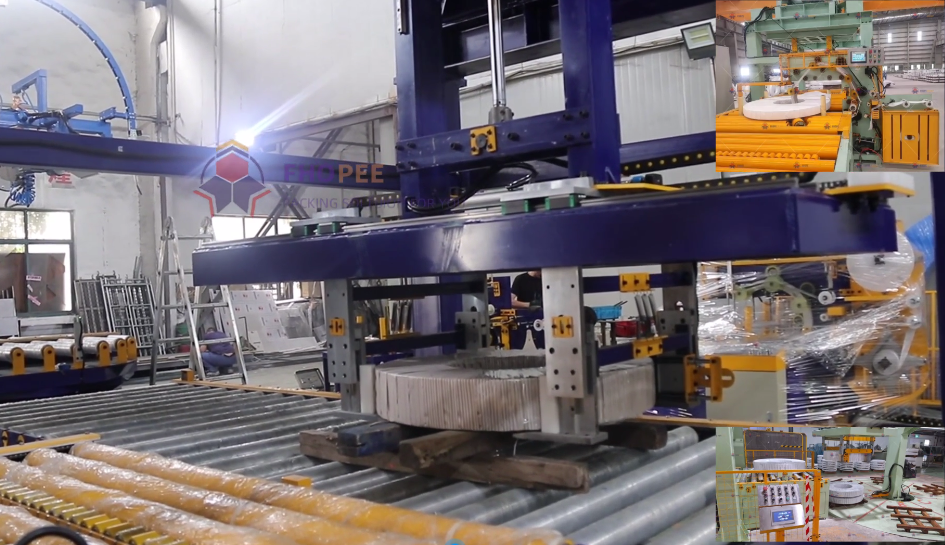
The process begins with the cross arm, which receives coils directly from the slitting line. This component is designed to support significant weight, with a capacity of up to 10 tons per arm and 40 tons in total. Once a coil is secured, the coil down ender lifts and flips the coil so that it lies flat, eye up, on the roller conveyors. This orientation is critical for the subsequent automated handling steps. The down ender typically completes this flip in 20 to 30 seconds, depending on the coil size and weight.
After flipping, centring conveyors and 90-degree transfer conveyors move the coil between stations. This ensures the coil is properly aligned for strapping and wrapping. The entire transfer process is controlled by an industrial PC that coordinates the movement of the coils through the line. This coordination ensures that the coils move smoothly from one station to the next without manual intervention.
What strapping and wrapping methods are used?
The line uses a PET strapping machine to secure the coils. The strapping machine threads the PET strap through the eye of the coil, applying 3, 4, or 6 straps depending on the coil specifications. The published strapping cycle is about 15 seconds. The PET strap dimensions are 0.80 mm × 16 mm.
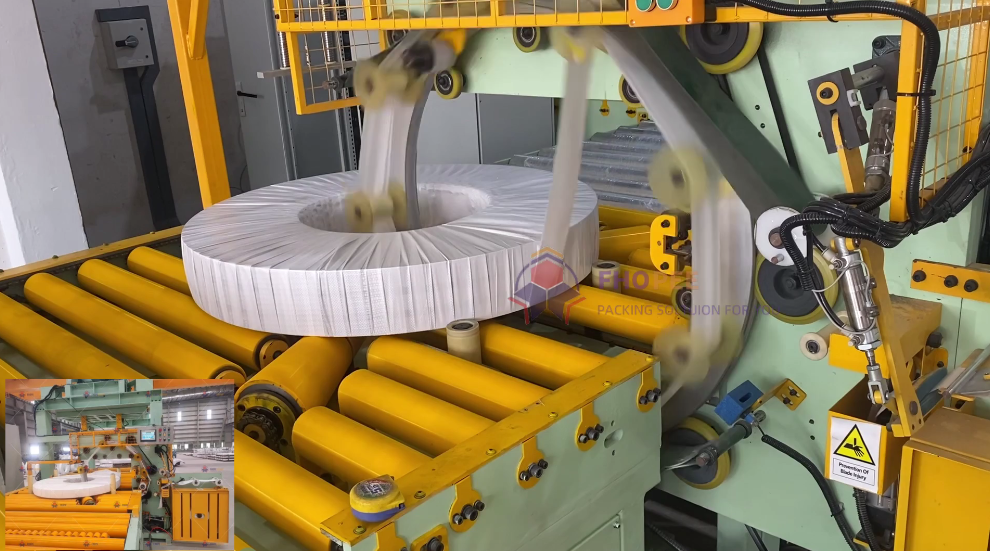
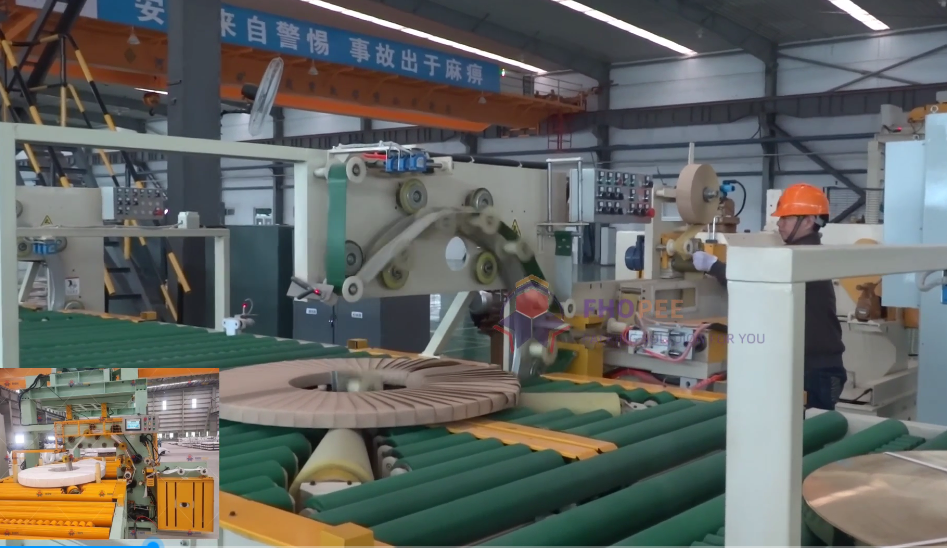
Following strapping, the coil moves to the woven belt wrapping machine. This machine wraps the coil with a PP woven sheet. The wrapping material has an outer diameter of 100 to 450 mm and is 90 to 100 mm wide. The wrapping process protects the coil surface from scratches and environmental damage during storage and transport. Label printers are integrated into the line to apply labels indicating the inner and outer diameter of the coil, ensuring traceability and easy identification.
Cum funcționează sistemul de stivuire?
The final stage of the line is the stacker with a turntable. This system stacks coils by thickness, utilizing six stations to build a stable pallet. The stacker can handle a maximum stack height of 1000 mm with the pallet and a total weight of 6000 kg per pallet. The maximum single coil weight that can be placed on the stack is 4000 kg.
It is important to note that the stacker’s capacity for single coils is below the line’s maximum coil weight of 5000 kg. Therefore, coils weighing between 4000 kg and 5000 kg require a specific layout configuration to ensure they are handled correctly. This point must be settled during the engineering phase to ensure the line meets the customer’s specific requirements. For coils in that band, the option is either a bypass conveyor that takes them straight to outfeed or a heavier-duty handling unit, and the choice is fixed at layout stage.
What are the technical specifications of the line?
The copper strip coil packing line is designed to handle a wide range of coil sizes. The specifications are as follows:
| Specificație | Valoare |
|---|---|
| Greutatea bobinei | 80 până la 5000 kg |
| bobina OD | 750 până la 1400 mm |
| Coil ID | 508 mm |
| Lățimea bobinei | 17 până la 400 mm |
| Curea PET | 0.80 mm × 16 mm |
| Material de ambalare | Folie țesută din PP, diametru exterior 100 până la 450 mm, lățime 90 până la 100 mm |
| Înălțimea maximă a stivei | 1000 mm with pallet |
| Maximum stack weight | 6000 kg pe palet |
| Bobină simplă maximă pe stivă | 4000 kg |
| Sursa alimentare | 380 V, 50 Hz |
These specifications are confirmed per project based on the customer’s specific coil requirements. The line is designed to be flexible, allowing for adjustments in strapping patterns, wrapping materials, and stack configurations to meet different production needs.
How is cycle time determined?
Cycle time on the line is determined by the slowest station in the process. The published figures give about 15 seconds for one PET strapping cycle and 20 to 30 seconds for the down ender flip. The wrapping and stacking stations have their own station times, which must be checked against the customer’s slitting line output.
For example, if the slitting line delivers one coil every 60 seconds, the takt time is 60 seconds per coil. The down ender at 20 to 30 seconds fits within this takt. However, the number of straps and the wrapping process must also be checked against this takt. Narrow coils come off the slitter in larger numbers, which shortens the takt and requires the packing line to operate faster. These station windows are not cycle times for the line; the actual cycle time has to be calculated from the proposed station layout and the transfer sequence between stations.
Ce caracteristici de siguranță sunt incluse?
The line is designed to guard the ring and fence the stations, so coils move without anyone at the rollers. That fence and guard set is the manufacturer’s standard design for a line in production; footage taken during commissioning often shows the stations open, so the delivered guard arrangement, the interlock logic and the stop categories are settled in the ordering technical agreement. The standards that apply depend on the destination market. For CE markets, ISO 12100 sets the risk-assessment method, and EN 415-10 covers general requirements for packaging machines, which fixes guarding and the stop arrangement.
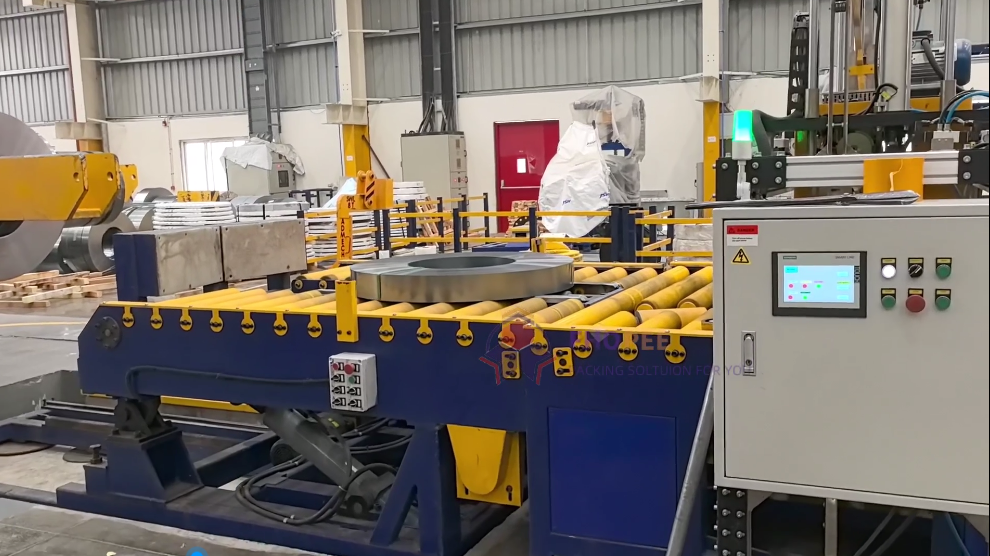
Stop, isolate and lock out the conveyor and the station before anyone frees a coil, threads strap or reaches into the ring. Each station has its own control cabinet, allowing for independent control and safety checks. The line is designed to prevent hands from being near the turning ring and the swing arm, reducing the risk of injury.
Certification of a delivered machine is confirmed in the project ordering agreement. ISO 12100:2010 is a risk-assessment method and EN 415-10:2014 is a design reference; these standards guide the design and safety features of the line but do not constitute a certificate.
How does the line integrate with production systems?
The line is controlled by an industrial PC that takes data from the slitting line or a barcode reader. This data includes information about the coil size, weight, and other specifications. The industrial PC shares the packing data with production systems such as MRC or ERP. This integration ensures that the packing data is accurately recorded and can be used for production planning and inventory management.
The data link to the MRC or ERP system is a key requirement for many customers, because it is what turns the packing record into something production planning can use. The interface protocol is agreed per project against the systems already installed on site.
What should buyers consider when selecting a line?
When selecting a copper strip coil packing line, buyers should consider the following factors:
- Greutatea, diametrul exterior și lățimea bobinei, pentru greutăți cuprinse între 80 și 5000 kg, 750 și 1400 mm și 17 și 400 mm.
- Bobine pe oră de la linia de tăiere.
- Numărul de curele și materialul de înfășurare.
- Înălțimea stivei și greutatea per palet.
- Coils above 4000 kg: whether the turntable stacker takes them or the line diverts them past it on a bypass conveyor or through a heavier-duty handling unit. This is a layout settlement, not a solved function.
- Legătură de date cu sistemul dumneavoastră MRC sau ERP.
These factors determine the configuration of the line and ensure that it meets the customer’s specific production requirements. Buyers should provide detailed information about their coil sizes, weights, and slitting output to the supplier to receive an accurate proposal.
Care este pasul urmator?
To get a real configuration for a copper strip coil packing line, buyers should submit their layout drawing with the coil sizes, weights and slitting output to info@fhopepack.com. We reply with a proposal after we confirm the details. The proposal will include the station list, the conveyor layout and the cycle check.
After receiving the proposal, buyers can book a site survey so we confirm the slitting line exit, the stacking area and the data link. This confirms that the line is designed to fit the customer’s production environment.