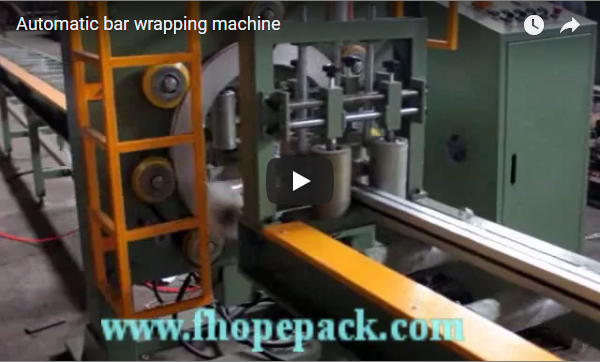
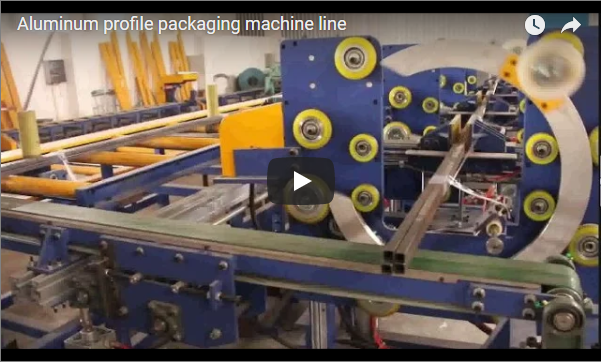
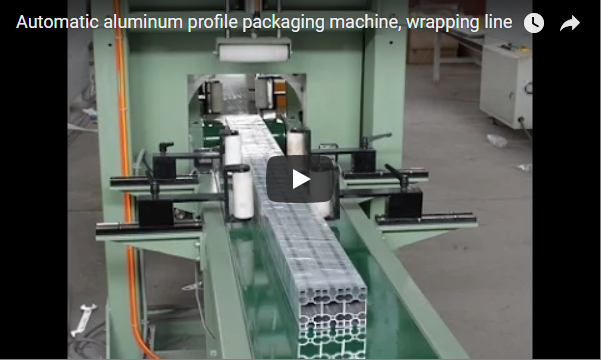
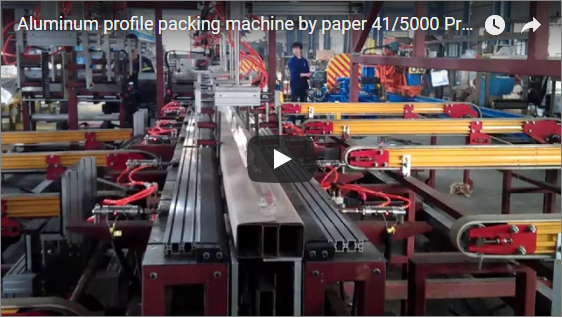
Sumário executivo This clip shows our automatic steel strapping station working on a tube mill run-out. A blue arch stands across the conveyor, a yellow strapping head comes down to a bundle of black square tube, and a coil dispenser beside the arch feeds the steel strap. The bundle indexes through the arch for each band, and our head tensions the strap at 7,000–18,000 N on our published data. Below we explain the station layout, the head data and a worked example for band spacing.
Conteúdo
- O que o vídeo mostra
- Why an arch station on the run-out
- Strapping head data
- Band spacing along the bundle
- Lista de verificação de seleção
- Segurança (Safety)
- Perguntas frequentes sobre engenharia
- Próxima etapa
- Leitura relacionada
- Fontes
O que o vídeo mostra
The clip is filmed beside a tube mill run-out in a large steel plant.
| Parte | O que você vê |
|---|---|
| arco | A blue rectangular arch frame stands across the run-out conveyor, so the bundle passes through it |
| Cabeça de tiras | A yellow head on vertical columns at the side of the arch moves down to the bundle |
| Fornecimento de alças | A yellow strap coil dispenser stands next to the arch and feeds steel strap to the head |
| Pacote | A square bundle of black square hollow section rests on the roller conveyor |
| Ciclo | The bundle stops in the arch, the head comes down, the band is tensioned and sealed, and the bundle moves on to the next band position |
The arch and dispenser are part of the tube line, so bundles are strapped where they are formed, with no crane move in between.
Why an arch station on the run-out
- Bundles stay square. The band goes on while the bundle sits in its forming position, so the square tube pack keeps its shape.
- Fixed station, moving bundle. The arch stays in place and the run-out conveyor indexes the bundle, so band spacing is set by conveyor travel.
- Strap fed from a dispenser. A coil dispenser beside the arch keeps strap feed close to the head.
- One operator view. Arch, head and dispenser sit together, so one operator can watch the whole station.
Strapping head data
Our published data for the automatic steel strapping machine for tube bundles. Head drive and joint type are set per project, so we confirm them in the proposal:
| item | Valor publicado |
|---|---|
| Correia | Aço de baixo carbono laminado a frio, azulado e encerado, 0.8 mm ou 1.0 mm |
| Strap and seal width | 25 mm or 32 mm seal |
| Tensão da correia | 7,000-18,000N |
| Alimentação e recolhimento | 2-3 m / s |
| Velocidade de tensão | 6 m / min |
| Bandas por pacote | 5 to 7, by bundle length |
The station is built to order, so the arch opening and conveyor follow your tube sizes and bundle section.
Band spacing along the bundle
Exemplo prático (ilustrativo). A 6,000 mm bundle with the first and last bands 500 mm in from the ends leaves a 5,000 mm span. With 6 bands there are 5 gaps, so the bands are 5,000 ÷ 5 = 1,000 mm apart. With 5 bands there are 4 gaps of 5,000 ÷ 4 = 1,250 mm. The conveyor indexes the bundle by that distance between cycles.
Lista de verificação de seleção
- Tube shape and size range, and bundle section.
- Bundle length and weight.
- Bands per bundle and positions.
- Strap width (25 mm or 32 mm seal).
- Bundles per hour from the mill.
- Link to your bundling and stacking stations, such as a steel tube bundle strapping machine with seal joint.
Segurança (Safety)
The head travels onto the bundle and tensions the strap up to 18,000 N, and the conveyor indexes heavy bundles. We guard the arch and conveyor zone to the risk assessment, so nobody reaches into the strap path while the station runs. For CE markets we apply ISO 12100:2010 for the risk assessment and PT 415-10: 2014 para requisitos gerais de máquinas de embalagem.
Perguntas frequentes sobre engenharia
Q: Where does the strapping station sit in a tube line? A: On the run-out conveyor after bundle forming, so bundles are strapped where they are made.
Q: Does the head move along the bundle? A: No. The arch stays fixed, the head moves down on its columns, and the conveyor indexes the bundle.
P: Qual a tensão da pulseira? R: A tensão da pulseira é ajustada entre 7,000 e 18,000 N.
Q: What strap does it use? A: Cold-rolled low-carbon steel strap, blued and waxed, 0.8 mm or 1.0 mm, with 25 mm or 32 mm seals.
Q: How many bands per bundle? A: 5 to 7, positioned by bundle length.
Q: How is band spacing set? A: By indexing the run-out conveyor between cycles; a 6,000 mm bundle with 6 bands and 500 mm end distances has them 1,000 mm apart.
Q: How fast are strap feed and tensioning? A: Feed and take-up run at 2–3 m/s, tensioning at 6 m/min.
P: Quais normas se aplicam? R: Para os mercados da CE, ISO 12100 e EN 415-10.
Próxima etapa
We size a steel strapping station for tube bundles in three steps:
- Envie o desenho do seu layout. with tube sizes, bundle section, length and weight, bands per bundle and bundles per hour, to info@fhopepack.com.
- Receba uma proposta em até 48 horas. com os dados e o layout da máquina.
- Agende uma visita técnica so we confirm the floor space and the link to your tube mill.
Leitura relacionada
- Cinta de amarração de feixe de tubos de aço com cabeça móvel
- Solução automática para amarração e cintagem de tubos de aço
- Cintas de aço com blocos de madeira
- Dados da máquina de cintar feixes de tubos de aço
Fontes
- Vídeo (nossa filmagem): o vídeo no YouTube
- Strap, seal, tension, speed and band-count data: Dados da máquina de cintar feixes de tubos de aço
- Band spacing: our worked arithmetic
- Âmbito das normas: ISO 12100:2010; PT 415-10: 2014
- Cronograma da proposta: aprovação da proposta pela prefeitura em até 48 horas.
Última revisão: 10/10/2026