Samenvatting
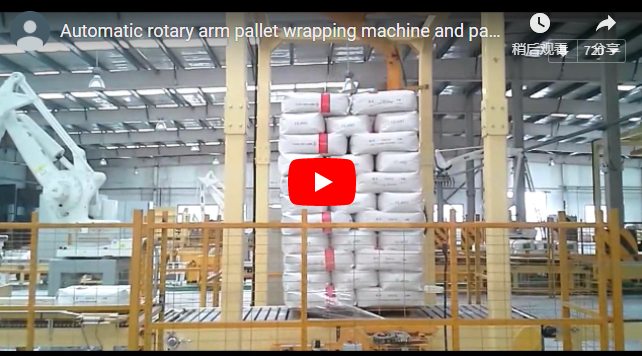
At the end of a bagging line a robot palletizer stacks the bags onto a pallet, and a roller conveyor carries the full pallet straight onto an inline turntable stretch wrapper. No forklift touches the pallet until it is wrapped. Our equivalent wrapper has a conveyor turntable level with the in-feed and out-feed, turns at 3–12 rpm, carries 2,000 kg and pre-stretches the film up to 200%. Below we cover stacking patterns for bags, the top press, the takt between palletizer and wrapper, and the film per pallet.
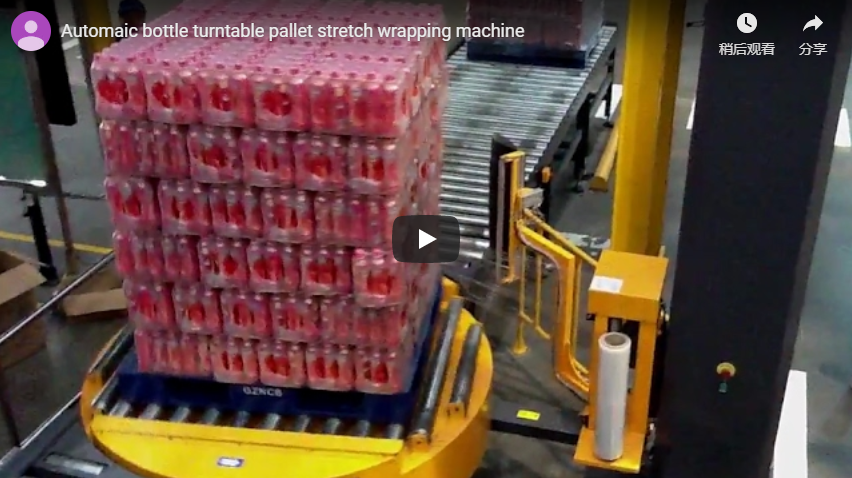
A yellow articulated robot picks bright pink bags from the in-feed conveyor and lays them layer by layer on a wooden pallet, behind yellow safety fencing. The finished stack, about 1.5 m high, runs over silver rollers onto the round yellow turntable of the wrapper. The turntable turns, and the film carriage on the yellow column travels up and down, until the pink bags are covered in clear film from the pallet to the top.
Inhoudsopgave
- From bag to wrapped pallet without a forklift
- Inline turntable wrapper data
- Stacking patterns for bags
- Pallet weight against the turntable
- Palletizer to inline wrapper takt
- Film per bag pallet at 200%
- Selectie checklist
- Veiligheid
- Veelgestelde vragen over techniek
- Volgende stap
- Gerelateerd lezen
- Bronnen
From bag to wrapped pallet without a forklift
The palletizer, the conveyors and the wrapper form one flow. The turntable, the loading conveyor and the unloading conveyor are in one horizontal line, so the pallet runs straight across. Nothing is lifted between stacking and wrapping, so the bags cannot slip on the stack before the film holds them. The forklift only meets the pallet at the end of the out-feed.
Inline turntable wrapper data
| Item | Automatic turntable wrapper B200 |
|---|---|
| Draaitafel snelheid | 3-12 tpm |
| Draagvermogen | 2,000 kg |
| Draaitafel transportband | double-chain drive, level with in-feed and out-feed conveyors |
| Voorrek | up to 200%, other ratios made to order |
| Filmlevering | separate DC drive motor |
| Film laden | about 10 s to thread a new roll by hand; the carriage door opens for roll change |
| Film | standard LLDPE stretch film, 0.025 mm, 500 mm wide on our B series |
| Schijven | all speeds motor-driven |
| opties | pneumatic top plate; pneumatic film grab and cut; packing height 2,800 mm; turntable 1,800 or 2,000 mm; capacity 2,500–3,000 kg |
The palletizer is sized separately for the bag weight, bag rate and pallet pattern. The bag gripper, a fork or clamp type for bags, is chosen with it, and its data is confirmed at quote.
Stacking patterns for bags
Bags are soft and slippery, so the pattern decides how stable the stack is before any film goes on.
| Patronen | Stabiliteit | Gebruik |
|---|---|---|
| Column, each layer the same | low: bags can slide out in columns | rigid cartons, rarely bags |
| Interlocked, layers turned in turn | high: each bag bridges two below | standard for bags |
| Interlocked plus top press during wrap | hoogst | light or very slippery bags |
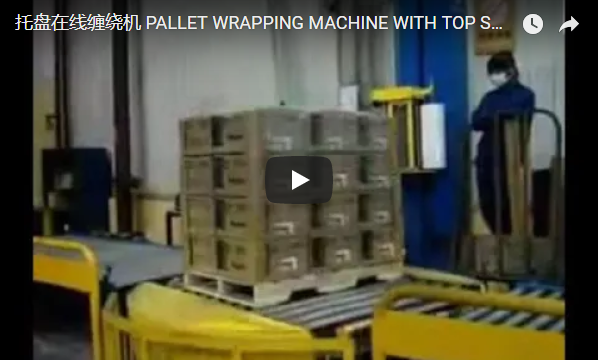
The pneumatic top plate presses the top layer while the turntable turns, so the light top bags cannot lift or move as the first winds go on. It is the option to take when the top layer has few bags or the bags are filled loosely.
Pallet weight against the turntable
Pallet weight = bags per layer × layers × bag weight + pallet weight. As an example, 5 bags per layer, 8 layers and 25 kg bags:
| Check | Berekening | Resultaat |
|---|---|---|
| Zakken per pallet | 5 × 8 | 40 |
| Gewicht van het product | 40 x 25 kg | 1,000 kg |
| Against the turntable | 1,000 kg plus pallet | inside 2,000 kg |
Heavier products such as 50 kg bags in the same pattern reach 2,000 kg before the pallet is added, so the 2,500–3,000 kg turntable option is the safe choice there.
Palletizer to inline wrapper takt
The palletizer sets the pallet rate: pallet build time = bags per pallet ÷ bags per minute. With the example 40 bags and an example rate of 10 bags a minute, a pallet is ready every 4 minutes, or 240 s. The wrapper must finish its cycle, including conveying in and out, within that time.
At 12 rpm one turn takes 5 s, so a long program of 30 turns takes 150 s. The rest of the wrapper cycle is conveying and the film cut:
| Stap voor | Time (example) |
|---|---|
| Conveying onto the turntable | 20 s |
| Wrapping, 30 turns | 150 s |
| Film grab, cut and wipe | 10 s |
| Conveying off | 20 s |
| Totaal | 200 s, inside 240 s |
The wrapper waits for the palletizer, and the spare time can go into extra bottom winds or a slower turntable for unstable stacks. Your conveying times are set by the conveyor speed and pallet length and confirmed at quote.
Film per bag pallet at 200%
Take a 1,200 × 1,000 mm pallet, 1,500 mm high, wrapped with 20 turns.
| Check | Berekening | Resultaat |
|---|---|---|
| Film path per turn | 2 × (1.2 + 1.0) | 4.4 m |
| Folie op de lading | 20 × 4.4 | 88 m |
| Film off the roll at 200% | 88 3 ÷ | ≈ 29 m |
Selectie checklist
- Bag weight, size and bags per minute.
- Palletgrootte en stapelpatroon.
- Stack height and total pallet weight.
- Top press: needed or not.
- Filmopnamen maken en monteren voor onbemand gebruik.
- Conveyor layout and space for the cells.
Veiligheid
We design the wrapper to EN 415-6 for pallet wrapping machines, with EN ISO 12100:2010 for risk assessment and EN 60204-1 for the electrical equipment. The robot cell and the wrapper cell are each closed by fencing with interlocked doors.
Muting light curtains at the conveyor openings let pallets pass and stop the machines if a person enters. The robot cell follows EN ISO 10218-2 for robot systems. Guarding and CE documents are agreed per project.
Veelgestelde vragen over techniek
Q: Does the pallet need a forklift between the palletizer and the wrapper? A: No. The conveyor and the turntable conveyor are level, so the pallet runs straight on.
Q: How heavy can the pallet be? A: 2,000 kg as standard; 2,500–3,000 kg as an option.
Q: How do you keep light top bags in place? A: With the pneumatic top plate pressing them during the wrap.
Q: Can the film be cut automatically? A: Yes, with the pneumatic film grab and cut option.
Q: How tall can the pallet be? A: Up to 2,800 mm with the high-mast option.
Volgende stap
- Send your bag size, weight, rate and pallet pattern naar info@fhopepack.com.
- We lay out the palletizer, conveyors and wrapper.
- We reageren binnen 24 uur met een voorstel en een offerte.
Gerelateerd lezen
- Automatic pallet wrapping machine B200 (product)
- Inline draaitafel palletwikkelaar
- Online palletwikkelaar met toppers
- Volautomatische lijn voor palletwikkelmachines
- Draaitafel rekwikkelaar B200
- Automatische palletwikkelmachine met foliesnijder
Bronnen
- FHOPE product page: automatic stretch wrapping machine B200
- FHOPE product page: automatic pallet wrapping machine B100 (film)
- EN 415-6; EN ISO 12100:2010; EN 60204-1; EN ISO 10218-2
Laatst beoordeeld: 19-10-2026