Resumen ejecutivo
A mold maintain rotator and flipping table, or mold maintenance flipping table, turns a heavy mold on its side so the toolroom can reach the parting faces, ejector side and cooling lines without a crane flip. Our hydraulic FPFT flipping tables carry 10–40 t on tables from 3,440 to 5,560 mm long. A worked example picks the table for an 8 t mold and checks the height after tilting.
Índice
- Why molds are flipped for maintenance
- Our green flipping table with bellows guard
- Operation, step by step
- FPFT flipping table data
- Worked example: an 8 t mold
- Aplicaciones
- Lista de verificación de selección
- Seguridad: EN 415-10 e ISO 12100
- Preguntas frecuentes sobre ingeniería
- El próximo paso
- Lectura relacionada
- Fuentes
Why molds are flipped for maintenance
An injection mold or die arrives at the toolroom lying flat. To clean the parting line, change inserts or check the ejector plate, the mold has to stand on its side. Turning it with a crane alone means a man guiding a swinging load under the hook, which is where accidents happen.
A flipping table does the turn on the floor. The crane only sets the mold down and lifts it off, and the operator stands at the control box away from the load.
Our green flipping table with bellows guard
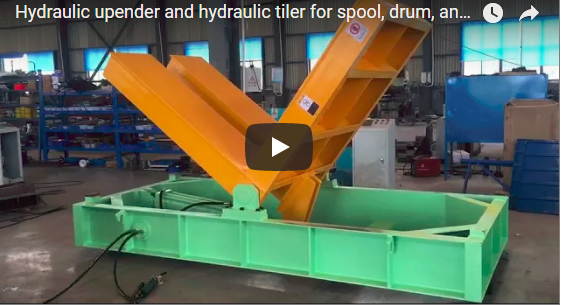
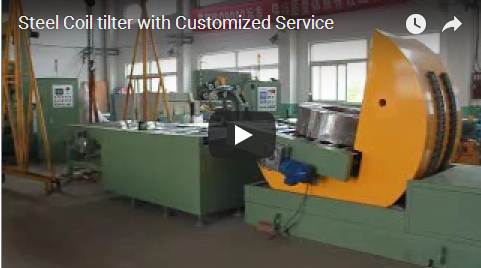
Our green flipping table has a long, low base and a table hinged along one edge. A hydraulic drive raises the table about the hinge, taking the mold from flat to upright.
A black, fan-shaped bellows guard closes the open side between table and base. It unfolds as the table rises and folds again as it comes down, so no one can reach into the gap. The operator runs the cycle from a control box at the side of the machine. Here the load is a large, worn steel mold block.
Operation, step by step
- Establecer. The crane places the mold on the flat table, against the stop on the hinge side.
- Claro. The operator steps back to the control box and the crane hook is removed.
- Inclinación. The table rises about the hinge. An inverter varies the hydraulic pump speed, so the table moves slowly at the start and end of the turn.
- Sostener. At 90° the mold stands on its side for work. The table can also stop at any angle in between.
- Regreso. The table lowers and the mold lies flat again, or the crane lifts it off upright.
Each FPFT table turns 90°. For a full 180° flip we place two tables face to face and run them together. The first table lifts the mold to upright. The second table meets it there and lowers it down the other side. The mold ends upside down, turned 180°, with no crane flip at any point. See our 180° big frame flipper.
FPFT flipping table data
From our hydraulic mold flipper table page, covering 10–40 t:
| Modelo | carga máxima | Table L × W × H |
|---|---|---|
| FPFT-10 | 10 t | 3,440 x 1,400 × 350 mm |
| FPFT-15 | 15 t | 3,810 x 1,600 × 350 mm |
| FPFT-20 | 20 t | 4,240 x 1,800 × 400 mm |
| FPFT-30 | 30 t | 4,640 x 2,000 × 450 mm |
| FPFT-40 | 40 t | 5,560 x 2,400 × 500 mm |
Motor power, hydraulic oil volume and machine weight depend on the build and are confirmed at quote. The table can be floor-mounted, or set in a pit so the table top is at floor level.
Worked example: an 8 t mold
Illustrative mold: 8 t, 1,600 mm long, 1,100 mm wide, 900 mm high.
Carga. We size with a 20% margin: 8 × 1.2 = 9.6 t, inside the FPFT-10's 10 t.
Huella. 1,600 × 1,100 mm sits on the 3,440 × 1,400 mm table, with room for the side stop.
Height after tilting. With the mold standing on its 1,100 × 900 mm end, the top sits at table height + mold length: 350 + 1,600 = 1,950 mm above the floor on a floor-mounted unit. The toolroom crane needs that height plus the hook and sling to lift the mold off upright. In a pit, the 350 mm drops out and the top is at 1,600 mm.
Ciclo. One flip is crane in + tilt + crane out: t = t_crane_in + t90 + t_crane_out. The tilt time t90 depends on the drive and the speed profile, and we confirm it at quote.
Aplicaciones
- Injection mold maintenance and insert changes
- Die casting and stamping die repair
- Mold assembly before trial
- Heavy fixtures and machine parts that need turning for machining
Lista de verificación de selección
- Heaviest mold weight, with its length, width and height.
- Turn needed: 90° or 180°.
- Floor-mounted or in a pit.
- Crane hook height in the toolroom.
- Fuente de alimentación.
- Destination country, for the CE file.
Seguridad: EN 415-10 e ISO 12100
We use EN 415-10 as the reference for this handling machine, with the CE risk assessment done to ISO 12100. The main hazards are the crushing gap at the hinge, the load shifting during the turn, and the crane work above the table. The bellows guard closes the hinge gap.
Electric limit switches and mechanical stoppers end the travel, and the table stops at its current angle if the power fails. The operator stays at the control box, out of the tilt path. The control type, such as hold-to-run, and the emergency stop circuit are specified with the CE risk assessment for your market. Hydraulic pressure and cylinder size are set by the build and confirmed at quote.
Preguntas frecuentes sobre ingeniería
Q: Can the table stop part-way? A: Yes. It can be stopped at any angle, and it holds there if the power is cut.
Q: Why is the start and end of the turn slow? A: The inverter ramps the hydraulic pump speed, so the oil flow, and with it the table speed, rises and falls gently. The mold does not jolt as it leaves flat or reaches upright.
Q: Do I need a pit? A: No. A pit only lowers the table to floor level, which helps when the crane height is tight.
Q: Which standard do you work to? A: EN 415-10 for the machine, with the risk assessment to ISO 12100.
El próximo paso
- Send your heaviest mold's weight and size a info@fhopepack.com.
- We select the FPFT table and check the crane height.
- Respondemos dentro de las 24 horas. with a layout and the turn options.
Lectura relacionada
- Mold flipper table (product)
- Mold flipper range (product)
- Mesa volteadora de moldes
- Mold flipping table FHOPE
Fuentes
- FHOPE hydraulic mold flipper table product page: FPFT data and safety features
- FHOPE mold flipper pages: 20% design margin
- Our green flipping table shown above
- Ejemplo práctico: figuras ilustrativas
- Normas: EN 415-10; ISO 12100:2010
Última revisión: 18/10/2026