Resumen ejecutivo: Las pilas de neumáticos sueltos se inclinan y se deslizan sobre palés y contenedores, por lo que las plantas los sujetan con flejes para formar unidades firmes. Nuestra máquina flejadora de neumáticos, que se muestra en este vídeo, comprime una pila de neumáticos en la cinta transportadora, la sujeta con flejes y la envía a lo largo de la línea de producción. La cantidad de flejes por pila depende de la altura de la pila y del diámetro exterior del neumático . Ajustamos ambos parámetros para cada proyecto.
Índice
- Lo que muestra el vídeo
- Cómo funciona el ciclo de flejado en línea
- Uso de correas por pila de neumáticos
- Ajustes por tamaño de neumático
- Controles y seguridad
- Lista de verificación para la selección de una máquina flejadora de neumáticos en línea
- Preguntas frecuentes sobre ingeniería
- El próximo paso
- Lectura relacionada
- Fuentes
Lo que muestra el vídeo
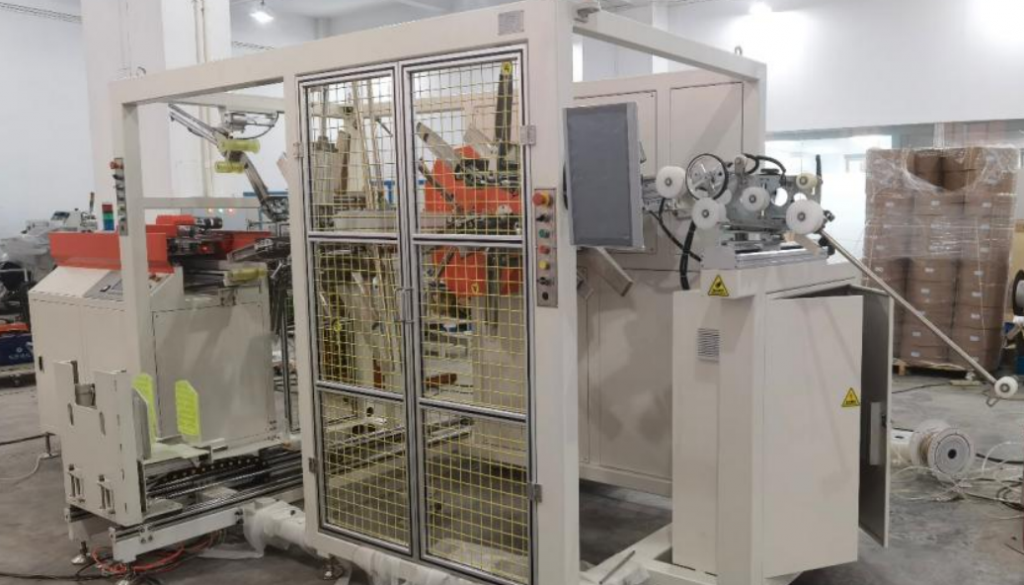
Una pila de neumáticos negros reposa sobre la cinta transportadora, bajo la prensa de nuestra máquina de estructura verde, con paneles de seguridad amarillos alrededor de las piezas móviles. Un operario trabaja en el área de control, situada detrás de la máquina.
La placa de presión baja y comprime la pila; luego, la cinta transportadora la lleva a la posición de flejado, donde se le coloca una correa. La pila flejada sale de la máquina, y la unidad de prensado y flejado se reinicia para la siguiente pila. La pila permanece en posición vertical durante todo el proceso.
Cómo funciona el ciclo de flejado en línea
| Paso | Lo que sucede |
|---|---|
| ¡Disfruta tu viaje! | La pila de neumáticos se detiene bajo la presión. |
| Comprimir | La placa de presión baja sobre la pila. |
| Moverse | La cinta transportadora lleva la pila a la posición de flejado. |
| Correa | Una correa rodea la pila |
| Restablecer | La unidad de prensado y flejado se reinició. |
| Salida | La pila sujeta funciona en |
Al comprimir primero la pila de neumáticos, estos se asientan, de modo que la correa se coloca sobre una pila firme y uniforme.
Uso de correas por pila de neumáticos
Ejemplo ilustrativo con dos bandas verticales:
| Parámetro | Valor |
|---|---|
| Diámetro exterior del neumático (ilustrativo) | 650 mm |
| Ancho del neumático (ilustrativo) | 200 mm |
| Altura de la pila, 6 × 200 | 1,200 mm |
| Longitud de la banda, 2 × (1,200 + 650) | 3,700 mm |
| Correa por pila, 2 × 3.7 m | 7.4 m |
Añade la superposición del sello a cada banda cuando pidas la correa.
Ajustes por tamaño de neumático
| Configuración | Por qué importa |
|---|---|
| Golpe de prensa | Coincide con la altura de la pila |
| Fuerza de prensa | Apilado firme sin dejar marcas en los neumáticos. |
| Bandas por pila | Qué tan bien se mantiene la pila en el manejo |
| Posición de parada de la cinta transportadora | Centra la pila debajo de la prensa |
Las probamos con sus medidas de neumáticos y las guardamos como recetas. Para neumáticos más pequeños, consulte nuestra línea de flejado automático de neumáticos de motocicleta.
Controles y seguridad
La prensa baja con fuerza y la correa queda bajo tensión. Mantenga las manos alejadas de la prensa y del área de flejado mientras la máquina esté en funcionamiento, y retire la pila únicamente cuando esté detenida.
Las normas aplicables dependen del mercado de destino. Para los mercados CE, la norma ISO 12100 establece el método de evaluación de riesgos y la norma EN 415-10 establece los requisitos generales para las máquinas de envasado.
Lista de verificación para la selección de una máquina flejadora de neumáticos en línea
- Diámetro exterior, ancho y rango de peso del neumático.
- Neumáticos por pila.
- Bandas por pila.
- Pilas por hora.
- Altura de la cinta transportadora y disposición de la línea.
- Tipo y ancho de la correa.
Preguntas frecuentes sobre ingeniería
P: ¿Por qué comprimir la pila antes de sujetarla con correas? R: Para que los neumáticos se asienten y la correa se coloque sobre una pila firme y uniforme.
P: ¿Cuánta cinta se necesita para apilar neumáticos? R: Aproximadamente 7.4 m para dos cintas en una pila de 1,200 mm de altura de neumáticos de 650 mm de diámetro exterior en nuestro ejemplo.
P: ¿La pila se mantiene en posición vertical? R: Sí. Se mantiene en posición vertical desde la entrada hasta la salida.
P: ¿Puede manejar diferentes tamaños de neumáticos? R: Sí, con carrera de prensado, fuerza y posición de parada almacenadas para cada tamaño.
P: ¿Cómo está protegida la máquina? R: Paneles de seguridad amarillos cubren las partes móviles.
El próximo paso
Planificamos su máquina flejadora de neumáticos en tres pasos:
- Envíe su plano de distribución con tamaños de neumáticos, pilas y salida a info@fhopepack.com.
- Reciba una propuesta en 48 horas., con el plan de prensa y banda.
- Solicitar una visita al sitio para comprobar la disposición de la cinta transportadora.
Lectura relacionada
- Empaquetadoras de neumáticos
- Vídeo: máquina automática de embalaje de neumáticos para el envasado en línea de neumáticos
- Vídeo: máquina de embalaje de neumáticos para neumáticos PCR
Fuentes
- Contenido de la máquina: Equipo de ingeniería de FHOPE, 4 de octubre de 2026
- Ejemplo de correa: nuestro ejemplo práctico, valores ilustrativos
- Máquina en acción: nuestro video en YouTube
- Alcance de las normas: ISO 12100:2010, EN 415-10: 2014
Última revisión: 04/10/2026